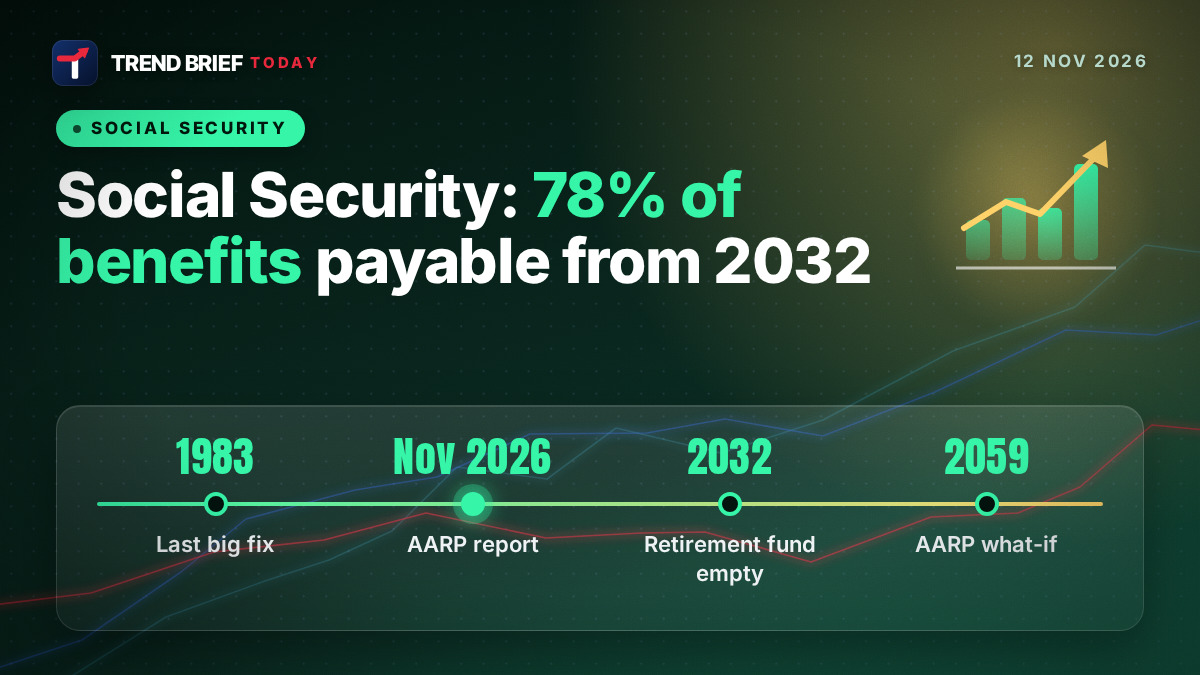
Social Security's retirement trust fund is projected to run out in late 2032, after which only about 78% of scheduled benefits could be paid unless Congress acts. A new AARP report says the program would have stayed fully funded until 2059 if the share of the economy it taxes had not shrunk since 1983. The AARP Public Policy Institute found that taxable payroll fell from 41% of US GDP in 1983 to 34% in 2025, which it says cost the program about $10.8 trillion in revenue between 1984 and 2034.[1][2] Here is what the dates mean for a monthly check and which fixes are on the table.
 | |
| Retirement fund (OASI) runs out | Fourth quarter of 2032[1][2][3] |
|---|---|
| Payable after that | About 78% of scheduled benefits[1][3] |
| Combined funds (OASDI) run out | Third quarter of 2034, about 83% payable[1][3] |
| 75-year shortfall | 4.42% of taxable payroll (3.82% in 2025)[3] |
| Taxable payroll, share of GDP | 41% in 1983, 34% in 2025[1][2] |
| AARP what-if date | Full benefits to 2059[1][2] |
| Wage cap | $184,500 in 2026, $192,300 in 2027[1][2] |
| Payroll tax rate | 6.2% worker + 6.2% employer = 12.4%[1][2] |
What AARP found
Social Security is paid for mostly by a payroll tax on wages. In 2025, payroll taxes made up 91% of the program's income, interest on the trust funds 5% and federal income tax on the benefits of higher-income retirees 4%, according to the AARP research.[1][2]
The problem AARP highlights is the base of that tax. Taxable payroll, the wages the tax actually reaches, was 41% of gross domestic product in 1983 but only 34% in 2025, and the trustees expect it to stay around that level.[1][2] AARP puts the drop down to income moving away from wages and towards business and investment income, which mostly escapes the payroll tax, plus automation and pass-through businesses whose owners can take pay as profit instead of salary.[1][2]
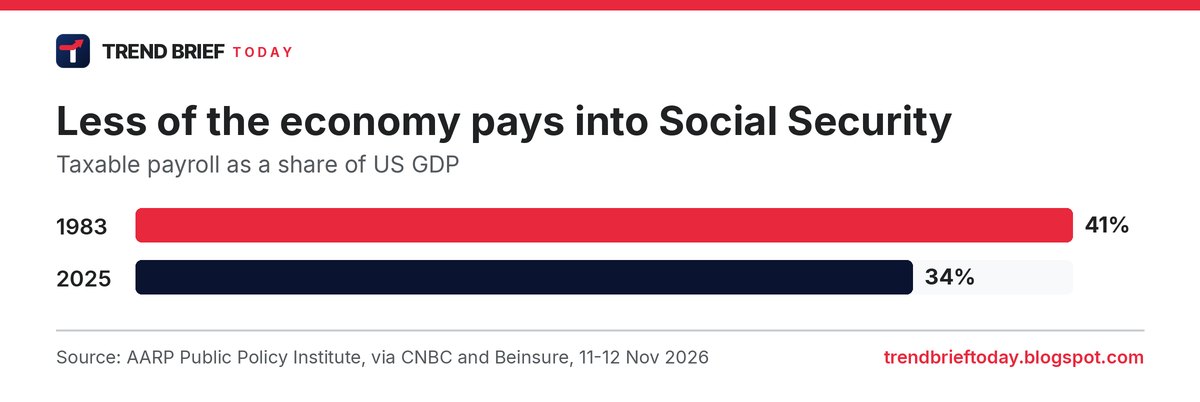
If taxable payroll had stayed at 41% of GDP from 1984 to 2034, AARP estimates Social Security would have collected an extra $10.8 trillion in today's money (2025 dollars), enough to pay full benefits until 2059. That is about 25 years past the 2034 date for the combined funds.[1][2]
"Social Security's finances have weakened not simply because America has grown older, but because the economy has changed, while the program's revenue system has not," Richard Johnson, vice president of financial security at the AARP Public Policy Institute, said at the briefing.[1] Beinsure reports the same line as a statement from the institute.[2]
Ageing still matters. AARP says the number of workers paying in for each beneficiary falls from 3.4 in 2000 to 2.4 by 2030, and lower birth rates push that ratio down further.[1][2] CNBC also cites the Roosevelt Institute, a liberal think tank, which says the wage cap now covers about 83% of all earnings, down from the 90% lawmakers expected to keep in 1983.[1]
2032 or 2034: which date matters
Social Security has two trust funds. The Old-Age and Survivors Insurance (OASI) fund pays retirement and survivor benefits, and the Disability Insurance (DI) fund pays disability benefits. The trustees' June 2026 report projects the OASI fund will be empty in the fourth quarter of 2032, when about 78% of scheduled benefits would still be payable from incoming taxes.[1][2][3] If the two funds were combined, the money would last until the third quarter of 2034, with about 83% payable.[1][3]
AARP used the 2034 date because Congress has moved money between the funds before.[1][2] But merging them needs a change in the law, so under current law the date that forces action is 2032, "six years from now", as Alicia Munnell of the Center for Retirement Research at Boston College puts it.[3]
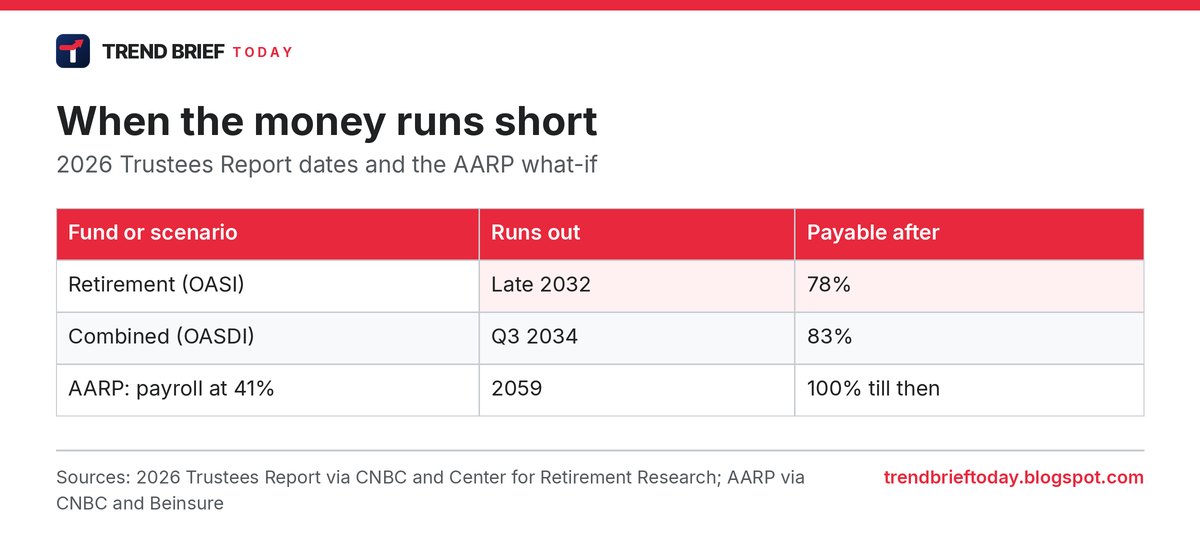
An empty trust fund does not mean Social Security stops paying. Payroll taxes keep coming in, and they cover about 78% of retirement benefits at first, falling to 62% by 2100 under the trustees' central assumptions (83% falling to 65% for the combined funds).[3] The Center for Retirement Research says the long-run gap grew in the 2026 report, to 4.42% of taxable payroll from 3.82% a year earlier, mainly because the trustees now expect birth rates to stay low, expect less immigration and counted the lower income-tax revenue on benefits after the One Big Beautiful Bill Act.[3]
What a cut would mean for your check
Nobody knows what Congress will do before 2032. If it does nothing, every benefit would be paid at the lower percentage, not only new ones. The table below is our own simple math on example amounts: it applies the trustees' 78% and 83% payable rates to today's check and ignores future cost-of-living increases.
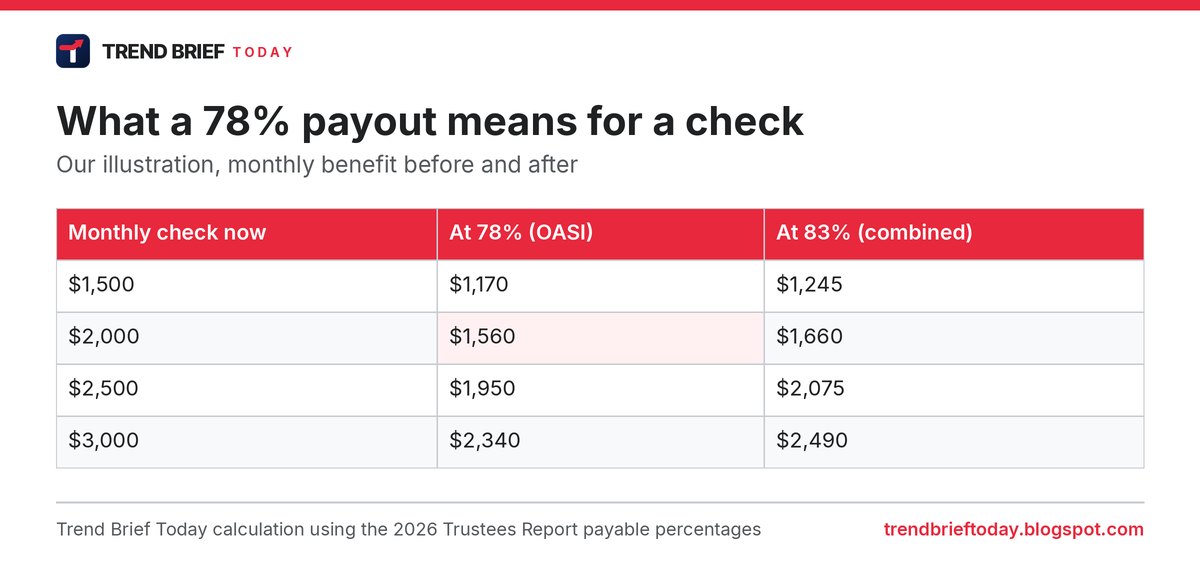
The Center for Retirement Research says the typical retiree who claims at 65 would see the share of pre-retirement earnings that Social Security replaces drop straight away from about 36% to about 29%.[3] AARP's Jenn Jones also said the 1983 changes (raising the full retirement age from 65 to 67, delaying cost-of-living increases by six months and taxing some benefits) have already cut lifetime benefits by about 19% for people turning 65 in 2026 compared with the old rules.[1][2]
The fixes on the table
AARP has not backed a specific bill. Its report leans towards raising more money from higher earners and from income that the payroll tax does not reach, while sparing low and middle earners.[1][2] "The fix for Social Security isn't cutting earned benefits; it's rebuilding the revenue behind them," Johnson said.[1]
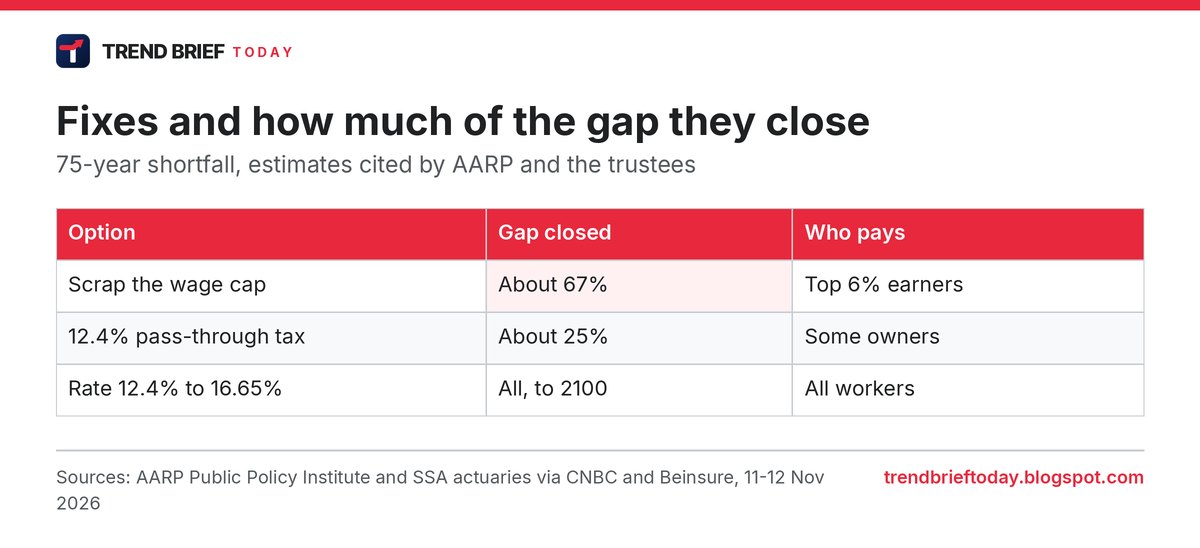
- Raise or scrap the wage cap. In 2026 the payroll tax stops at $184,500 of wages, and that limit rises to $192,300 in 2027. Only about 6% of people earned at or above the cap in 2024. Bills in Congress would apply the tax again above $250,000 or $400,000, or remove the cap. Removing it would close about 67% of the 75-year gap if the extra tax did not earn extra benefits, according to AARP's reading of Social Security actuaries' estimates.[1][2]
- Tax pass-through business income. A new 12.4% tax on investment income for active S corporation officers and limited partners would close about 25% of the gap, citing the actuaries.[1][2]
- Raise the payroll tax rate. AARP did not focus on this. The trustees estimated that lifting the combined rate from 12.4% to 16.65% from January 2026 would have kept the combined program solvent through 2100.[1][2] The Center for Retirement Research gives the gap as 4.42 percentage points, or 2.21 points each for workers and employers.[3]
For a sense of public mood, CNBC cites a February University of Maryland survey of 2,509 adults in which 62% backed slowly raising the worker payroll tax from 6.2% to 6.5%.[1]
Frequently asked questions
When will Social Security run out of money?
It will not run out completely. The retirement trust fund is projected to be empty in late 2032, and after that incoming taxes would cover about 78% of scheduled benefits. The combined retirement and disability funds would last until 2034, with about 83% payable.[1][3]
Will my Social Security check be cut in 2032?
Only if Congress does not act before then. Under current law, benefits would be paid at the lower percentage once the retirement fund is empty. Lawmakers have changed the program before, most recently in a big way in 1983.[1][3]
What did the AARP report say?
That the wages subject to Social Security tax fell from 41% of GDP in 1983 to 34% in 2025. Had they stayed at 41%, the program could have paid full benefits until 2059 and collected about $10.8 trillion more between 1984 and 2034.[1][2]
What is the Social Security wage cap for 2026 and 2027?
$184,500 in 2026, rising to $192,300 in 2027. Wages above the cap are not subject to the 6.2% Social Security tax.[1][2]
References
- Konish, Lorie. "Social Security could pay full benefits until 2059 if taxable payroll kept pace with GDP: AARP report". CNBC. November 11, 2026. cnbc.com
- "Social Security faces 2032 benefit cuts, but tax reforms could delay them until 2059". Beinsure. November 12, 2026. beinsure.com
- Munnell, Alicia H. "Social Security's Financial Outlook: The 2026 Update in Perspective". Center for Retirement Research at Boston College. June 2026. crr.bc.edu