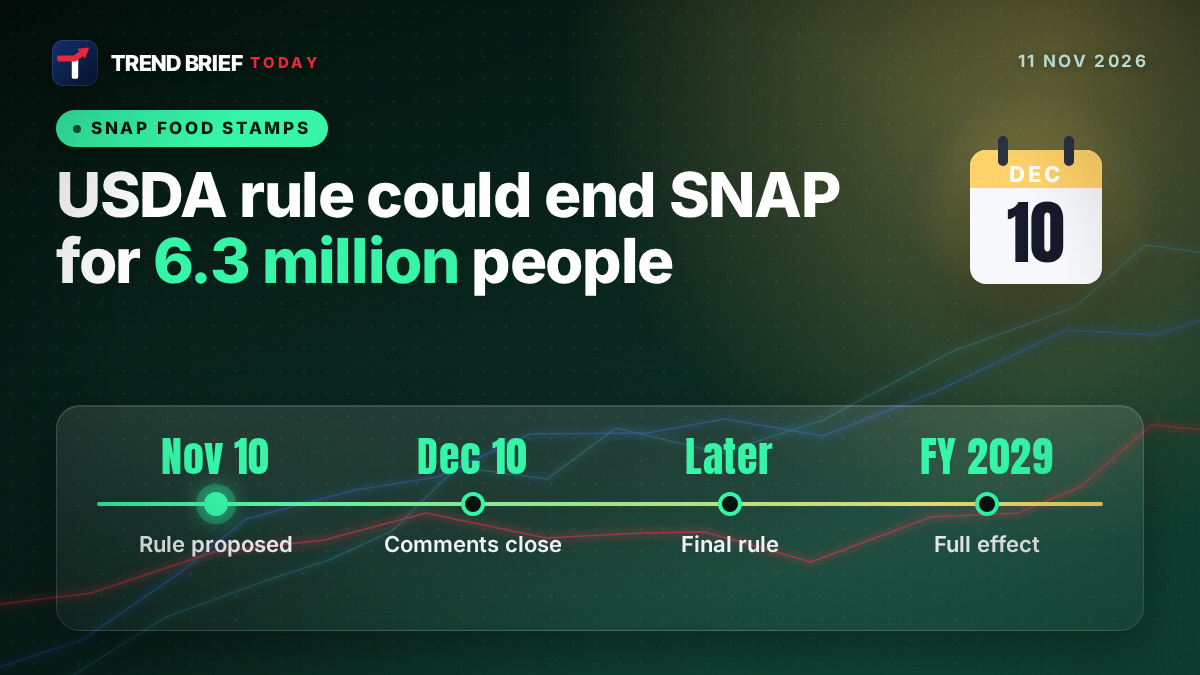
The US Department of Agriculture has proposed a rule that would end SNAP food stamp benefits for about 6.3 million people in 3.2 million households. It does this by scrapping "broad-based categorical eligibility", the option 46 states use to let families skip the federal income and savings tests. The proposal was published in the Federal Register on Tuesday, November 10, 2026. Nothing changes yet: the public can comment until December 10, USDA then has to write a final rule, and the agency itself expects the full effect in fiscal year 2029.[1][2][3]
 | |
| Agency | USDA Food and Nutrition Service |
|---|---|
| Rule | "Reforming Categorical Eligibility" (proposed) |
| Published | Tuesday, Nov 10, 2026 (91 FR 72454) |
| Docket | FNA-2026-0661 |
| Comments close | Thursday, Dec 10, 2026 |
| People affected | About 6.3 million (17.6% of participants) |
| Households affected | About 3.2 million (16.9%) |
| States using BBCE | 46 (December 2025) |
| Federal savings | $44.65 billion, FY 2027 to 2031 |
| Full effect | Fiscal year 2029 (USDA estimate) |
What the SNAP rule would change
Under federal law, a SNAP household without an older or disabled member normally has to pass two income tests (gross income at or below 130% of the federal poverty guidelines and net income at or below 100%) plus a limit on countable savings. Households with an older or disabled member only have to meet the net income test.[1]
There is a shortcut. A household that already gets benefits from a program funded by Temporary Assistance for Needy Families (TANF) is "categorically eligible" for SNAP, so the state does not run the full SNAP tests again. Since 2009 most states have stretched that shortcut by giving applicants a small TANF-funded service, such as a referral or a phone line, and then counting it as TANF. That stretch is what officials call broad-based categorical eligibility, or BBCE.[1][3]
The proposal would only allow categorical eligibility for households that actually receive TANF assistance, which in practice means cash help. Non-cash TANF services would no longer count, and the phrase "authorized to receive" would be removed, so a household has to really get the benefit, not just qualify for it.[1][2]
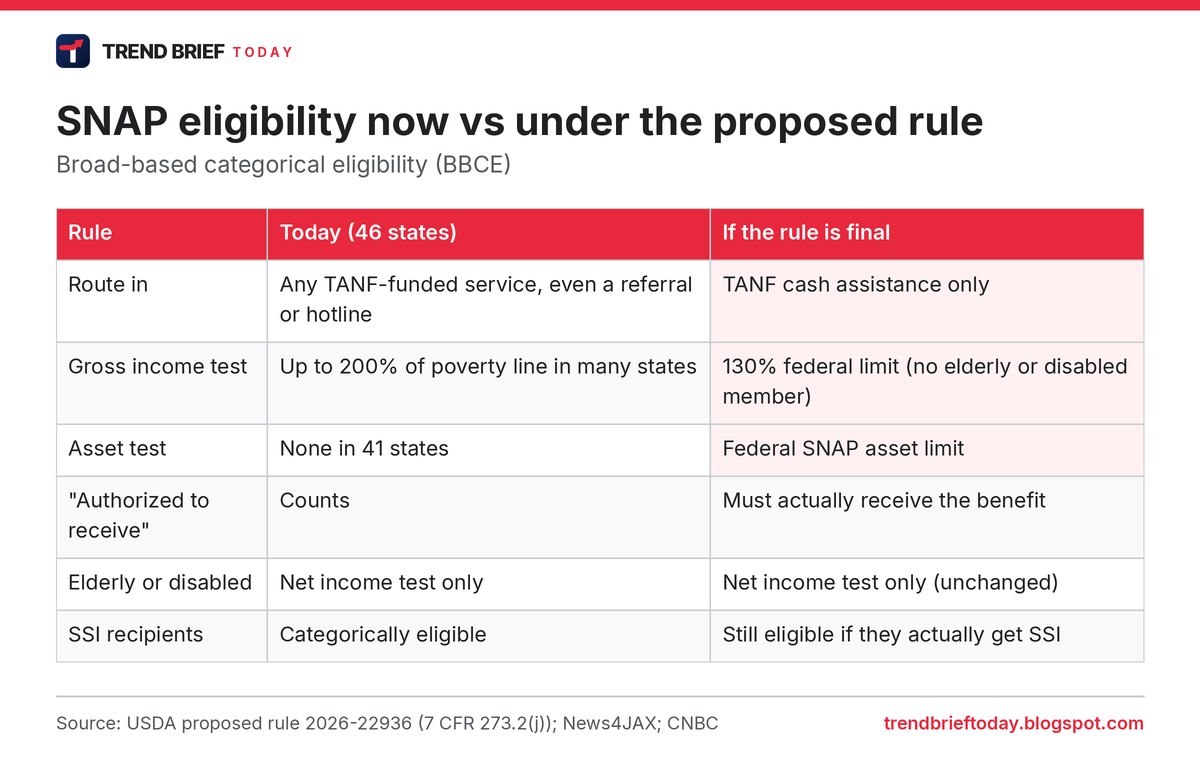
USDA says the shortcut has drifted from what Congress intended. As of December 2025, 46 states used BBCE, 37 of them with gross income limits above the federal 130% line and 41 with no asset limit at all. The rule points to cases where people with large savings received SNAP in states with no asset test, including a widely reported Minnesota millionaire.[1][3]
Who will lose SNAP benefits
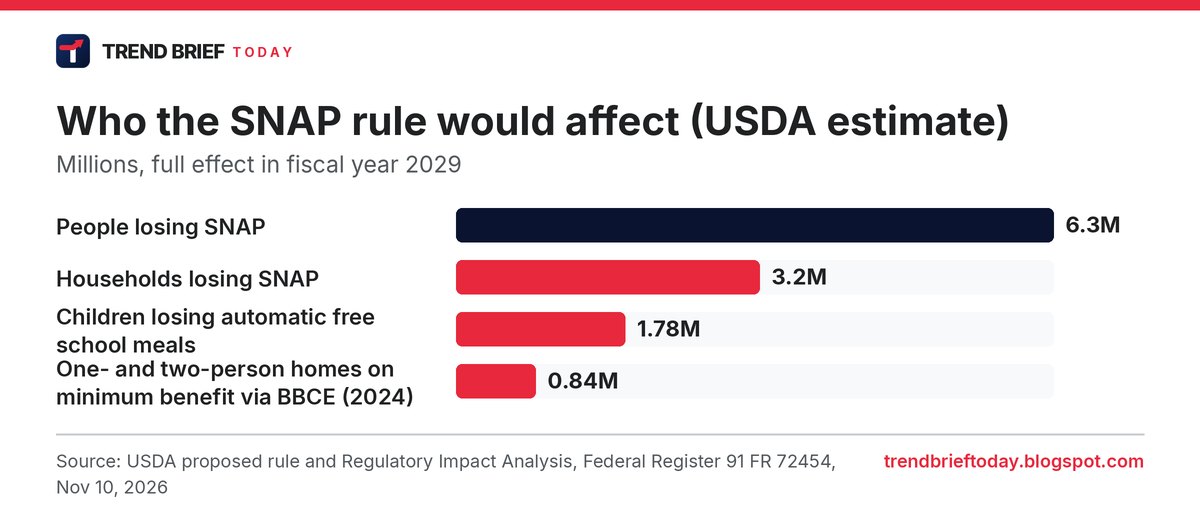
USDA's regulatory impact analysis estimates that 16.9% of participating households, or 17.6% of participants, would no longer get SNAP because their income or savings are above the federal limits. That is about 3.2 million households containing 6.3 million people in fiscal 2029, the first year the rule is expected to be fully in force.[1][2][3]
The groups most exposed are:
- Working families with gross income above 130% of the poverty line who qualify today only because their state uses a higher limit, often up to 200%. CNBC notes TANF limits generally sit between 130% and 200% of the poverty level.[2]
- Households with savings above the federal asset limit in the 41 states that dropped the asset test. USDA estimates that in fiscal 2024 about 2.5 million participating households (5.4 million people) had resources above the SNAP limit, and 1.2 million households (2.0 million people) had income above the federal limits.[1][3]
- Small households on the minimum benefit. More than 840,000 one- and two-person households got the minimum benefit ($23 a month in FY 2025) in 2024 only because of BBCE, about $214 million in total.[1][3]
USDA's own civil rights review says households with children and households with older members could be affected, along with households headed by Asian, Hispanic or multiracial adults. It plans guidance and outreach for states to soften this.[1]
What is not changing
| Rule | Today | Under the proposal |
|---|---|---|
| Net income test for older or disabled members | Only test they face | Same |
| SSI households | Categorically eligible | Still eligible, if all members actually receive SSI |
| TANF cash assistance households | Categorically eligible | Still eligible |
| Benefit amounts for households that stay | Set by income and deductions | No change in the formula |
| Who already lost SNAP under the 2025 law | Separate cuts | This rule is in addition |
The proposal does not cut monthly benefit amounts for people who still qualify, and it does not touch the work rules changed by the July 2025 tax and spending law. CNBC reports more than 5.5 million people have already left SNAP since that law, putting enrollment at about 36 million, according to USDA data.[1][2]
Free school meals, WIC and Summer EBT
SNAP enrollment automatically qualifies children for free school meals and other help, so the rule reaches beyond food stamps. USDA estimates about 1.78 million children would lose automatic free school meal eligibility. Some headlines say 1.8 million children would lose free lunch, but USDA's own numbers are more nuanced: about 97% of those children would still qualify by income through a normal school meal application, 1.66 million would stay on free meals, 93,000 would move to reduced price and 28,000 would pay full price.[1][2]
The agency also expects about 42,000 children could stop getting Summer EBT from summer 2029, and about 5,500 of the 22,000 WIC participants who now qualify through BBCE would no longer be eligible.[1]
How much the rule saves and costs
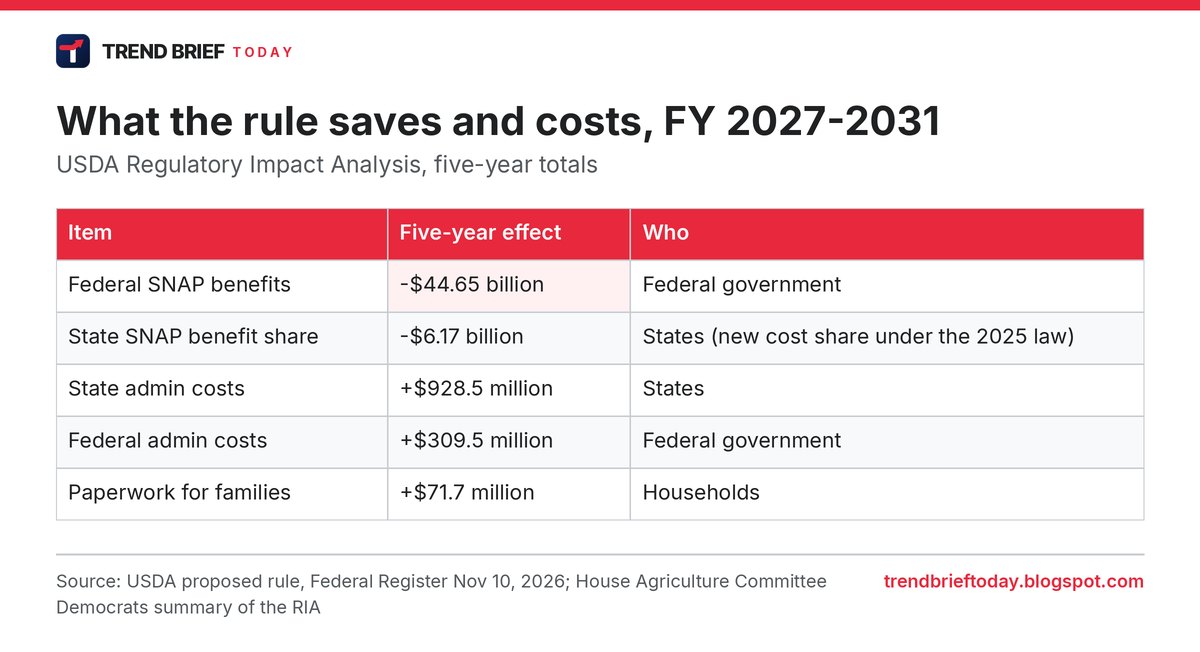
USDA puts the cut in federal SNAP benefit spending at about $44.65 billion over fiscal 2027 to 2031. States would spend about $6.17 billion less on benefits, because the 2025 law makes them share benefit costs, but about $928.5 million more on administration as they check income and savings for more applicants. Federal administrative costs rise by about $309.5 million.[1][3][4]
Food costs are part of the backdrop. October's consumer price report showed prices still rising faster than forecast; see US CPI October 2026 for the latest figures, and why gas prices fell below $4 for the other big household cost.
Reaction
USDA says the change would make eligibility more uniform and "preserve benefits for the truly needy". The rule text calls the current set-up a loophole and says supporting it is "irresponsible to Congress and the taxpayer".[1][2]
Representative Angie Craig of Minnesota, the top Democrat on the House Agriculture Committee, called it "heartless and cruel" and said it would "make it harder to meet basic needs". Her committee staff note that total benefit cuts, federal plus state, come to about $50.82 billion.[2][4] USDA itself accepts the rule may add administrative work for states.[1]
This is not the first try. A similar rule was proposed in 2019 and withdrawn by the Biden administration on June 10, 2021. USDA is also asking for comments on the 2019 "ongoing and substantial" approach as an alternative.[1]
Timeline
| Date | Step |
|---|---|
| FY 2008 to 2011 | States using BBCE grow from 18 to 43 |
| 2019 | First Trump-era proposal to limit BBCE |
| June 10, 2021 | That proposal withdrawn |
| July 2025 | Tax and spending law cuts SNAP and adds state cost sharing |
| Nov 10, 2026 | New proposed rule published (91 FR 72454) |
| Dec 10, 2026 | Comment deadline |
| Not set | Final rule and start date |
| Fiscal 2029 | USDA expects full effect |
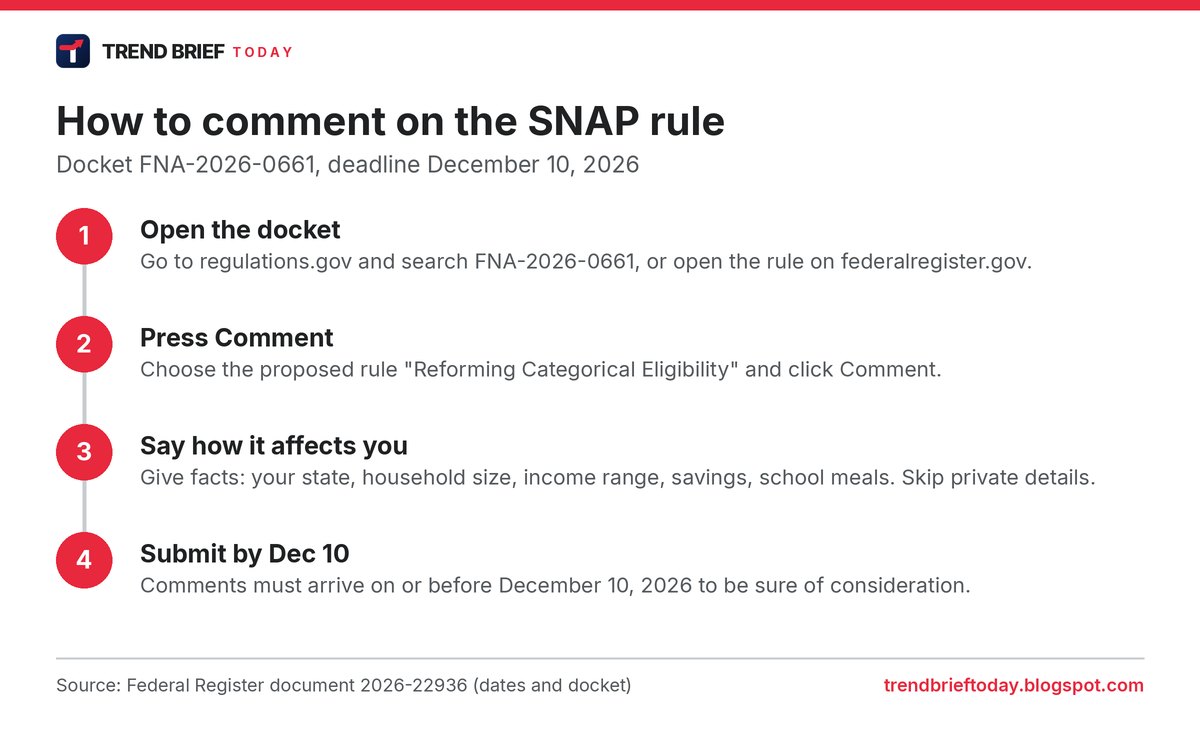
How to comment on the SNAP rule
Anyone can file a comment. Use docket FNA-2026-0661 on regulations.gov, or open document 2026-22936 on federalregister.gov, and submit by December 10, 2026. Comments that explain real effects, such as your state, household size and how school meals or savings would be affected, carry more weight than one-line opinions.[1][3]
Frequently asked questions
Will I lose my SNAP benefits?
Not now. If the rule becomes final, you would be at risk only if you qualify today through your state's broader TANF rules and your gross income is above 130% of the poverty line or your savings are above the federal limit. Households with an older or disabled member face only the net income test, as now.[1]
When does the SNAP change take effect?
No start date has been set. Comments close on December 10, 2026, then USDA must publish a final rule. Its cost estimates start in fiscal 2027, and it expects the full effect in fiscal 2029.[1][3]
How do I comment on the SNAP rule?
Go to regulations.gov, search FNA-2026-0661, open "Reforming Categorical Eligibility" and press Comment before December 10.[1]
Is it true 6.3 million people will lose food stamps?
That is USDA's own estimate for fiscal 2029: 6.3 million people in 3.2 million households, about 17.6% of participants. It assumes the rule is finalised as proposed.[1][2]
Will children lose free school lunch?
About 1.78 million children would lose automatic eligibility, but USDA says about 97% would still qualify for free or reduced price meals by applying on income.[1]
References
- "Supplemental Nutrition Assistance Program: Reforming Categorical Eligibility" (proposed rule, 91 FR 72454, docket FNA-2026-0661). USDA Food and Nutrition Service, Federal Register. November 10, 2026.
- "Trump administration moves to cut food stamps for 6.3 million people". CNBC. November 10, 2026.
- "USDA proposes SNAP eligibility overhaul, could cut benefits for millions". News4JAX (WJXT). November 11, 2026. Also: "Trump moves to cut SNAP benefits for 6.3 million people". Gray News via WLFI. November 10, 2026.
- "Ranking Member Angie Craig Slams Trump Administration Effort to Kick an Additional 6.3 Million Americans off SNAP". House Agriculture Committee Democrats. November 9, 2026.