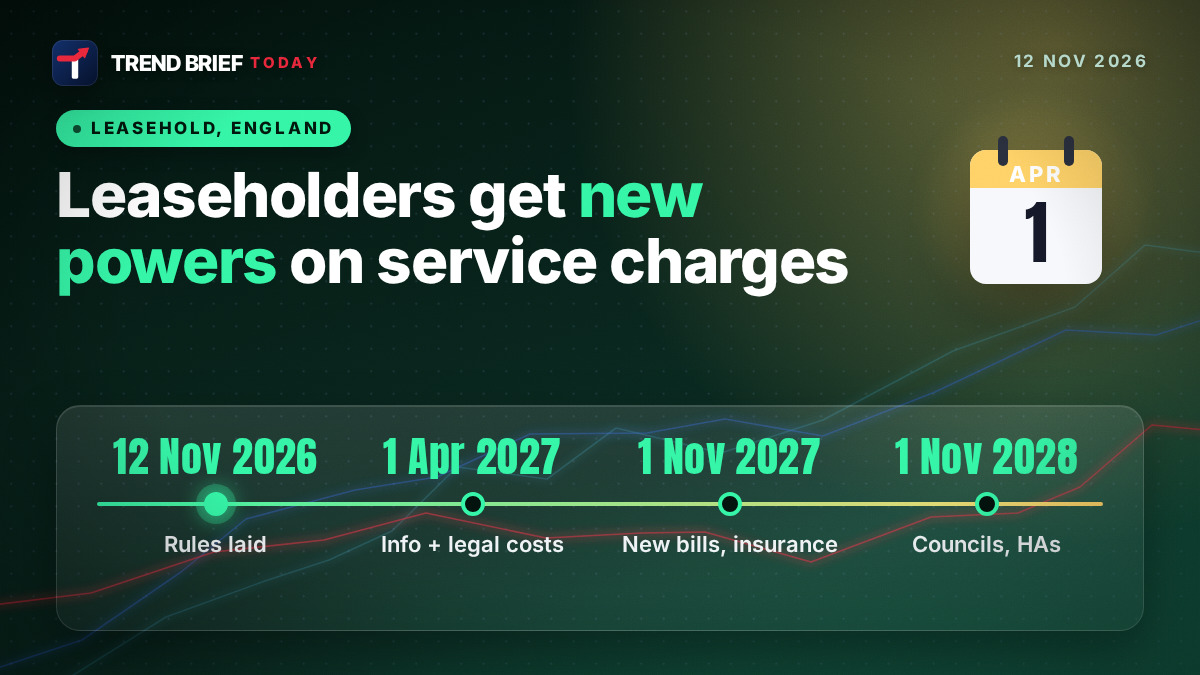
More than three million leaseholders in England will get stronger rights to see what their service charges pay for and to challenge them, with the first changes starting on 1 April 2027. From that date landlords will need a court or tribunal's approval before they can pass their legal bills on to leaseholders, and standard bills, accounts and insurance details follow from November 2027.[1][2][3]
 | |
| Announced | 11 November 2026 (22:30 GMT)[1][4] |
|---|---|
| Regulations laid | 12 November 2026[1] |
| Covers | Leaseholders in England[1][3] |
| Leaseholders affected | More than 3 million[1][2][4] |
| First rights start | 1 April 2027[1][2][3] |
| Standard bills (private landlords) | 1 November 2027[1][2][3] |
| Councils and housing associations | 1 November 2028[1][2][4] |
| Law behind it | Leasehold and Freehold Reform Act 2024[1][3] |
| Department | MHCLG[1] |
What was announced
The government published the plan on the evening of 11 November under the headline "Flat owners handed massive boost to fight rip-off service charges". It brings in service charge protections from the Leasehold and Freehold Reform Act 2024, which had been passed but were still waiting for the detailed rules to switch them on.[1][3]
GOV.UK says five sets of regulations are being laid in Parliament on 12 November 2026, covering service charges, information, building insurance and landlords' legal costs. A sixth set, with more detail on the legal cost changes, is due before the end of 2026 and will also start on 1 April 2027. All of it still needs Parliament's approval.[1]
Prime Minister Andy Burnham said: "It is simply wrong that millions of leaseholders can be hit with unfair charges, then face another bill just for challenging them."[1][2][3] Housing Minister Matthew Pennycook said service charges that are "rapidly escalating and frequently opaque" are putting "huge financial strain" on leaseholders.[1][2][3]
What changes on 1 April 2027
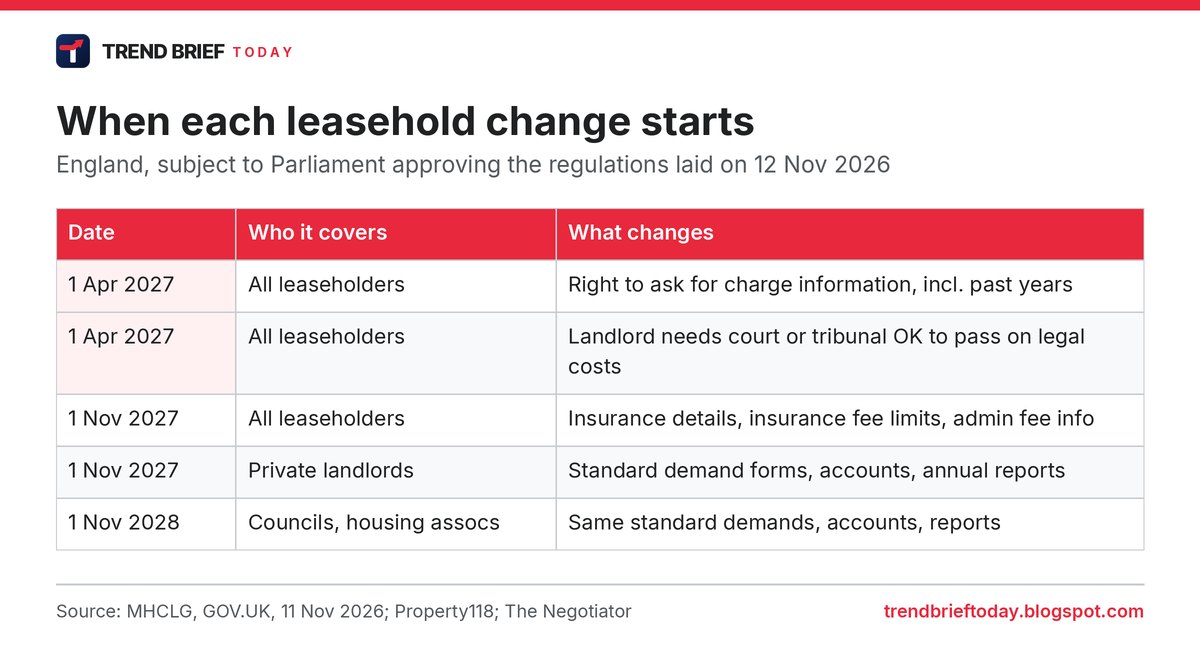
Two things start first, and they are the two that matter most if you think a bill is wrong.
A right to information. Leaseholders will be able to demand information about their service charges, so they can see how the building is managed, maintained, repaired and insured. They can also ask about previous years, and the landlord will need a good reason to refuse.[1][2][3]
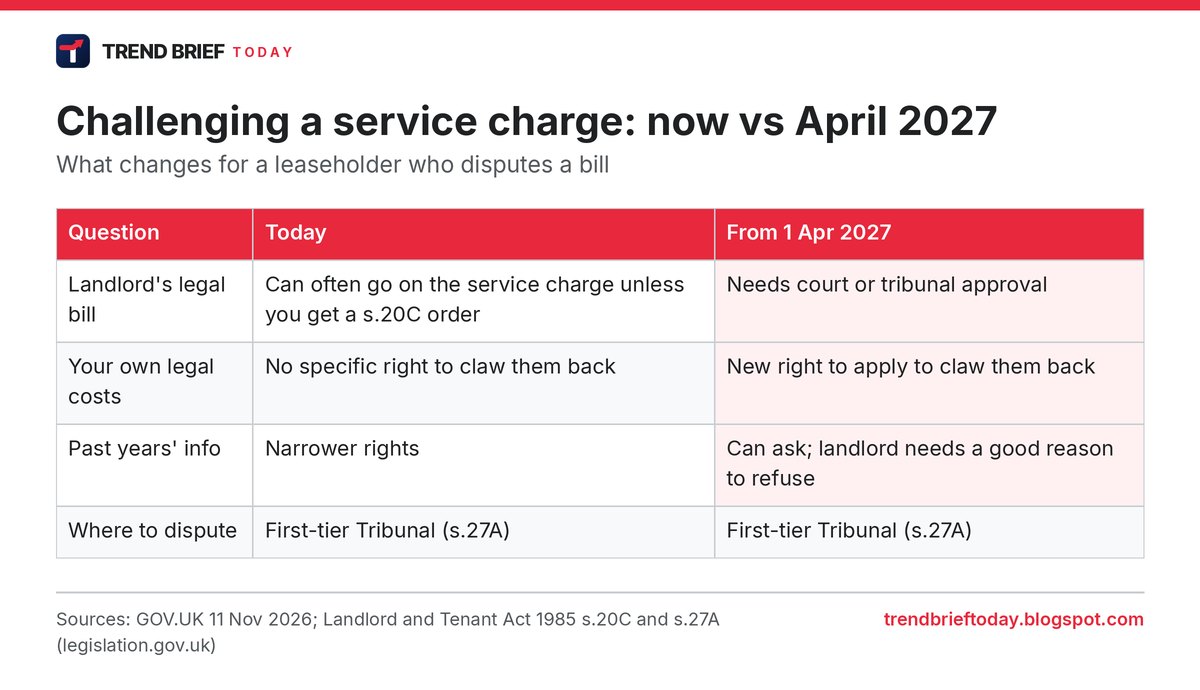
Protection from the landlord's legal bills. At the moment a leaseholder who disputes a charge can end up paying towards the landlord's lawyers through the service charge, even after winning. The government calls this "a huge barrier" to challenging costs. From April 2027, landlords will need court or tribunal approval to pass on legal costs, and leaseholders get a new right to claw back their own legal expenses.[1][2][3]
The MHCLG media blog puts it more simply: you are "no longer at risk of automatically footing your landlord's legal bills" for challenging something you think is unfair.[4]
What changes from November 2027 and 2028
From 1 November 2027, every leaseholder, whether the landlord is a private company, a council or a housing association, should get clearer information as standard. That includes detail on the building insurance they pay towards, stronger protection against excessive fees for arranging and managing that insurance, and a clear list of admin fees they could face.[1][2]
Private landlords have extra duties from the same date: simpler, standardised service charge demand forms, plus financial accounts and annual reports.[1][2][3] Councils and housing associations get an extra 12 months, so their leaseholders see the standard demands, accounts and reports from 1 November 2028. The government says this is because their accounting systems are more complex.[1][4]
Mark Chick, a director of ALEP, said the change is "an important shift from leaseholders having to ask for information to receiving it as a matter of course."[2][3]
What the rules do not do
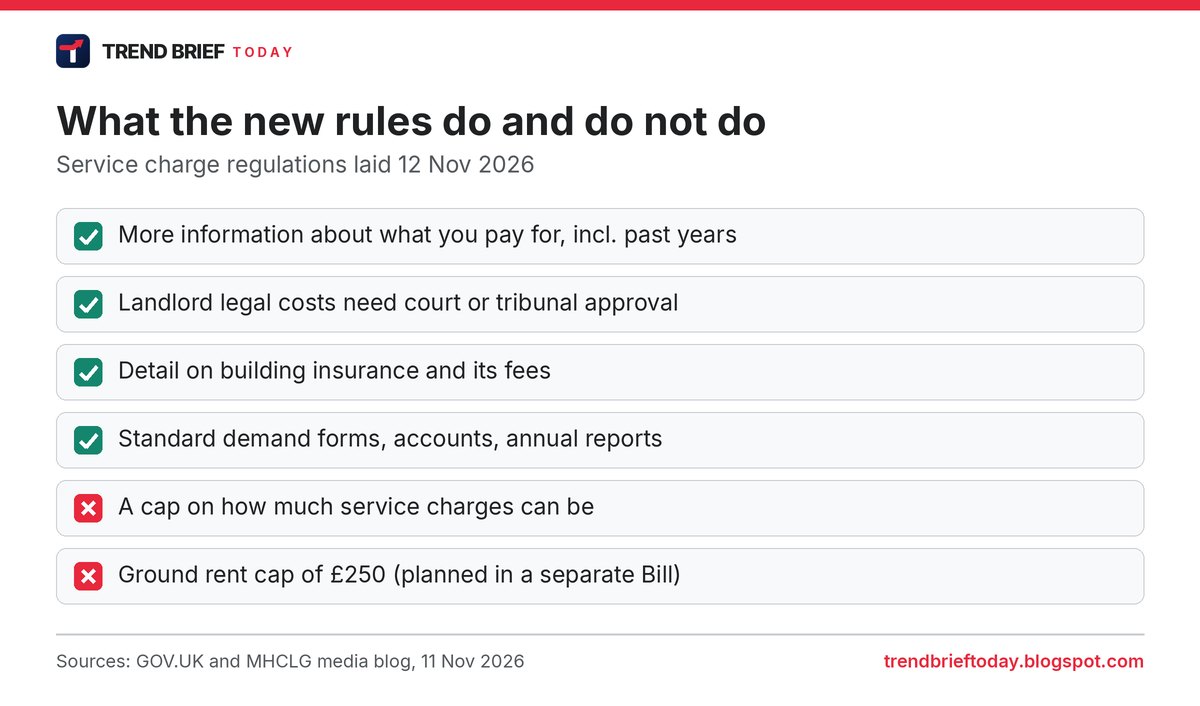
They do not cap service charges. MHCLG's own explainer says so directly, because buildings still have to be maintained, repaired and insured. The aim is to make unreasonable costs easier to spot and cheaper to fight.[4]
The bigger changes sit in a separate law. The Commonhold and Leasehold Reform Bill is due in Parliament before Christmas 2026. The government says it will make commonhold the default for most new flats, make it easier for existing leaseholders to switch, cap existing ground rents at £250 and replace forfeiture with a new enforcement system.[1][4] The Negotiator also notes further reforms were promised before the Christmas break.[3] None of that is law yet.
What you can do now
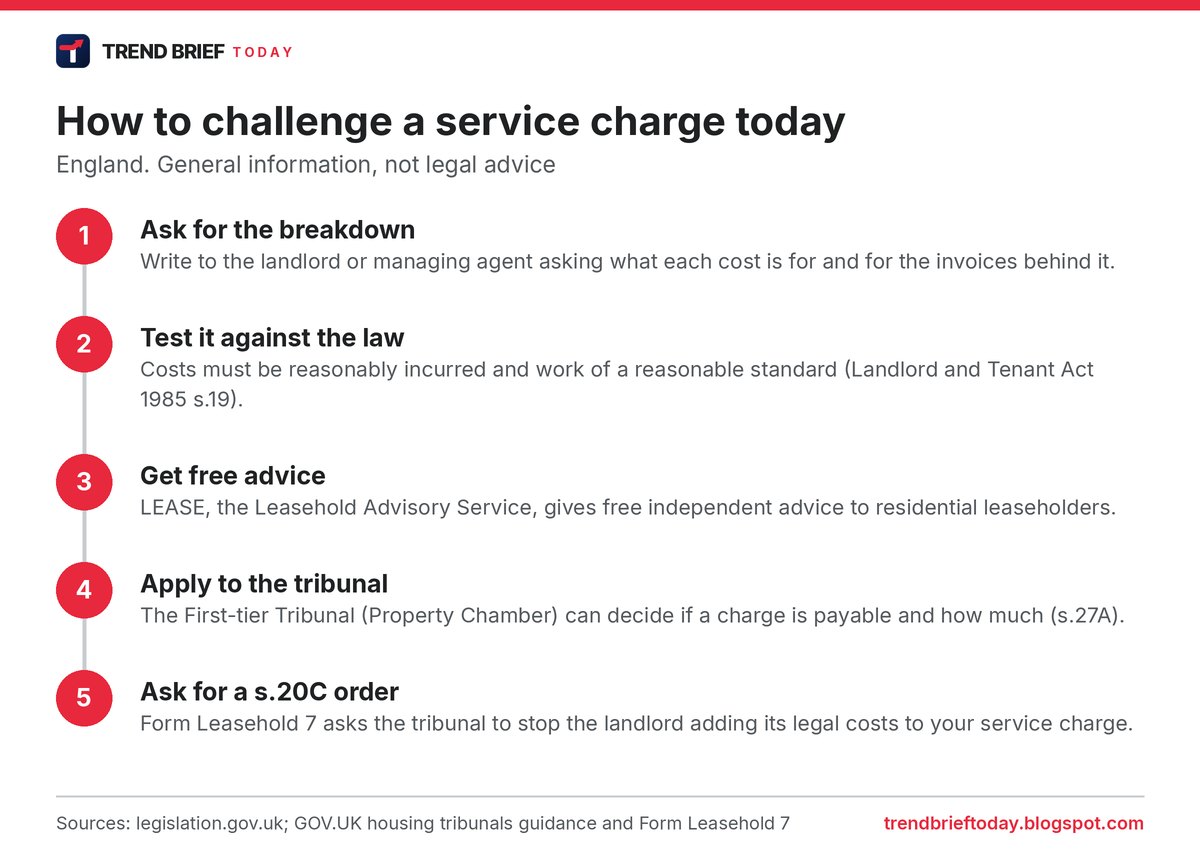
You do not have to wait until 2027 to question a bill. The current law already says service charge costs count only if they are "reasonably incurred", and works or services must be of a reasonable standard.[5]
If you cannot settle it with the landlord or managing agent, you can apply to the First-tier Tribunal (Property Chamber) for a ruling on whether a charge is payable and how much. You can do this whether or not you have already paid.[6][8] You can also ask the tribunal for a "section 20C" order so the landlord cannot add its legal costs for the case to your service charge. GOV.UK's Form Leasehold 7 is used for that.[7][9]
Free, independent advice for residential leaseholders is available from LEASE, the Leasehold Advisory Service.[9] Its chief executive, Kion Ahadi, said service charges are "the most common issue leaseholders contact us about".[1][3]
This is general information, not legal advice. Check your lease and get advice for your own case.
| Date | What happens |
|---|---|
| 2024 and 2025 | Government consultations on the detailed rules[1] |
| 11 Nov 2026 | Changes announced[1][2] |
| 12 Nov 2026 | Five sets of regulations laid in Parliament[1] |
| By end of 2026 | Sixth set on legal costs; Commonhold and Leasehold Reform Bill due before Christmas[1][4] |
| 1 Apr 2027 | Information rights and legal cost protection[1][2][3] |
| 1 Nov 2027 | Insurance and admin fee details for all; standard demands, accounts and reports from private landlords[1][2] |
| 1 Nov 2028 | Standard demands, accounts and reports from councils and housing associations[1][2] |
Frequently asked questions
When do the new leasehold service charge rules start?
The first rights start on 1 April 2027. More arrive on 1 November 2027 and, for council and housing association leaseholders, on 1 November 2028.[1][2]
Do the changes apply in Scotland, Wales or Northern Ireland?
The announcement covers leaseholders in England.[1][3]
Will my service charge go down?
Not automatically. There is no cap. The rules give you more information and make it less risky to challenge costs that look unreasonable.[4]
Can my landlord still charge me its legal costs?
From 1 April 2027, only with a court or tribunal's approval. Until then you can ask the tribunal for a section 20C order.[1][7]
Is this the end of leasehold?
No. Wider reforms, including the £250 ground rent cap and commonhold changes, are in a separate Bill that has not yet been introduced.[1][4]
References
- "Flat owners handed massive boost to fight rip-off service charges". Ministry of Housing, Communities and Local Government, GOV.UK. November 11, 2026. gov.uk
- "Government announces new protections to help leaseholders challenge service charges". Property118. November 12, 2026. property118.com
- Lewis, Nigel. "LEASEHOLD CHARGES: Latest reforms revealed by Prime Minister". The Negotiator. November 12, 2026. thenegotiator.co.uk
- "Explainer: Major victory for 3 million leaseholders as government takes action on rip-off service charges". MHCLG in the Media (GOV.UK blog). November 11, 2026. mhclgmedia.blog.gov.uk
- "Landlord and Tenant Act 1985, section 19: Limitation of service charges: reasonableness". legislation.gov.uk. legislation.gov.uk
- "Landlord and Tenant Act 1985, section 27A: Liability to pay service charges: jurisdiction". legislation.gov.uk. legislation.gov.uk
- "Landlord and Tenant Act 1985, section 20C: Limitation of service charges: costs of proceedings". legislation.gov.uk. legislation.gov.uk
- "Solve a residential property dispute". GOV.UK. gov.uk
- "Apply to stop a landlord recovering legal costs from a leaseholder: Form Leasehold 7". HM Courts and Tribunals Service, GOV.UK. gov.uk