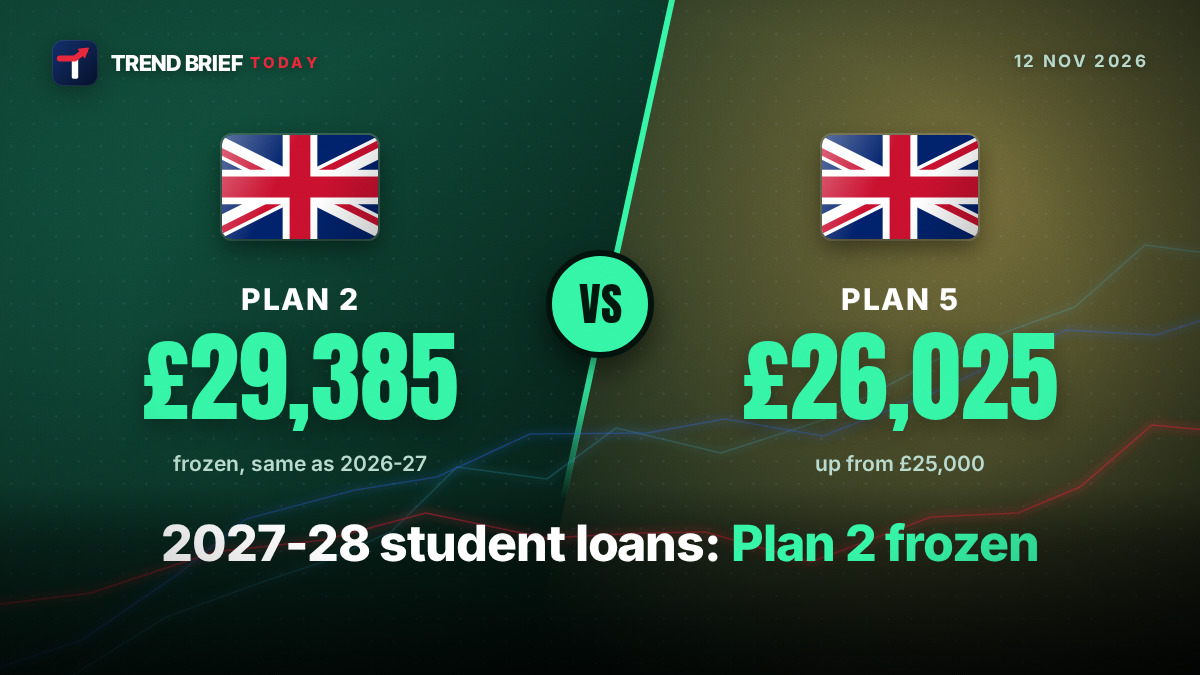
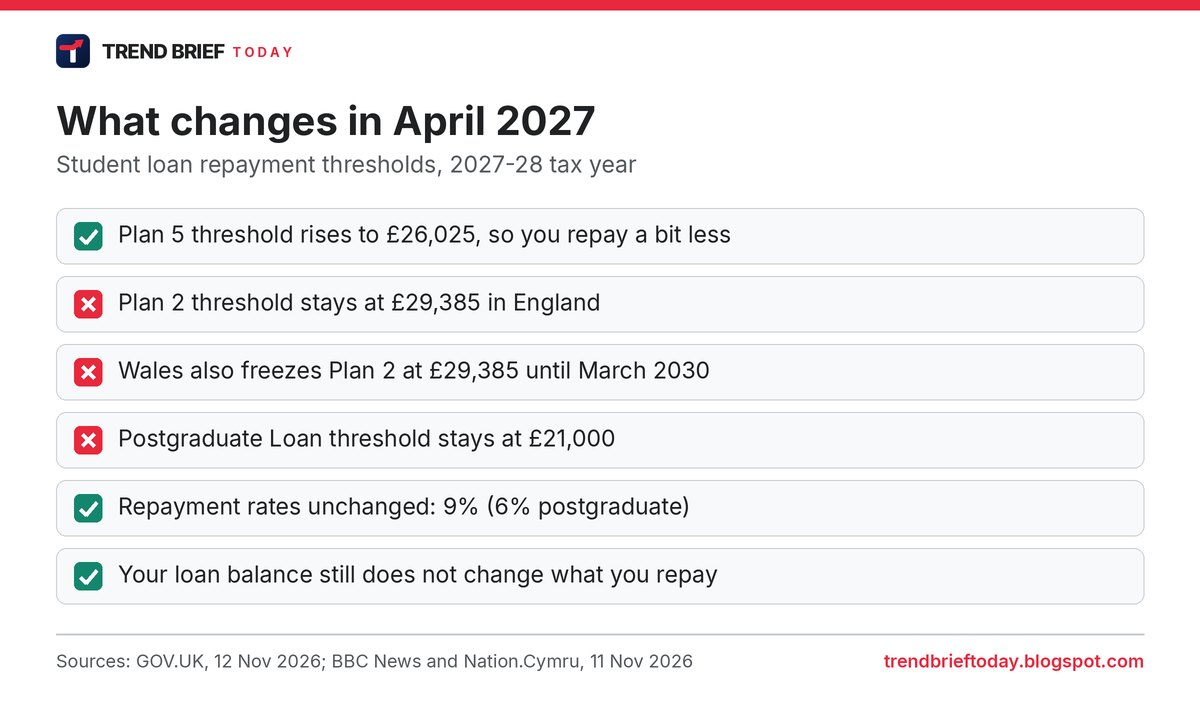
The UK government has set student loan repayment thresholds for the 2027-28 tax year, which starts on 6 April 2027. The Plan 2 threshold stays frozen at £29,385, the Plan 5 threshold rises from £25,000 to £26,025, and the Postgraduate Loan threshold stays at £21,000. Graduates keep repaying 9% of income above the threshold (6% for postgraduate loans), so a frozen threshold means more of any pay rise goes on repayments, while Plan 5 borrowers will pay up to about £92 a year less.[1][2][3]
 | |
| Announced | 12 November 2026, GOV.UK[1] |
|---|---|
| Applies | 6 April 2027 to 5 April 2028[1] |
| Plan 2 | £29,385 (frozen)[1][2][3] |
| Plan 2 higher interest threshold | £52,885 (frozen)[1][3] |
| Plan 5 | £26,025 (from £25,000)[1][4] |
| Postgraduate Loan (Plan 3) | £21,000 (frozen)[1][4] |
| Repayment rate | 9%; 6% for postgraduate[4] |
| Wales | Plan 2 frozen at £29,385 until March 2030[2][3] |
What was announced
The notice on GOV.UK is short. For Plan 2 undergraduate loans, the repayment threshold and the lower interest rate threshold "remains at £29,385 from 6 April 2027 to 5 April 2028", and the higher interest rate threshold "remains at £52,885". For Plan 5, the loans taken out by students in England who started from the 2023 academic year, the repayment threshold "will rise to £26,025". For Plan 3, the Postgraduate Loan, the threshold stays at £21,000.[1]
None of this is a surprise for Plan 2 borrowers in England. The freeze was announced by the then Chancellor Rachel Reeves in her November 2025 Budget, which held the Plan 2 threshold at £29,385 for three years from April 2027 rather than letting it rise with inflation. Nation.Cymru reports that her successor as Chancellor, John Healey, left that freeze in place in his own Budget.[2][3] The Plan 5 figure is the real news in this notice: it rises by £1,025, which works out at 4.1%.[1][4]
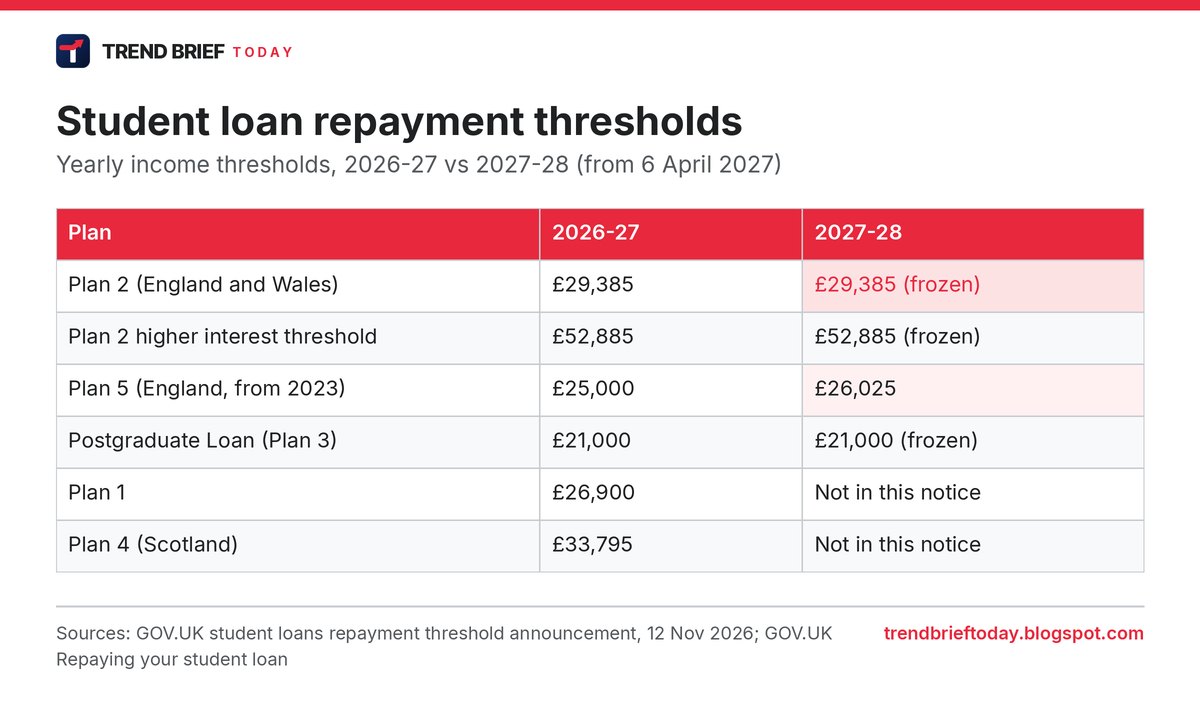
Plan 1 and Plan 4 were not in the 12 November notice. For reference, the current 2026-27 thresholds on GOV.UK are £26,900 for Plan 1 and £33,795 for Plan 4, the plan used by Scottish borrowers.[4] We will add the 2027-28 figures for those plans when they are published.
Which plan are you on?
You cannot choose your plan; it depends on where you applied for student finance and when your course started. If you applied to Student Finance England, GOV.UK says you are on Plan 5 for an undergraduate course or PGCE started on or after 1 August 2023, Plan 2 for one started between 1 September 2012 and 31 July 2023, and Plan 1 if you started before 1 September 2012. Student Finance Wales borrowers who started on or after 1 September 2012 are on Plan 2. Scottish borrowers are on Plan 4 and Northern Ireland borrowers on Plan 1. Master's and doctoral loans go on a Postgraduate Loan plan.[4]
If you are not sure, sign in to your online student loan account and download your "active plan type letter". GOV.UK says to show it to your employer if their payroll has you on a different plan, and that you can get a refund if you overpaid because of the wrong plan type.[4]
What you will repay in 2027-28
The amount you owe makes no difference to what you repay each year. Repayments are a share of what you earn above your plan's threshold: 9% for Plans 1, 2, 4 and 5, and 6% for a Postgraduate Loan. Payroll works it out on each payday against a monthly or weekly threshold, so a bonus month can trigger a repayment even if your yearly pay is below the line, and you can ask for a refund after the tax year ends.[4]
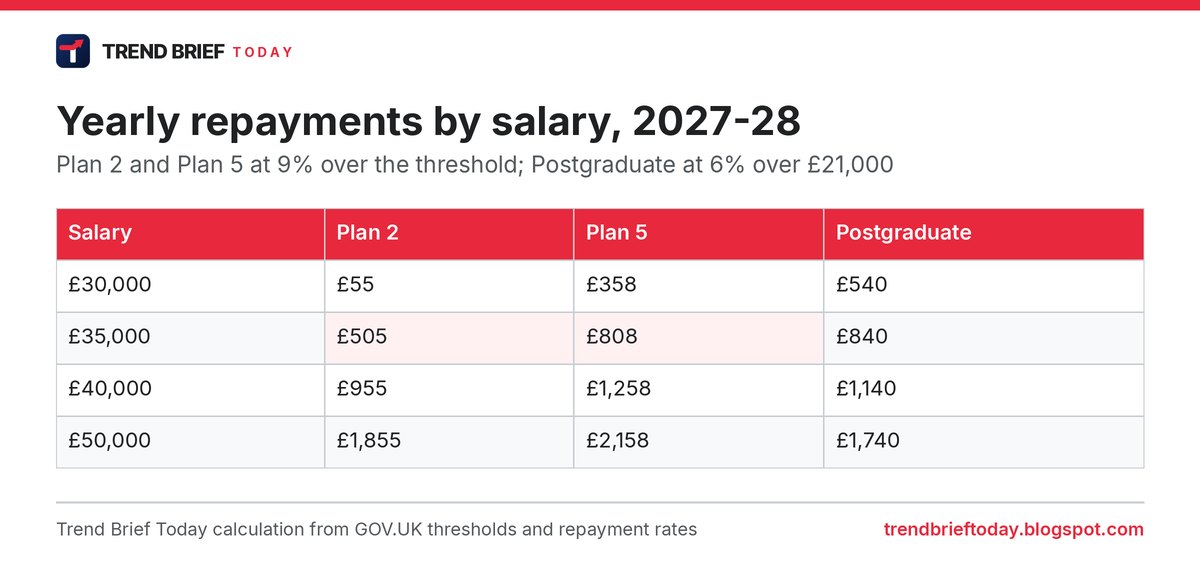
Here is what that means in 2027-28 at a few salaries. These are our own sums using the new thresholds and the official rates.
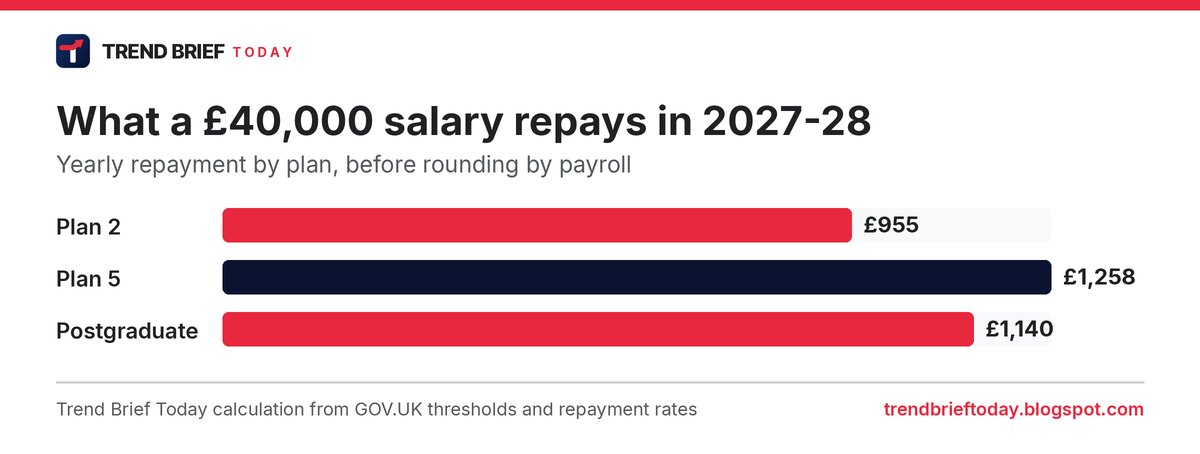
| Salary | Plan 2 (threshold £29,385) | Plan 5 (threshold £26,025) | Postgraduate (threshold £21,000) |
|---|---|---|---|
| £30,000 | £55 a year | £358 a year | £540 a year |
| £35,000 | £505 a year (about £42 a month) | £808 a year (about £67 a month) | £840 a year |
| £40,000 | £955 a year | £1,258 a year | £1,140 a year |
| £50,000 | £1,855 a year | £2,158 a year | £1,740 a year |
If you have a Postgraduate Loan as well as an undergraduate loan, both are taken at the same time, so someone on Plan 2 earning £40,000 with a master's loan would repay about £955 plus £1,140 a year. If you have two undergraduate plans, for example Plan 1 and Plan 2, GOV.UK says you repay 9% over the lowest of the thresholds, as a single deduction.[4]
Plan 5: a small saving
Because the Plan 5 threshold goes up by £1,025, anyone on Plan 5 earning more than £26,025 will repay £92.25 a year less in 2027-28 than they would at today's £25,000 threshold, if their pay stays the same. That is 9% of £1,025, or under £8 a month.[1][4]
Plan 2: what the freeze costs
For Plan 2 the threshold does not move, so a pay rise feeds straight into higher repayments. To give a sense of scale, had the Plan 2 threshold risen by the same 4.1% as Plan 5, it would have been about £30,590. On that basis, a Plan 2 graduate earning above that level pays roughly £108 a year more because of the freeze. That figure is our illustration, not an official estimate, and the gap widens in each of the three frozen years if thresholds would otherwise have kept rising.[1][2]
The freeze also matters for interest. On Plan 2, interest after you leave your course depends on income: GOV.UK currently lists 4.1% at £29,385 or less, rising on a sliding scale to 6% at £52,885 or more (the current cap). With both of those income points frozen, more graduates move up that scale as wages rise. Plan 5 borrowers are charged 4.1% at the moment, and the Postgraduate Loan 6%.[4]
Wales freezes Plan 2 too
Most Welsh undergraduates are on Plan 2, and the Welsh Government said on 11 November that it would also freeze their threshold at £29,385 for three years from April 2027, until March 2030. The interest thresholds of £29,385 and £52,885 stay the same as well.[2][3]
Cefin Campbell, the Welsh Government's deputy minister for skills and tertiary education, said "This is not a decision I wanted to take." He said repayments run through a shared UK-wide system run by the Student Loans Company and HMRC that "cannot support different repayment thresholds for Welsh and English borrowers".[2][3] The previous Welsh Government had said earlier this year that it would not freeze the threshold, the BBC notes.[2]
NUS Cymru president Jennifer Taylor criticised the move: "We signed a contract, based on repayment thresholds rising each year," she told the BBC, adding: "let's be clear, a bank could not get away with this."[2] Campbell pointed out that Welsh Plan 2 borrowers still have a higher threshold than English Plan 5 borrowers and have any balance written off a decade sooner, and that Wales cancels up to £1,500 of each borrower's debt.[2][3]
What happens next
The new thresholds start on 6 April 2027 and apply through payroll or Self Assessment without you having to do anything. Plan 2 stays at £29,385 until at least April 2030 in both England and Wales unless a future Budget changes it. Nation.Cymru reports that Healey told MPs at Treasury questions this week that the government would "keep an eye" on the issue.[3] The Welsh Government's higher education review will look at future repayment arrangements, and Campbell said ministers are considering raising the Welsh tuition fee cap, with a decision due "in the next couple of weeks".[2][3]
Frequently asked questions
What is the Plan 2 student loan threshold for 2027-28?
£29,385 a year, the same as in 2026-27. It applies from 6 April 2027 to 5 April 2028 and is frozen at that level for three years.[1][2]
What is the Plan 5 repayment threshold from April 2027?
£26,025 a year, up from £25,000.[1][4]
Has the postgraduate loan threshold changed?
No. It stays at £21,000, and you repay 6% of income above it.[1][4]
Does the freeze apply in Wales?
Yes. The Welsh Government is freezing the Plan 2 threshold for Welsh borrowers at £29,385 from April 2027 until March 2030.[2][3]
Does owing more mean I repay more each month?
No. What you repay depends only on your income above the threshold, not on your balance. The balance and interest affect how long you repay and whether anything is written off at the end.[4]
References
- "Student Loans Repayment Threshold Announcement". Department for Education, GOV.UK. November 12, 2026. gov.uk
- "Welsh students to start repaying loans earlier after thresholds frozen". BBC News. November 11, 2026. bbc.co.uk
- "Welsh Government freezes student loan repayment threshold for three years". Nation.Cymru. November 11, 2026. nation.cymru
- "Repaying your student loan: how much you repay" and "which repayment plan you're on". GOV.UK. Retrieved November 12, 2026. gov.uk