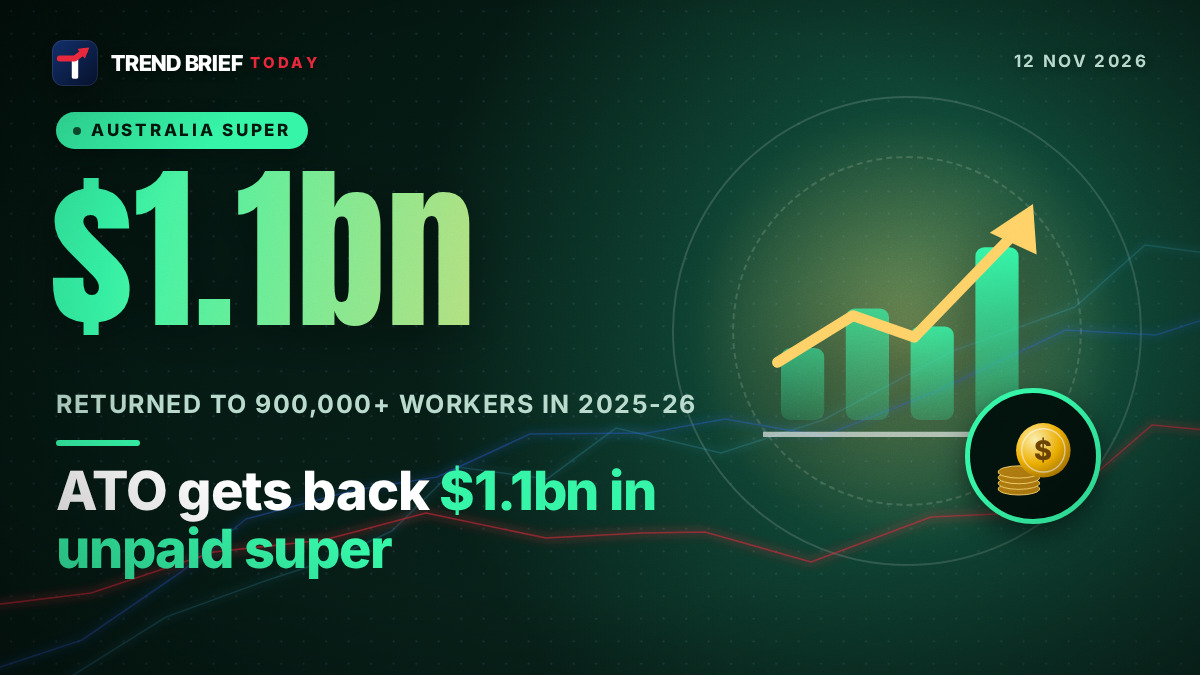
The Australian Taxation Office (ATO) says it returned more than $1.1 billion in unpaid superannuation to the super funds of over 900,000 workers in the 2025-26 financial year, after chasing employers who had not paid what they owed. The figures, released on Thursday 12 November 2026, also show $1.17 billion in super guarantee charge raised (up from $795 million a year earlier) and almost $250 million in penalties. They are the first annual numbers since Payday Super started on 1 July 2026.[1][2][3]
 | |
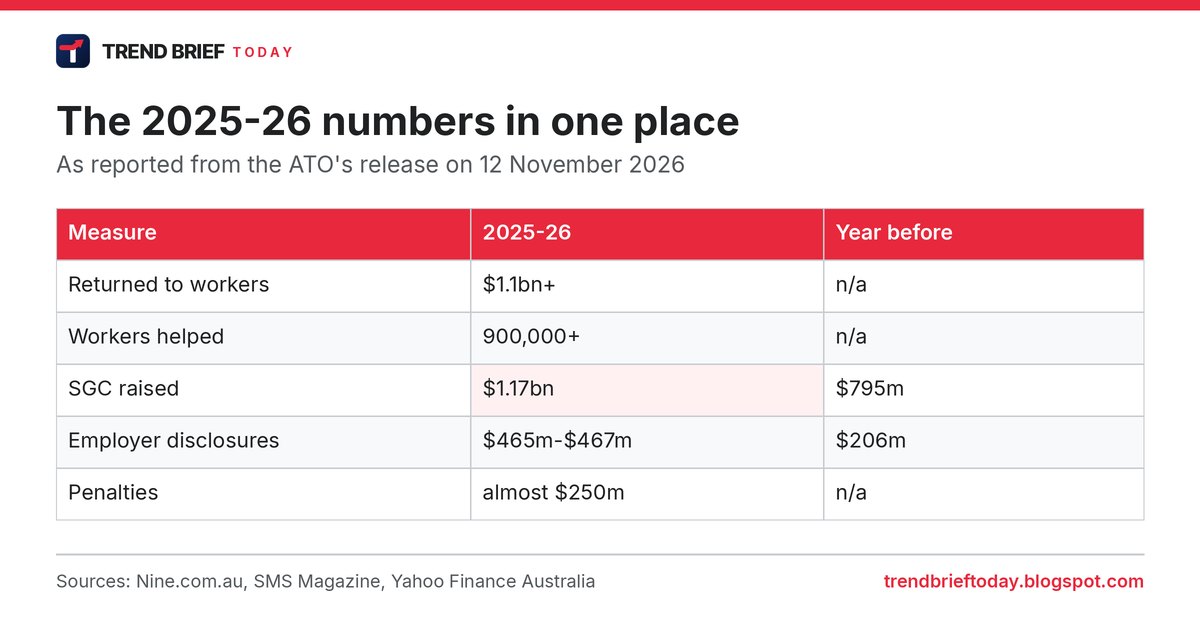
| Returned to workers | More than A$1.1 billion[1][2][3] |
|---|---|
| Workers helped | More than 900,000[1][2] |
| SGC raised | A$1.17 billion (A$795 million in 2024-25)[2][3] |
| Disclosed by employers | A$465 million to A$467 million (A$206 million a year earlier)[1][2][3] |
| Penalties | Almost A$250 million[1][3] |
| Employers contacted | Over 254,000[2] |
| Paid on time without ATO action | Nearly 93% of obligations[1][2][3] |
| Payday Super start | 1 July 2026[1][3] |
What the ATO announced
Every employer in Australia has to pay a set share of an eligible worker's ordinary earnings into their super fund. This is the super guarantee (SG). When an employer pays late or not at all, the ATO can raise the super guarantee charge (SGC) against it, collect the money and pass it on to the worker's fund. The ABC notes the ATO can also fine the employer on top of the super owed.[1][4]
For 2025-26 the ATO says it helped return more than $1.1 billion to over 900,000 Australians. It dealt with more than 254,000 employers through reminders, prompts and targeted audits and reviews, and raised $1.17 billion in SGC liabilities, compared with $795 million in the year before.[2][3]
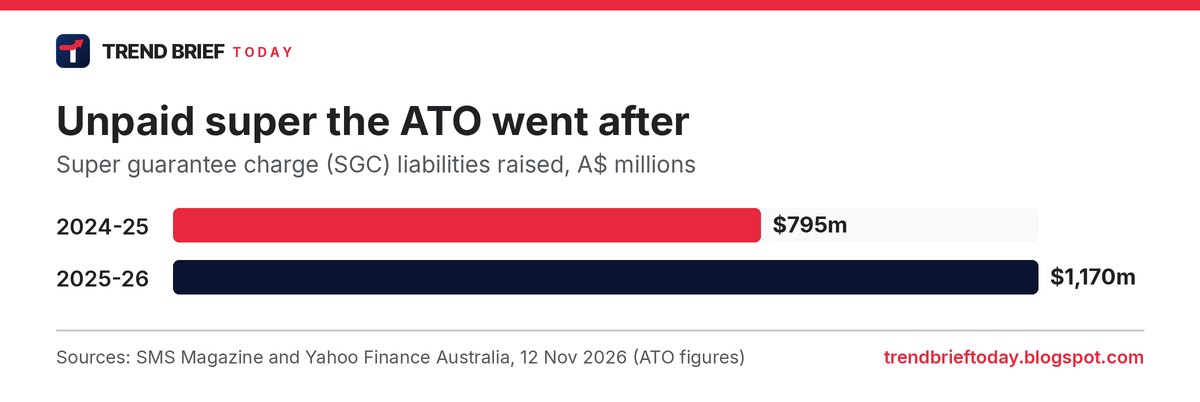
A big part of the rise came from employers owning up after a nudge. Employers disclosed $465 million in SGC after ATO prompts in 2025-26, according to SMS Magazine, or $467 million according to Nine and Yahoo Finance; both put the previous year at $206 million.[1][2][3] That is more than double either way.
Deputy Commissioner Ben Kelly said: "Paying the super workers are entitled to is non-negotiable." He added: "We know the vast majority of employers do the right thing, with nearly 93 per cent of super guarantee obligations being met without any ATO intervention. However, for a small proportion of employers who chose not to act following our prompts, we have used firmer compliance activities and raised almost $250 million in penalties."[1][3]
Why the numbers jumped
The ATO links the rise to more compliance work and more contact with employers.[3] It does not say how much of the $1.1 billion relates to any one industry or employer size, and none of the reports we read break the money down by state.
The gap is still large. Yahoo Finance cites Super Members Council data that Australians miss out on about $6.3 billion a year in unpaid super, an average of around $1,850 each, which it says can leave a worker more than $30,000 worse off at retirement.[3] Treat that as an industry estimate; it is not an ATO figure. An earlier industry estimate reported by the ABC in 2024 was up to $5.1 billion a year.[4]
What Payday Super changes
Until 30 June 2026, employers only had to pay super at least four times a year, on quarterly due dates. Since 1 July 2026, Payday Super means they must pay it each payday, whether that is weekly, fortnightly or monthly.[1][3][4] The contribution generally needs to reach the worker's fund within seven business days of payday.[1][2]
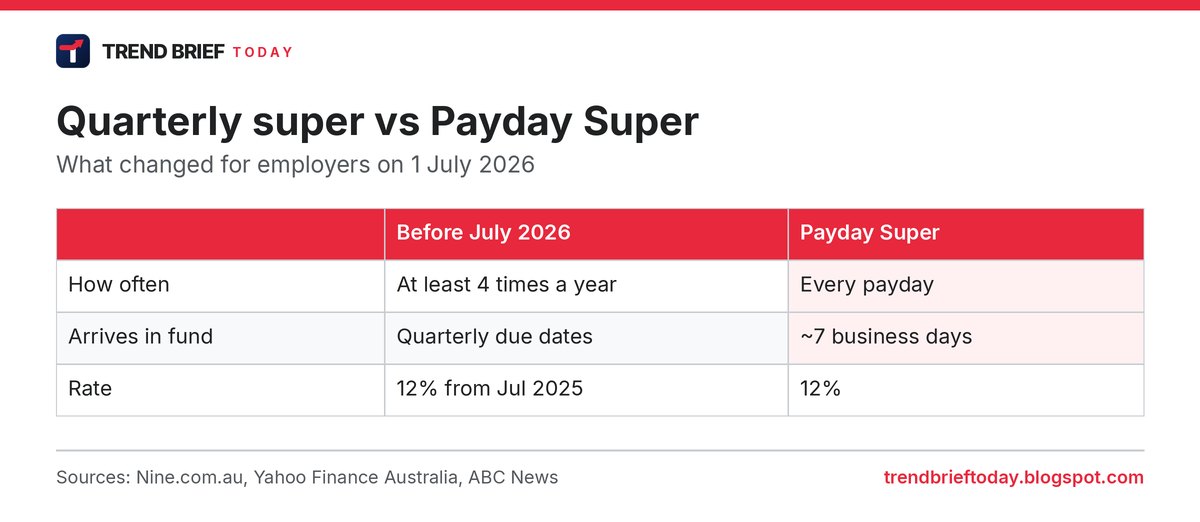
The SG rate itself has been 12% of ordinary time earnings since 1 July 2025, when it rose from 11.5%.[4][5]
The ATO says early data shows employers are paying more often and that rejected contributions have fallen, even with more payments going through and less time to make them.[1][2] Kelly said more frequent payments mean workers "receive their super sooner, giving their savings more time to grow", and that the new system "will also help us identify any unpaid super earlier and take more timely action".[1][2] He also told employers who have not yet moved to Payday Super timeframes to "do so as soon as possible".[3]
How to check if your employer paid your super
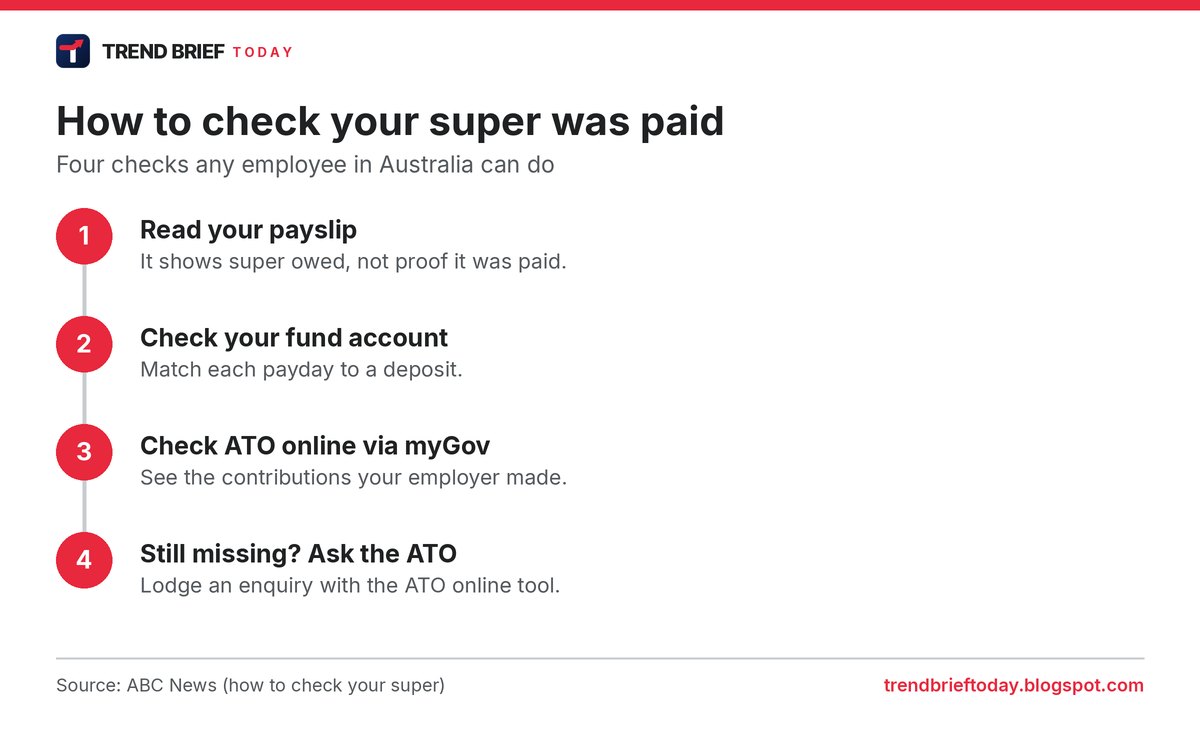
A super amount printed on your payslip shows what your employer says you are owed. It does not prove the money reached your fund.[4] The ABC's checklist suggests these steps:[4]
- Check your super fund account. Log in to your fund or read your member statement and match deposits against your pay dates. Under Payday Super, money should arrive within about seven business days of each payday.[1][4]
- Check ATO online services. Through myGov or the ATO app you can see the contributions your employer has reported.[4]
- Ask your employer. Ask how much they paid and into which fund.[4]
- Tell the ATO. If money is still missing, lodge an enquiry with the ATO using its online tool. The ATO can then check whether the employer paid and charge them if not.[4]
A union, a workplace legal centre or the Fair Work Ombudsman can also help.[4] Most employees over 18 are entitled to super whether they work full-time, part-time or casually, and under-18s qualify if they work more than 30 hours a week. The old rule that excluded people earning under $450 a month from one employer ended on 1 July 2022.[4]
Frequently asked questions
How much unpaid super did the ATO recover in 2025-26?
More than $1.1 billion was returned to the super funds of over 900,000 workers, and $1.17 billion in super guarantee charge was raised.[1][2]
Do I need to do anything to get the money?
No claim is needed for money the ATO recovers: it goes to your super fund. If you think super is missing, check your fund and ATO online services and report it to the ATO.[1][4]
What is Payday Super?
Since 1 July 2026 employers must pay super with each pay cycle instead of quarterly, and it should generally reach your fund within seven business days of payday.[1][3]
What is the super guarantee rate now?
12% of ordinary time earnings, since 1 July 2025.[4][5]
References
- Andrew, Tilli. "Hundreds of thousands of Aussies get $1.1 billion windfall from tax office". Nine.com.au. November 12, 2026. nine.com.au
- "ATO reduces amount of unpaid super". SMS Magazine (selfmanagedsuper). November 12, 2026. smsmagazine.com.au
- Venz, Sophie. "ATO warning as nearly a million Aussies see unpaid superannuation returned amid new rule change". Yahoo Finance Australia. November 12, 2026. au.finance.yahoo.com
- Dervisevic, Hanan. "Are you being paid superannuation correctly by your employer? Here's how to find out". ABC News. August 28, 2024. abc.net.au
- "Superannuation in Australia". Wikipedia. Retrieved November 12, 2026. en.wikipedia.org