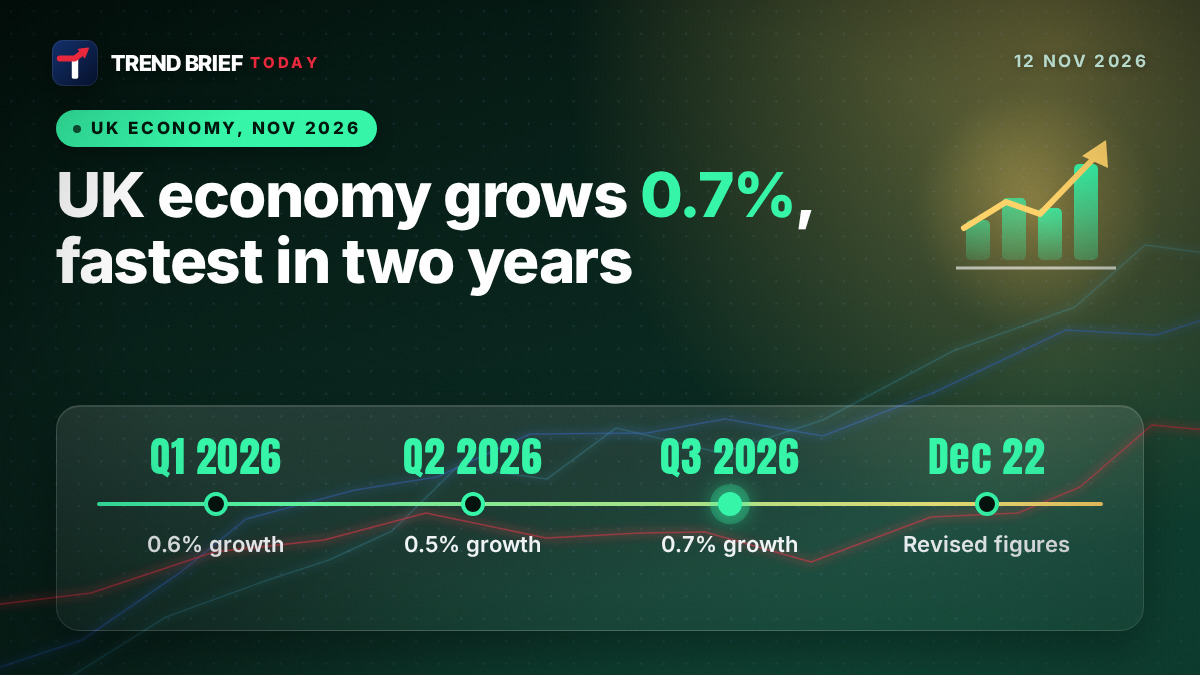
The UK economy grew by 0.7% between July and September 2026, its fastest quarterly growth in more than two years, according to the first official estimate from the Office for National Statistics (ONS) published on Thursday, November 12.[1][2] Growth picked up from 0.5% in the spring, and the economy was 1.9% bigger than a year earlier.[1][3] Services did almost all of the work, led by computer programming and other business services that the ONS links to AI and cloud computing, while house building and restaurants fell back.[1][2][3] Here is what the figures say, how the UK compares with other rich countries and what it could mean for interest rates and household finances.
 | |
| Quarter | Q3 2026 (July to September) |
|---|---|
| Growth | 0.7% on the previous quarter[1] |
| Previous quarter | 0.5% (April to June)[1] |
| On a year earlier | 1.9% higher[1][3] |
| September alone | 0.2% growth[1][3] |
| GDP per head | Up 0.7% on the quarter[1] |
| Published by | Office for National Statistics, Nov 12, 2026[1] |
| Next estimate | December 22, 2026[1] |
What the ONS said
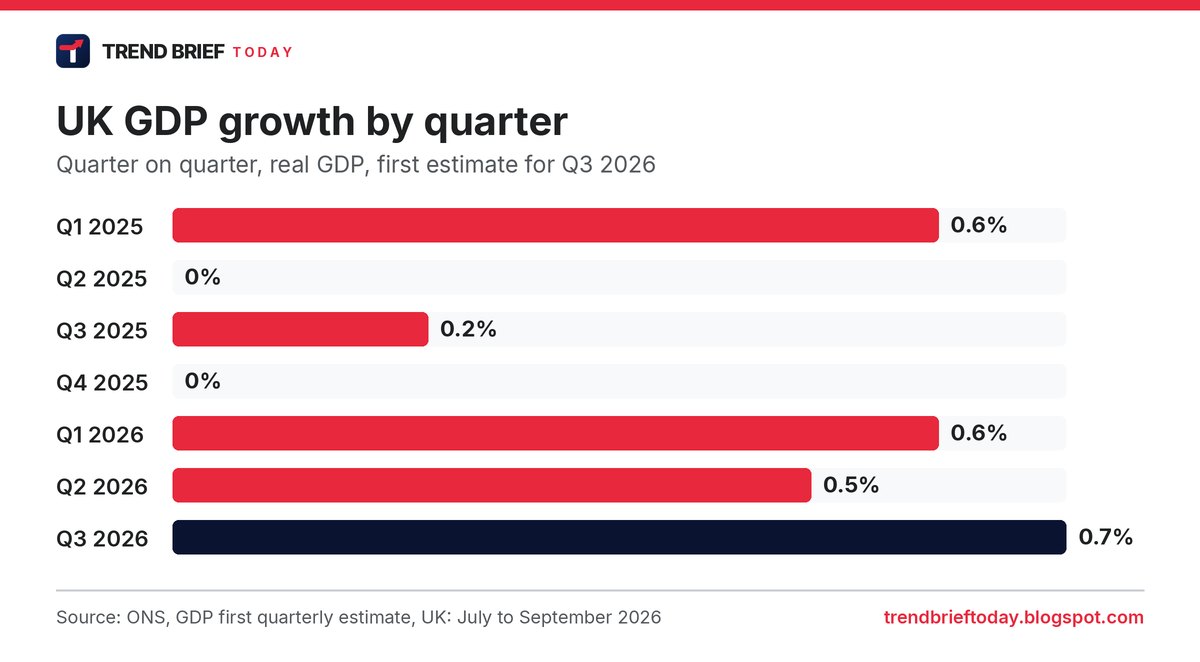
Real gross domestic product, the total value of everything the UK produces after taking out inflation, rose by an estimated 0.7% in the third quarter of 2026. That follows 0.6% in the first quarter and 0.5% in the second, so 2026 has now had three solid quarters in a row after a flat end to 2025.[1] The BBC describes it as the fastest rate of growth for more than two years.[2]
Compared with the same three months of 2025, the economy was 1.9% larger. GDP per head, which adjusts for population growth and is closer to what people feel in their own pockets, also rose 0.7% in the quarter and was 1.7% higher than a year ago.[1]
The ONS also published its monthly figures for September on the same morning. The economy grew 0.2% in September, after no growth at all in August (revised down from 0.1%) and 0.4% in July.[1] City AM reports that forecasters had expected September to be flat.[3]
What drove the growth
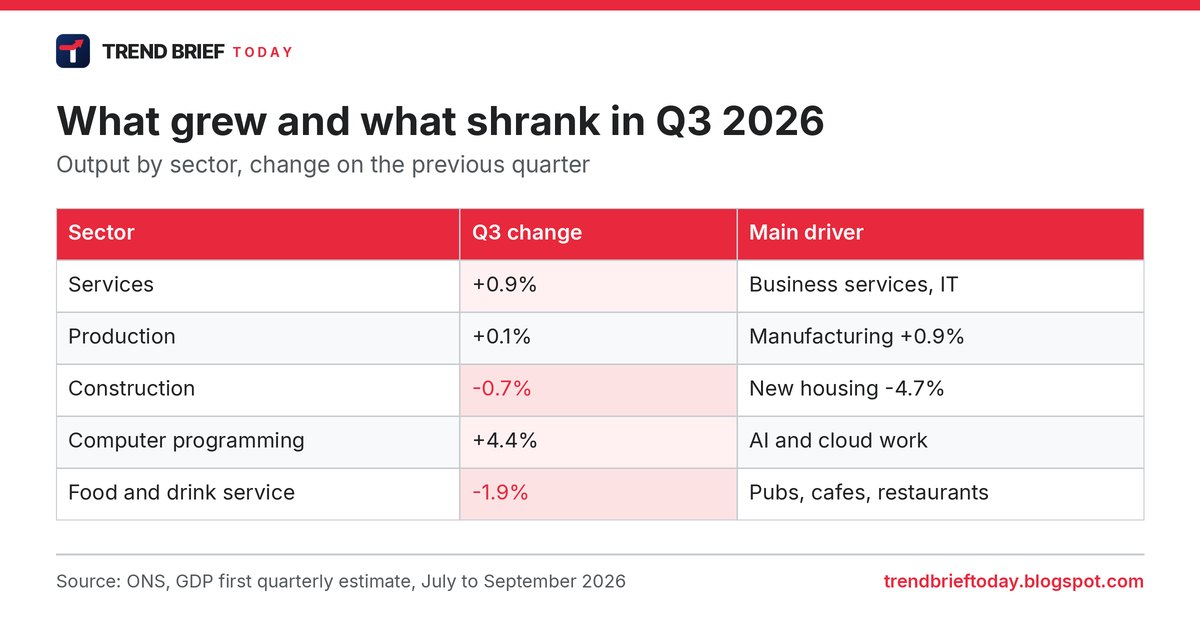
Almost all of the growth came from services, which rose 0.9% in the quarter. Business-facing services grew 1.0%, while consumer-facing services such as shops, hotels and leisure grew 0.5%.[1] Eleven of the fourteen service industries grew.[1]
- Computer programming and consultancy grew 4.4%, helping information and communication rise 2.1%. The ONS says this industry has been the biggest driver of growth across 2026, and that many of the firms reporting the largest rises in turnover work in AI and cloud computing, although it cannot measure the exact effect.[1]
- Administrative and support services rose 4.1%, mainly because of rental and leasing (up 6.6%).[1]
- Manufacturing grew 0.9%, led by computer, electronic and optical products (up 4.6%), but production as a whole only managed 0.1% because mining, energy supply and water all fell.[1]
- Construction fell 0.7%. New private housing work dropped 4.7%, the biggest drag.[1]
- Food and drink service, which covers restaurants, cafes and pubs, fell 1.9%, and education fell 0.5%.[1]
Grant Fitzner, the ONS chief economist, said the economy "grew robustly in the third quarter almost entirely due to strong and widespread growth in the services sector", adding that computer programming registered its fastest growth in the last three years and that "we continue to see evidence that AI-linked businesses helped to boost this sector".[2][3]
Where the spending came from
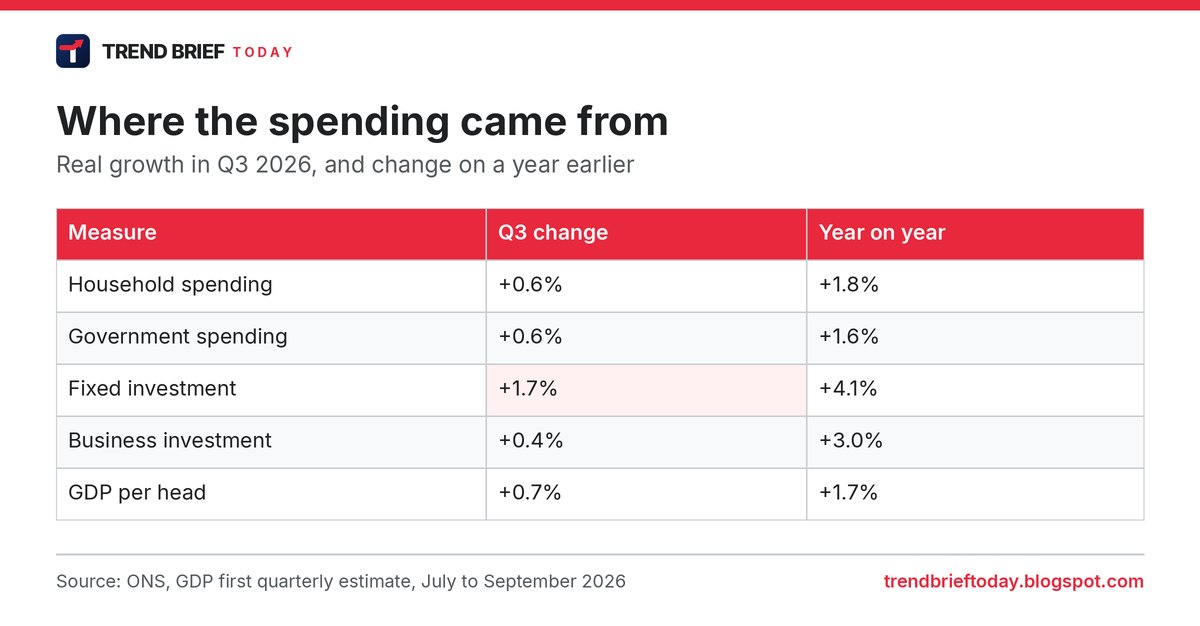
Looked at from the spending side, households and investment drove the quarter. Real household spending rose 0.6%, mainly on transport and housing, and was 1.8% higher than a year earlier. Government spending also rose 0.6%, with defence, public administration and health behind most of the increase.[1]
Fixed investment jumped 1.7%, driven by machinery and equipment and transport equipment. Business investment, a narrower measure, rose 0.4% and was 3.0% higher than a year ago.[1][3] City AM notes that households kept spending through the summer even though the Iran war pushed up energy prices.[3]
How the UK compares with the G7
Among the G7 economies that have reported for July to September, only the United States grew faster, at 0.8%. Canada grew 0.3%, Germany 0.2% and Italy was flat, while France shrank by 0.1%. Japan's figure was not out when the ONS compiled its table.[1]
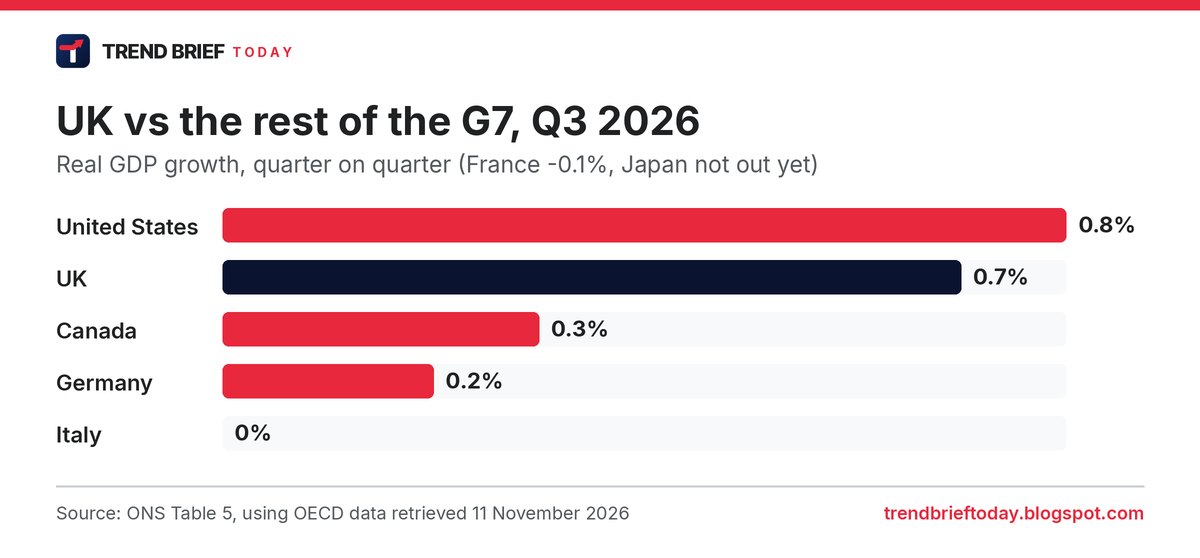
Over the whole of 2025 the UK grew 1.2%, behind the US (2.3%) and Canada (1.9%) but ahead of France, Germany and Italy.[1]
What politicians said
Prime Minister Andy Burnham called the figures "welcome news", saying: "Despite a year where events around the world have pushed up costs here at home, our economy is growing, bringing hope for the future."[2][3] City AM reports that Chancellor John Healey said the economy was showing "stand-out resilience".[3]
What it means for interest rates and your money
Strong growth makes it harder for the Bank of England to cut interest rates. Bank Rate is 4% after the November 5 decision, and the Bank expects inflation to rise towards about 5% by the middle of 2027 because of higher energy costs.[4] The National Institute of Economic and Social Research (NIESR) said on November 11 that rates may have to go higher, and forecast growth of 1.6% this year and 1.1% in 2027.[5][3]
For households, the picture is mixed. Growth and steady spending point to a resilient jobs market, but they also reduce the chance of cheaper mortgages soon. City AM reports that the Office for Budget Responsibility expects the energy price shock to drag growth down to about 1% next year.[3] The next Bank of England decision is on December 17, 2026.[6]
What happens next
| Date | What comes out |
|---|---|
| November 12, 2026 | First estimate: Q3 GDP up 0.7%, September up 0.2%[1] |
| December 17, 2026 | Bank of England interest rate decision[6] |
| December 22, 2026 | Quarterly national accounts: revised Q3 figures[1] |
First estimates do change. The ONS says that since 2000 the average revision between the first estimate and the final figure three years later has been +0.08 percentage points, and the average size of a revision, up or down, is 0.27 points.[1]
Frequently asked questions
How much did the UK economy grow in the third quarter of 2026?
By 0.7% between July and September 2026, up from 0.5% in the second quarter, according to the ONS first estimate. It was 1.9% bigger than a year earlier.[1]
Is this the fastest UK growth in two years?
Yes. The BBC and City AM both describe it as the fastest quarterly growth in more than two years.[2][3]
Why did the economy grow so fast?
Mainly services, especially computer programming, consultancy and other business services. The ONS says AI-linked firms helped. Household spending and investment also rose.[1][2]
Did the UK grow in September 2026?
Yes, by 0.2%, after no growth in August and 0.4% in July.[1]
Does this mean interest rates will go up?
Not by itself. Strong growth reduces the case for cuts, and some forecasters such as NIESR think rates need to rise because of inflation. The next decision is on December 17.[5][6]
When are the next UK GDP figures?
The ONS publishes revised figures for July to September on December 22, 2026.[1]
References
- "GDP first quarterly estimate, UK: July to September 2026". Office for National Statistics. November 12, 2026. ons.gov.uk
- "UK economy grows at fastest rate for more than two years". BBC News. November 12, 2026. bbc.co.uk
- "UK economy grows 0.7 per cent as AI boom lifts business investment". City AM. November 12, 2026. cityam.com
- "Monetary Policy Summary, November 2026". Bank of England. November 5, 2026. bankofengland.co.uk
- "Economic Outlook, Autumn 2026". National Institute of Economic and Social Research. November 11, 2026. niesr.ac.uk
- "Upcoming MPC dates". Bank of England. bankofengland.co.uk