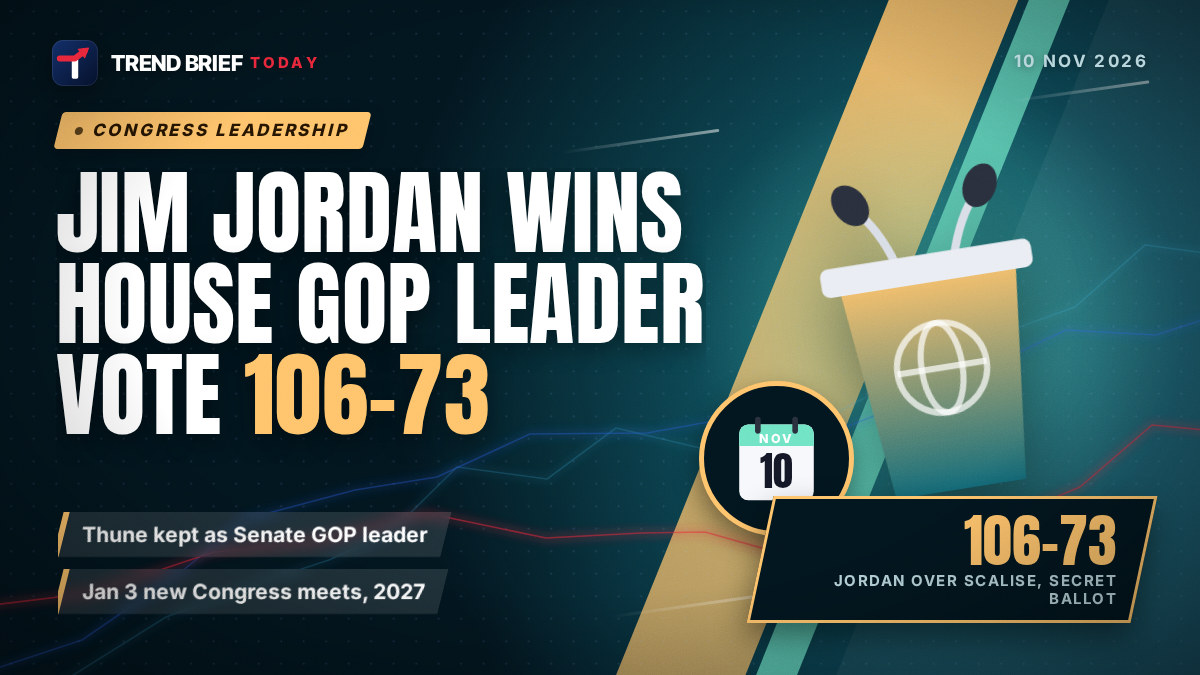
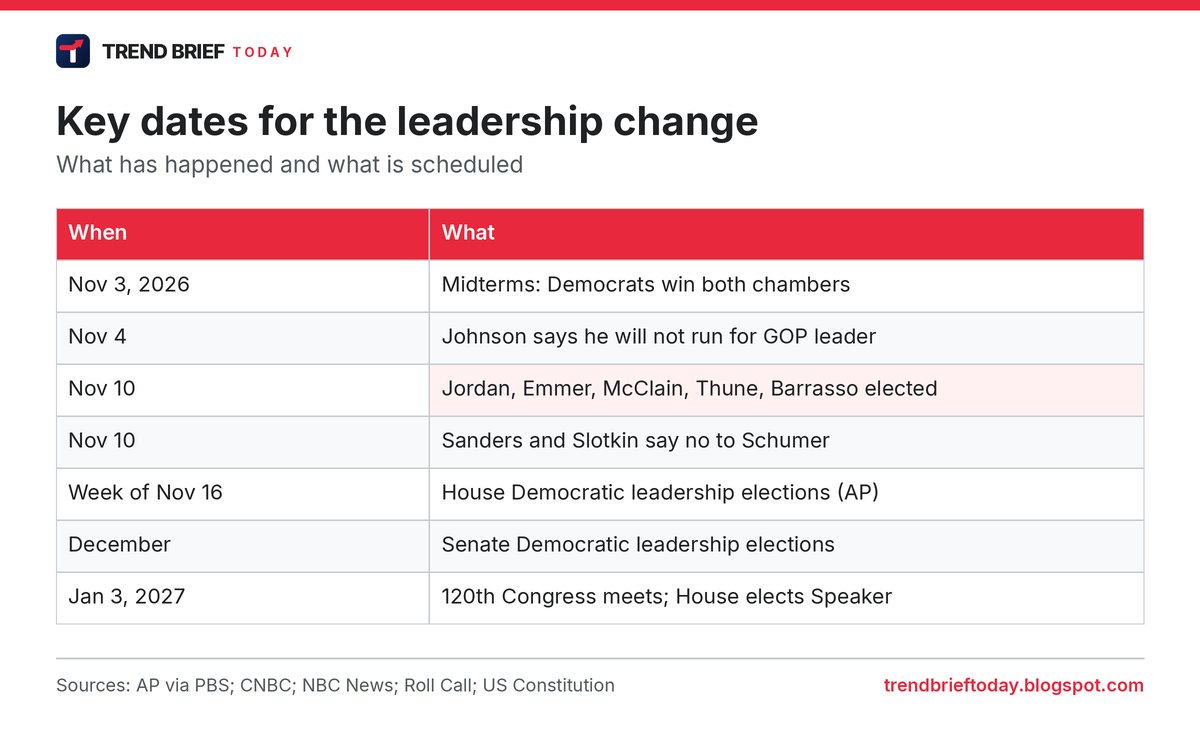
House Republicans elected Jim Jordan of Ohio as their leader for the next Congress on November 10, 2026, beating Majority Leader Steve Scalise 106-73 in a secret ballot. Senate Republicans kept John Thune as their leader on the same day. Both men will lead their party in the minority when the 120th Congress opens on January 3, 2027, because Democrats won control of both chambers in the midterms. On the Democratic side nothing is settled yet: Bernie Sanders said he will not back Chuck Schumer for Senate majority leader, and the Democratic leadership votes have not been held.[1][2][3][12]
 | |
| Date | Tuesday, November 10, 2026 (Republicans) |
|---|---|
| For | 120th Congress, from January 3, 2027 |
| House GOP leader | Jim Jordan (Ohio), 106-73 over Steve Scalise |
| House GOP whip | Tom Emmer (Minnesota), 103-76 over August Pfluger |
| House GOP conference chair | Lisa McClain (Michigan), 93 votes on the first ballot |
| Senate GOP leader | John Thune (South Dakota), unopposed |
| Senate GOP whip | John Barrasso (Wyoming), unopposed |
| House Democrats vote | Week of November 16 (AP) |
| Senate Democrats vote | Expected in December (Roll Call, NBC) |
| Speaker election | January 3, 2027, full House roll call |
What happened on November 10
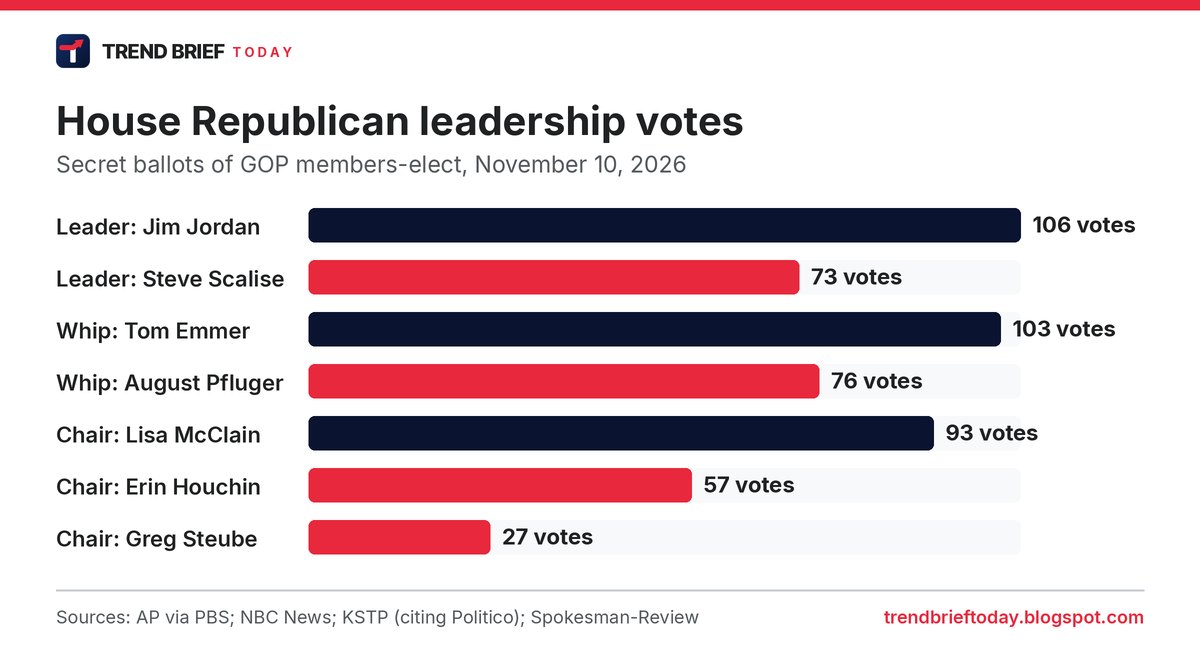
Republicans who will serve in the next Congress met behind closed doors on Tuesday and voted by secret ballot. Jordan, the chairman of the House Judiciary Committee, defeated Scalise 106-73, according to two Republican lawmakers in the room who spoke to NBC News. The Associated Press reported the same result.[1][2] That adds up to 179 ballots, which gives a rough idea of how small the Republican conference will be next year. NBC News puts the incoming Democratic majority at roughly 260 seats, the largest in 35 years.[1]
The job was open because Speaker Mike Johnson announced the day after the November 3 election that he would not run for minority leader in the 120th Congress.[3][2] Johnson remains Speaker until the new Congress begins, so Jordan does not take over until January.
The rest of the House Republican team stayed the same. Tom Emmer kept the whip post, the No. 2 job, beating August Pfluger of Texas 103-76, according to KSTP, which cited Politico. The Washington Examiner also reported that Emmer won.[4][5] Lisa McClain won another term as conference chair on the first ballot with 93 votes, against 57 for Erin Houchin and 27 for Greg Steube, according to a McClain spokesman quoted by the Spokesman-Review. The AP had listed the same three candidates.[6][2]
Who is Jim Jordan?
Jordan, 62, has represented Ohio in the House for about two decades. He co-founded the House Freedom Caucus and was its first chairman, and he has chaired both the Oversight and Judiciary committees.[2][1] In his pitch to colleagues he leaned on that committee experience, writing: "I am battle-tested on the oversight front and I know the Democrats' playbook."[1][2]
This was not the first Jordan versus Scalise contest. Both ran for Speaker after Kevin McCarthy was removed in October 2023, neither could get enough votes, and the job went to Johnson.[2][17] Scalise, 61, has been in the leadership since 2014, first as whip and then as majority leader, and told colleagues he raised $67.9 million for this year's midterms.[2][1]
John Thune stays as Senate Republican leader
Senate Republicans re-elected Thune without opposition after meeting for most of the day in the Old Senate Chamber. CBS News says he was chosen by acclamation.[7][9] John Barrasso of Wyoming stays as whip, also unchallenged. The rest of the team is Tom Cotton (conference chair), Shelley Moore Capito (policy committee chair), James Lankford (conference vice chair) and Bernie Moreno, who becomes chair of the party's Senate campaign committee.[8] Today that campaign job is held by Tim Scott, according to the Senate's own leadership page.[14]
The vote was not entirely smooth. Ron Johnson of Wisconsin gathered signatures from Senators John Kennedy, Ted Budd, Rick Scott and Mike Lee to force a meeting about delaying the election, but the conference voted to go ahead, and Johnson walked out as voting began.[9][7] Josh Hawley also argued for a delay. Both CBS and the AP say the party lost at least seven Senate seats, with Alaska and Mississippi still uncalled.[7][9]
Afterwards Thune said in a statement that he was "honored to have their continued trust and support to lead the Senate Republican Conference in the 120th Congress." He also promised to lengthen the lame-duck session in November and December so Republicans can confirm more nominees and pass more bills before Democrats take over.[3][8]
The Democratic side: Speaker and Senate majority leader
Democrats will pick the two most powerful jobs, Speaker of the House and Senate majority leader, but they have not voted yet.
House Democrats
The AP reports that House Democrats hold their leadership elections next week, meaning the week of November 16. It says Hakeem Jeffries of New York, the current Democratic leader, is expected to become Speaker and Katherine Clark of Massachusetts is expected to become majority leader.[2] The party vote only makes Jeffries the Democratic nominee. The Speaker is formally chosen by the whole House on January 3, 2027, when the new Congress meets.[13][15]
Senate Democrats and the Schumer question
Chuck Schumer, Democratic leader for a decade, wants to stay on as majority leader. Bernie Sanders, the Vermont independent who caucuses with Democrats, said on Tuesday he will not support him. "I personally have known Chuck Schumer for over 30 years, and I like Chuck. Nobody works harder than Chuck Schumer. But in my view the time is now for change," Sanders said.[10][11]
Elissa Slotkin of Michigan stood with him and also called for new leadership, but neither senator named an alternative. Chris Van Hollen of Maryland says he is in "active listening mode" about a run. Schumer told reporters: "I'm confident I will be elected majority leader."[11][10] To win, he needs a majority of the Democratic caucus.[10]
The date is not fixed in public. Roll Call says the Senate Democratic elections are expected in December, and NBC News says Senate Democrats will not elect their leaders until next month. An earlier ABC News report, published before the Republican votes, said Democrats would choose House and Senate leaders next week. We go with December for the Senate until the caucus sets a date.[11][10][16]
Who leads Congress now and in 2027
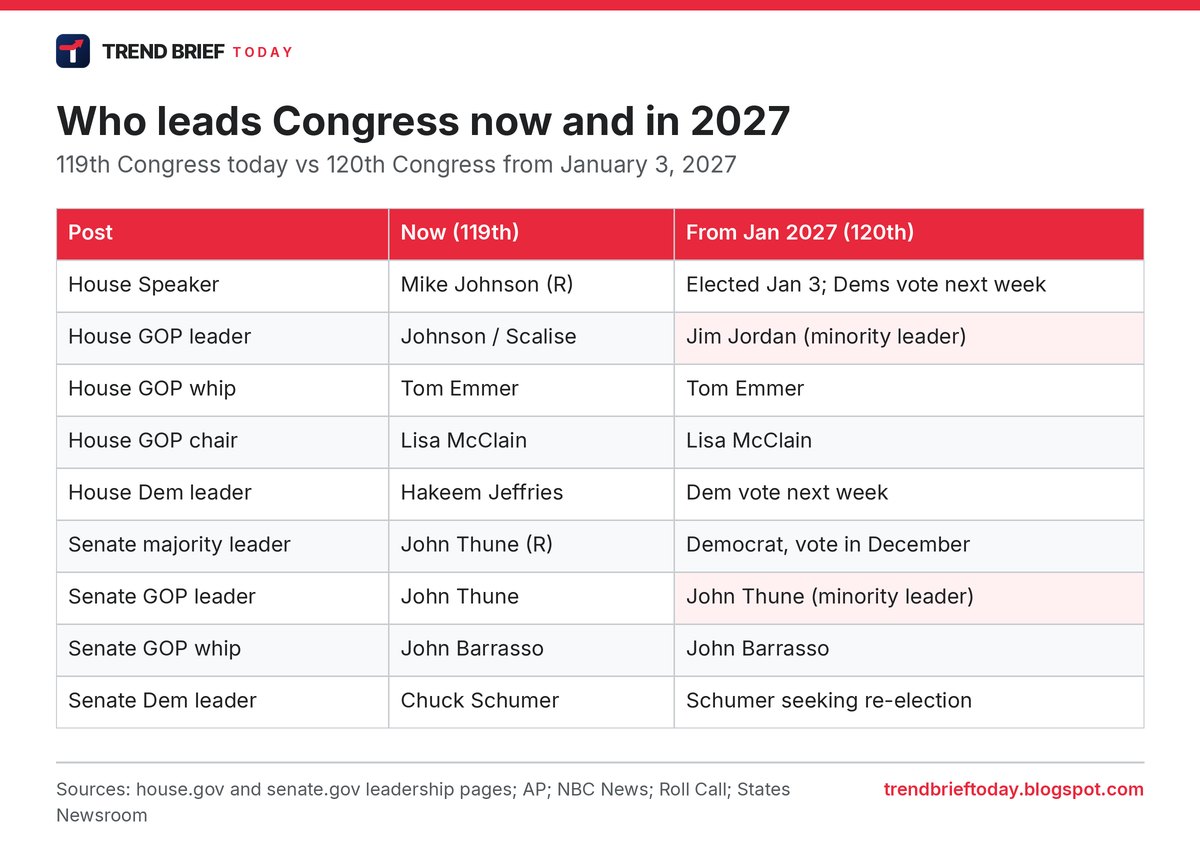
| Post | Now (119th Congress) | From January 3, 2027 (120th) |
|---|---|---|
| Speaker of the House | Mike Johnson (R) | Elected by the full House on Jan 3; Democrats nominate first |
| House Republican leader | Johnson as Speaker, Steve Scalise as majority leader | Jim Jordan, minority leader |
| House Republican whip | Tom Emmer | Tom Emmer |
| House Republican Conference chair | Lisa McClain | Lisa McClain |
| House Democratic leader | Hakeem Jeffries | Decided in the Democratic vote (week of Nov 16) |
| Senate majority leader | John Thune (R) | A Democrat, chosen by the caucus (expected December) |
| Senate Republican leader | John Thune | John Thune, minority leader |
| Senate Republican whip | John Barrasso | John Barrasso |
| Senate Democratic leader | Chuck Schumer | Schumer is seeking another term; Sanders and Slotkin oppose |
Current officeholders are from the official house.gov and senate.gov leadership pages, checked on November 11, 2026.[13][14]
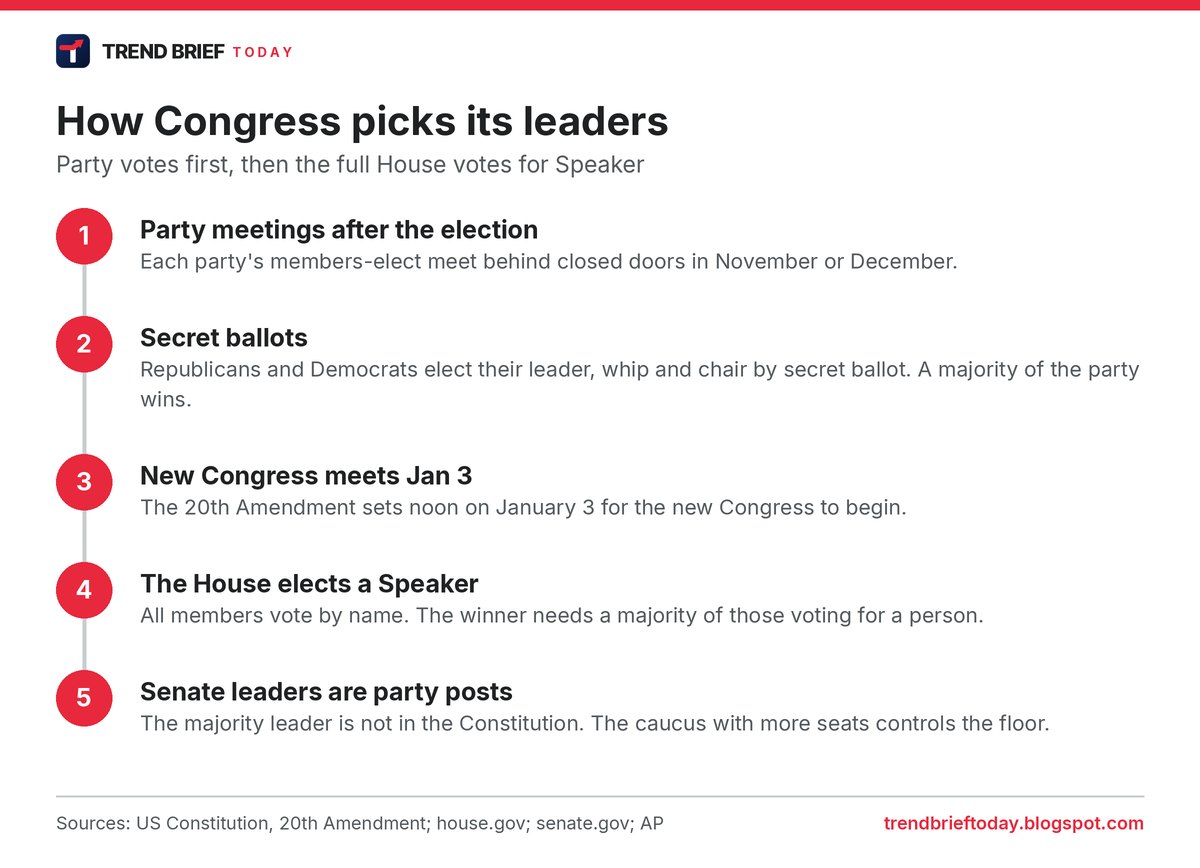
How Congress leadership elections work
There are two kinds of votes, and they are easy to mix up.
- Party votes. After each election, the Republican conference and the Democratic caucus in each chamber meet privately and elect their own leaders, whips and chairs by secret ballot. Only members of that party who will serve in the new Congress vote, and a majority of the party wins.[2][10]
- The Speaker vote. The Constitution says the House chooses its Speaker. On the first day of a new Congress every member votes out loud by name. The winner needs a majority of the votes cast for a named candidate, which is why members voting "present" lowered the bar for Kevin McCarthy on the 15th ballot in January 2023.[15][17]
The Senate majority leader is not mentioned in the Constitution. It is a party job, and the party with more senators controls what comes to the floor.[14] Under the 20th Amendment, the new Congress begins at noon on January 3, so all of these changes take effect then.[15]
What happens next
Until January, Republicans still run both chambers. Thune has pledged longer hours and more votes in the lame-duck session, and Republicans are pushing to confirm as many nominees as possible before they lose the majority.[8][7] In the minority, Thune keeps real influence as long as the Senate's 60-vote rule for most legislation stays in place.[8]
Jordan has said Republicans will play "offense, not defense" in the minority. The AP expects Democrats to open many investigations of the Trump administration, and Jordan has pitched himself as the right person to answer them.[2][1] For the bigger picture of what the new Congress means, see our US midterm results 2026 explainer. Democrats have also said they will return to the Hegseth impeachment articles after January.
Frequently asked questions
Who is the new House minority leader?
Jim Jordan of Ohio. House Republicans elected him on November 10, 2026, by 106 votes to 73 over Steve Scalise. He takes the job when the 120th Congress opens on January 3, 2027.[1][2]
Is Mike Johnson still Speaker?
Yes, until the new Congress meets on January 3, 2027. He said on November 4 that he would not run for Republican leader in the next Congress.[3]
Who will be Speaker of the House in 2027?
The full House votes on January 3, 2027. Democrats will hold the majority, and the AP reports that Hakeem Jeffries is expected to be their nominee after the party votes the week of November 16. Nothing is official until the floor vote.[2]
Who will be Senate majority leader in 2027?
Not decided. Democrats will hold the majority and choose their leader in a caucus vote, expected in December. Chuck Schumer is seeking the job. Bernie Sanders and Elissa Slotkin say they will not back him, and Chris Van Hollen is considering a run.[10][11]
Was John Thune re-elected?
Yes. Senate Republicans kept him as leader without opposition on November 10, after a push to delay the vote failed. He will be minority leader from January.[7][9]
Why are the vote totals unofficial?
Party leadership ballots are secret and neither party publishes a count. The 106-73, 103-76 and 93-57-27 figures come from lawmakers or spokespeople who spoke to reporters.[1][4][6]
More US explainers: California billionaire tax rejected: the Prop 40 results.
References
- "House Republicans elect Rep. Jim Jordan as their next leader following election losses". NBC News. November 10, 2026.
- "House Republicans pick Ohio Rep. Jim Jordan to lead them in the minority". Associated Press (via PBS News). November 10, 2026.
- "Rep. Jim Jordan, Sen. John Thune elected GOP leaders in Congress". CNBC. November 10, 2026.
- "Minnesota Congressman Tom Emmer elected House Minority Whip". KSTP. November 10, 2026.
- "Tom Emmer defeats August Pfluger for No. 2 spot in House GOP minority". Washington Examiner. November 10, 2026.
- "Lisa McClain wins reelection as House Republican Conference chair". The Spokesman-Review. November 10, 2026.
- "Senate Republicans vote to keep Thune as leader after election wipeout". Associated Press (via PBS News). November 10, 2026.
- "US Senate GOP leader Thune reelected for next 2 years even after election losses". States Newsroom. November 10, 2026.
- "Thune reelected as Senate GOP leader after brutal midterm losses". CBS News. November 10, 2026.
- "Bernie Sanders says he won't support Chuck Schumer for Senate majority leader". NBC News. November 10, 2026.
- "Rift grows among Senate Democrats over who will lead in majority". Roll Call. November 10, 2026.
- "Republicans elect Jim Jordan as House minority leader after midterm defeats". The Guardian. November 10, 2026.
- "House Leadership". US House of Representatives. Checked November 11, 2026.
- "Senate Leadership". United States Senate. Checked November 11, 2026.
- "Constitution of the United States", Article I, Section 2 and the Twentieth Amendment. Congress.gov.
- "Jordan and Scalise face off for House GOP leader after midterms defeat". ABC News. November 10, 2026.
- "Speaker of the United States House of Representatives". Wikipedia.
- "US Midterm Results 2026 Explained". Trend Brief Today. November 2026.