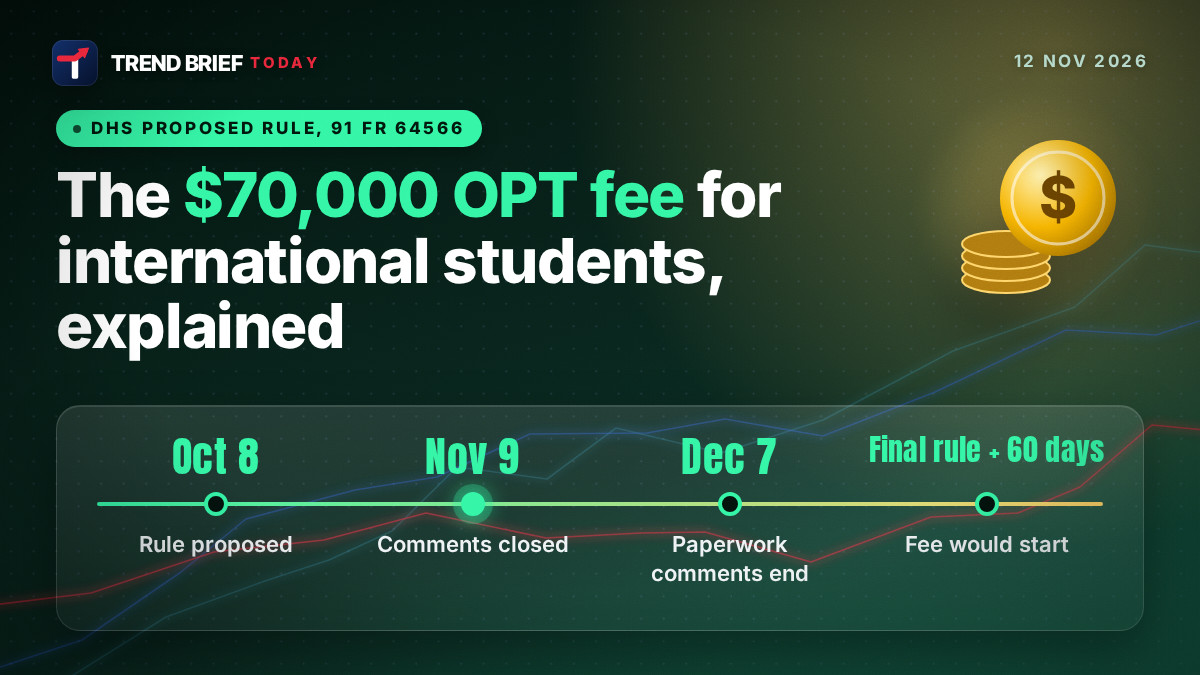
The Department of Homeland Security has proposed that US colleges pay $70,000 for each international student they recommend for Optional Practical Training (OPT), plus $30,000 for every later round of OPT, such as the 24-month STEM extension. That second fee is why some reports say $70,000 and others say $100,000: a STEM graduate who uses both would cost the school $100,000 in total. The fee is not in force. Public comments closed on November 9, 2026, and under the draft it would only apply to OPT recommendations dated 60 days or more after DHS publishes a final rule. Here is what the rule text says, who would pay, and what students on F-1 visas should do now.
 | |
| Rule | "Optional Practical Training Fees", notice of proposed rulemaking[1] |
|---|---|
| Citation | 91 FR 64566, FR Doc. 2026-20660, RIN 1653-AB01[1] |
| Docket | ICEB-2026-0100[1][6] |
| Published | October 8, 2026[1][5] |
| Initial fee | $70,000 per student[1][2] |
| Later OPT | $30,000 each, including a STEM extension[1][5] |
| Who pays DHS | The school (SEVP-certified institution)[1][3] |
| Comments | Closed November 9, 2026 (about 9,000)[2][6] |
| Start | 60 days after a final rule (no date yet)[1] |
What DHS has proposed
The proposal was published in the Federal Register on October 8, 2026, signed by Homeland Security Secretary Markwayne Mullin.[1][2] It would add a new paragraph to the regulation that already holds the SEVIS fee, 8 CFR 214.13, setting two OPT fees for F-1 students:[1]
- $70,000, one time, the first time a school recommends a student for OPT.
- $30,000 before any later OPT recommendation for a student whose $70,000 fee has already been paid.
The money has to be paid before the school's designated school official (DSO) enters the OPT recommendation in SEVIS, and USCIS would not grant the work permit until the fee is paid.[1] A school can ask for a refund case by case, but only if the student has not yet received the employment authorization document (EAD). Once the EAD is issued, the fee is not refundable "under any circumstances", and refund decisions cannot be appealed.[1]
The fees would not fund the student visa program. The rule says they would go into the US Treasury as a miscellaneous receipt and that ICE could not keep them, a point the American Council on Education (ACE) also stresses in its response.[1][3]
$70,000 or $100,000: which is right?
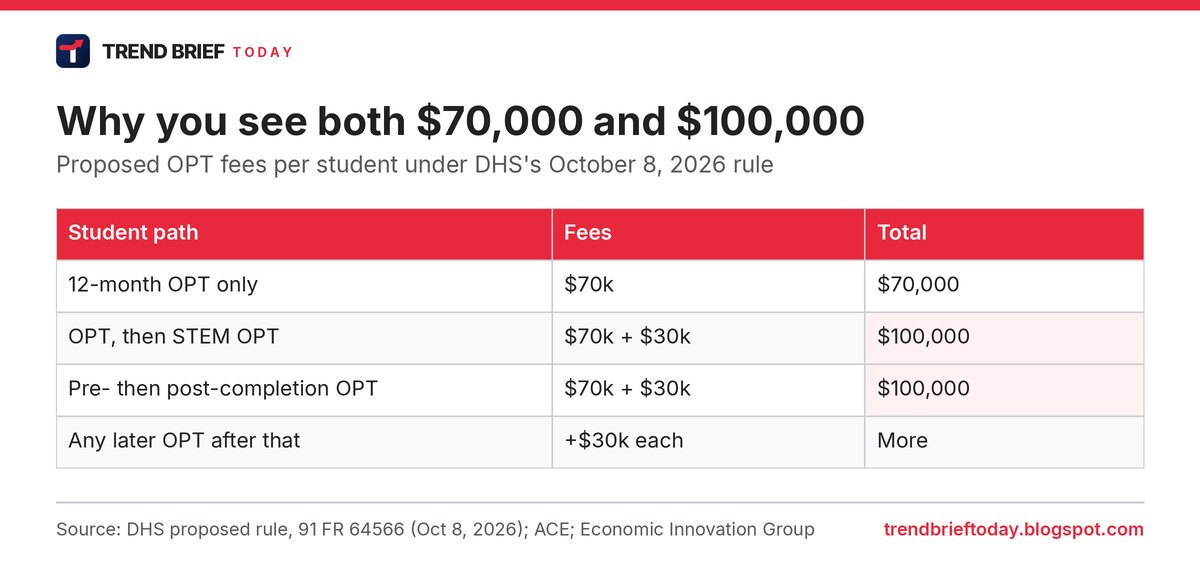
Both, depending on the student. The rule's own summary lists "$70,000 for initial OPT; and $30,000 for any subsequent OPT".[1] A student on a non-STEM degree normally gets one 12-month OPT period, so the school would pay $70,000. A STEM graduate who goes on to the 24-month STEM OPT extension needs a second recommendation, which adds $30,000. DHS's own analysis compares "paying $70,000 for only a single year" with "paying $100,000 for up to three years with STEM OPT eligibility".[1] ACE, the Economic Innovation Group and the Presidents' Alliance on Higher Education and Immigration all describe the same $70,000 plus $30,000 structure.[3][4][5]
The same $100,000 total applies to a student who uses pre-completion OPT while studying and then post-completion OPT after graduating. DHS expects many schools would avoid that split and use only post-completion OPT, paying $70,000 for 12 months instead of $100,000.[1] The $100,000 headline is also easy to mix up with separate H-1B fee plans. Inside Higher Ed notes DHS previously proposed a $100,000 fee for H-1B workers, and an August 2026 DHS proposal would set a $103,265 fee on H-1B cap petitions.[2][8]
Who would actually pay
On paper, the school. The proposed text says an "SEVP-certified educational institution must pay" each fee.[1] In practice the rule leaves the door open to passing the cost on: DHS writes that schools "may mitigate their budgetary impact by passing the financial obligation of this proposed fee onto F-1 nonimmigrant students, all students, or employers", and that DSOs are not required to recommend a student for OPT at all.[1]
Colleges say neither route works. In comments summarized by Inside Higher Ed, institutions argued students and employers could not afford the charge and that making them pay would create a "pay-to-play" system where only wealthier international students get job training.[2] ACE and 36 other higher education groups asked DHS to withdraw the rule completely.[3]
How many students use OPT
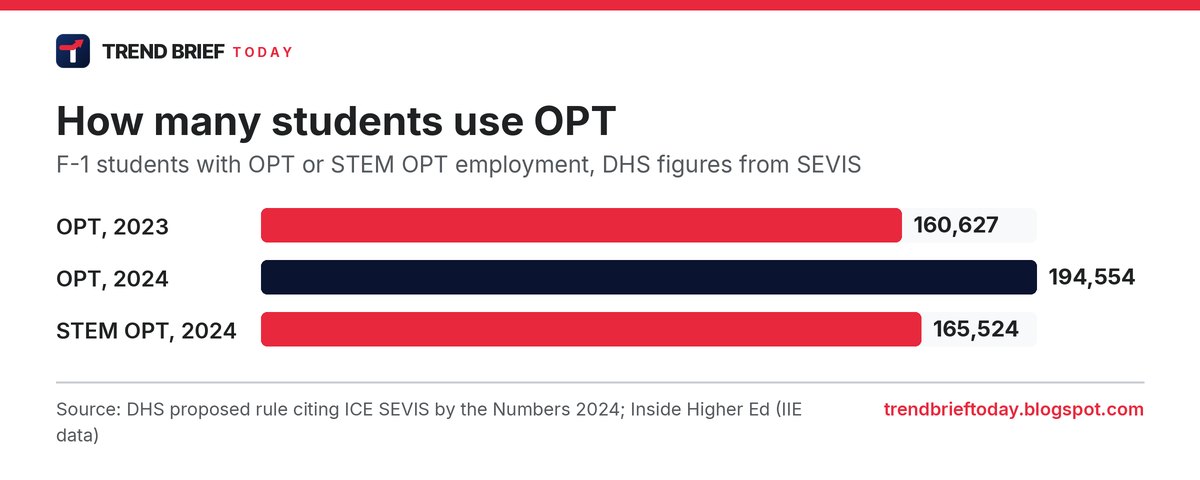
OPT lets F-1 students work in their field for up to 12 months, and STEM graduates can add 24 more months.[1] DHS says 194,554 F-1 students were granted OPT work permits and reported working for an employer in 2024, up from 160,627 in 2023, and that 165,524 more were on STEM OPT in 2024, citing ICE's SEVIS by the Numbers report.[1] Using Institute of International Education data, Inside Higher Ed puts the number on OPT at about 294,000, nearly double the roughly 147,000 of 2015-16 and about a quarter of all F-1 holders.[7] The counts differ because they measure different things, but both show a program that has grown fast.
DHS estimates the fees would bring in between $8.4 billion and $16.5 billion a year, with a central estimate of $12.4 billion, depending on how many students schools still sponsor.[1] For the 22 Association of American Universities members whose comments it reviewed, Inside Higher Ed estimated about $2.1 billion a year, from $13 million at the low end to more than $100 million at eight universities.[2]
Why DHS says it needs the fee
The rule frames the fee as a fraud and worker-protection measure. DHS says OPT growth has "exponentially outpaced" the number of employers it can review and investigate, and points to schemes in which students claim to work at companies that do not exist.[1][2] It also cites the payroll tax point: F-1 students on OPT are generally exempt from Social Security and Medicare (FICA) taxes for their first five calendar years, which critics say gives employers a reason to hire them over US graduates.[1] DHS argues a high fee would make schools more selective about whom they recommend.[1]
Opponents dispute that logic. EIG's comment letter says the fee would sharply cut OPT participation and harm American workers and universities "without meaningfully addressing fraud or national security concerns".[4] The Presidents' Alliance questions DHS's legal authority and how the fee amounts were set, and says several implementation questions are unresolved.[5]
When could it start?
| Date | Step |
|---|---|
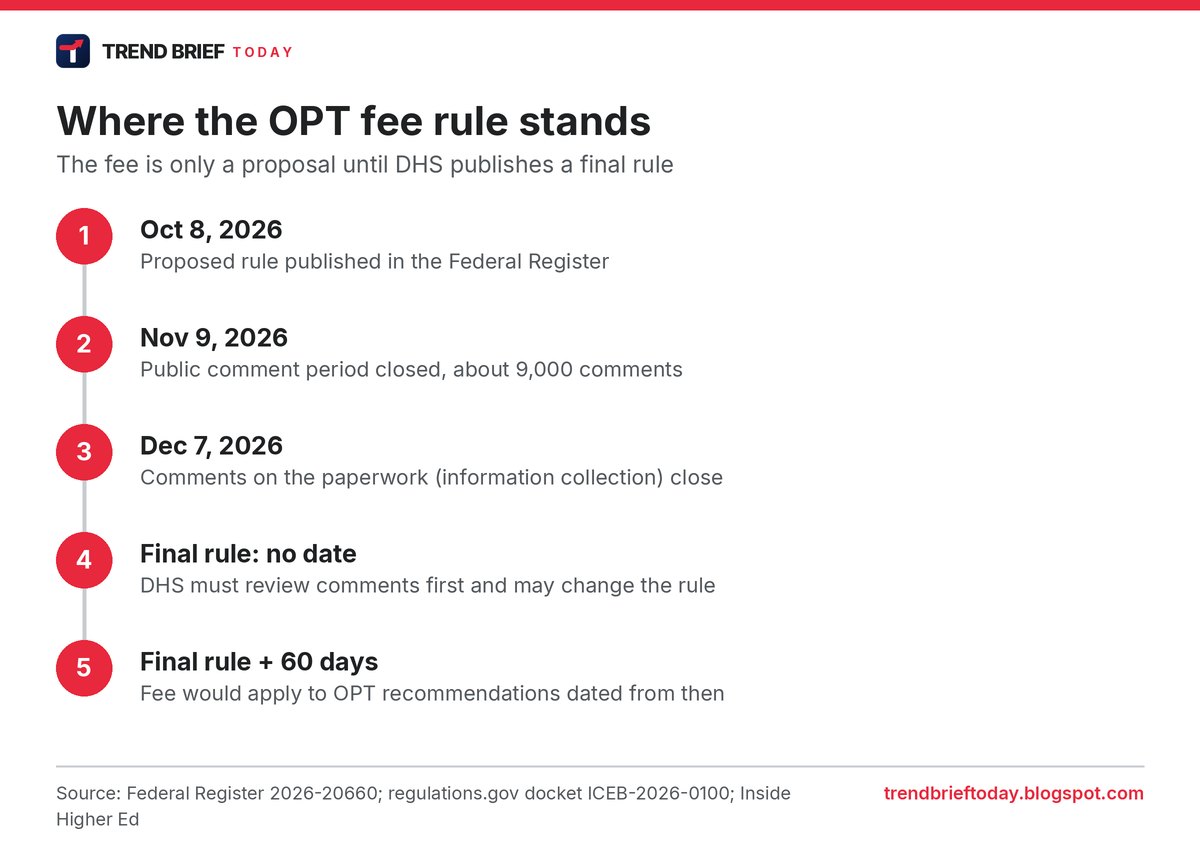
| October 8, 2026 | Proposed rule published (91 FR 64566)[1] |
| November 9, 2026 | Public comment period closed[1][2] |
| November 12, 2026 | 8,947 comments posted on the regulations.gov docket[6] |
| December 7, 2026 | Comments on the information collection (paperwork) close[1] |
| Not set | Final rule, after DHS reviews comments[1] |
| Final rule + 60 days | Fee applies to DSO recommendations dated on or after this day[1] |
DHS has not said when a final rule will come, and it can change the amounts or drop the rule after reading the comments.[1][5]
What students on F-1 should do now
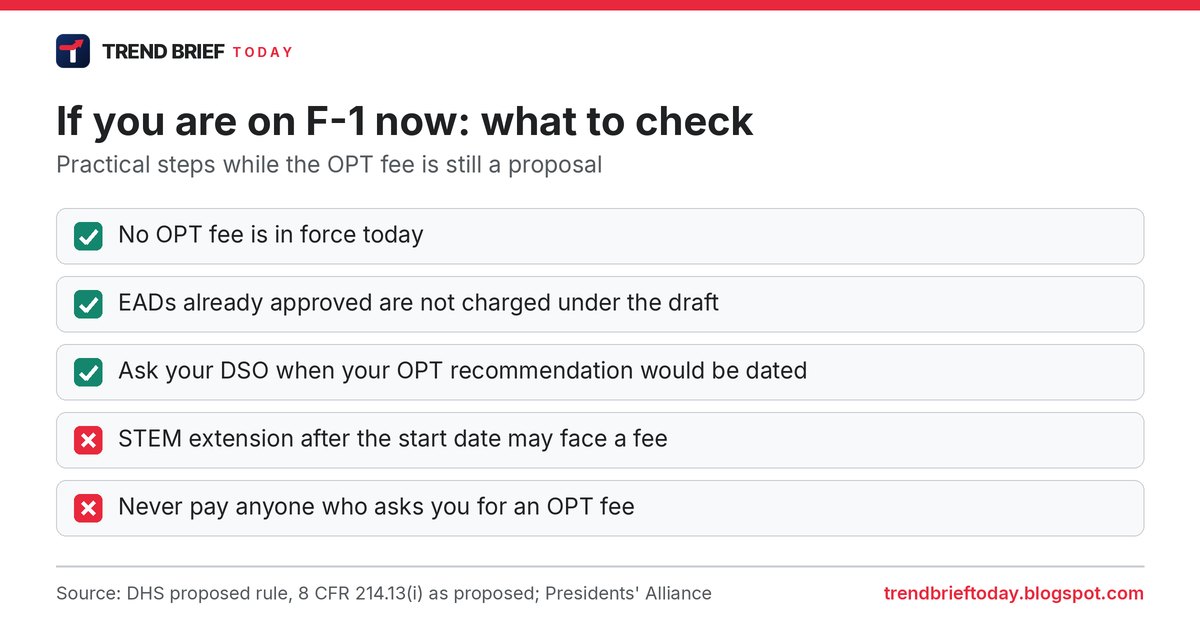
Nothing is charged today. The transition clause ties the fee to the date on the DSO's OPT recommendation: only recommendations dated on or after 60 days past the final rule would need it. DHS says this protects students who applied before the effective date.[1]
The open question is a student who started OPT before the rule and then needs a STEM extension after it starts. The draft charges $30,000 only where the $70,000 fee "has been paid", and it says schools must pay $70,000 for each student whose recommendation is dated after the start date, so as written the first post-rule recommendation looks like it would carry the larger fee. DHS has not published guidance on this case, so treat it as unsettled and ask your DSO.[1][5]
Practical steps: keep your OPT and STEM OPT paperwork on schedule, ask your international office how it plans to handle the fee if it becomes final, and watch the Federal Register docket. Because the school pays DHS directly, a message asking you to pay an "OPT fee" to an individual is a scam warning sign.[1]
Frequently asked questions
Is the $70,000 OPT fee in effect?
No. It is a proposed rule. Comments closed on November 9, 2026, and the fee would only apply 60 days after a final rule is published.[1][2]
Is the OPT fee $70,000 or $100,000?
$70,000 for the first OPT and $30,000 for each later one. A STEM student using OPT plus the 24-month extension would cost $100,000 in total.[1][3]
Do students pay the OPT fee?
The rule makes the school pay DHS, but DHS says schools could pass the cost on to students or employers.[1][2]
Does the fee affect people already on OPT?
Not for OPT already recommended or approved before the start date. A later STEM extension recommended after the start date is not clearly addressed in the draft.[1][5]
Can the fee be refunded?
Only before the student's EAD is issued, at SEVP's discretion. After that it is not refundable.[1]
Where does the money go?
To the US Treasury as a miscellaneous receipt, not to ICE or the student visa program.[1][3]
References
- "Optional Practical Training Fees" (proposed rule), 91 FR 64566, FR Doc. 2026-20660. US Department of Homeland Security, Federal Register. October 8, 2026. federalregister.gov
- "Colleges Say OPT Fee Would Cost Tens of Millions". Inside Higher Ed. November 11, 2026. insidehighered.com
- "ACE, Others Call on DHS to Withdraw Proposed OPT Fee Increase". American Council on Education. November 9, 2026. acenet.edu
- "EIG Letter: DHS Should Rescind Proposed $70,000 OPT Fee". Economic Innovation Group. November 10, 2026. eig.org
- "Presidents' Alliance Submits Comments on DHS's OPT Fee Proposed Rule". Presidents' Alliance on Higher Education and Immigration. November 9, 2026. presidentsalliance.org
- Docket ICEB-2026-0100, public comments (count read November 12, 2026). Regulations.gov. regulations.gov
- "What OPT Is and How It Affects the Economy in 6 Charts". Inside Higher Ed. October 23, 2026. insidehighered.com
- "Fee for Certain H-1B Petitions" (proposed rule), 91 FR 54817. US Department of Homeland Security, Federal Register. August 25, 2026. federalregister.gov