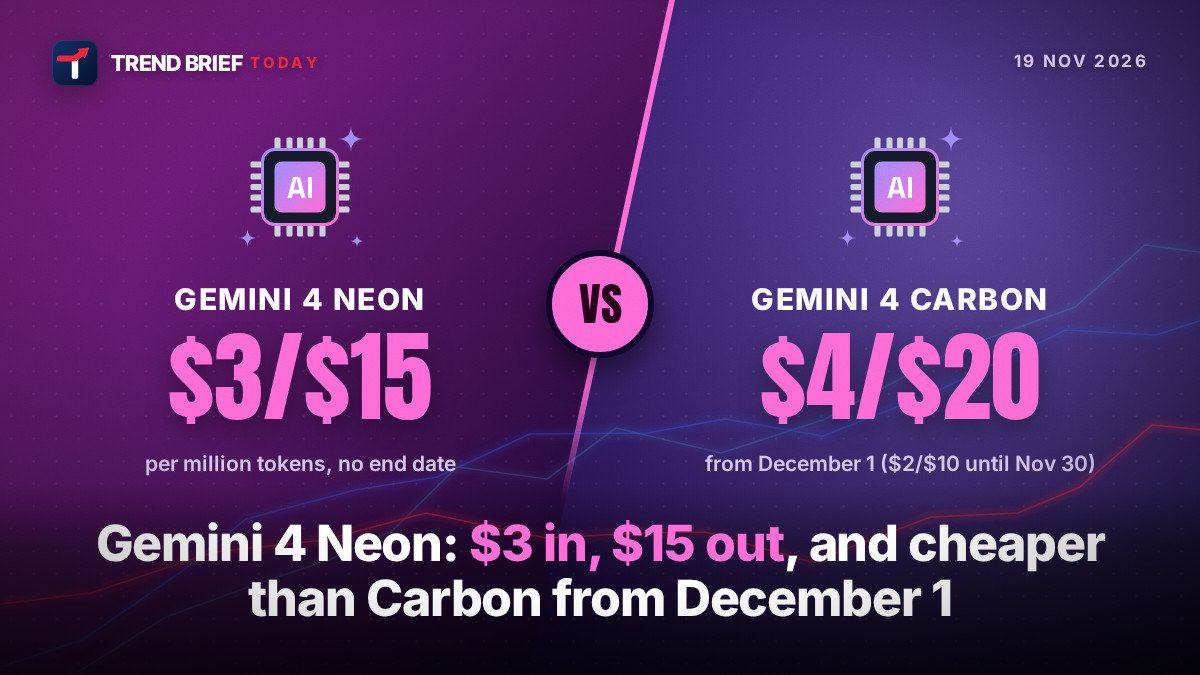
Gemini 4 Neon is Google's newest AI model, released on November 18, 2026, and it sits between the heavyweight Gemini 4 Carbon and the cheap, fast Gemini 4 Hydrogen.[1][3] Developers pay $3 per million input tokens and $15 per million output tokens, and in the Gemini app it is open to Google AI Pro subscribers as well as Ultra.[1][2] The odd part is the timing: for the rest of November Neon costs more per token than Carbon, but on December 1 Carbon's price doubles and Neon becomes the cheaper of the two without changing a cent.[2][7]
 | |
| Made by | Google DeepMind[1] |
|---|---|
| Released | November 18, 2026[1] |
| Position | Between Carbon (deepest reasoning) and Hydrogen (fast, everyday)[1][3] |
| API price | $3 input, $15 output per million tokens; cached input $0.15[2] |
| Free tier | No[2] |
| Context window | 1 million tokens[1] |
| Thinking levels | Low, medium, high (default), xhigh[1][7] |
| Gemini app | Google AI Pro and Ultra subscribers[1][3] |
| Announced by | Koray Kavukcuoglu, SVP, Google DeepMind[1] |
What is Gemini 4 Neon?
Google has been naming its Gemini 4 models after chemical elements, and the names tell you very little, so here is the short version. Carbon is the one Google points at its hardest, longest problems. Hydrogen is the quick, cheap model that now runs a lot of everyday Gemini work. Neon is the middle child: Google's own blog calls it "frontier-level intelligence with fast end-to-end task completion" for software engineering, knowledge work and science.[1]
In the announcement Google sums up the split this way: Carbon "tackles your hardest, long-horizon projects", Hydrogen "handles fast everyday execution", and Neon "balances depth and efficiency".[1] Interesting Engineering reports Google's claim that Neon matched or beat Carbon's quality in early internal tests while finishing tasks three times faster.[4] That is a vendor claim, not something an outside lab has repeated yet.
It is also the fourth Gemini 4 model in about five weeks, which is a fast pace even by the standards of this year's AI race.
| Model | Wider release | Standard API price per million tokens (input / output) |
|---|---|---|
| Gemini 4 Argon | October 13, 2026 | $2 / $10 until November 30, then $4 / $20[2] |
| Gemini 4 Carbon | November 10, 2026 | $2 / $10 until November 30, then $4 / $20[2] |
| Gemini 4 Hydrogen | November 12, 2026 | $1.50 / $7.50, with a free tier[2] |
| Gemini 4 Neon | November 18, 2026 | $3 / $15, no end date, no free tier[1][2] |
Release dates for Argon, Carbon and Hydrogen come from our earlier explainers, linked above; prices are from Google's pricing page as it read on the morning of November 19.[2]
How much does Gemini 4 Neon cost?
On the standard paid tier, Neon costs $3 for every million tokens you send it and $15 for every million it writes back, and Google counts thinking tokens as output.[2] Cached input, meaning text the model has already seen in a recent request, drops to $0.15 per million, a 95% discount. Google only does this caching automatically on Gemini 4; you cannot set it up yourself.[1][2]
There are cheaper and dearer ways to call it. Google's pricing page lists these tiers for Neon:[2]
| Tier | Input per million tokens | Output per million tokens |
|---|---|---|
| Standard | $3.00 (cached $0.15) | $15.00 |
| Batch or Flex | $1.50 (cached $0.075) | $7.50 |
| Priority | $5.40 (cached $0.27) | $27.00 |
Batch and Flex run at half price, so a batch job on Neon costs exactly what Hydrogen costs on the standard tier. Priority is 1.8 times the standard rate. Searches the model runs through Google Search grounding are billed on top: 5,000 a month are free across Gemini 3 and newer models, then $14 per 1,000.[2]
The December 1 price twist
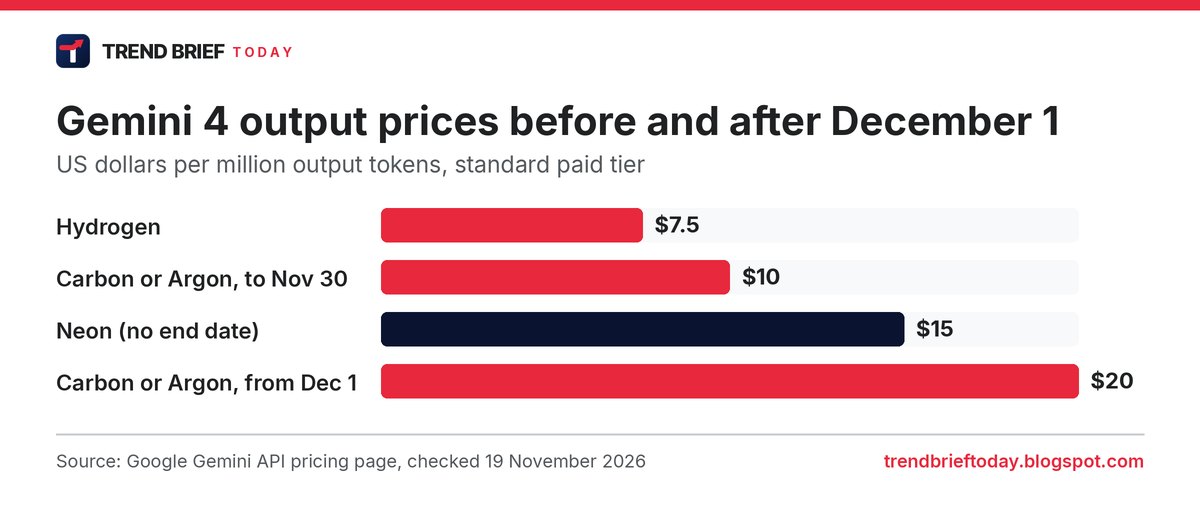
This is the part most launch stories skipped. Carbon and Argon are on an introductory price of $2 and $10 that ends on November 30. From December 1 both go to $4 and $20, which is a straight doubling.[2] Neon's $3 and $15 has no end date on Google's page.
Put those side by side and the order flips. Until November 30, Neon is 50% more expensive per token than Carbon. From December 1, it is 25% cheaper. OrcaRouter, a company that resells model access and so watches these price lists closely, makes the same point: Neon's rate card is the only Gemini 4 one that does not move in December.[7]
To make that concrete we priced one made-up but realistic workload: an app or coding agent that runs 1,000 tasks a month, each sending 200,000 tokens of code and documents and getting 20,000 tokens back. We used the same token count for every model, which is the simplest fair test of the price list alone.
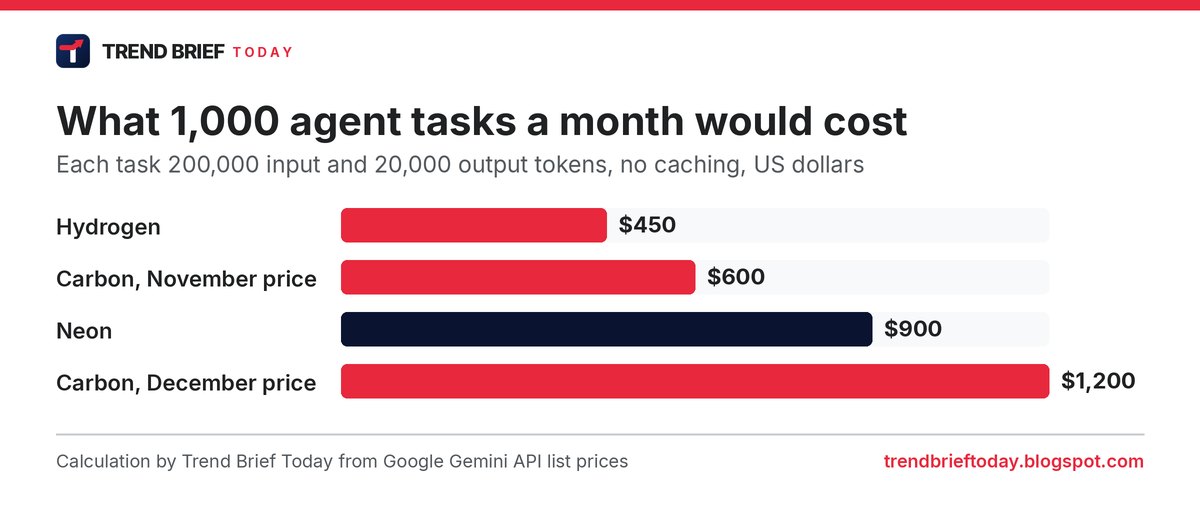
On those numbers Neon costs $900 a month, against $600 for Carbon today and $1,200 for Carbon from December. Hydrogen does the same token volume for $450.[2] If 80% of the input is cached, which is common when an agent keeps re-reading the same files, the bills fall to roughly $444 for Neon, $296 for Carbon now, $592 for Carbon in December and $222 for Hydrogen. The ranking does not change; the gaps just shrink.
So if you are signing off a budget that runs into 2027, compare Neon against Carbon's December price, not its November one. Anyone testing Carbon this month on the cheap rate should expect the bill to double on the first of the month.
Is Neon really 32% cheaper per task than Carbon?
Google says Neon, at its default high thinking level, has "a 32% lower cost per task than Carbon", and 50% to 80% lower cost per task than top rival frontier models on two leaderboards.[1] Per-task cost depends on two things: the price per token and how many tokens the model burns to finish. Google gave neither the token counts nor which Carbon price it used.
That second gap matters a lot, so we worked it backwards.
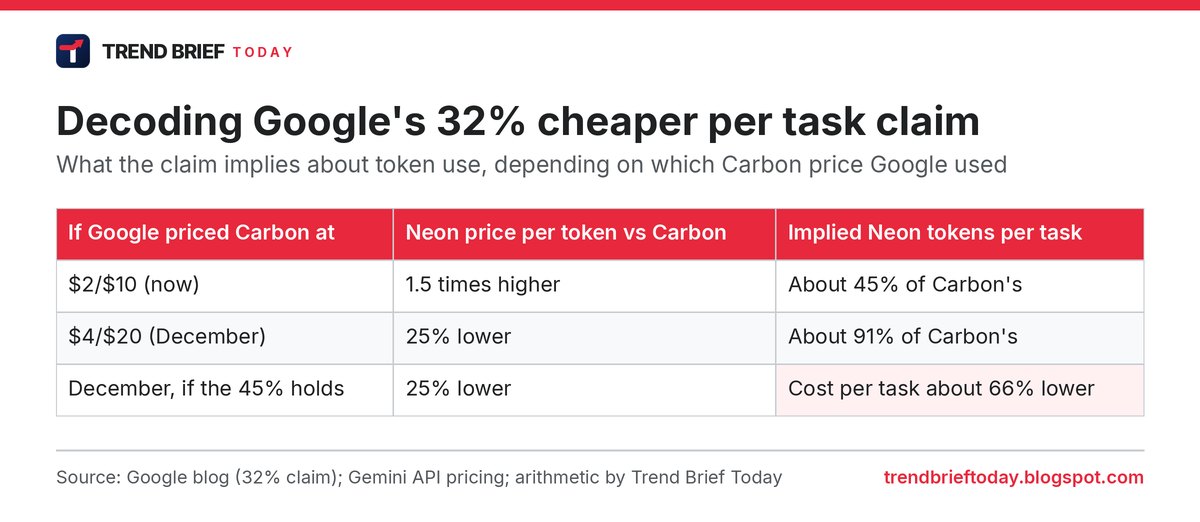
If Google priced Carbon at today's $2 and $10, Neon's tokens cost 1.5 times as much, so for Neon to come out 32% cheaper overall it would need to use only about 45% of the tokens Carbon uses for the same job (0.68 divided by 1.5). If Google used Carbon's December price, Neon's tokens are already 25% cheaper, and the claim only needs Neon to use about 91% of Carbon's tokens.
The first reading is the interesting one. If Neon really finishes jobs on under half of Carbon's tokens, then once Carbon's price doubles the saving per task grows to about 66%, roughly a third of Carbon's cost. That fits Google's separate claim that Neon finishes three times faster, since fewer tokens usually means less time.[4] But it is a big if. OrcaRouter notes that Neon's token use is not disclosed anywhere in the announcement and calls the 32% figure "a vendor figure about a vendor benchmark".[7] Our advice is the boring one: run a week of your own traffic through both and look at the bill.
Gemini 4 Neon benchmarks: what Google claims
Google's blog post is packed with scores. We split them by who did the measuring, because a third-party leaderboard is worth more than a lab's own test.[1][7]
| Test | Neon result (Google's report) | Who runs the test |
|---|---|---|
| Artificial Analysis Intelligence Index | 61, third overall, at xhigh | Artificial Analysis (independent)[1] |
| Artificial Analysis Coding Agent Index | 58.6, first overall | Artificial Analysis (independent)[1] |
| Vals Index | 70.9%, second | Vals AI (independent)[1] |
| Agent Arena Index | 1336, second, from 4,200+ real agent sessions | Arena (independent)[1] |
| Zapier AutomationBench | 56.3%, first | Zapier[1] |
| Vending-Bench 2 | $16,843 simulated business profit, first | Andon Labs[1] |
| Terminal-Bench 4.1 | 65.2% | Reported by Google[1] |
| SWE-sweep | 12.8% on a basic harness, 39.0% inside Google Antigravity | Reported by Google[1] |
Two things stand out. First, the headline 61 on the Intelligence Index is a score at the extra-effort xhigh setting, not the default, and OrcaRouter says Artificial Analysis had not yet published its own Neon page when it checked on November 19, so for now that number is Google citing Artificial Analysis.[7] Second, the SWE-sweep result triples from 12.8% to 39.0% just by running inside Google's own Antigravity coding tool.[1] That says as much about the tool wrapped around the model as about the model, which is worth remembering if you plan to call Neon from your own code rather than through Antigravity.
VentureBeat's headline put Neon's coding at the level of Anthropic's Claude Opus 5.5 for less money,[8] and Android Authority notes Google is pitching Neon directly against Anthropic and OpenAI models.[3] If you are comparing vendors, our GPT-6.2 Astra and Sol pricing guide has OpenAI's newest rates.
Who can use Gemini 4 Neon?
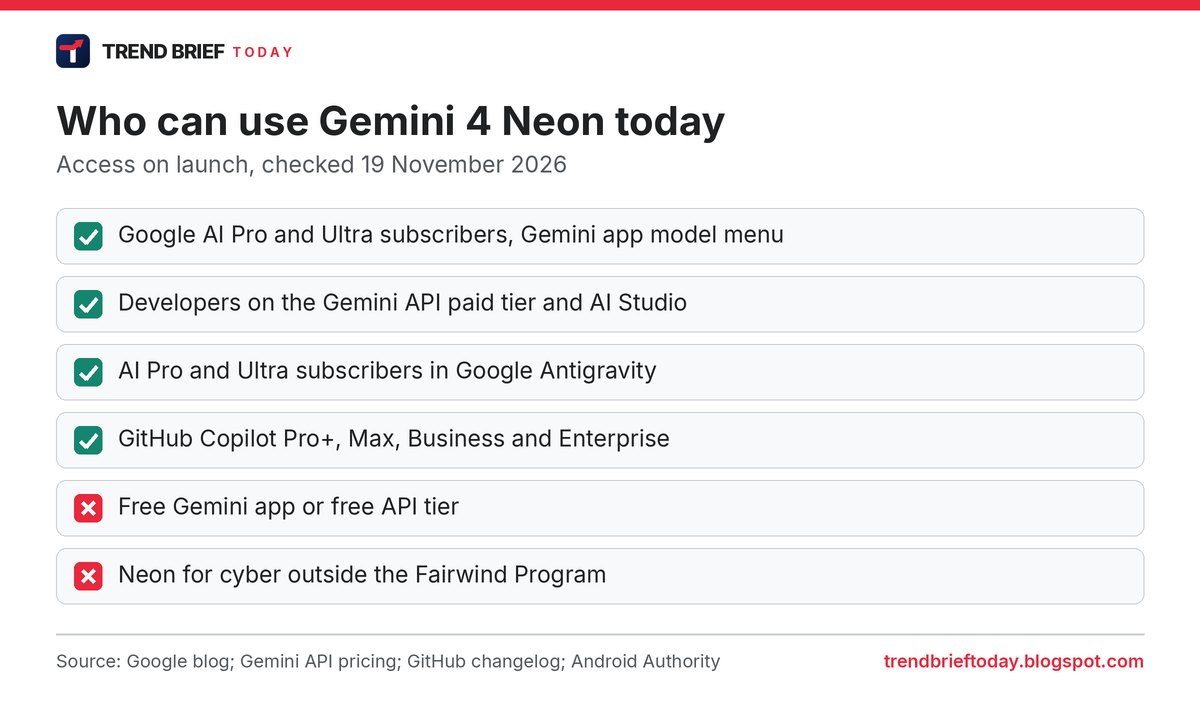
The biggest change for ordinary users is access. Carbon in the Gemini app is still limited to AI Ultra, Google's top plan. Neon is open to AI Pro subscribers too, and you pick it from the model menu in the app.[1][3] iPhone in Canada adds that Neon can also run Tasks in Gemini, the feature that works through multi-step jobs for you, though using Neon for those still needs Pro or Ultra.[5] If you are on the free plan, you do not get Neon.
Developers can call it through the Gemini API paid tier in Google AI Studio and Android Studio, and businesses through Gemini for business. AI Pro and Ultra subscribers can also use it in Google Antigravity.[1] GitHub added Neon to Copilot on launch day for Copilot Pro+, Max, Business and Enterprise users, billed at Google's list price, and says the rollout is gradual.[6]
Neon for cyber and the safety numbers
Google is also releasing a security version, "Gemini 4 Neon for cyber", to vetted defenders through its Fairwind Program over the coming days. Google says it scored 90.5% on SEC-bench Pro for finding code flaws and 76% on the hard tier of AutoBaxBench for writing secure code.[1][4] Nobody outside that program can test those claims yet.[7]
On safety, Google says Neon refused only 1.98% of tasks on Terminal-Bench 4.0, took shortcuts on 2.45% of tasks in its coding cheating test (the lowest of any Gemini 4 model) and passed 99.2% of its agent honesty checks.[1] These are Google's internal tests. For background on why labs now report numbers like this, see our piece on Google's report of a fully automated AI cyberattack.
Should you switch to Neon?
For someone paying for AI Pro and using the Gemini app, the answer is easy: try it. It costs you nothing extra and it is the strongest model your plan unlocks.[1][3] Google suggests it for jobs like reading a pile of billing statements to work out why a utility charge jumped, which is a fair test you can run on your own paperwork.[1][5]
For developers it is a budget question. Here is how we would think about it:
- If you are on Carbon now and staying past November 30, test Neon this month. At December prices it is 25% cheaper per token before any token savings.[2]
- If most of your work is simple and high volume, Hydrogen at half Neon's price is still the obvious pick, and it is the only Gemini 4 model with a free tier.[2]
- Do not default to xhigh. OrcaRouter quotes Google's own documentation warning that xhigh "can cause overthinking" on simple prompts, and every extra thinking token is billed as output at $15 per million.[2][7]
- Use Batch for anything that can wait. It halves the bill to $1.50 and $7.50.[2]
Frequently asked questions
When was Gemini 4 Neon released?
On November 18, 2026. It is rolling out in the Gemini app, the Gemini API and Google Antigravity.[1]
How much does Gemini 4 Neon cost?
$3 per million input tokens and $15 per million output tokens on the standard API tier, $0.15 for cached input, and half that on Batch or Flex.[2]
Is Gemini 4 Neon free?
No. There is no free API tier and no access on the free Gemini app plan. You need Google AI Pro or Ultra, or a paid API key.[1][2]
Is Gemini 4 Neon better than Carbon?
Google says it matches Carbon on quality in its internal tests while finishing three times faster, but it still recommends Carbon for the hardest long-running problems.[1][4]
Is Gemini 4 Neon cheaper than Carbon?
Not until December. Neon is $3 and $15, Carbon is $2 and $10 until November 30, then $4 and $20.[2]
Can I use Gemini 4 Neon in GitHub Copilot?
Yes, on Copilot Pro+, Max, Business and Enterprise, with a gradual rollout from November 18.[6]
More AI guides: Gemini 4 Carbon, Gemini 4 Hydrogen and GPT-6.2 Astra and Sol.
References
- Koray Kavukcuoglu, "Introducing Gemini 4 Neon", Google (The Keyword), November 18, 2026.
- Google AI for Developers, "Gemini Developer API pricing", Google, accessed November 19, 2026.
- Stephen Schenck, "Gemini 4 Neon is ready to get some work done for AI Pro power users", Android Authority, November 18, 2026.
- Neetika Walter, "Gemini 4 Neon targets complex coding, research with 3x faster task completion", Interesting Engineering, November 18, 2026.
- "Google's Gemini 4 Neon Is Here. Who Gets to Use It?", iPhone in Canada, November 18, 2026.
- "Gemini 4 Neon in GitHub Copilot", GitHub Changelog, November 18, 2026.
- "Gemini 4 Neon Is Here, and It Costs More Per Token Than the Flagship It Was Measured Against", OrcaRouter blog (an AI model reseller), November 19, 2026.
- "Google launches Gemini 4 Neon with Opus 5.5-level coding performance at 25% lower API token prices", VentureBeat, November 18, 2026 (headline).