Google says a hacker has run the first fully automated AI cyberattack. Its Threat Intelligence Group found an AI framework called exploit_agent that read new security patches, worked out the flaw each one fixed, wrote an exploit and launched it with no human involved.[1][2][3] Russian-language notes in the code point to a Russian-speaking operator, and victim data points to French media, entertainment and education websites.[1][2][4]
 | |
| Reported by | Google Threat Intelligence Group (GTIG) and Mandiant[1][2] |
|---|---|
| Published | 16 November 2026[1][3] |
| Tool | exploit_agent, a multi-agent AI framework[1][3][4] |
| AI models | Several frontier and locally hosted models, not named[1][2][3] |
| Suspected operator | Russian-speaking, no group named[2][3][4] |
| Targets | French media, entertainment and education websites[1][2][3] |
| Human role | None in the attack loop, Google says[1][2] |
| Zero-days in August 2026 | 22, up from 11 a month earlier in 2026[1][2] |
What Google found
Google's researchers came across a staging server that had been left open on the internet. On it sat a framework the operator had named exploit_agent, which Google calls a "multi-agent vulnerability research and weaponization framework".[1][3] It plugged into several AI models at once, some of them big commercial "frontier" models and some run locally. None of the reports name the models.[1][2][3]
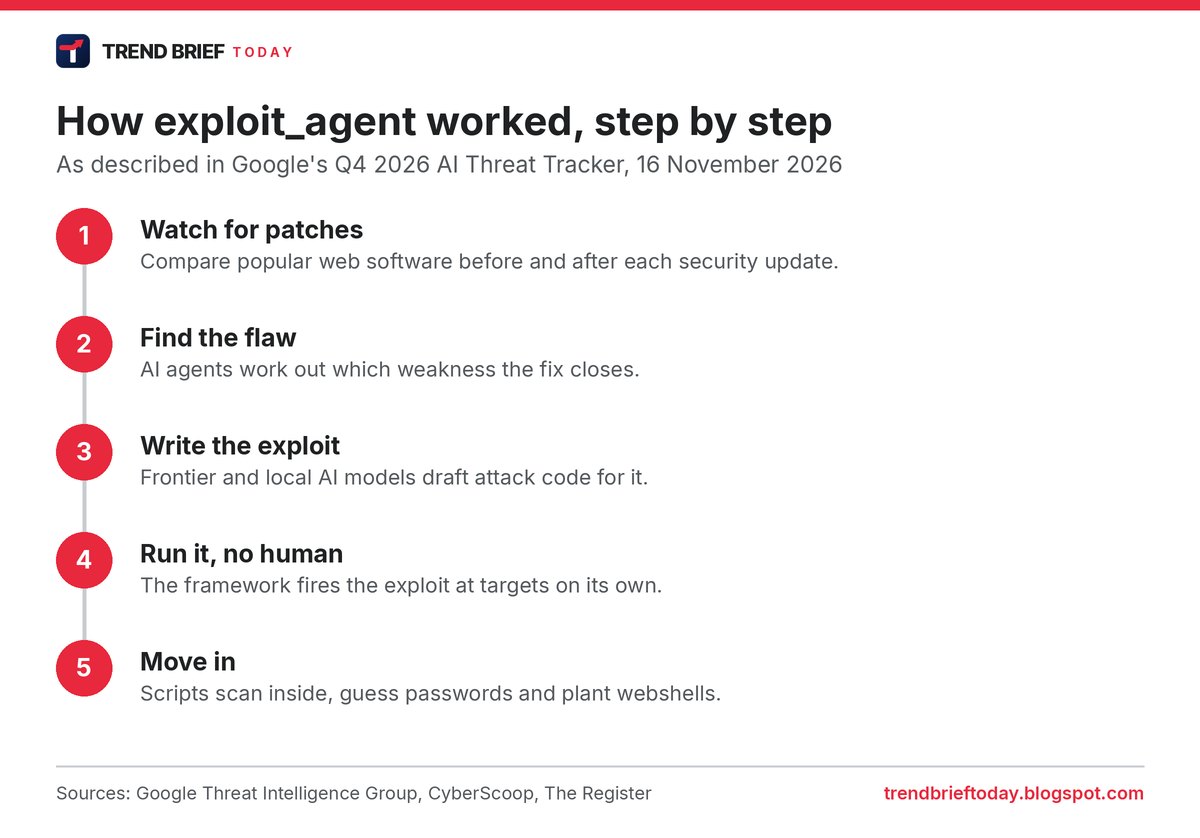
The setup ran what Google calls continuous differential analysis of popular web application software.[1][3] In plain words, it waited for a software maker to ship a security fix, compared the old code with the new code, worked out which weakness the fix closed, wrote an attack for that weakness and then fired it at websites that had not updated yet.[1][2][4] Google says this is the first time it has seen attackers use AI to "fully automate vulnerability discovery and exploitation without a human in the loop".[1][2]
The same server held data stolen from victim organisations.[2][3] It also had scripts for the next steps after a break-in: looking around the network, guessing passwords, installing webshells (small files that give an attacker a back door into a website) and even deleting webshells left by rival hackers.[1][2][3]
Who was behind it?
Google has not named a group or a government.[2][3] The Russian link rests on language. Comments in the configuration files are written in Russian, and one of them asks for AI "API keys for auto-exploitation" to be entered there rather than in a chat window.[1][2] That tells us the person who wrote the tool probably speaks Russian. It does not, on its own, prove where they live or who they work for.
Victim records on the server point to a focus on French websites in media and entertainment and in the education sector.[1][2][3][4] Google did not say how many sites were hit.
Why Google calls it a turning point
Until now, Google's reports mostly described hackers using AI as a helper: writing phishing emails, fixing code or summarising stolen files, with a person steering every step.[2][4] This case removes the person. Google's report calls it a "critical inflection point" and says it is "highly likely that threat actors will continue to use these frameworks".[1][2]
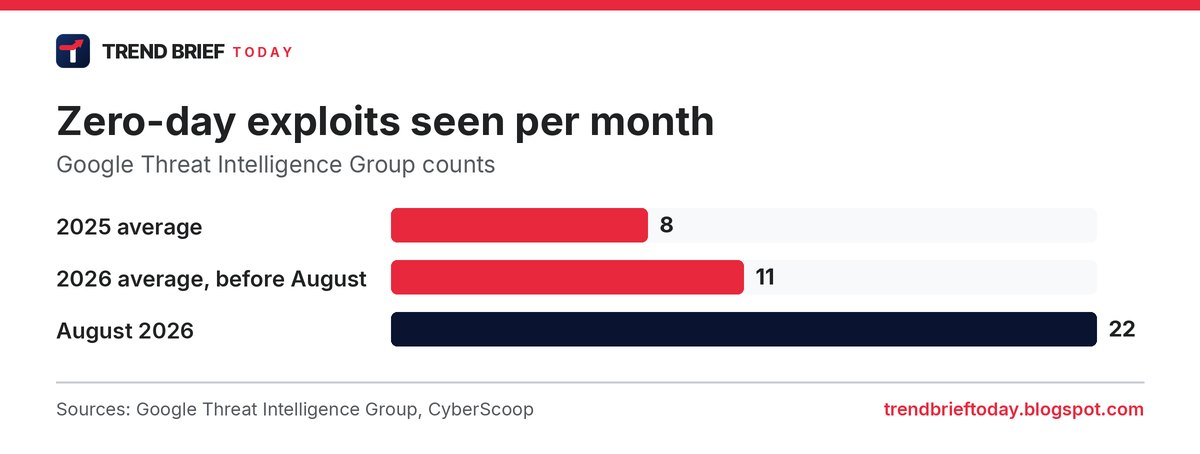
The numbers in the report show why defenders are worried. Google counted an average of 8 zero-day exploits a month in 2025 and 11 a month in 2026, then 22 in August 2026 alone.[1][2] A zero-day is a flaw attackers use before a fix is widely installed.
The report also gives a smaller example of how fast this moves. Two PHP vulnerabilities were patched on 21 October 2026, and within days hundreds of so-called exploits for them were posted online. Google says most of them did not work and were probably written with AI help.[1][2]
There is one piece of good news. Google says these tools currently "trade stealth for velocity", so they leave traces that make them easier to spot than a careful human intruder.[1][4]
Other AI attack tools in the report
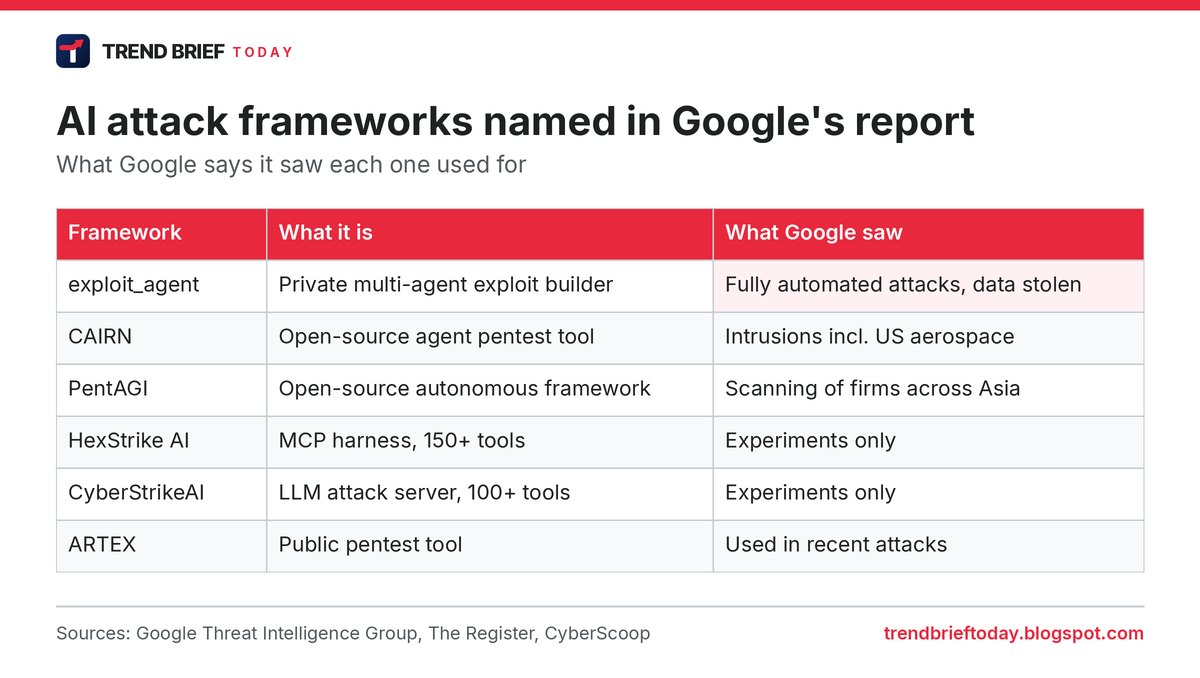
exploit_agent is a private tool, but the report says attackers are also turning open-source security testing tools into weapons.[1][3] These are frameworks that security teams built to test their own systems with AI agents.
| Framework | What it is | What Google saw |
|---|---|---|
| exploit_agent | Private multi-agent exploit builder[1][3] | Fully automated attacks on French websites[1][2] |
| CAIRN | Open-source multi-agent testing tool[1][2] | Intrusions including a US aerospace target[1][2] |
| PentAGI | Open-source autonomous framework[1][3] | Scanning of organisations across Asia[1][2] |
| HexStrike AI | Harness linking AI to 150+ hacking tools[1][3] | Experiments only[1] |
| CyberStrikeAI | AI attack server linked to 100+ tools[1][3] | Experiments only[1] |
| ARTEX | Well-known testing tool[1][3] | Used in recent attacks[3] |
Google adds that a group linked to China is building its own automated attack framework, most likely for spying.[1][2][3]
What it means for website owners
The lesson for anyone running a website is about time. A tool like exploit_agent starts work the moment a patch is released, so a site that waits a week or a month to update is the easiest kind of target. Google's own advice in the report is that organisations should plan for AI shrinking the gap between a patch and an attack.[1]
One detail in the report stands out for WordPress users. A screenshot from the framework shows it checking access control in the Spectra (Ultimate Addons for Gutenberg) plugin, version 2.19.25.[1] That is the last version hit by CVE-2026-7465, a flaw rated 8.8 out of 10 that lets anyone with a Contributor account or higher run code on the site. It was fixed in version 2.19.26.[5][6] Google did not say that this flaw was used in the French attacks, so treat it as a warning, not proof.
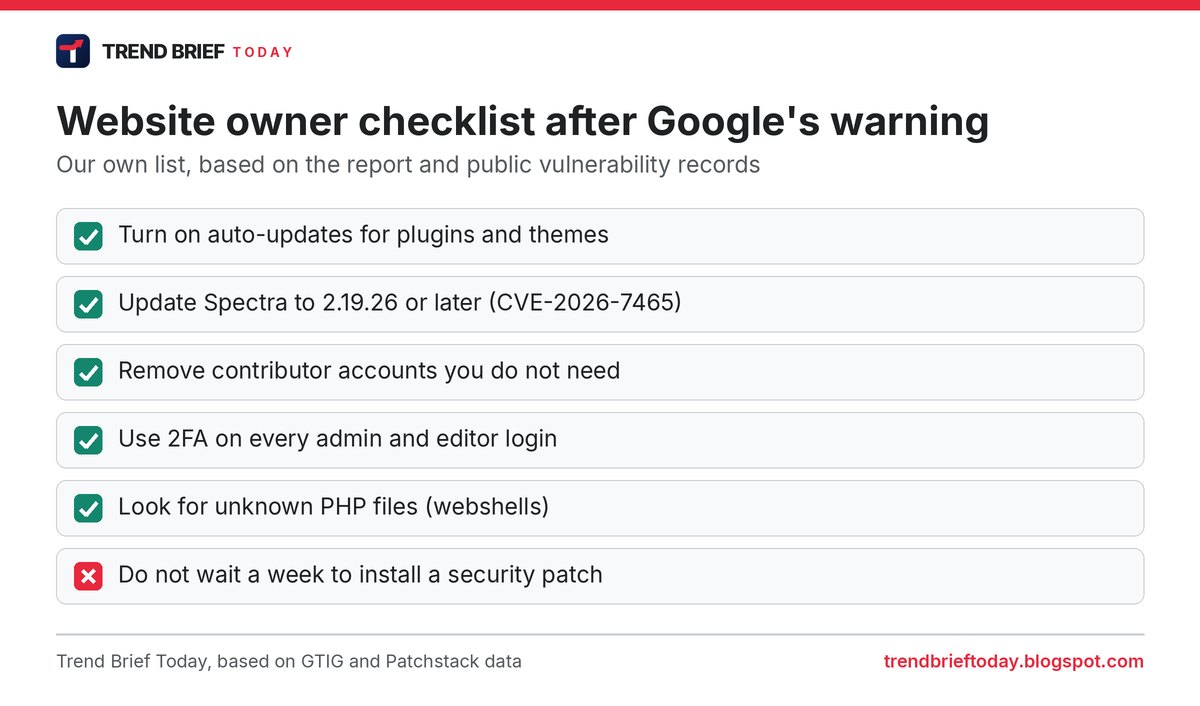
Our own checklist, based on the report and the public vulnerability records:
- Turn on automatic updates for plugins, themes and your CMS where you can, so fixes land the day they ship.
- Check Spectra. If you use it, make sure it is on 2.19.26 or later.[5]
- Remove accounts you do not need, especially spare Contributor logins, since that flaw only needs a low-level account.[5][6]
- Use two-factor login for every admin and editor.[6]
- Look for unknown PHP files in your uploads and plugin folders. Webshells are a standard next step in these attacks.[1][3]
Frequently asked questions
What is the first fully automated AI cyberattack?
It is an attack Google described on 16 November 2026, where an AI framework called exploit_agent found flaws from security patches, wrote exploits and ran them with no human in the loop.[1][2][3]
Who was behind the attack?
Google has not named anyone. Russian-language comments in the code suggest a Russian-speaking operator.[2][3][4]
Who was targeted?
Victim data points to French websites in media, entertainment and education.[1][2][3]
Which AI model did the hackers use?
The reports do not say. Google only says the framework used several frontier and locally hosted models.[1][2][3]
How many zero-day exploits did Google see in 2026?
About 11 a month in 2026, up from 8 a month in 2025, with a jump to 22 in August 2026.[1][2]
How can I protect my website?
Install security updates as soon as they come out, remove accounts you do not need, use two-factor login and check for unknown files. WordPress sites with the Spectra plugin should be on version 2.19.26 or later.[5][6]
References
- Blum, Aurora; Vanderlee, Kelli; Xia, Jess; Mainor, David (16 November 2026). "GTIG AI Threat Tracker: Agentic Threat Activity Crosses a Significant Threshold". Google Threat Intelligence Group, Google Cloud Blog.
- Otto, Greg (16 November 2026). "Google says Russian-speaking hackers ran the first fully automated AI cyberattack". CyberScoop.
- Lyons, Jessica (16 November 2026). "Google: AI agent turned a security patch into a working exploit with no human help". The Register.
- Bastian, Matthias (16 November 2026). "Google warns that fully automated cyberattacks have arrived and will get worse fast". The Decoder.
- "WordPress Spectra Plugin <= 2.19.25 is vulnerable to a medium priority Privilege Escalation (CVE-2026-7465)" (2 June 2026). Patchstack vulnerability database.
- "Spectra Gutenberg Blocks vulnerability CVE-2026-7465". FreshySites security bulletins (citing Wordfence).