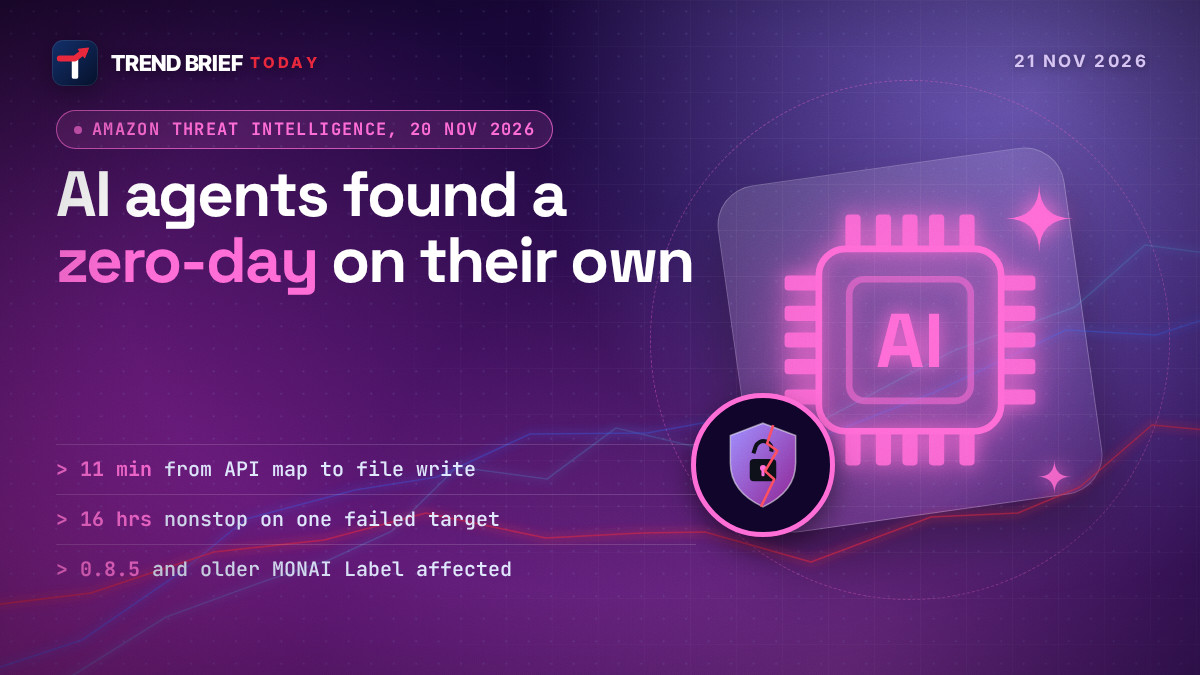
Cairn is a free, open-source AI penetration-testing tool, and Amazon says hackers have now used it to find and exploit a brand-new security flaw with almost no human help.[1][2] A suspected China-linked operator gave a team of Cairn AI agents one goal, "obtain shell access", and the agents found a zero-day in MONAI Label, an open-source medical imaging AI app, in about 11 minutes and later took root control of a university server.[1][3][4] The bug is fixed in MONAI Label's code, but at our check the latest version on PyPI was still the affected 0.8.5, so anyone running it should apply the workarounds below.[5][6][7]
 | |
| Tool | Cairn, open-source autonomous AI pentest framework[1][3] |
|---|---|
| Attacker | Suspected China-nexus actor (moderate confidence)[1][2] |
| Targets | Universities in East Asia outside mainland China[1][3] |
| Campaign dates | About 48 hours from 8 September 2026[1][2] |
| Zero-day in | MONAI Label, medical imaging AI app[2][4] |
| Flaw type | Path traversal, arbitrary file write[1][5] |
| Affected | monailabel 0.8.5 and older[5] |
| Advisory | GHSA-qc22-rmgc-vg94, critical, no CVE yet[4][5] |
| Reported by | Amazon Threat Intelligence, 20 November 2026[1][3] |
What happened
On 10 September 2026, Amazon Threat Intelligence found a server running a copy of Cairn with no password on it. Because the operator had left it open, Amazon could read the whole history of the project: the settings, the prompts typed by the attacker and the output of the AI agents.[1][3] Amazon published what it saw on 20 November in a post on the AWS Security Blog, and CJ Moses, the chief information security officer of Amazon Integrated Security, described it to reporters.[1][3][4]
The records show a campaign of about 48 hours starting on 8 September, aimed at IP addresses belonging to universities in East Asia outside mainland China.[1][2] The operator handed the agents a list of targets and variations of a single instruction, "obtain shell access", which means getting a foothold that lets you run commands on a machine.[1][3] From there, Amazon says, "the AI agents planned, executed, and adjusted their approach as they learned, without the operator choosing each next step".[1][3]
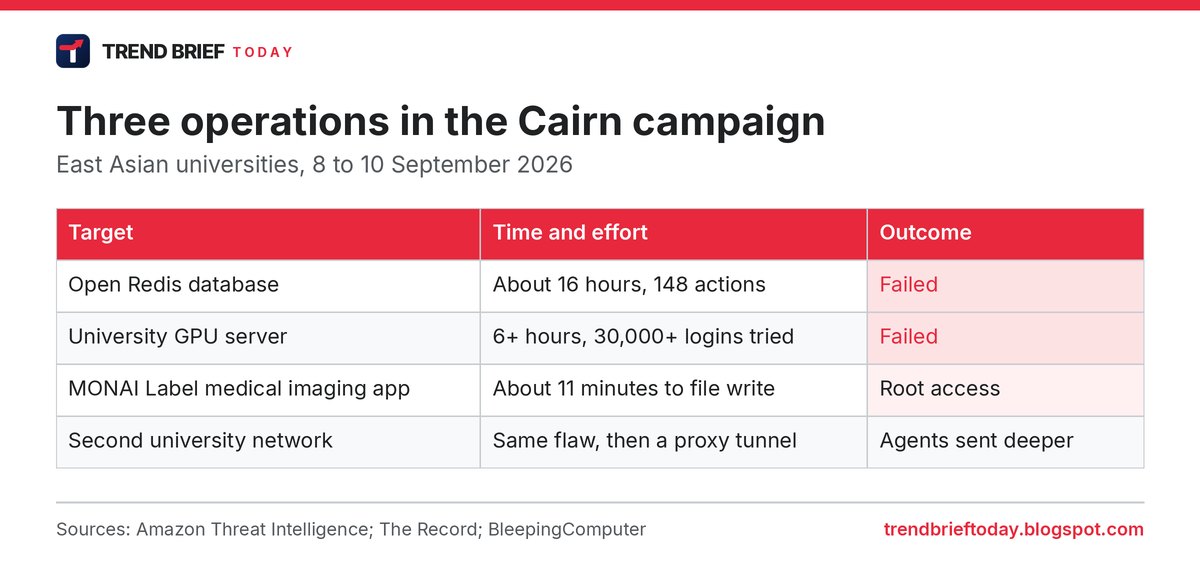
Most of the campaign failed. One operation spent about 16 hours and 148 actions trying to take over an open Redis database, including a Log4Shell attempt, and got nowhere.[1][3] Another spent more than six hours trying over 30,000 username and password combinations, built from about 80 real usernames found on the university's public web pages, without finding a working login.[1][2][3]
How the AI agents found the zero-day
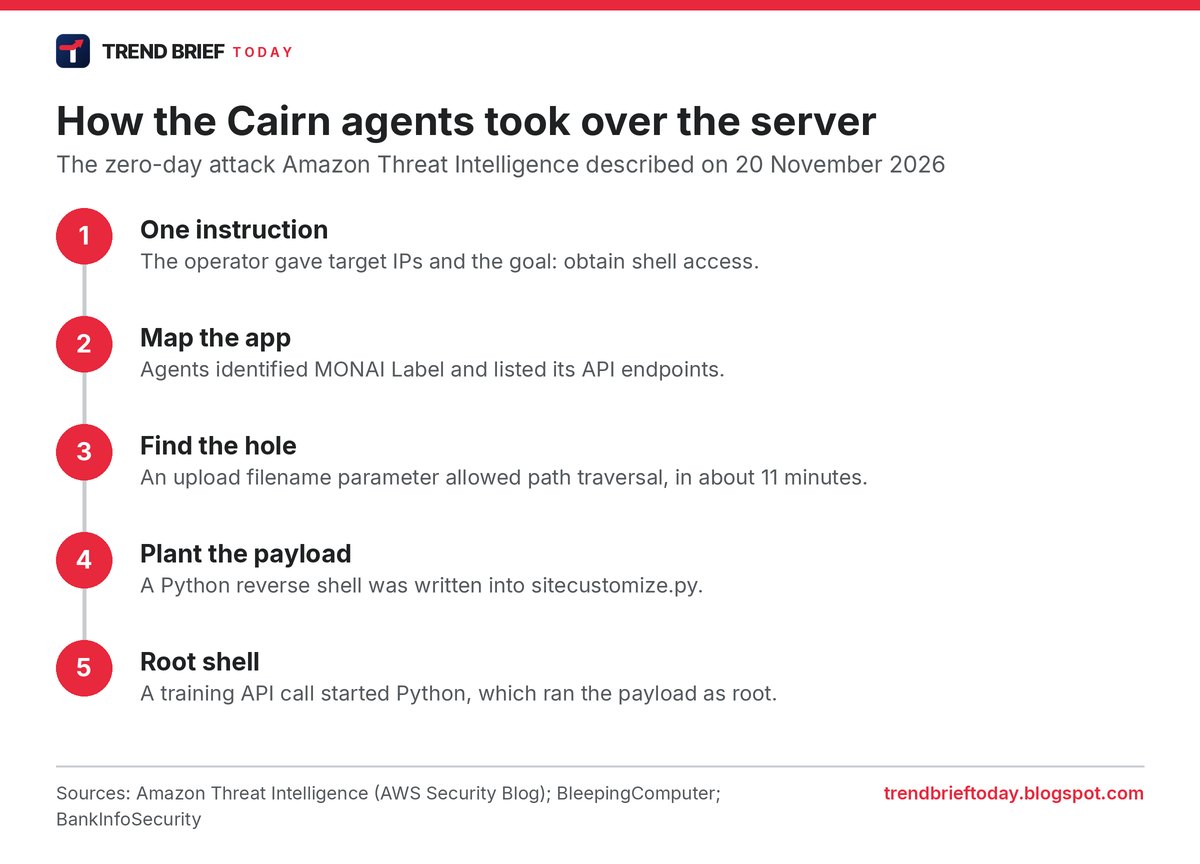
The one success came against a server running MONAI Label, an open-source tool researchers use to label medical images with AI help.[2][4] The agents worked out what software it was, listed its API endpoints and spotted an upload endpoint that took a filename. They tested that filename for path traversal, a trick where you add ../ to a name to escape the folder the file is meant to land in. It worked. Amazon says it took about 11 minutes to go from mapping the API to writing files anywhere on the server.[1][2][4]
In a later session the agents turned that into full control. They wrote a Python reverse shell into sitecustomize.py, a file Python loads automatically every time it starts, then called a training endpoint so the app launched a new Python process. That process ran the payload and opened a shell running as root.[1][4]
Amazon says it has "high confidence" this was a true zero-day, because there was no fix, issue, advisory or prior mention of it anywhere when it was found.[1][3] The operator then stepped in: after the discovery, they gave the agents a proxy into a second university network running the same software and told them to go after other machines there.[1][2][4]
What is Cairn?
Cairn is not a piece of malware. It is an open-source framework built to help defenders test their own systems, and Amazon describes it as "a research and problem-solving engine for defenders".[1][4] You give it a starting point and a goal in plain language, and it coordinates several AI agents to find a way there. Moses says that same ease of use is what makes it attractive to attackers.[1][3]
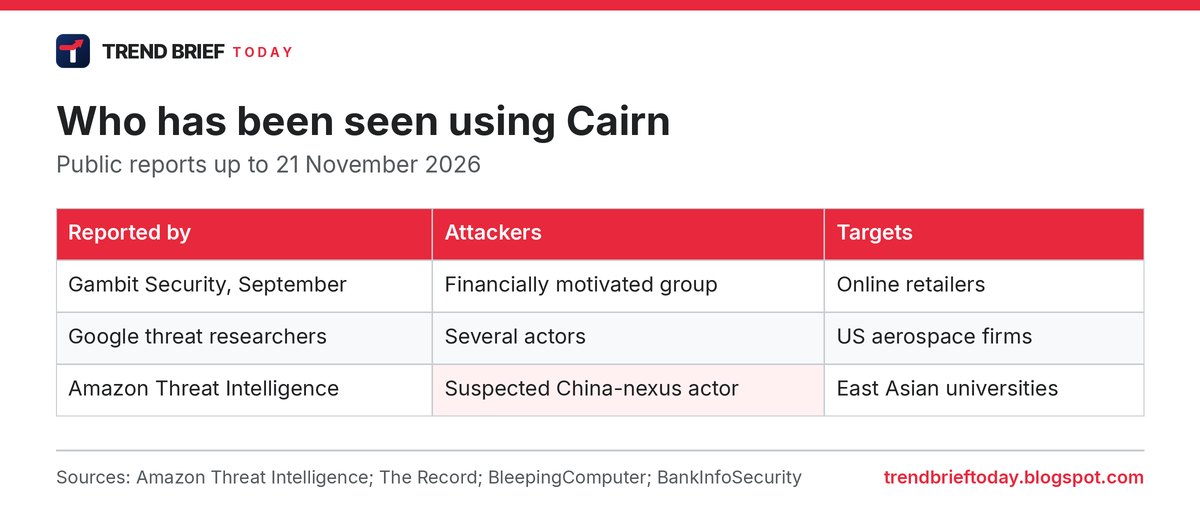
It is spreading. Gambit Security first documented a financially motivated group using Cairn against online retailers in September, and Google's threat researchers reported this week that they had seen it in intrusions at US aerospace companies.[1][2][3] Eyal Sela of Gambit told The Record that Cairn matters more than better-known tools such as Artex because it is general purpose, and "when a tool is more generic, it is less predictable".[3]
Amazon declined to tell BankInfoSecurity which AI models the attacker plugged into Cairn, and declined to tell The Record which universities were hit or which country they are in.[3][4]
Who is behind it?
Amazon attributes the campaign to a China-nexus threat actor with moderate confidence, not high confidence.[1][2] Its reasons are that the prompts were written in Simplified Chinese, the timestamps in the attack scripts were set to China Standard Time, and the targets were universities likely to be of strategic interest to China.[1][3][4] No group name has been given.
The victims were not AWS customers, so Amazon had no direct way to warn them. It says it worked with a government partner to notify the organisations instead.[1][3]
Is MONAI Label fixed? What we found
Here the reports and the record do not line up neatly, so we checked GitHub and PyPI ourselves at 09:44 GMT.
The fix itself exists. A pull request titled "fix: confine datastore write paths" was merged into MONAI Label on 19 October 2026, and the project published a security advisory, GHSA-qc22-rmgc-vg94, on 18 November.[5][6] The advisory rates the bug critical and lists the Python package monailabel at version 0.8.5 and older as affected, with no patched version named.[5] It says plainly that "the fix will be included in the next MONAI Label release".[5]
The latest release on PyPI, the place pip install monailabel pulls from, was still 0.8.5, uploaded on 25 November 2024.[7] BankInfoSecurity reports that the project is still asking for a CVE number.[4] So if you installed MONAI Label the normal way, you are almost certainly running a version with this hole, even though the code fix is public.[5][7]
The advisory also explains why it is so dangerous. The upload endpoint, PUT /datastore/image, used the caller's image name without checking it, and the label endpoint had the same problem. Authentication is switched off by default, so "any network client that can reach the server can exploit this".[5]
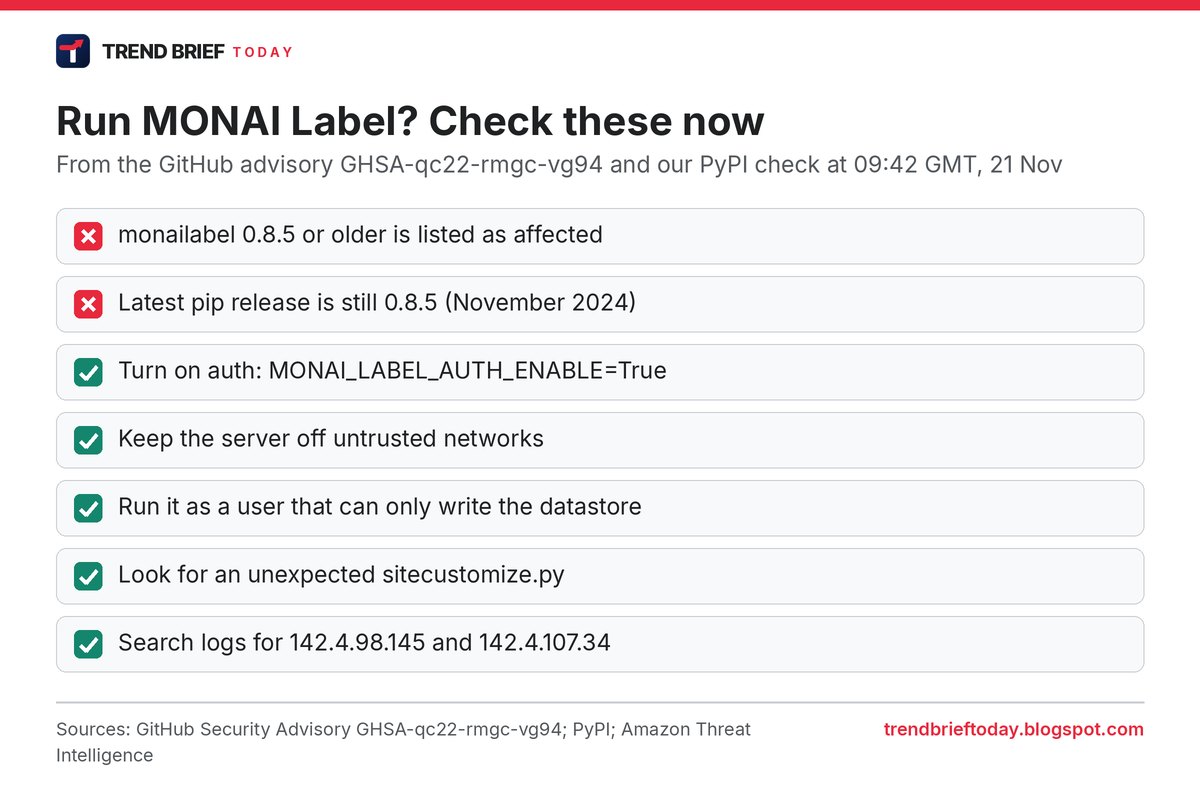
What to do if you run MONAI Label
These steps come from the advisory's own workarounds and from the indicators Amazon published.[1][5]
- Turn on authentication. Set
MONAI_LABEL_AUTH_ENABLE=Trueand do not give the ANNOTATOR role to anyone you do not trust, because that role is enough to use the flaw.[5] - Take it off open networks. Do not expose a MONAI Label server to the internet or to untrusted networks.[5]
- Limit what it can write. Run the server as an ordinary user that can only write to its datastore folder, not as root.[5]
- Look for the payload. The attack used
sitecustomize.py, so a file of that name you did not create in your Python environment is a red flag.[1][4] - Check your logs. Amazon lists two IP addresses seen between 8 and 10 September 2026: 142.4.98.145 and 142.4.107.34.[1][2]
- Upgrade when you can. Watch for a release newer than 0.8.5, or build from the project's main branch, which includes pull request 1915.[5][6][7]
Why it matters beyond one app
The striking number is not the 11 minutes. It is the 16 hours. Moses notes that the agents that failed against the Redis server "ran continuously for 16 hours without breaks, sleep, or working-hour constraints".[1][3] An agent that finds and uses a zero-day in minutes "completes its activity faster than many security operations centers can manually triage an alert", he says.[1][4]
Amazon's advice to companies is to lean on high-confidence detections that trigger an automatic response, "with humans overseeing outcomes rather than reviewing every individual action".[1][4] For anyone running niche open-source tools on a reachable server, the practical lesson is simpler: AI agents can now probe obscure software that human attackers might never have bothered to read. Patching widely used servers fast still matters too, as the public exploit for the NGINX HTTP/2 vulnerability showed this month.
| Date (2026) | Event |
|---|---|
| September | Gambit Security reports Cairn used against online retailers[1][3] |
| 8 September | Roughly 48-hour campaign on East Asian universities begins[1][2] |
| 10 September | Amazon finds the attacker's open Cairn server[1][3] |
| 19 October | Fix merged into MONAI Label's code (pull request 1915)[6] |
| 18 November | MONAI Label advisory GHSA-qc22-rmgc-vg94 published[2][5] |
| 20 November | Amazon publishes its findings[1][3] |
| 21 November | Latest PyPI release still 0.8.5 at our check[7] |
Frequently asked questions
What is the Cairn AI tool?
An open-source framework that coordinates several AI agents to reach a goal given in plain language. It was built for security testing and defence, but attackers have started using it.[1][3]
Did AI really find a zero-day on its own?
Amazon says yes: the agents found and exploited the MONAI Label flaw while working toward the operator's goal, without the operator choosing each step. A human still picked the targets and later directed the agents into a second network.[1][3]
Which version of MONAI Label is affected?
The advisory lists monailabel 0.8.5 and older. No newer release was on PyPI when we checked at 09:44 GMT on 21 November.[5][7]
Was Amazon or AWS hacked?
No. Amazon found the attacker's server and reported what it saw. The victims were universities that were not AWS customers.[1][3]
Is MONAI itself affected?
The bug was first reported against the main MONAI project, but the advisory says the affected code is in MONAI Label, the separate labelling server.[5]
References
- Amazon Threat Intelligence, AWS Security Blog, Chinese-nexus actor's Cairn AI agents found a zero-day on their own, 20 November 2026.
- BleepingComputer (Bill Toulas), Hackers use autonomous AI tool Cairn to find zero-day, take over server, 20 November 2026.
- The Record from Recorded Future News (Jonathan Greig), Amazon says Chinese hackers used Cairn AI tool to discover apparent zero-day during attack on university, 20 November 2026.
- BankInfoSecurity (Tiffany Wang), Hackers Use Cairn to Hack Medical Imaging Application, 20 November 2026.
- Project MONAI on GitHub, GHSA-qc22-rmgc-vg94: Path traversal in datastore upload endpoints allows arbitrary file write, published 18 November 2026, rated critical.
- Project MONAI on GitHub, Pull request 1915: fix: confine datastore write paths, merged 19 October 2026.
- Python Package Index, monailabel release history, checked by Trend Brief Today at 09:42 GMT on 21 November 2026 (latest release 0.8.5, uploaded 25 November 2024).