Gemini 4 Hydrogen is Google's new fast, lower-cost AI model in the Gemini 4 family. It launched on Thursday, November 12, 2026, replaces Gemini 3.8 Flash, and now powers AI answers in Google Search for all users worldwide.[1][2][4] For developers it costs $1.50 per million input tokens and $7.50 per million output tokens, and Google says it scores slightly higher than its frontier model Gemini 4 Argon on one independent intelligence ranking.[1][4][5]
 | |
| Made by | Google DeepMind (Google)[1][6] |
|---|---|
| Released | November 12, 2026, rolling out globally[1][5] |
| Type | Fast, efficient model for everyday work, coding and agents[1][6] |
| Replaces | Gemini 3.8 Flash (released September 2026)[4][5][6] |
| API price | $1.50 input / $7.50 output per million tokens[1][4][5] |
| Context window | 1 million tokens in, up to 1 million out[1][5] |
| Thinking levels | Low, medium, high (default), xhigh (new)[1][4][6] |
| In Google Search | All users, globally[2][4][6] |
| Announced by | Koray Kavukcuoglu, SVP, Google DeepMind[1][5][6] |
What is Gemini 4 Hydrogen?
Hydrogen is the third model in Google's Gemini 4 family, after Gemini 4 Argon and Gemini 4 Carbon.[1][5] Google keeps naming these models after chemical elements, which Ars Technica notes is less descriptive than the old "Pro" and "Flash" labels. Hydrogen's job is clear though: it takes over from the faster, cheaper Flash models that most people in Google's products actually use.[4]
In the announcement, Koray Kavukcuoglu, senior vice president at Google DeepMind, put it this way: "While our frontier models, Gemini 4 Carbon and Gemini 4 Argon, excel at deep, long-horizon reasoning on your hardest problems, Hydrogen is built for rapid execution across diverse agentic workflows."[1][6] In plain terms, Carbon and Argon are for the hardest thinking, and Hydrogen is for doing a lot of ordinary work quickly: writing code, running tests, drafting documents and answering search questions.[1][6]
SiliconANGLE points out that three Gemini 4 models have now shipped in just over six weeks, and that Hydrogen arrived two days after Carbon opened up to paying developers.[5] You can read about that release in our Gemini 4 Carbon explainer.[8]
Is it really better than Argon?
On one measure, Google says yes. On the Artificial Analysis Intelligence Index, Hydrogen at its default "high" thinking level scored 51, against 50 for Argon. At the new "xhigh" level it reached 54.[1][4][5] That is the claim behind most of today's headlines about a cheaper model beating the flagship.[5][6]
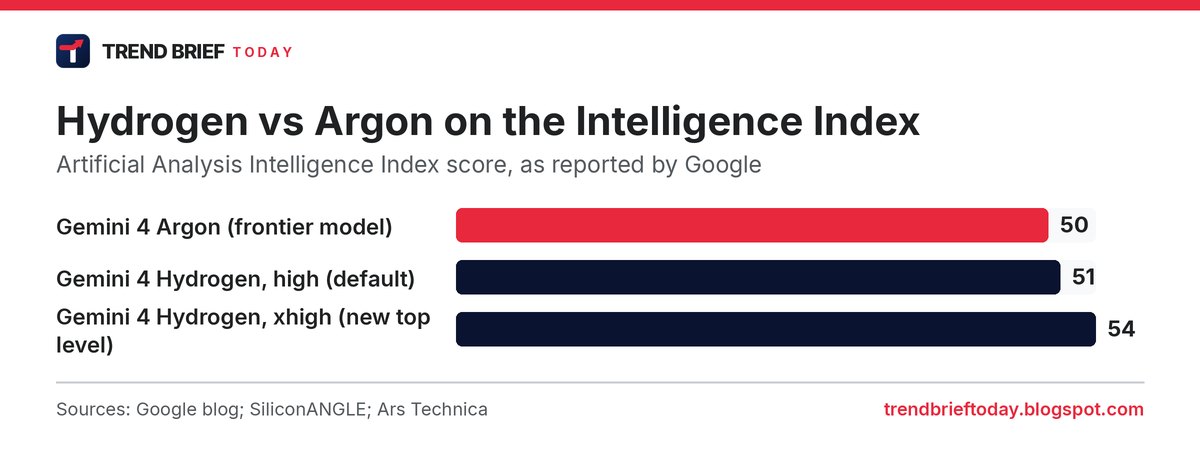
It is worth reading that carefully. Google still positions Argon and Carbon as the best models for long, complex tasks and for security work, and says Hydrogen is meant to pair with them, not replace them.[1][4] One index score does not mean Hydrogen is better at everything, and Mashable notes that Google itself says the model can still make things up, like all generative AI.[6]
What changes compared with Gemini 3.8 Flash
Most of Google's numbers compare Hydrogen with Gemini 3.8 Flash, the model it replaces.[5] Google says Hydrogen:[1][4][5]
- finishes tasks about 2.5 times faster at its default high setting;[1][4][5]
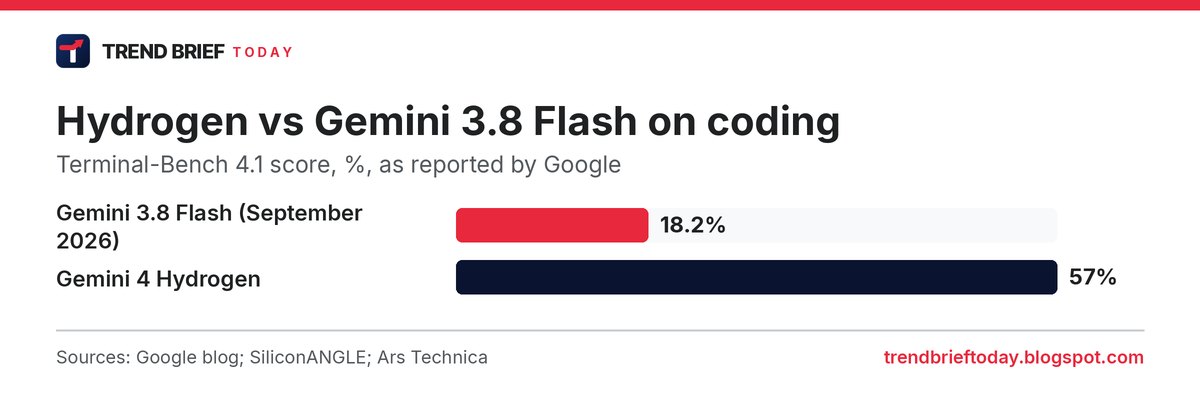
- scores 57% on Terminal-Bench 4.1, a command-line coding test, against 18.2% for 3.8 Flash;[1][5]
- cuts "fabricated claims" by more than five times;[1][4]
- is up to two times less likely to go around permission limits when a task is blocked.[1][6]
Google also says early partners saw Hydrogen run 2 to 2.8 times faster than 3.8 Flash on data-heavy enterprise work while using 12% to 23% fewer tokens.[1] These are company figures from its own testing and partner reports.
Price for developers
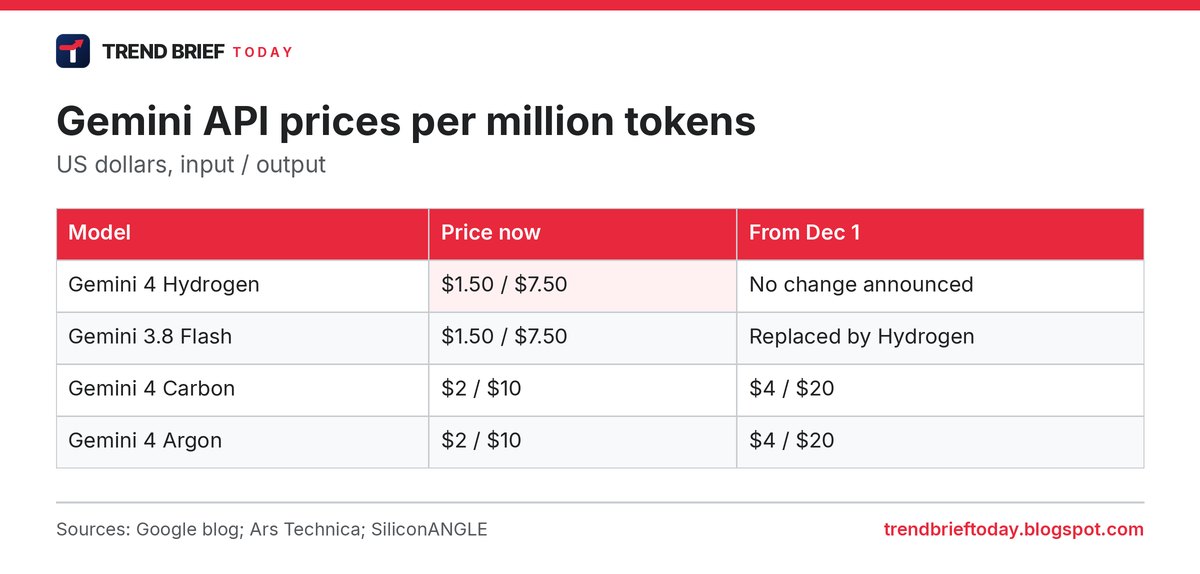
Through the Gemini API, Hydrogen costs $1.50 per million input tokens and $7.50 per million output tokens, flat across the whole 1 million token context window.[1][5] Ars Technica says that is unchanged from 3.8 Flash.[4]
The bigger models are more expensive and about to get pricier. Carbon and Argon cost $2 and $10 per million tokens now, rising to $4 and $20 when the introductory pricing ends on November 30.[4][5][8]
Where you can use it
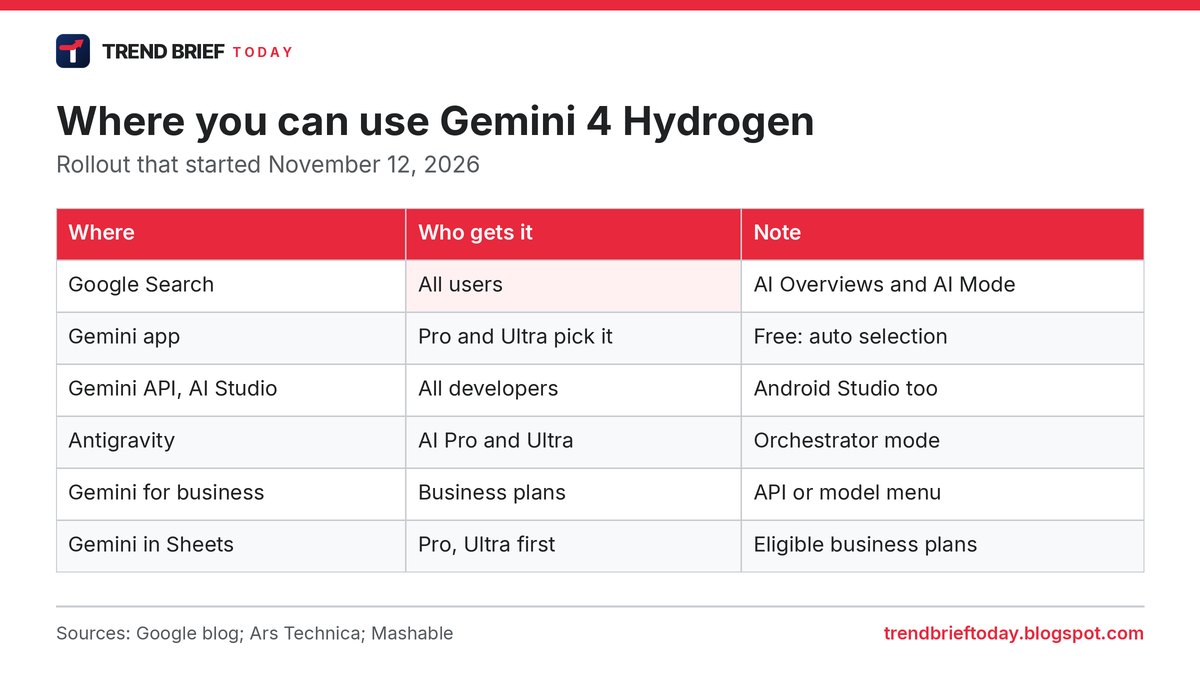
Google says Hydrogen started rolling out globally on November 12 across its consumer, developer and business products:[1][3]
- Google Search: for all users. Google calls it "the biggest model upgrade to Search yet".[2][4]
- Gemini app: in the model menu. Google's footnote says free users get Hydrogen through automatic model selection when it is the right model for the prompt. Ars Technica reports that picking it directly is for AI Pro and Ultra subscribers.[1][4]
- Developers: the Gemini API in Google AI Studio and Android Studio, plus Google Antigravity for paid AI Pro and Ultra subscribers.[1][3][5]
- Businesses: Gemini for business through the API or the model menu, Antigravity, and Gemini in Google Sheets on eligible plans.[1][3]
Unlike Argon and Carbon, which went first to a small group of vetted cybersecurity researchers, Hydrogen skipped that stage and opened up right away.[4][5]
What it means for Google Search
For most people, Search is where they will meet Hydrogen. In a separate post, Robby Stein, VP of Product for Google Search, said Hydrogen is now available globally in Search for all users.[2] Google says it changes three things:[1][2]
- It handles long, multi-part questions, typos and very specific requests better.[2][6]
- Answers get more visual, with more images, comparison tables and structured responses.[2][4]
- Its "query fan-out", where Search runs many related searches at once, is meant to link to a wider range of websites.[2][4]
Ars Technica says the new model will show up in both AI Overviews and AI Mode, and adds a note of caution on the links promise: "we've heard that from Google before".[4] Publishers will be watching whether the wider linking actually sends more visitors.
Orchestrator: Hydrogen working with Carbon
Alongside Hydrogen, Google added a feature called Orchestrator to Antigravity, its AI coding tool.[1][7] Instead of using one model for a whole job, Orchestrator lets a planning model such as Carbon or Argon explore the code and write a plan, then hands the actual edits, builds and tests to Hydrogen. If Hydrogen keeps failing tests, control goes back to the planner.[7]
Google says that on Terminal-Bench 4.0, Orchestrator came close to Carbon's success rate while using 24% less quota on average and finishing 19% faster.[1][5] InfoWorld quotes analyst Pareekh Jain of Pareekh Consulting describing it as "like pairing a senior architect with a superfast coder."[7]
Timeline of the Gemini 4 releases
| Date (2026) | What happened |
|---|---|
| September | Gemini 3.8 Flash released[5][6] |
| October 13 | Gemini 4 Argon opens to paying developers after about two weeks with vetted security researchers[5] |
| October 28 | Google announces Gemini 4 Carbon[8] |
| November 10 | Carbon opens to paying developers, businesses and AI Ultra subscribers[5][8] |
| November 12 | Gemini 4 Hydrogen launches and replaces 3.8 Flash, including in Google Search[1][4][5] |
| November 30 | Introductory Carbon and Argon API prices end ($4 / $20 from then)[5][8] |
Frequently asked questions
What is Gemini 4 Hydrogen?
Google's new fast, lower-cost Gemini 4 model for everyday tasks, coding and AI agents. It replaced Gemini 3.8 Flash on November 12, 2026.[1][4]
Is Gemini 4 Hydrogen free?
In Google Search it is used for all users at no cost. In the Gemini app, free users get it when automatic model selection picks it; choosing it directly is for AI Pro and Ultra subscribers, according to Ars Technica.[1][2][4] Developers pay $1.50 / $7.50 per million tokens through the API.[1][5]
Is Hydrogen better than Gemini 4 Carbon or Argon?
Not overall. Google says it narrowly beats Argon on the Artificial Analysis Intelligence Index (51 vs 50), but still recommends Carbon and Argon for the hardest, longest tasks.[1][4][5]
What does "xhigh" mean?
It is a new fourth thinking level. Higher levels let the model reason longer, which costs more time and tokens but can give better answers. Hydrogen's levels are low, medium, high (the default) and xhigh.[1][4][6]
Who announced Gemini 4 Hydrogen?
Koray Kavukcuoglu, senior vice president at Google DeepMind and Google's Chief AI Architect, in a Google blog post on November 12.[1][5][6]
References
- "Introducing Gemini 4 Hydrogen". Koray Kavukcuoglu, Google blog. 12 November 2026 (updated 13 November 2026).
- "Google Search gets a major upgrade with Gemini 4 Hydrogen". Robby Stein, Google blog. 12 November 2026.
- "Gemini 4 Hydrogen: everyday coding and agentic workflows for developers". Google blog. 12 November 2026.
- "Google rolls out Gemini 4 Hydrogen, finally replacing 3.8 Flash". Ars Technica. 12 November 2026.
- "Google releases Gemini 4 Hydrogen, a lower-cost model said to outscore Argon". SiliconANGLE. 12 November 2026.
- "Google unveils Gemini 4 Hydrogen, its new AI model built for speed". Amanda Yeo, Mashable. 13 November 2026.
- "Google adds multi-model Orchestrator, Gemini 4 Hydrogen, to Antigravity". InfoWorld. 13 November 2026.
- "Gemini 4 Carbon released: price, who gets it, Carbon vs Argon". Trend Brief Today. 10 November 2026.