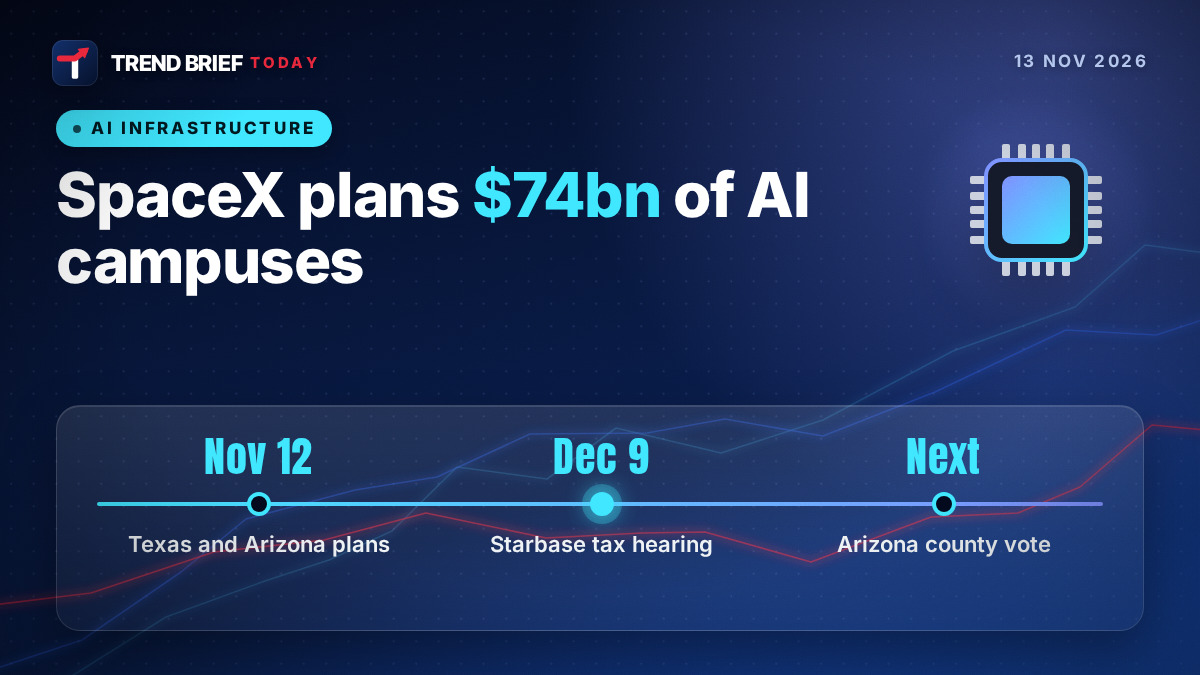
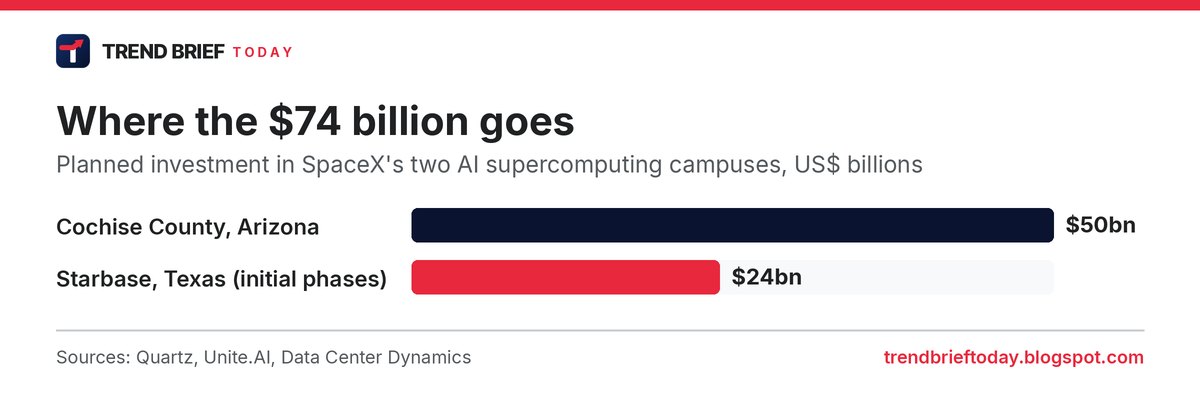
SpaceX said on Thursday, November 12, 2026, that it plans to invest more than $74 billion in two AI supercomputing campuses: up to $24 billion at Starbase in South Texas and about $50 billion in Cochise County, Arizona.[1][2][11][12] The Texas site would run on its own gas-fired power plant and faces a tax-break hearing on December 9, while the Arizona campus still needs county approval.[1][2][4][6]
 | |
| Announced | Thursday, November 12, 2026[1][2] |
|---|---|
| Total | More than $74 billion[1][2][11][12] |
| Texas site | Starbase, near the Port of Brownsville; up to $24 billion for the initial phases[1][4][5] |
| Arizona site | Cochise County; about $50 billion[1][2] |
| Purpose | Training frontier AI systems[1][2] |
| Next date | December 9: Starbase City Commission hearing on a property tax abatement[1][4][5] |
| Status | Texas work started; Arizona needs county approval[1][2][6] |
What SpaceX announced
SpaceX set out plans on Thursday for two very large computing campuses built to train advanced AI systems. Together they carry a planned investment of more than $74 billion.[1][2][11] Reuters, The New York Times and DigiTimes reported the same total, and the company gave the site-by-site figures itself.[1][3][11][12]
- Starbase, Texas: up to $24 billion, on land SpaceX owns near the Port of Brownsville. The money covers only the first phases, and a city notice leaves room for later expansion.[1][4][5]
- Cochise County, Arizona: about $50 billion, for what would be SpaceX's first facility in the state.[1][2][6]
Unite.AI, which went through the company's plan documents, says the Starbase centre is meant to train "frontier" AI for uses such as medical research, emergency response, manufacturing and national security, and to help SpaceX test computing in space later on.[2] Quartz reported the same training goal.[1]
The Texas campus at Starbase
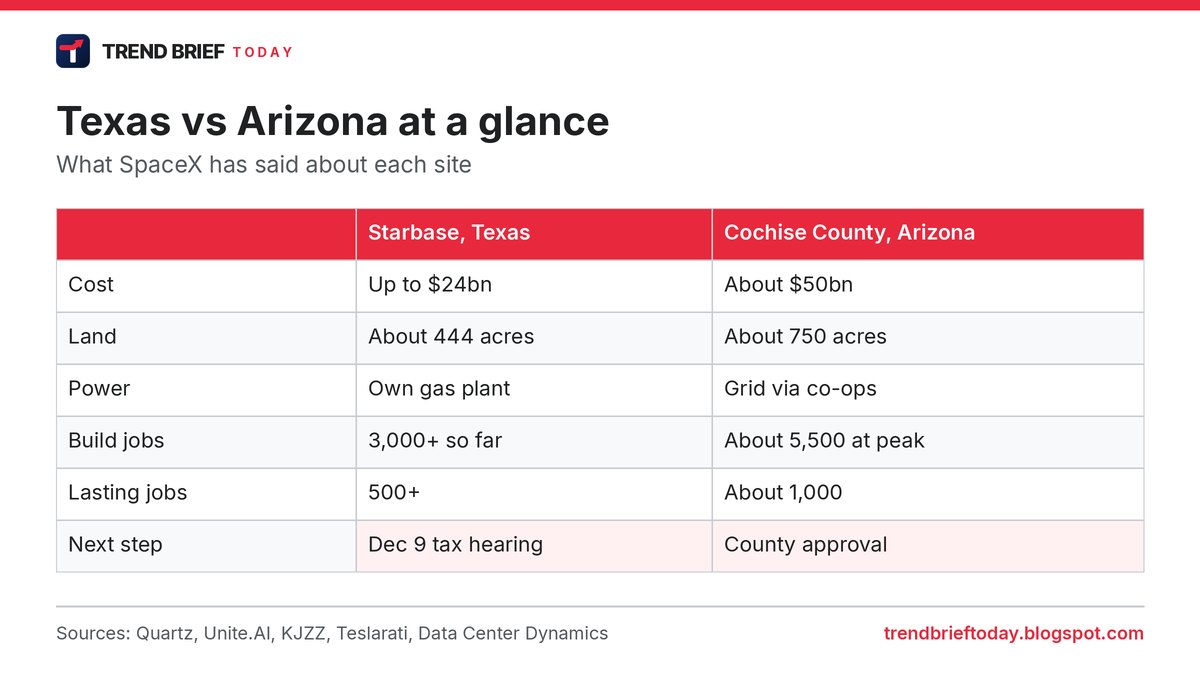
The Texas site sits on roughly 444 acres between Boca Chica Boulevard and the Port of Brownsville, inside the city limits of Starbase, the company town SpaceX built around its rocket launch site.[4][5][7] A Starbase public notice says SpaceX "proposes to construct, own, and operate a gas-fired power plant and super-compute facility" there, so the campus would make its own electricity instead of drawing from the public grid.[1][4]
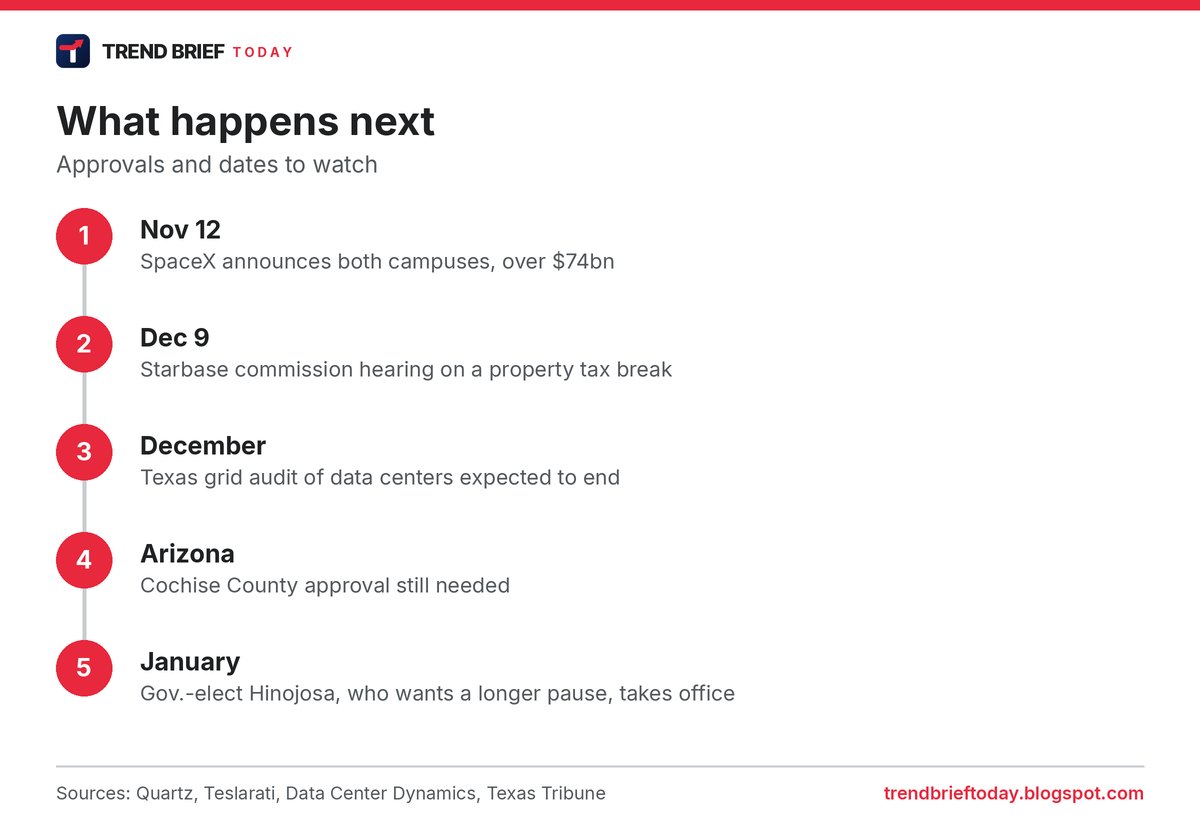
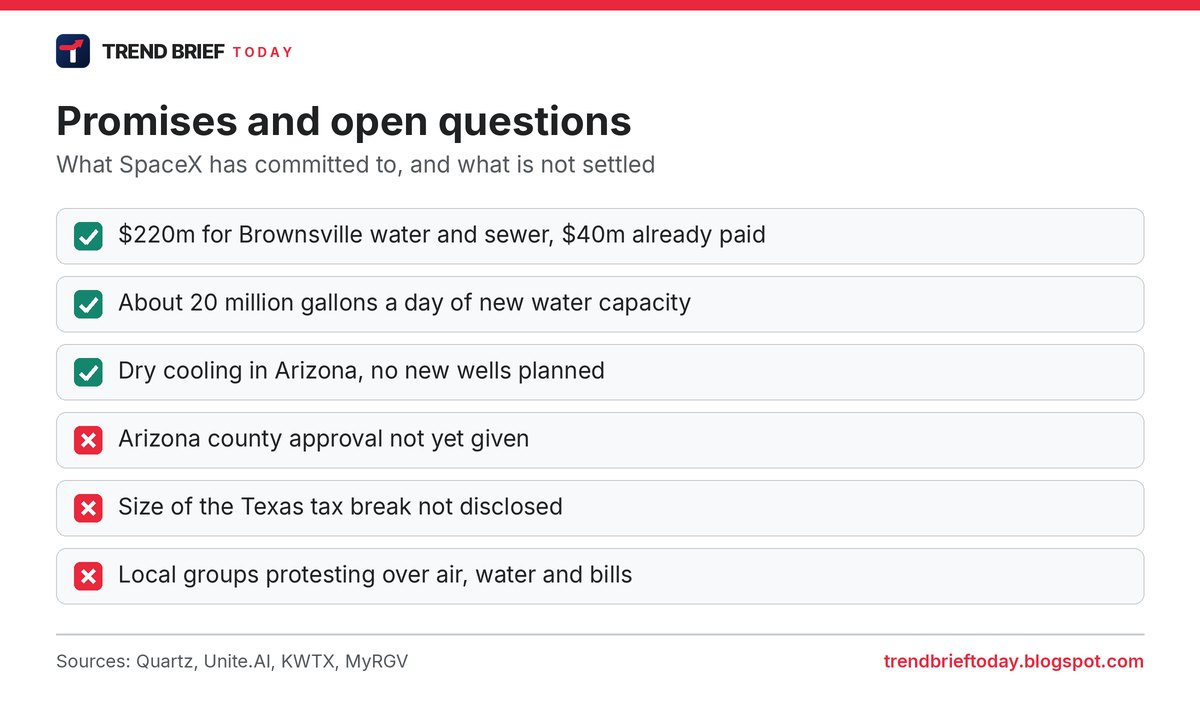
SpaceX says the project has already created more than 3,000 construction jobs and should support more than 500 permanent jobs once it is running.[1][2] The Starbase City Commission will consider a property tax abatement and an economic development agreement for it at a 7 p.m. hearing on December 9. The notice does not say how big the tax break would be.[1][4][8]
The land swap with Brownsville
The land has a history. Over the summer SpaceX asked Brownsville to remove the tract from its city limits and offered $220 million for water and wastewater projects in return. Brownsville agreed in August, and Starbase later annexed the land.[4][7][8] Brownsville's own pause on new data centers took effect last week, so the site now sits outside it.[4][7]
SpaceX says it has already handed $40 million of the $220 million to the Brownsville Public Utilities Board and that the projects will add about 20 million gallons of water a day.[1][2] Local environmental group the South Texas Environmental Justice Network has protested against the campus over air pollution, water use and power bills, while other residents have welcomed the jobs.[7][8]
The Arizona campus in Cochise County
The Arizona plan is bigger in money and in power. It covers about 750 acres in Cochise County in the south-east of the state and is designed for up to 6 gigawatts at full build-out.[2][5][6] The plan lists nine single-storey computer buildings.[2][5]
Unlike Starbase, the Arizona campus would buy its power from the grid through local electric cooperatives rather than build its own plant.[1][2] It would use dry cooling, with sealed liquid loops and fans instead of cooling towers, and SpaceX says it plans no industrial groundwater use.[1][2] The company says members of the local cooperative could see lower electricity bills: Quartz reports a figure of up to 20%, and Unite.AI, citing the plan, gives a range of 10% to 40% over the life of the project.[1][2]
SpaceX expects about 5,500 construction jobs at the peak and about 1,000 permanent jobs.[1][2] The company held a public meeting at a school in Cochise County earlier this month, where residents raised questions about water, power costs and wildlife.[1][6] The county still has to approve the project.[2][6]
Texas politics could slow things down
The Texas campus lands in a state that is rethinking data centers. Outgoing Governor Greg Abbott ordered an audit of data center projects seeking grid connections and froze new environmental permits for them until it is done. Grid operator ERCOT expects that review to end in December.[9][10]
Governor-elect Gina Hinojosa, the Democrat who won the governor's race on November 3, campaigned on keeping data center approvals paused until lawmakers pass new rules, and she has called Abbott's temporary pause "a scam".[1][9][10] She takes office in January. It is not yet clear how state policy would apply to a site inside Starbase's city limits.[8][9]
For the wider picture on how the election changed state and federal power, see our midterm results explainer.
Why it matters
Training the largest AI models needs huge amounts of electricity and cooling, and companies are racing to lock in land and power. SpaceX's two sites show the two main ways of doing that: build your own gas plant, as in Texas, or sign up for grid power from local utilities, as in Arizona.[1][2] Both routes now depend on local votes and, in Texas, on a new governor who wants fewer data centers, not more.[1][9][10]
Frequently asked questions
How much is SpaceX investing in AI data centers?
More than $74 billion across two campuses: about $50 billion in Cochise County, Arizona and up to $24 billion at Starbase, Texas.[1][2][11]
Where is the SpaceX data center in Texas?
At Starbase, on about 444 acres between Boca Chica Boulevard and the Port of Brownsville in Cameron County.[4][5]
Has the Arizona project been approved?
No. SpaceX still needs approval from Cochise County.[2][6]
Will the campuses use local water?
SpaceX says the Arizona site uses dry cooling with no planned industrial groundwater use, and in Texas it is paying $220 million for new water and wastewater capacity in the Brownsville area.[1][2]
When is the next decision?
The Starbase City Commission hearing on a tax abatement for the Texas site is set for 7 p.m. on December 9.[1][4][5]
References
- Quartz. "SpaceX is planning more than $74 billion in AI supercomputing campuses in Texas and Arizona". 12 November 2026.
- Unite.AI. "SpaceX Unveils Two AI Supercomputing Campus Plans in Texas and Arizona". 12 November 2026.
- DigiTimes. "SpaceX's US$74 billion Texas-Arizona AI data center expansion faces local opposition and political hurdles". 13 November 2026.
- Teslarati. "SpaceX's $24B Starbase supercomputer plan slipped past a key roadblock". 11 November 2026.
- Data Center Dynamics. "Elon Musk's SpaceX targets nat-gas plant and supercomputing facility at Starbase City, Texas". 11 November 2026.
- KJZZ. "SpaceX is behind proposed data center in Cochise County". 10 November 2026.
- KWTX. "SpaceX to build $24 billion data center in South Texas, sidestepping moratorium". 12 November 2026.
- MyRGV (The Brownsville Herald). "SpaceX planning $24 billion data center on property disannexed by Brownsville". 11 November 2026.
- The Texas Tribune. "Under Hinojosa, Texas data center approvals could stay paused". Emily Foxhall. 4 November 2026.
- Data Center Dynamics. "Texas governor-elect Gina Hinojosa promises continued data center moratorium, further legislation". 5 November 2026.
- Reuters. "SpaceX plans over $74 billion investment in Texas, Arizona AI campuses". 12 November 2026.
- The New York Times. "SpaceX Plans $74 Billion Investment to Build Data Centers in Texas and Arizona". 12 November 2026.