Google made Gemini 4 Carbon, which it calls its strongest AI model, available to paying developers, businesses and Google AI Ultra subscribers on November 10, 2026. Through the API it costs $2 per million input tokens and $10 per million output tokens until November 30, then $4 and $20 from December 1. In the Gemini app it is only for AI Ultra subscribers for now. Google also began previewing /swarm, a feature in its Antigravity coding app that turns one prompt into a team of AI agents.[1][2][3]
 | |
| Developer | Google DeepMind |
|---|---|
| Family | Gemini 4 (with Gemini 4 Argon) |
| First access | Late October 2026, cyber defenders in the Fairwind Program |
| Wider release | November 10, 2026 |
| API price to Nov 30 | $2 input / $10 output per 1M tokens |
| API price from Dec 1 | $4 input / $20 output per 1M tokens |
| Free API tier | No |
| Gemini app | Google AI Ultra subscribers |
| Context window | Up to 1 million tokens (model card) |
| Inputs | Text, images, audio, video |
| Knowledge cutoff | March 2026 (model card) |
What Google released
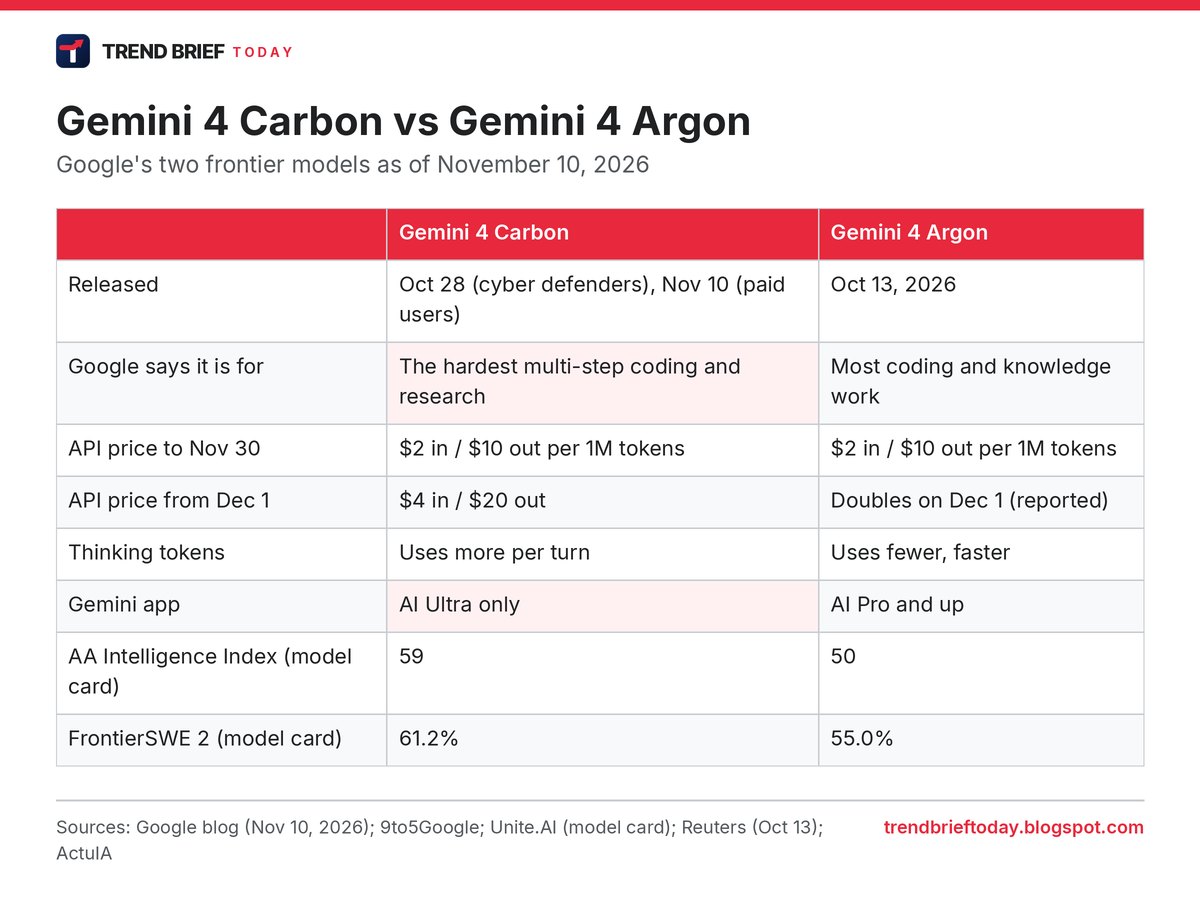
Gemini 4 Carbon is the second model in Google's Gemini 4 family. The first, Gemini 4 Argon, launched for developers and businesses on October 13.[8][9] Google first gave Carbon to a small group of cybersecurity defenders through what it calls the Fairwind Program "two weeks ago", which Unite.AI dates to an October 28 announcement.[1][6] On November 10 it opened the model to everyone who pays.[1][2][4]
Google's pitch is that the two models do different jobs. In its words, "Argon remains the ideal choice for the majority of software engineering and knowledge work, while Carbon is built for tasks that test the limits of a model's intelligence like complex, multi-step coding and debugging and open-ended scientific research and discovery." Carbon gets there by "using more tokens than Argon to explore thoroughly, reason deeply, and run extended verification loops."[1] The Verge and 9to5Google both quote the same split.[2][3] In the Gemini app's model picker, 9to5Google reports that Argon is labelled "Code & analysis" and Carbon "Most complex work", and that Gemini 3.1 Pro has been removed from the app.[3]
Price: cheap per token, but it thinks longer
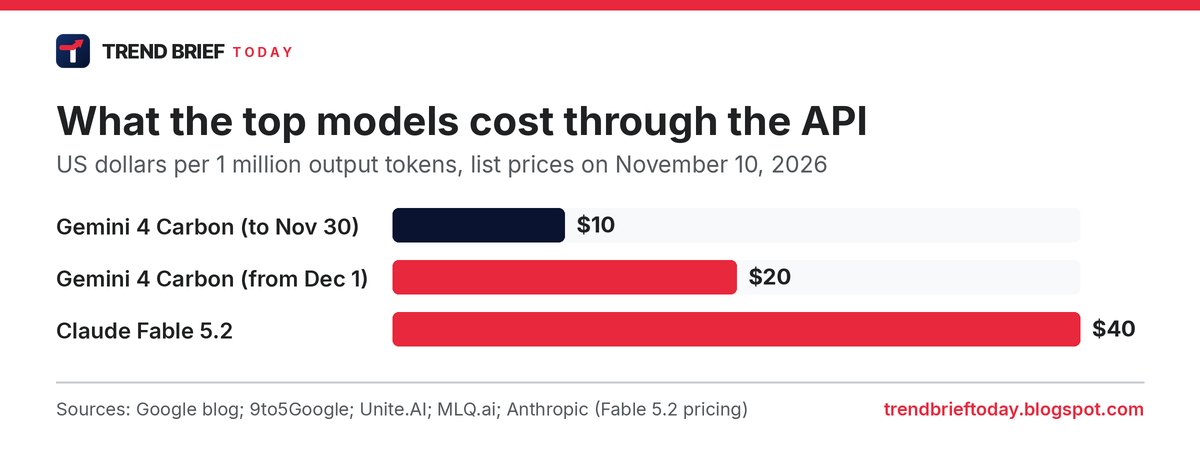
Carbon launched at the same introductory API price as Argon: $2 per million input tokens and $10 per million output tokens.[1][6] 9to5Google and Unite.AI both report that the introductory period ends on November 30, after which the price becomes $4 and $20 per million tokens.[3][6] The Verge also says the cost doubles at the end of November.[2] Argon's API price is set to double on December 1 as well, according to ActuIA.[10]
That is far below Anthropic's newest model. Claude Fable 5.2, launched a day earlier, lists at $8 per million input tokens and $40 per million output tokens, so Carbon's launch price is a quarter of Fable's per token. The Verge also puts it at about a fifth of OpenAI's GPT-6 Astra.[2][7][11] We covered the Fable launch in Claude Fable 5.2 and Mythos 5.2 explained.
There is a catch that both The Verge and Unite.AI point out. Carbon uses more "thinking" tokens than Argon on the same request, and Google bills every token, including the thinking ones. So a cheap per-token price does not guarantee a cheap job.[2][6] Carbon is also not in the Gemini API's free tier.[6]
Who can use it and where
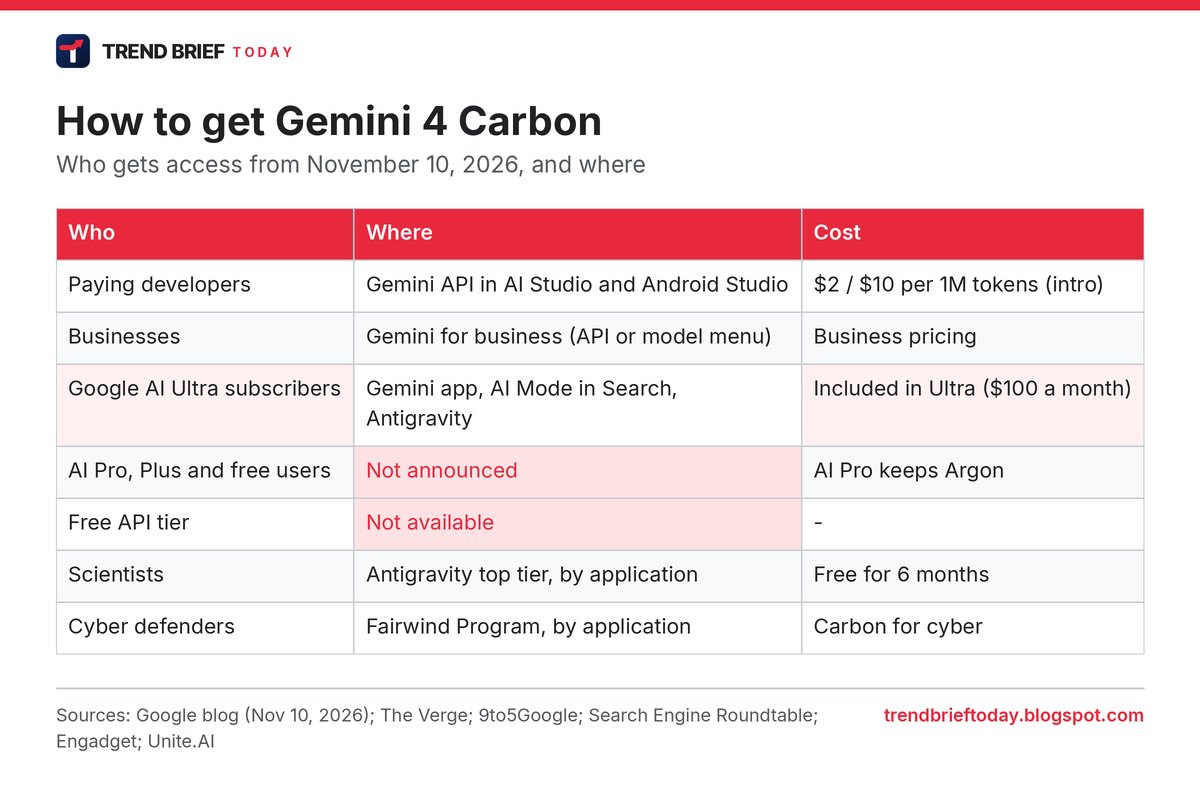
- Developers: through the paid tier of the Gemini API in Google AI Studio and Android Studio.[1][3][6]
- Businesses: in Gemini for business, through the API or the model menu.[1][3]
- Google AI Ultra subscribers: rolling out in the Gemini app, AI Mode in Google Search and Google Antigravity.[1][2][5] Engadget and ZDNET put AI Ultra at $100 a month.[4][12]
- Everyone else: The Verge says it is not clear when, or if, Carbon will reach lower tiers or free users. AI Pro subscribers keep Argon in the app.[2][3]
- Scientists: Google is giving selected researchers free access to Argon and Carbon on Antigravity's highest usage tier for six months, by application.[1][4][6]
- Cyber defenders: the stronger "Carbon for cyber" version stays behind Fairwind Program applications.[1][6]
In Search, Google's Robby Stein posted that Carbon in AI Mode gives "deeper reasoning & better instruction following" for the hardest questions, according to Search Engine Roundtable.[5]
What /swarm in Antigravity does
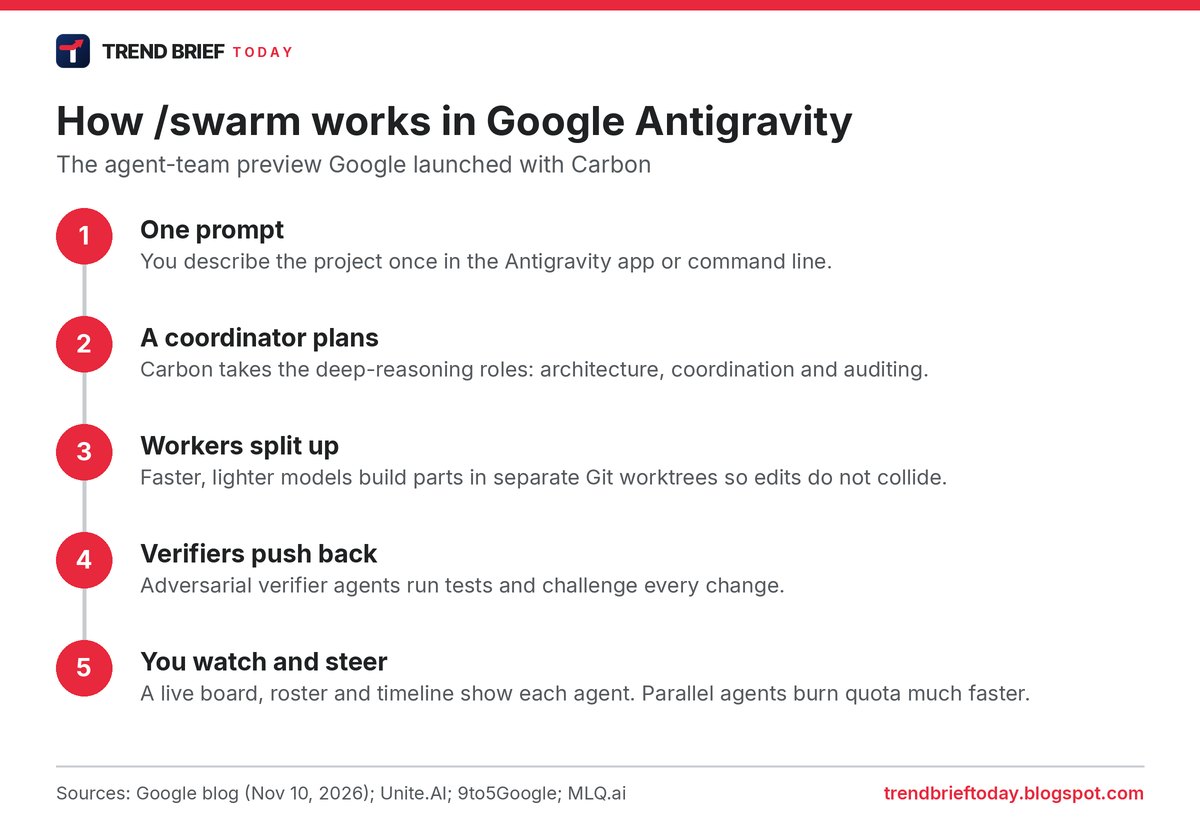
The other launch is a preview called /swarm in Google Antigravity, Google's agent-based coding app. Google says it turns "a single prompt into a coordinated team of agents you can track in real time."[1] Carbon takes the roles that need the most reasoning, such as architecture, coordination and auditing, while faster and cheaper models do the routine building in parallel, and "adversarial verifiers" test every change.[1][7]
Unite.AI, citing Antigravity's documentation, adds that each worker gets its own Git worktree so edits do not collide, agents talk through a shared message board, and a live board and timeline let you steer single agents. It also notes a warning that parallel agents use up quota much faster than normal chat.[6] Google's demos include an interactive 3D exhibition of the Eiffel Tower's construction and a 3D model of a Google office rebuilt from 206 drawing views over 10 overnight loops.[1][7]
How good is it?
Google says Carbon ranks first on CursorBench 4.0, Perplexity's WANDR and Zapier's AutomationBench "at more than 2X lower cost per task compared to the next best external model". It does not name that model.[1][7]
The independent picture is closer. The model card, as reported by Unite.AI, gives Carbon 61.2% on the FrontierSWE 2 coding test against 55.0% for Argon, but behind the 65.5% it lists for GPT-6 Astra and 62.3% for Claude Opus 5.5.[6] Anthropic's own launch table for Fable 5.2 puts Fable ahead of Carbon on coding, science and computer-use tests, with Carbon ahead only on AutomationBench, 53.9% to 51.4%.[7][11] MLQ.ai reports that the Artificial Analysis Intelligence Index now scores Fable 5.2 at 65 and Carbon at 60, ahead of Opus 5.5 and GPT-6 Astra.[7] The Verge also notes that companies can and do pick the benchmarks that flatter them.[2]
| Claim | Google, November 10 | Other source |
|---|---|---|
| Multimodal Knowledge Agent (MKA) test | Carbon ranks #2, more than 6X cheaper per task than the leader[1] | 9to5Google quotes Google wording that Carbon "ranks #1 while using 3X fewer tokens"[3] |
| Best model overall | "Our strongest model"[1] | Artificial Analysis now has Fable 5.2 ahead, 65 to 60 (via MLQ.ai)[7] |
| Cost | Same introductory price as Argon[1] | More thinking tokens per job, all billed[6] |
Safety and the cyber version
Because Carbon is strong at finding and fixing software flaws, Google kept the full cyber version gated. It says that in simulated attack tests Carbon blocked 99% of an adaptive red-team agent's attack paths, cutting the per-attempt breach rate to 0.8% from 3.1% for Argon, and that Gray Swan's automated cyberattack query success rate fell to 2.17% from 9.86%.[1][7] Unite.AI, reading the safety report, adds a less flattering number: on 25 high-severity tasks, 40% were still breached at least once after 200 attempts each.[6] Google also reports a 0% attack success rate on Gray Swan's indirect prompt injection benchmark, while saying such attacks remain possible.[1][6]
Timeline
| Date | Event |
|---|---|
| October 13, 2026 | Gemini 4 Argon launches for developers and businesses[8][9] |
| October 28, 2026 | Carbon announced for cyber defenders in the Fairwind Program[6][7] |
| November 9, 2026 | Anthropic releases Claude Fable 5.2 at $8 / $40[11] |
| November 10, 2026 | Carbon opens to paying developers, businesses and AI Ultra; /swarm preview[1][2] |
| November 30, 2026 | Introductory API price ends[3][6] |
| December 1, 2026 | Price rises to $4 / $20 per million tokens[6] |
The AI race this week also has a money side: Anthropic began the roadshow for its stock market listing on the same day. See Anthropic IPO: price range and valuation. For Apple's paid add-on approach to AI, see Apple Intelligence usage packs explained.
Frequently asked questions
Is Gemini 4 Carbon free?
No. It is not in the Gemini API free tier, and in the Gemini app it is only for Google AI Ultra subscribers for now.[3][6]
How much does Gemini 4 Carbon cost?
$2 per million input tokens and $10 per million output tokens until November 30, 2026, then $4 and $20 from December 1.[3][6]
Should I use Carbon or Argon?
Google itself says Argon is the better choice for most coding and knowledge work, and Carbon is for the hardest multi-step tasks. Carbon is slower and uses more tokens.[1][6]
Is Carbon better than Claude Fable 5.2?
On most published tests, no. Anthropic's table and the Artificial Analysis index put Fable 5.2 ahead, while Carbon is much cheaper per token and leads on AutomationBench.[7][11]
What is /swarm?
A preview feature in Google Antigravity that splits one prompt across a team of AI agents, with Carbon coordinating and checking the work.[1][6]
References
- "Gemini 4 Carbon is now available". Google (The Keyword). November 10, 2026.
- "Google releases Gemini 4 Carbon with agent 'swarm' feature". The Verge. November 10, 2026.
- "Gemini 4 Carbon rolling out to Gemini app for AI Ultra, Argon remains". 9to5Google. November 10, 2026.
- "Google's Gemini 4 Carbon is now widely available around the world". Engadget. November 10, 2026.
- "Gemini 4 Carbon Available In Google Search AI Mode". Search Engine Roundtable. November 10, 2026.
- "Google Expands Gemini 4 Carbon Access Beyond Cybersecurity Defenders". Unite.AI. November 10, 2026.
- "Google makes Gemini 4 Carbon widely available at $2 per million input tokens and previews agent swarms". MLQ.ai. November 10, 2026.
- "Google launches flagship AI model Gemini 4 Argon for developers, businesses". Reuters. October 13, 2026.
- "Google releases Gemini 4 Argon, its new frontier model: Benchmarks, how to try it, and pricing". Mashable. October 13, 2026.
- "Google's Gemini 4 Argon API to double prices on 1 December". ActuIA. October 16, 2026.
- "Claude Fable 5.2 and Mythos 5.2". Anthropic. November 9, 2026.
- "Is Google's AI Ultra plan worth $100/month? I compared it to Plus and Pro tiers". ZDNET. May 21, 2026.