NASA's Voyager 1 will be one light-day from Earth on Wednesday, November 18, 2026, at about 5:16 a.m. EST (10:16 UTC). That is roughly 16.09 billion miles (25.89 billion kilometers), so far that light, and every radio command, needs a full 24 hours to reach it. No spacecraft has ever been that far away. NASA is marking it with a worldwide "Shine Bright for Voyager's Light-Day" event after sunset on Tuesday, November 17, and a live discussion from JPL on November 19. Below: the exact numbers, how to join in, what still works on a probe launched in 1977, the "Big Bang" power fix and the scary two days in October when it went quiet.[1][3][6]
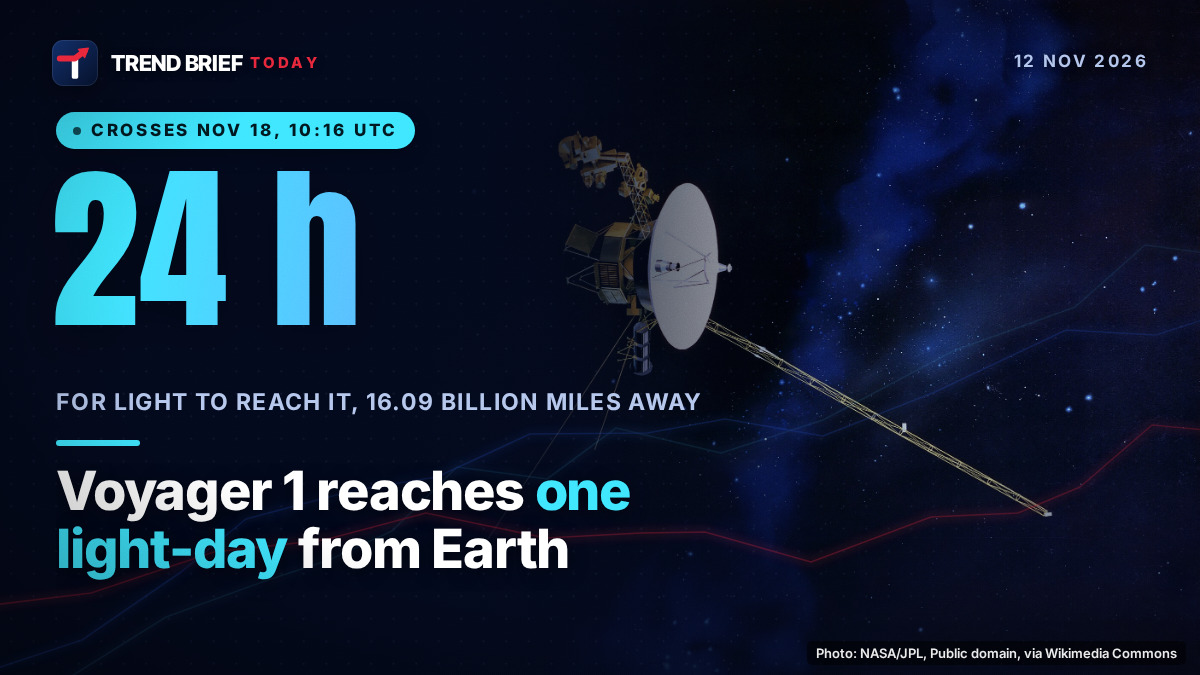 | |
| Cover photo: NASA/JPL, Public domain, via Wikimedia Commons. | |
| Milestone | One light-day from Earth, the first spacecraft ever[1][3] |
|---|---|
| When | Wednesday, November 18, 2026, about 5:16 a.m. EST / 10:16 UTC[5][6][8] |
| Distance | About 16.09 billion miles (25.89 billion km), roughly 173 AU[3][4][6] |
| Signal delay | 24 hours one way, 48 hours for a reply[3][7] |
| Speed | About 38,000 mph (61,000 km/h)[3][5] |
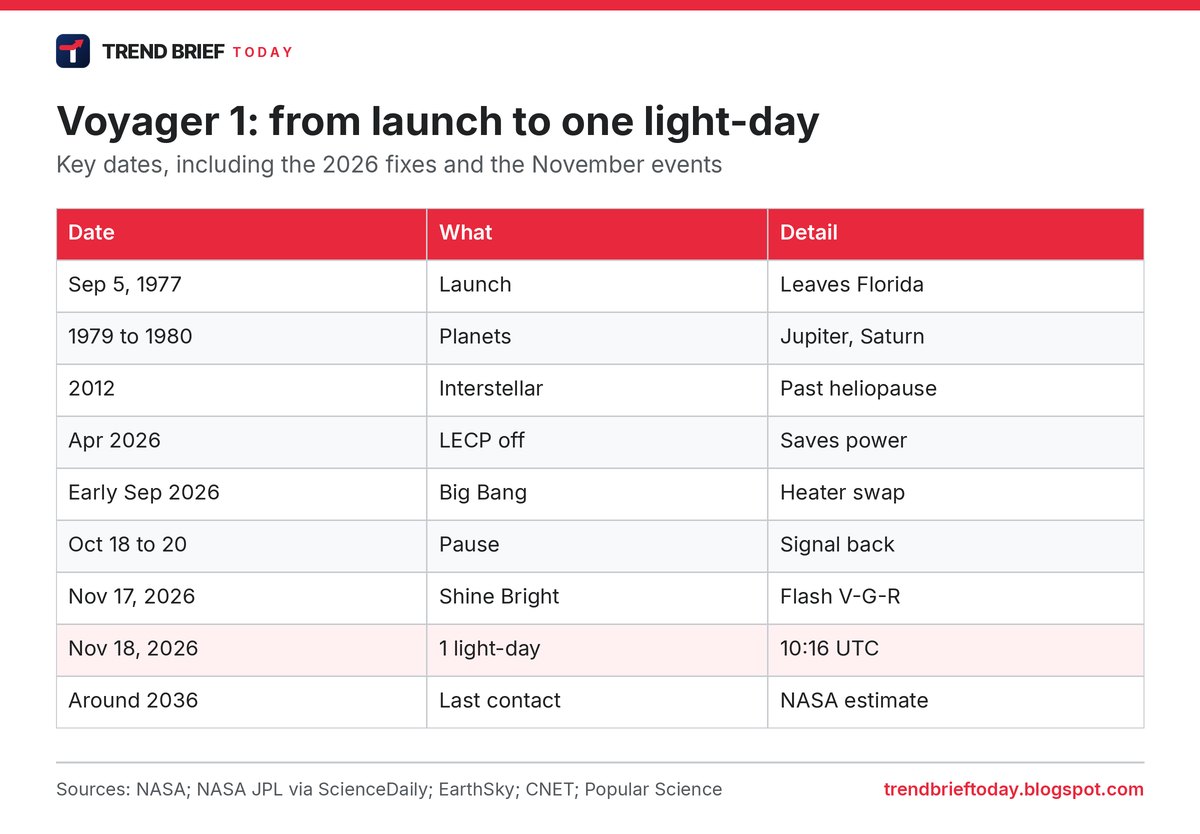
| Launched | September 5, 1977[4][6] |
| Instruments on | 2 of the original 10[5][7] |
| Public event | Shine Bright, after sunset on Tuesday, November 17[1][2] |
When exactly Voyager 1 crosses one light-day
NASA's November 10 announcement gives the date: on Wednesday, November 18, Voyager 1 "will have traveled one light-day from Earth, which is more than 16 billion miles (25.9 billion kilometers)."[1] EarthSky, quoting NASA, puts the moment at 4:16:07 a.m. CST, which is 10:16:07 UTC. CNET and Universe Today both give the same time as 5:16 a.m. Eastern.[5][6][8] Popular Science wrote 5:18 a.m. EST, two minutes later, so treat the minute as approximate.[7]
In UK time that is 10:16 a.m. GMT. In Sydney it is 9:16 p.m. AEDT on the same Wednesday, and on the US West Coast it is 2:16 a.m. PST. Nothing visible happens at that second. As NASA JPL's own write-up puts it, crossing the line "will not produce any physical change" for the spacecraft; it simply keeps going through the same stretch of interstellar space.[3]
How far is one light-day?
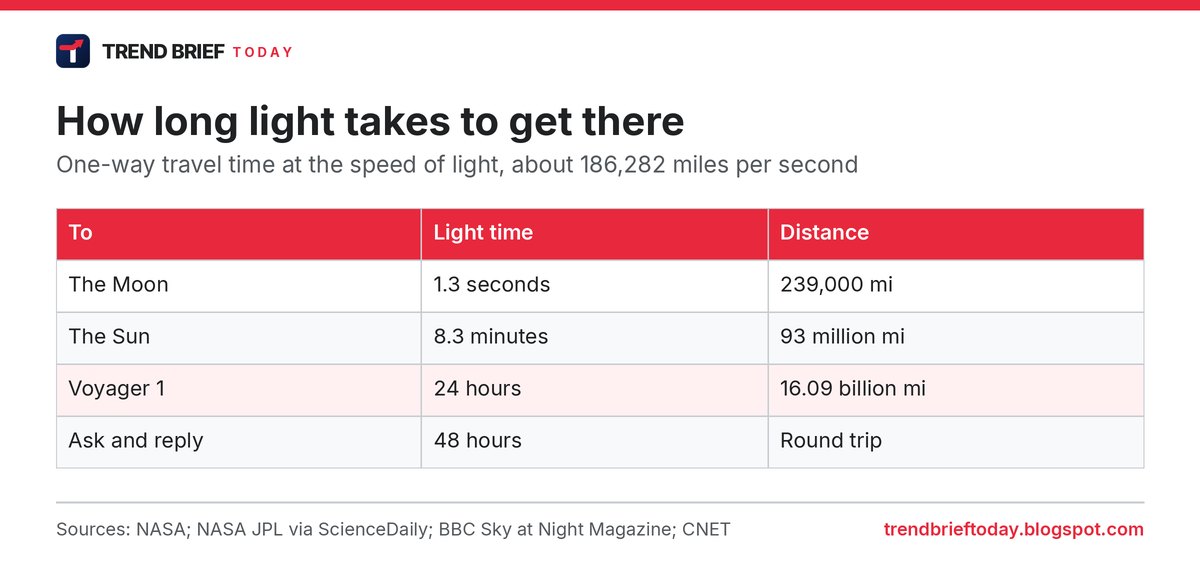
A light-day is a distance, not a length of time. It is how far light goes in 24 hours, at about 186,282 miles every second. That works out to about 16.1 billion miles or 25.9 billion kilometers.[5][6] EarthSky puts it at 173.14 astronomical units, meaning 173 times the distance from Earth to the Sun.[6]
For a sense of scale, sunlight takes a little over eight minutes to reach us. The Moon, the farthest place people have ever been, is just over one light-second away, as Universe Today points out.[8] CNET did the walking maths: at 3 mph, a person would need 612,015 years to cover one light-day.[5]
The delay is the part that matters to the team. "If you want to say 'hello' to Voyager, you send your message and then you go home and you wait two days before you finally get a response," Voyager project manager Suzanne Dodd of NASA JPL said.[3][4] A command goes out, takes a day to arrive, and the answer takes another day to come back.
How to join NASA's "Shine Bright for Voyager's Light-Day"
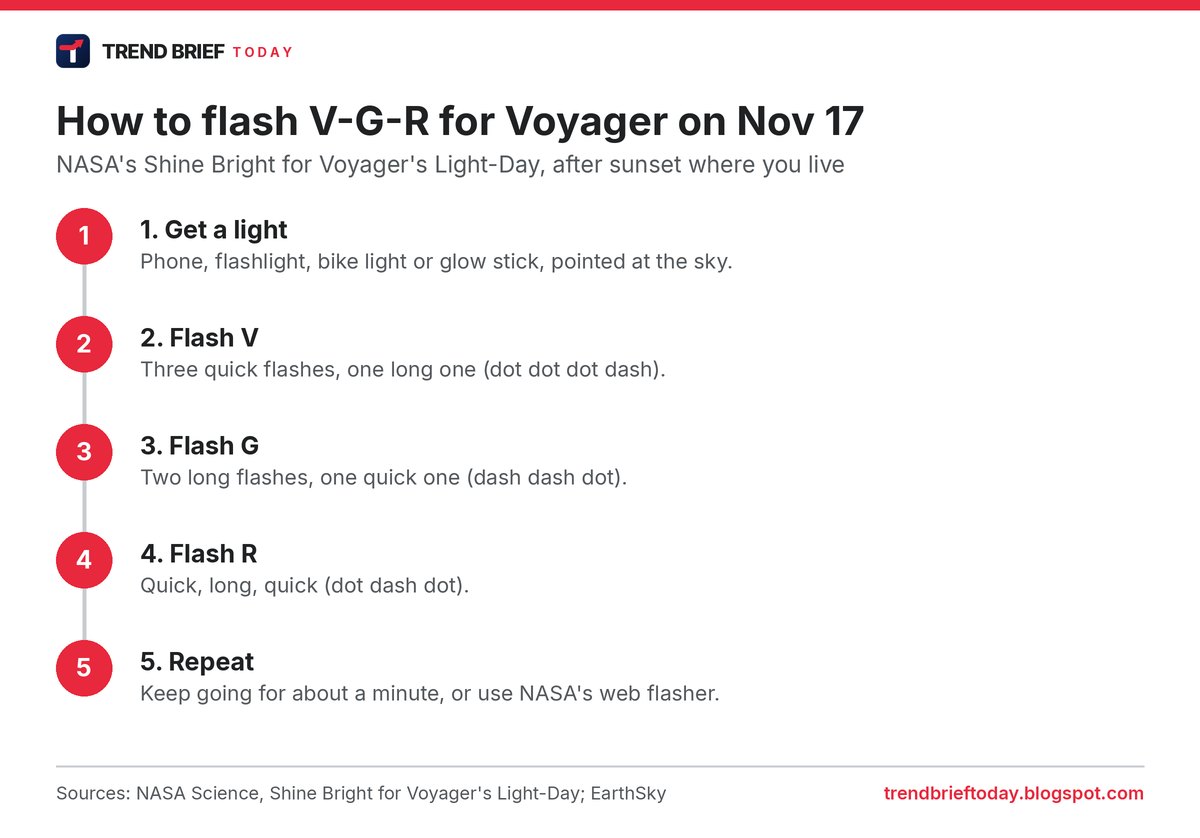
NASA is asking people everywhere to make "a symbolic wave of golden light encircling the planet" after sunset on Tuesday, November 17. The idea is to point a light at the sky and flash V-G-R, Voyager's call sign, in Morse code.[1][2]
You do not need to know Morse code. NASA built a web page that turns a phone or tablet into an automatic V-G-R flasher; open it in your browser and point the screen up. If you want to do it by hand, V is dot dot dot dash, G is dash dash dot and R is dot dash dot. Quick flashes last under a second, long ones about a second, with a short pause between letters. NASA suggests repeating it for about a minute.[2][6]
NASA wants photos and videos shared on social media with the tag @NASA. One nice detail from NASA's page: the Golden Record that both Voyagers carry already contains a Morse code message, "Ad astra per aspera," Latin for "through struggle to the stars."[1][2]
The JPL event on November 19
On Thursday, November 19, at 12 p.m. EST (5 p.m. GMT), NASA JPL in Southern California will hold a moderated talk on both Voyagers, their science in interstellar space and the job of keeping them alive, followed by a Q&A. NASA lists project manager Suzanne Dodd, mission manager Kareem Badaruddin and deputy project scientist Jamie Rankin of Princeton University among the speakers. It will also preview a NASA+ Voyager documentary planned for 2027, the mission's 50th anniversary, according to the agency.[1][7]
What still works on Voyager 1
Voyager 1 launched with 10 science instruments. Only two are still on.[5][7] The most recent to go was the Low-Energy Charged Particle instrument, switched off in April 2026 to save power.[6][7] Universe Today names the two left as the Plasma Wave Subsystem and a magnetometer, which measure the plasma and magnetic field around the probe.[8]
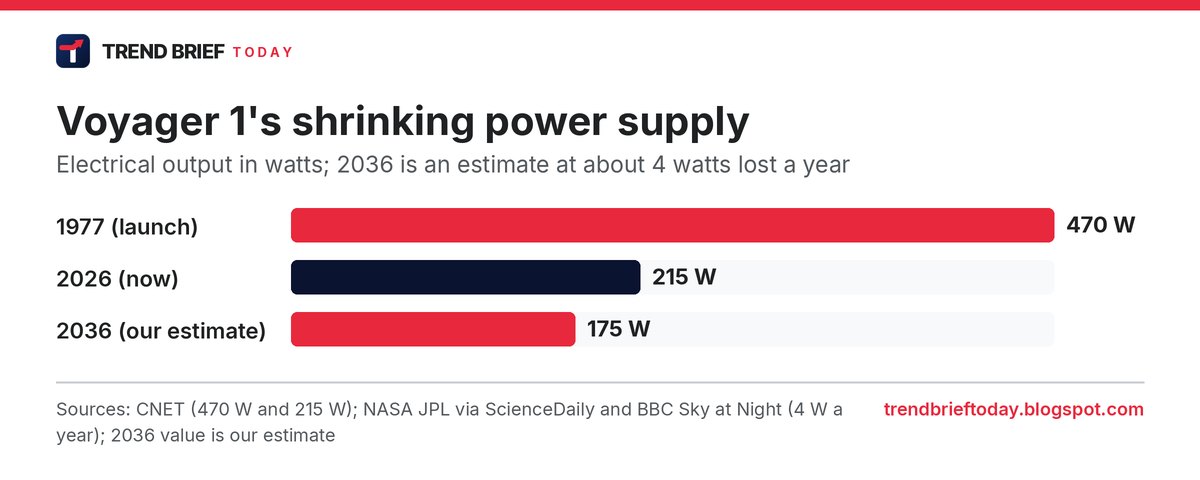
Power comes from radioisotope thermoelectric generators, which turn the heat of decaying plutonium-238 into electricity. Output drops by about 4 watts a year.[3][4][5] CNET says the generators made about 470 watts at launch and about 215 watts now; Universe Today says "a little over 200 watts," about what an electric blanket uses.[5][8] Its radio transmitter runs on about 23 watts, according to Popular Science, which is why only the giant 70-meter dishes of NASA's Deep Space Network can still hear it.[7]
Voyager 1 has been in interstellar space, outside the Sun's protective bubble, since 2012. Jamie Rankin told Popular Science she thinks the probe is close to the edge of truly "undisturbed, pristine interstellar medium," where the Sun's influence fades out.[1][7]
The "Big Bang" power fix
In early September 2026, engineers switched off three devices on Voyager 1 and turned on three lower-power replacements at the same moment. NASA called it the "Big Bang." The devices help keep the spacecraft warm, so all three had to change together to keep the heat spread evenly while cutting the power draw.[3][4][5]
The same swap was done on Voyager 2 about six weeks earlier.[3][4] Without it, NASA would have had to switch off another Voyager 1 instrument as early as summer 2027.[3][4][8] Every command for the swap took close to a day to arrive, which CNET notes made the job even harder.[5]
Why Voyager 1 went silent in October
On October 18 and 19, the Deep Space Network heard nothing from Voyager 1 during two planned contacts, 24 hours apart. On October 20 the signal came back.[3][4] Engineers found that one set of thrusters had stopped working and the onboard computers had switched to the backup set on their own. That is part of a safety system called fault protection, which puts the spacecraft in a stable state and pauses normal work so the team on Earth can look at the problem.[3][4][7]
NASA has not said what caused it. "This is the first time we've seen the spacecraft do something like this, but we are also at a point in the mission where we have to expect the unexpected," mission manager Kareem Badaruddin said. "We're relieved to be back in contact with Voyager 1 and are eager to understand what happened."[3][4][7]
How long does Voyager 1 have left?
NASA expects the Deep Space Network to lose contact with Voyager 1 around 2036, when there will not be enough power to send a signal home. The last science instrument is expected to go off some time in the 2030s.[5][7] Rankin told Popular Science the end is "probably not 20 years from now. It's probably not 10 years from now."[7] That makes one light-day very likely the last big distance milestone Voyager 1 reports back; two light-days is far beyond its power supply.[5][7]
After that it will keep flying anyway, silent, toward the constellation Ophiuchus.[6][8] CNET says it will take about 300 years to reach the inner edge of the Oort Cloud, the icy shell of comets around the solar system.[5]
Its twin, Voyager 2, launched about two weeks earlier, on August 20, 1977, but took a slower path past Uranus and Neptune. It is about 2 billion miles closer to us. EarthSky says NASA does not expect Voyager 2 to reach one light-day until November 2035, and CNET thinks it will probably have lost its instruments by then.[4][5][6]
| Voyager 1 | Voyager 2 | |
|---|---|---|
| Launched | Sep 5, 1977 | Aug 20, 1977 |
| Planets visited | Jupiter, Saturn | Jupiter, Saturn, Uranus, Neptune |
| Entered interstellar space | 2012 | 2018 |
| One light-day | Nov 18, 2026 | Nov 2035 (NASA, via EarthSky) |
| Heading toward | Ophiuchus | Sagittarius and Pavo |
Sources for the table: NASA, EarthSky, BBC Sky at Night Magazine, CNET.[1][4][5][6]
Frequently asked questions
What time does Voyager 1 reach one light-day?
About 5:16 a.m. EST on Wednesday, November 18, 2026, which is 10:16 UTC and 10:16 a.m. in the UK.[5][6]
How far away is Voyager 1 right now?
Just under 16.1 billion miles (about 25.9 billion km) in mid-November 2026, and it is still travelling at about 38,000 mph. NASA's Voyager site has a live odometer.[2][3]
Is Voyager 1 still working?
Yes. It still sends data from two instruments, and contact came back on October 20 after a two-day silence.[3][7]
How do I take part in Shine Bright for Voyager?
After sunset on November 17, point a light at the sky and flash V-G-R in Morse code, or use NASA's automatic flasher page on your phone. Share it with the tag @NASA.[1][2]
When will Voyager 1 stop talking to Earth?
NASA's estimate is around 2036, when the power runs too low for the radio.[5][7]
References
- "NASA Invites Media, Public to Join Voyager 1 One-Light Day Activities". NASA. November 10, 2026. nasa.gov
- "Shine Bright for Voyager's Light-Day". NASA Science. November 4, 2026. science.nasa.gov
- "NASA's Voyager 1 is about to reach a historic one-light-day milestone". ScienceDaily (materials from NASA's Jet Propulsion Laboratory). November 3, 2026. sciencedaily.com
- "NASA gets Voyager 1 back online after comms glitch, just in time for the probe to reach a mind-blowing milestone". BBC Sky at Night Magazine. November 3, 2026. skyatnightmagazine.com
- "NASA's Voyager 1 to Cross Historic One Light-Day Milestone on Nov. 18". CNET. November 9, 2026. cnet.com
- "Celebrate as Voyager 1 reaches 1 light-day from Earth! Here's how". EarthSky. November 10, 2026. earthsky.org
- "Voyager 1 is almost one light-day away from Earth". Popular Science. November 9, 2026. popsci.com
- Dickinson, David. "'Big Bang' Fix Puts Voyager Across the 'One Light-Day' Mark". Universe Today. November 6, 2026. universetoday.com
Image credits: Cover photo: NASA/JPL, Public domain, via Wikimedia Commons.