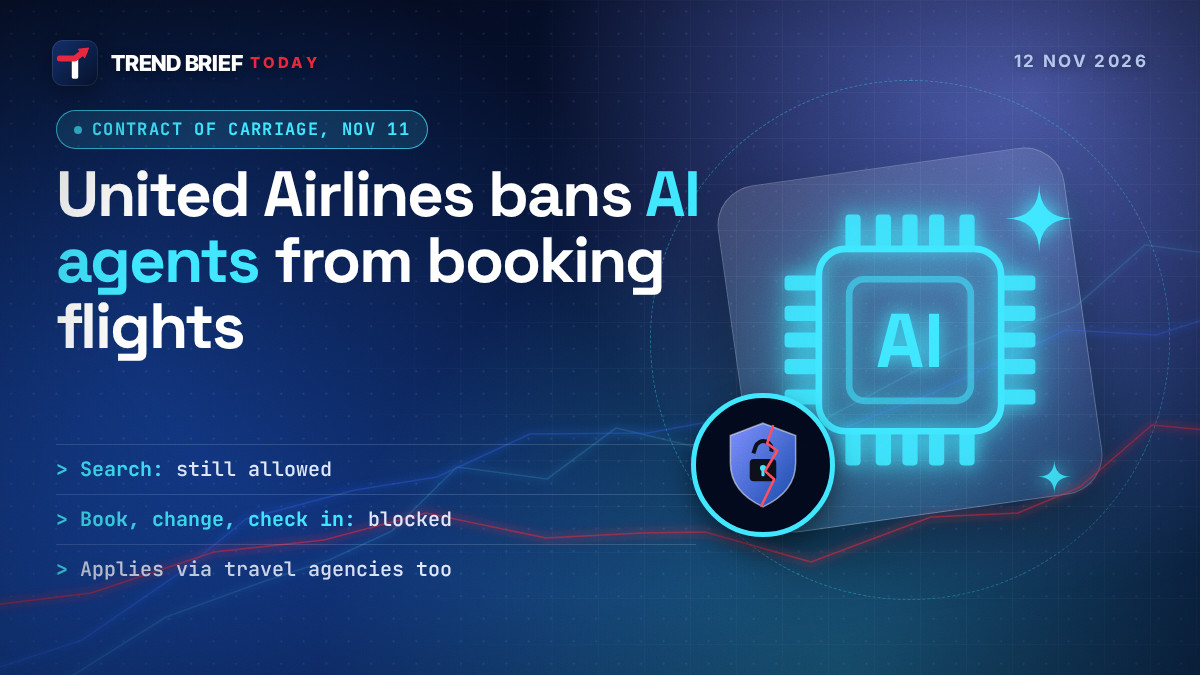
United Airlines said on Wednesday, November 11, 2026, that it is banning personal AI agents, such as Meta's Muse, from booking, changing or checking in for its flights on a traveler's behalf, both on united.com and through travel agencies and booking sites. Your assistant can still search for United flights and show you fares; the purchase itself has to be made by you. Below: exactly what is and is not allowed, the reasons United gave, what its CEO said the day before, and what to do if you plan trips with AI.[1][2][4]
 | |
| Announced | Wednesday, November 11, 2026[1][4] |
|---|---|
| Airline | United Airlines (Chicago) |
| What is banned | Unauthorized third-party personal AI agents or assistants booking, changing or servicing tickets[1][5] |
| Where | United's website and app, plus travel agencies and aggregators[1][2][4] |
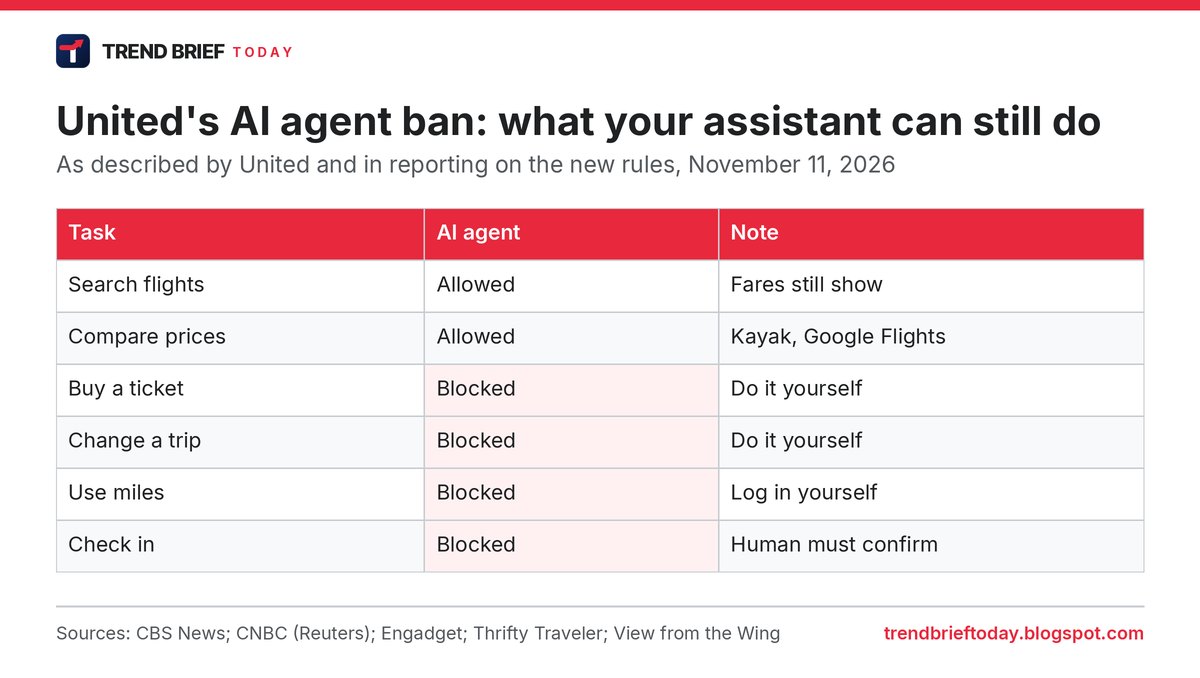
| Still allowed | Searching and comparing United flights and fares[5][6] |
| Reasons given | Data security, unintended purchases, FAA and DOT rules[1][2] |
| CEO | Scott Kirby |
| First? | First US airline to say so explicitly[4][6] |
What United announced
In a statement on Wednesday, United said it "is taking steps to restrict access, directly within our digital platforms and indirectly via travel agencies and aggregators, to prohibit use by unauthorized, third-party personal AI agents or assistants". It is updating its booking, ticketing and distribution policies to match.[1][2][4]
An AI agent here means software that does a task for you rather than just answering a question: you tell it to find and buy a flight, and it logs in, fills the forms and pays. To do that it needs your account login and payment details, which is where United draws the line.[1] Skift and Thrifty Traveler both describe United as the first US airline to say outright that it will restrict these tools.[4][6]
View from the Wing, which read the revised contract of carriage dated November 11, reports that a new rule bans "the use of AI Agents to make, modify or service a Ticket, and/or to purchase any service or product", that the ban applies even when a customer supervises or approves what the software does, and that another rule lets United cancel reservations made or serviced by such agents.[5]
Why United says it is doing this
United gave two kinds of reason. The first is security. "Sharing account credentials with personal, third-party, AI assistants can expose sensitive information, and actions taken by these tools may result in unintended purchases, account changes, or use of MileagePlus miles," the airline said.[1][2]
The second is regulation. United says an AI tool doing things like checking in could clash with Federal Aviation Administration and Department of Transportation rules. Its example is the check-in step where a passenger confirms their bags hold no prohibited items such as explosives, which United says only a human can acknowledge.[1][2][3]
Then there is the reason analysts keep pointing to. At an event in Chicago on Tuesday, a day before the announcement, CEO Scott Kirby said of AI agents: "To be honest, I don't want to create another middleman."[3][5][6] Henry Harteveldt of Atmosphere Research Group told CBS News that United does not want "yet another, and potentially even more powerful, intermediary" on top of Google, metasearch sites and online travel agencies, and added that "flight searches cost airlines money".[1]

Can my AI assistant still find United flights?
Yes. The ban is about completing transactions, not about research. The Wall Street Journal, as cited by View from the Wing, reports that agents can still present United flights and prices, and Thrifty Traveler puts it simply: your assistant can pull up United flights and fares, it just cannot buy them for you.[5][6]
United fares will also stay on flight search sites such as Kayak, Hopper and Google Flights, Harteveldt told CBS News, so finding a good fare should not get any harder. "But by blocking the AI bots, United won't make it any easier to find its fares, either," he said.[1]
How United will spot an agent booking made through a travel site is an open question. View from the Wing argues that a ban written into a contract is not a technical block, and that a purchase completed on a site like Expedia may simply look like an Expedia booking to the airline.[5]
Are other companies doing the same?
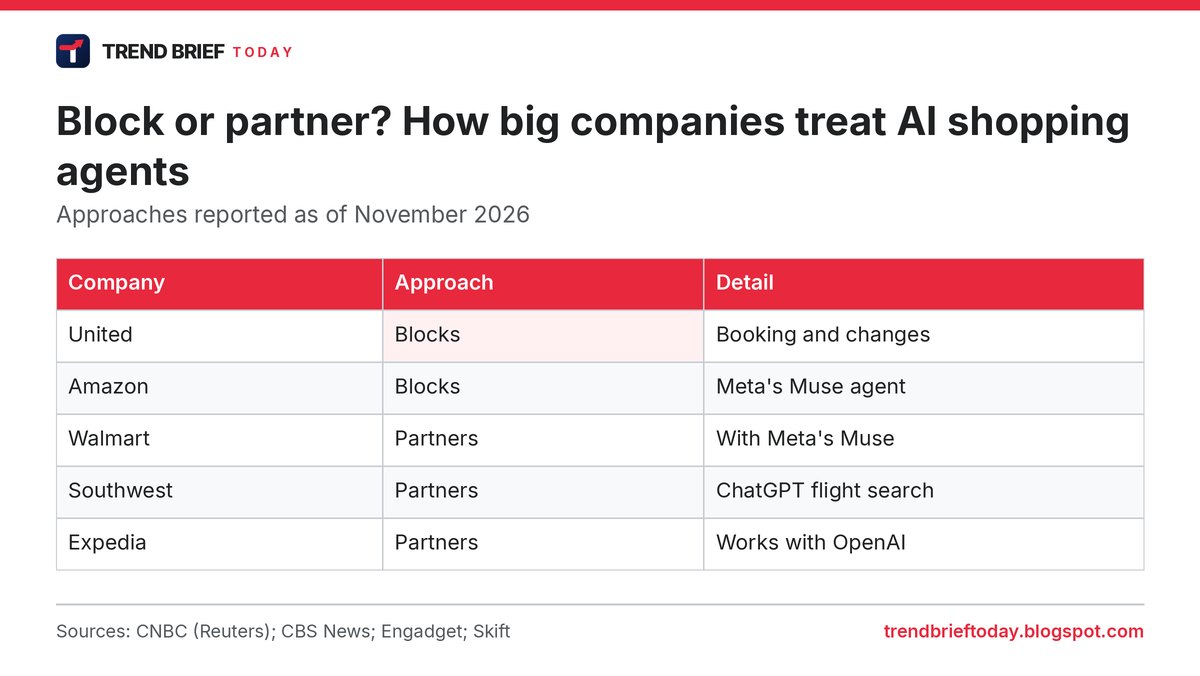
Not all of them. Reuters, via CNBC, notes that Amazon has blocked Meta's agent Muse while Walmart has partnered with it, and that online travel firms Expedia and Booking are working with OpenAI.[2] Engadget adds JPMorgan Chase to the list of businesses blocking agents.[3] Among airlines, Southwest has gone the other way, making its flight inventory available to ChatGPT users through a plug-in.[1][3][4]
Real use is still small. Engadget points to Uber's third-quarter call: in the week of Halloween, AI agents were behind 500 Uber Eats orders and four rides out of 320 million trips and deliveries.[3] View from the Wing makes a similar point, that United is acting while agent bookings are still rare, which makes it a cheap moment to say no.[5]
What this means if you book with AI
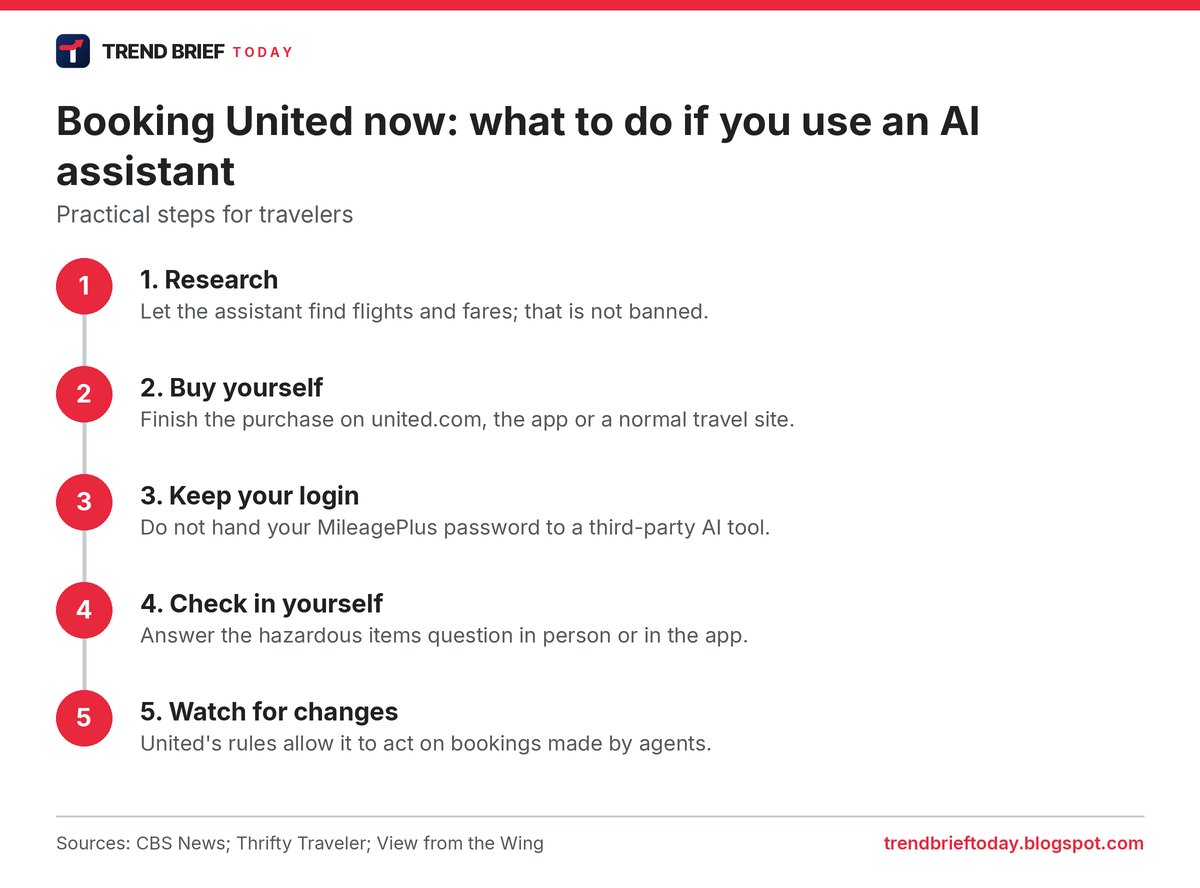
For most travelers, very little changes today. If you already search on Google Flights or ask a chatbot for ideas, keep doing it. The practical rule is to let the AI do the research and then finish the purchase yourself on united.com, the United app or a normal travel site, logged in as you.[1][6]
Keep your MileagePlus password away from third-party AI tools. That is United's main stated worry, and under the revised rules a booking made or changed by an agent can be cancelled by the airline, according to View from the Wing's reading of the contract.[1][5] Do your own check-in, too, because the hazardous items declaration is the step United says needs a human.[1][3]
Frequently asked questions
Is United Airlines banning AI?
No. It is banning unauthorized third-party personal AI agents from booking, changing or servicing its tickets. Searching for flights with AI is still fine.[1][5][6]
When did the United AI agent ban start?
United announced it on Wednesday, November 11, 2026, and View from the Wing reports a contract of carriage revision dated the same day.[1][5]
Does the ban apply to Expedia and other travel sites?
United says it will restrict agent use indirectly through travel agencies and aggregators as well as on its own platforms.[1][2][4]
Which AI agents are affected?
Any unauthorized personal AI agent or assistant. Reports name Meta's Muse and xAI's Grok as examples of the kind of tool covered.[1][6]
Do other US airlines ban AI agents?
United is the first US airline to say so explicitly. Southwest has instead opened its flight search to ChatGPT users.[4][1]
References
- "United Airlines bans AI agents from booking flights on behalf of travelers". CBS News (MoneyWatch). November 11, 2026. cbsnews.com
- "United Airlines moves to block AI agents from its platform over security concerns". Reuters (via CNBC). November 11, 2026. cnbc.com
- "United is restricting AI agents from booking flights". Engadget. November 11, 2026. engadget.com
- "United Airlines Moves to Block Personal AI Agents From Booking Flights". Skift. November 11, 2026. skift.com
- Leff, Gary. "United Airlines CEO Scott Kirby Bans AI Agents From Booking Tickets, Doesn't Want 'Another Middleman'". View from the Wing. November 11, 2026. viewfromthewing.com
- Newman, Jackson. "United Blocks Personal AI Agents from Booking Flights, Will Other Airlines Follow?". Thrifty Traveler. November 11, 2026. thriftytraveler.com