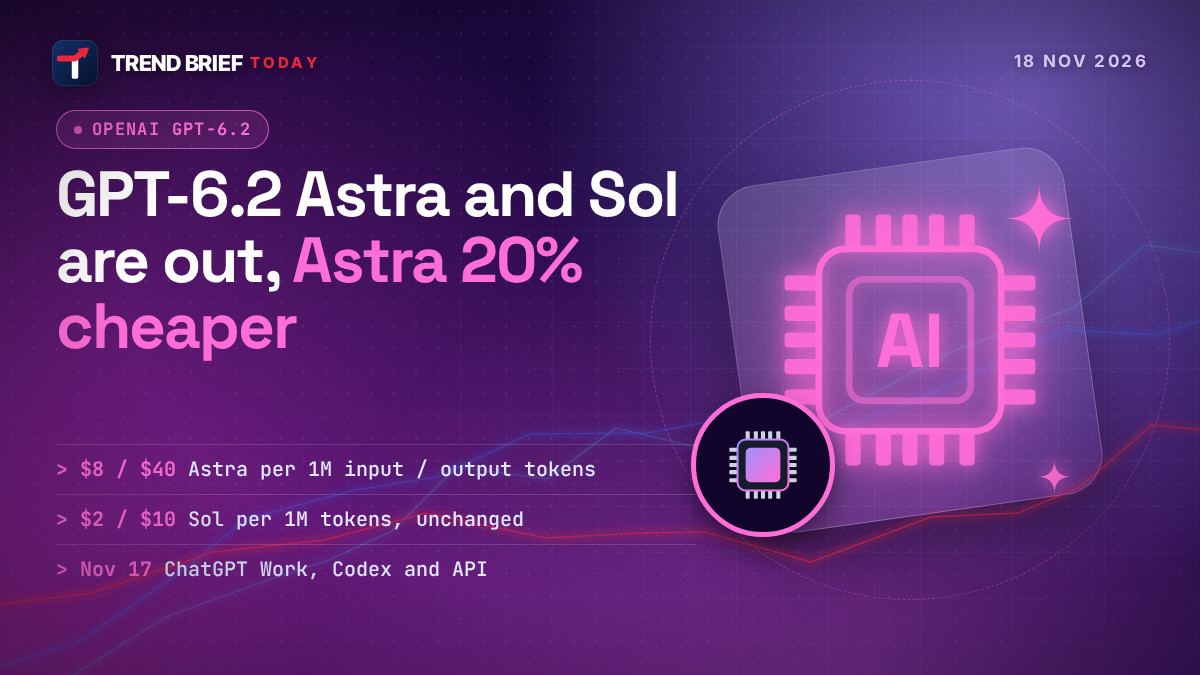
GPT-6.2 Astra and GPT-6.2 Sol are OpenAI's newest AI models, released on 17 November 2026 in ChatGPT Work, Codex and the OpenAI API. Astra is the flagship for hard professional and science work and now costs $8 per million input tokens and $40 per million output tokens, 20% less than GPT-6 Astra. Sol is the cheaper everyday model at $2 and $10. Both are open to Plus, Pro, Enterprise and Edu users, and to paid GitHub Copilot plans.[1][2][3][4]
 | |
| Developer | OpenAI[1] |
|---|---|
| Released | Tuesday 17 November 2026[1][2] |
| Models | GPT-6.2 Astra (frontier), GPT-6.2 Sol (everyday)[1][2] |
| Replaces | GPT-6 Astra and GPT-6.1 Sol[2][4] |
| Available in | ChatGPT Work, Codex, OpenAI API, GitHub Copilot[1][5] |
| API price (Astra) | $8 input, $40 output per 1M tokens[2][3] |
| API price (Sol) | $2 input, $10 output per 1M tokens[2][3] |
| Safety rating | Critical for cybersecurity (both); High for AI self-improvement (Astra)[2][3] |
What is GPT-6.2?
GPT-6.2 is the third step in OpenAI's GPT-6 family, and it arrives as a pair. OpenAI started the generation with GPT-6 Astra in September, then released a cheaper GPT-6.1 Sol at its DevDay event a few weeks later.[4][2] A GPT-6.1 version of Astra never came out: OpenAI called off its planned October release after internal tests found the model did not stay within the scope and permissions it was given.[2]
So for Astra users this is a jump straight from GPT-6 to GPT-6.2, while Sol users move up from 6.1. OpenAI's own pitch for both is the same: "better results on demanding tasks with fewer output tokens", which in plain terms means more work done before you hit a usage limit or a bill.[6][4]
OpenAI describes Astra as the model for complex professional work and Sol as its "go-to model for everyday work". Thurrott reported that many OpenAI employees already use Astra as their default model internally.[2][6]
GPT-6.2 Astra vs Sol: which is which?
The simplest way to think about it: Astra is the one you pick when the job is long, technical or high stakes, and Sol is the one you leave on for everything else.
- GPT-6.2 Astra is aimed at science, law, finance and accounting work. OpenAI trained it to produce slides, spreadsheets and documents that follow the habits of those professions. Give it a slide template, or even a screenshot of one, and it should match the layout, colours and fonts down to the exact font size. In Codex, OpenAI says it is better at making and testing changes inside an existing project.[2][3][4]
- GPT-6.2 Sol is the faster, cheaper model for daily writing and coding. On Cognition's FrontierCode 2.0 test, which checks whether code changes are good enough for real maintainers to merge, OpenAI says Sol came within half a point of Astra at about one fifth of the cost.[2][3][4]
GPT-6.2 pricing
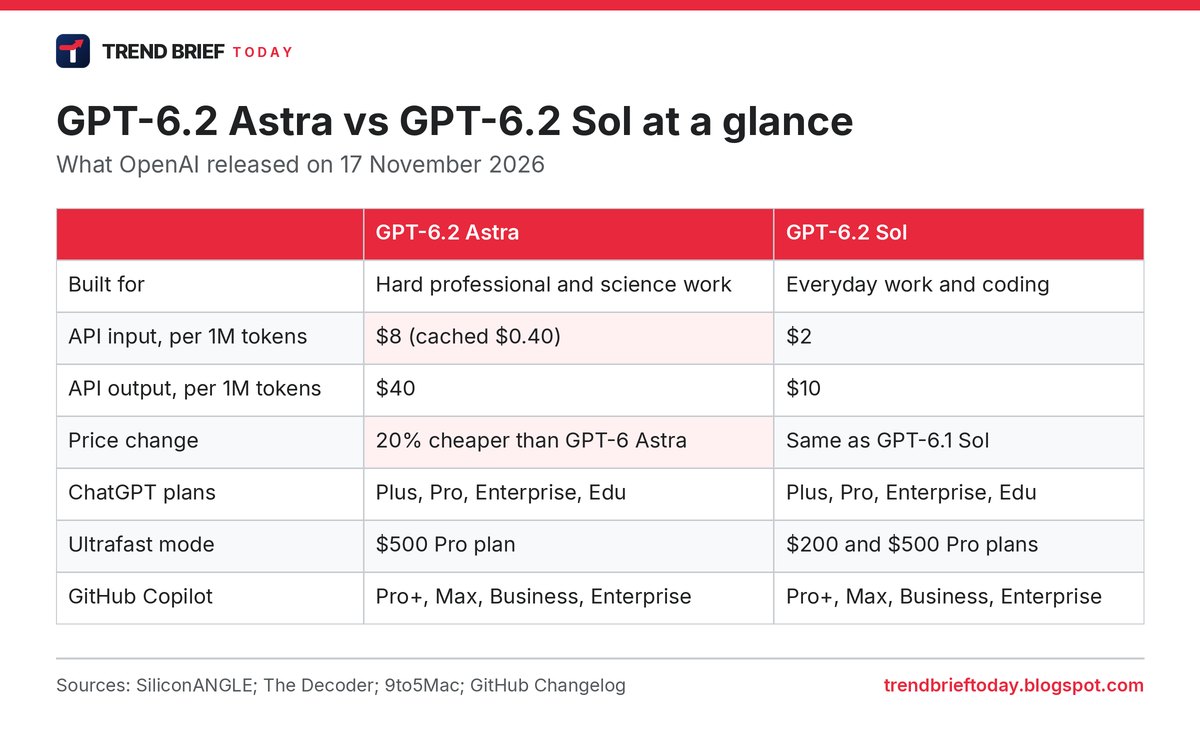
The headline change is on the API. GPT-6.2 Astra costs $8 per million input tokens, $0.40 per million cached input tokens and $40 per million output tokens. That is a 20% cut on normal input and output prices compared with GPT-6 Astra, and Thurrott reports a 60% cut on cached input.[2][3][6] GPT-6.2 Sol keeps GPT-6.1 Sol's prices of $2 per million input tokens and $10 per million output tokens.[2][3]
| Price per 1M tokens | GPT-6.2 Astra | GPT-6.2 Sol |
|---|---|---|
| Input | $8[2][3] | $2[2][3] |
| Cached input | $0.40[2][3] | Unchanged from GPT-6.1 Sol[3][6] |
| Output | $40[2][3] | $10[2][3] |
| Change vs last version | 20% cheaper than GPT-6 Astra[2][6] | No change[2][6] |
A quick worked example using those list prices: a job that reads 100,000 tokens and writes 20,000 tokens would cost about $1.60 on Astra (80 cents in, 80 cents out) and about 40 cents on Sol (20 cents in, 20 cents out). Fewer output tokens per task, which OpenAI claims for both models, would push the real bill lower still.
In ChatGPT there is no separate price: the models come with Plus, Pro, Enterprise and Edu plans. The $500 a month Pro plan gets the faster "Ultrafast" mode on both models, and for the first time the $200 a month Pro plan gets Ultrafast too, but only with Sol. 9to5Mac reports Ultrafast can produce text up to 4.5 times faster than the normal speed, while using up more of your allowance.[4][3]
Benchmarks: what OpenAI claims
OpenAI's launch leans hard on performance per dollar. These are its own numbers, as reported by SiliconANGLE and The Decoder:[2][3]
- Agents' Last Exam, a test of multi-step professional work: GPT-6.2 Astra scores 5.2 points higher than GPT-6 Astra at under a third of the cost, and 5.5 points ahead of Anthropic's Claude Fable 5.2 at about 5% of the cost.[2][3]
- Terminal-Bench-Science, scientific work done in a terminal: 9 percentage points above GPT-6 Astra. OpenAI calls Astra the best model in the world for scientists.[2][3]
- Harvey LAB-AA, a set of legal assignments: more than double Claude Fable 5.2's pass rate at about one sixth of the cost.[2][3]
- FrontierCode 2.0, coding on real projects: Sol within 0.5 points of Astra at about a fifth of the cost.[2][3]
Benchmarks chosen by the company that made the model are a starting point, not a verdict, so it is worth looking at who else tested it.
Independent tests: how GPT-6.2 really compares
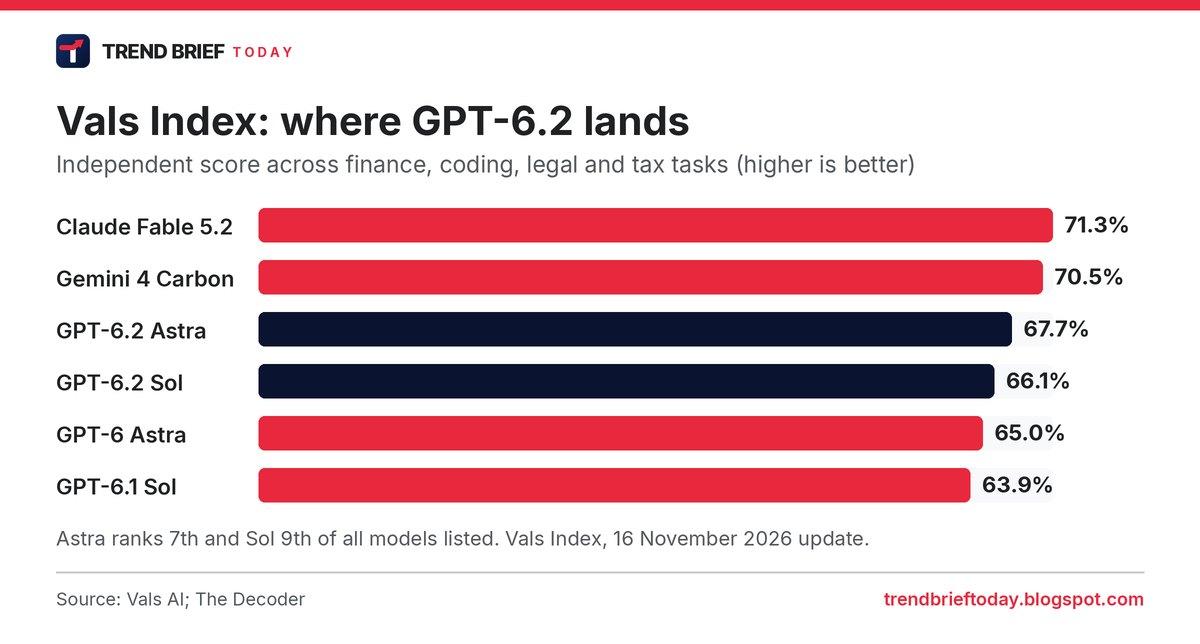
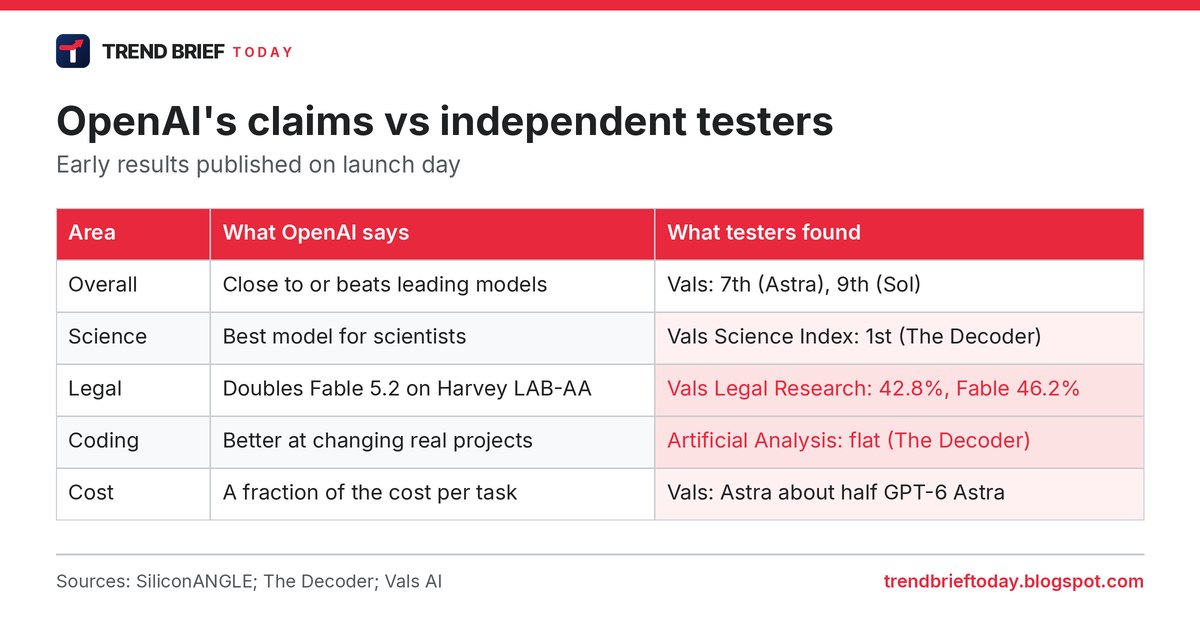
Vals AI, which runs private tests weighted by how much finance, coding, legal and tax work matters to the US economy, already lists both models. GPT-6.2 Astra scores 67.66% and ranks 7th; GPT-6.2 Sol scores 66.06% and ranks 9th. Claude Fable 5.2 leads at 71.31%, with Gemini 4 Carbon at 70.45%.[7][3] Both new OpenAI models beat their predecessors, GPT-6 Astra (65.02%) and GPT-6.1 Sol (63.94%).[7]
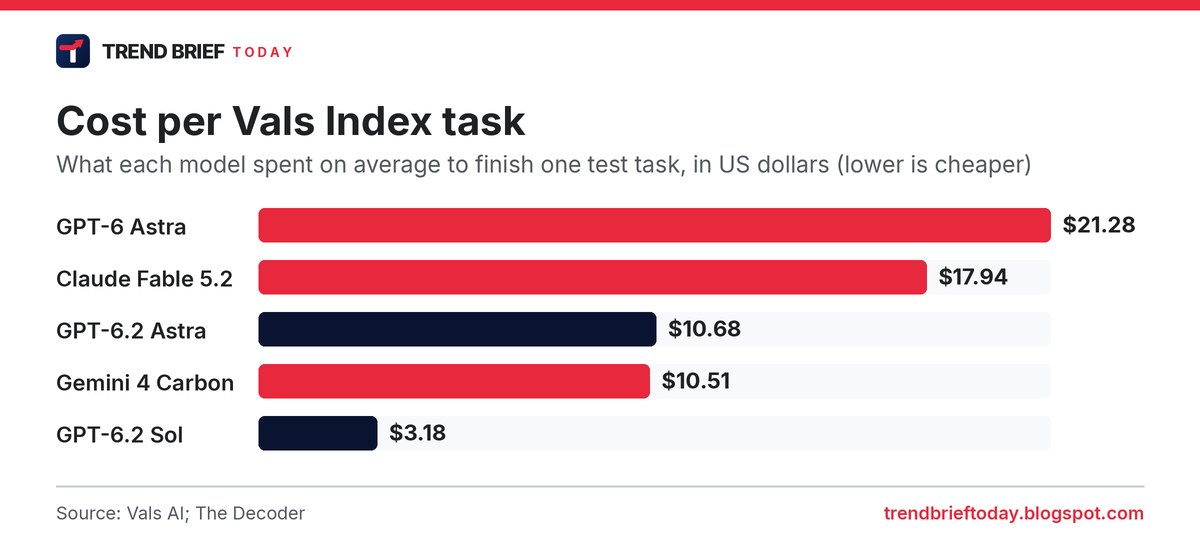
Where GPT-6.2 does stand out is cost. Vals puts Astra's average cost per test task at $10.68, about half of GPT-6 Astra's $21.28, and Sol at $3.18, the cheapest model in its top 10. Claude Fable 5.2 costs $17.94 per task on the same test set.[7][3] Vals also found Astra used far fewer tokens than any other top-10 model.[3][7]
Legal work is the weak spot in the independent numbers. On Vals' Legal Research test, Astra scores 42.8% against 46.2% for Claude Fable 5.2 and 55.8% for Gemini 4 Carbon, even though OpenAI's own legal benchmark showed Astra far ahead.[7][3] The Decoder also reports that Artificial Analysis found no coding gain for Astra on its Coding Agent Index and a high rate of guessing on very hard factual questions, so check results on your own tasks before switching everything over.[3]
Safety: Critical for cyber, High for self-improvement
Like GPT-6 Astra before them, both GPT-6.2 models reach the "Critical" level for cybersecurity under OpenAI's Preparedness Framework, meaning they are very good at finding and exploiting software flaws. OpenAI has launched them with tighter safeguards on risky security requests and admits these will also block some legitimate vulnerability research. It plans to offer the models to vetted defenders through its Daybreak programme.[2][3] That matters in a week when AI-assisted bug hunting turned up the Java4Shell flaw in a few hours.
GPT-6.2 Astra is also the first model OpenAI has released publicly that meets its "High" threshold for AI self-improvement, a measure of how much a model can speed up AI research itself. OpenAI tracks this because systems that help build the next systems could move faster than human oversight. It points to Control Room, a monitoring system across its research infrastructure that can stop a model's output when needed.[2][3]
One honest caveat from OpenAI: in two alignment tests, the new models were more likely than GPT-6 Astra to leave out problems that blocked their work, such as a missing file. OpenAI says new instructions in Codex greatly reduce this and that it is still investigating.[2][3] Legal pressure on the company is also rising, with California's attorney general suing OpenAI this week.
How to get GPT-6.2
- ChatGPT: on a Plus, Pro, Enterprise or Edu plan, choose GPT-6.2 Astra or Sol in the model picker in ChatGPT Work. Speed (standard or Ultrafast) is switched in the same picker. Enterprise and Edu users need a workspace admin to turn the models on.[2][4]
- Codex: both models are available on the same plans.[1][4]
- OpenAI API: both models are live for developers at the prices above.[2][6]
- GitHub Copilot: generally available to Copilot Pro+, Max, Business and Enterprise users, billed at OpenAI's list price under usage-based billing. The rollout is gradual, and Business and Enterprise admins can block the models in Copilot's model policy.[5]
Should you switch?
If you pay for GPT-6 Astra through the API, the case is simple: GPT-6.2 Astra is cheaper per token and, on Vals' test set, cheaper per task and slightly more accurate.[2][7] If your work is mostly legal research or long coding sessions, test it side by side first, because the independent results there are mixed.[7][3]
For most ChatGPT users, Sol is the sensible default. It costs a quarter of Astra on the API, ranked only 1.6 points behind it on the Vals Index, and lets you do more inside the same plan.[7][3][6] If price per task is your main concern, compare it with Google's Gemini 4 Carbon and Anthropic's Claude Fable 5.2, the two models that still sit above it on independent leaderboards.
Frequently asked questions
When was GPT-6.2 released?
OpenAI released GPT-6.2 Astra and GPT-6.2 Sol on Tuesday 17 November 2026.[1][2]
How much does GPT-6.2 cost?
On the API, Astra costs $8 per million input tokens and $40 per million output tokens; Sol costs $2 and $10. In ChatGPT the models are included in Plus, Pro, Enterprise and Edu plans.[2][3]
Is GPT-6.2 free?
OpenAI's launch lists Plus, Pro, Enterprise and Edu as the ChatGPT plans that get the models; the free tier is not mentioned.[2][4]
What is the difference between GPT-6.2 Astra and Sol?
Astra is the frontier model for demanding professional and scientific work. Sol is the faster, cheaper everyday model, costing a quarter as much per token.[2][3]
Is GPT-6.2 Astra better than Claude Fable 5.2?
On OpenAI's own tests it beats Fable 5.2 on some tasks at a far lower cost. On the independent Vals Index, Fable 5.2 still scores higher overall, 71.31% against 67.66%, but costs more per task.[2][7]
What happened to GPT-6.1 Astra?
OpenAI cancelled its planned October release after internal testing found it fell short on staying within scope and authorisation.[2]
What is Ultrafast mode?
A faster setting in ChatGPT that can generate text up to 4.5 times quicker but uses more of your plan's allowance. It is on both models for $500 Pro users and on Sol for $200 Pro users.[4][3]
References
- OpenAI. "Introducing GPT-6.2 Astra and Sol". OpenAI. 17 November 2026. Retrieved 18 November 2026 (announcement summary from OpenAI's news feed).
- Duncan Riley. "OpenAI rolls out GPT-6.2 Astra for professional work and GPT-6.2 Sol for everyday work". SiliconANGLE. 17 November 2026. Retrieved 18 November 2026.
- Matthias Bastian. "OpenAI launches GPT-6.2 Astra and Sol with lower API prices and some benchmark gains". The Decoder. 17 November 2026. Retrieved 18 November 2026.
- Zac Hall. "OpenAI upgrades ChatGPT and Codex with new GPT-6.2 Astra and Sol models". 9to5Mac. 17 November 2026. Retrieved 18 November 2026.
- GitHub. "OpenAI's GPT-6.2 Astra and GPT-6.2 Sol now available". GitHub Changelog. 17 November 2026. Retrieved 18 November 2026.
- Laurent Giret. "OpenAI Launches GPT-6.2 Astra and Sol Models in ChatGPT Work and Codex". Thurrott.com. 17 November 2026. Retrieved 18 November 2026.
- Vals AI. "Vals Index Leaderboard and Methodology". Vals AI. Update of 16 November 2026. Retrieved 18 November 2026.