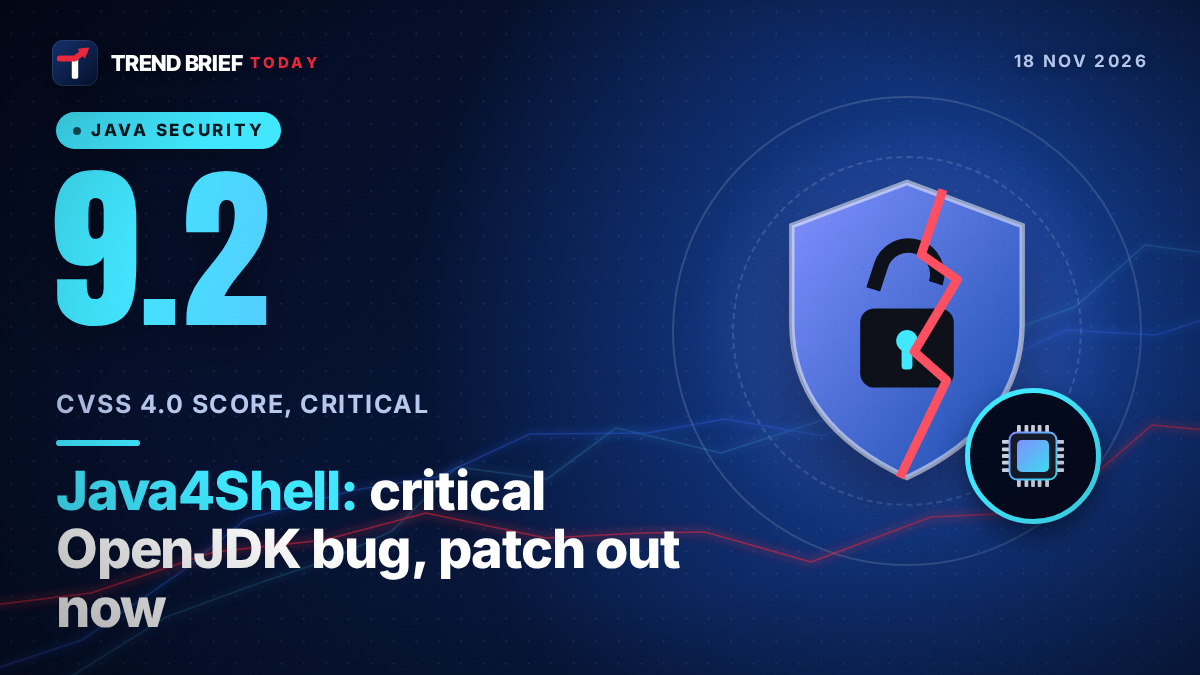
Java4Shell (CVE-2026-114938) is a critical memory-corruption bug in the Base64 decoder of OpenJDK, the code behind almost every Java runtime. It affects OpenJDK 17.0.6 and later, including Oracle Java, Amazon Corretto, Eclipse Temurin and Microsoft's build, but only on x86-64 servers whose CPUs support AVX-512 VBMI. Fixes came out on 17 November 2026, and researchers say they used it to take over Jira, Confluence, Jenkins and Keycloak without a password.[1][2][3]
 | |
| CVE | CVE-2026-114938[4] |
|---|---|
| Disclosed | Tuesday 17 November 2026[1][2] |
| Component | OpenJDK HotSpot x86-64 Base64 intrinsic (java.util.Base64)[1][6] |
| Severity | 9.2 critical (CVSS 4.0, Calif); 8.1 high (CVSS 3.1, Oracle and OpenJDK)[2][4][6] |
| Affected | OpenJDK 17.0.6 and later, and builds made from it[1][2] |
| Hardware | x86-64 CPUs with AVX-512 VBMI only; ARM64 not affected[1][2] |
| Found by | Quang Luong of Calif, using OpenAI's Codex[1][2][3] |
| Fix | OpenJDK and Oracle updates, 17 November 2026[1][6] |
What is Java4Shell?
Java is meant to be memory-safe. The language checks every array access, so the buffer-overflow bugs that plague C programs should not happen in Java code. But parts of the Java runtime itself are written in C, C++ and hand-written assembly, and that is where this bug lives.[1]
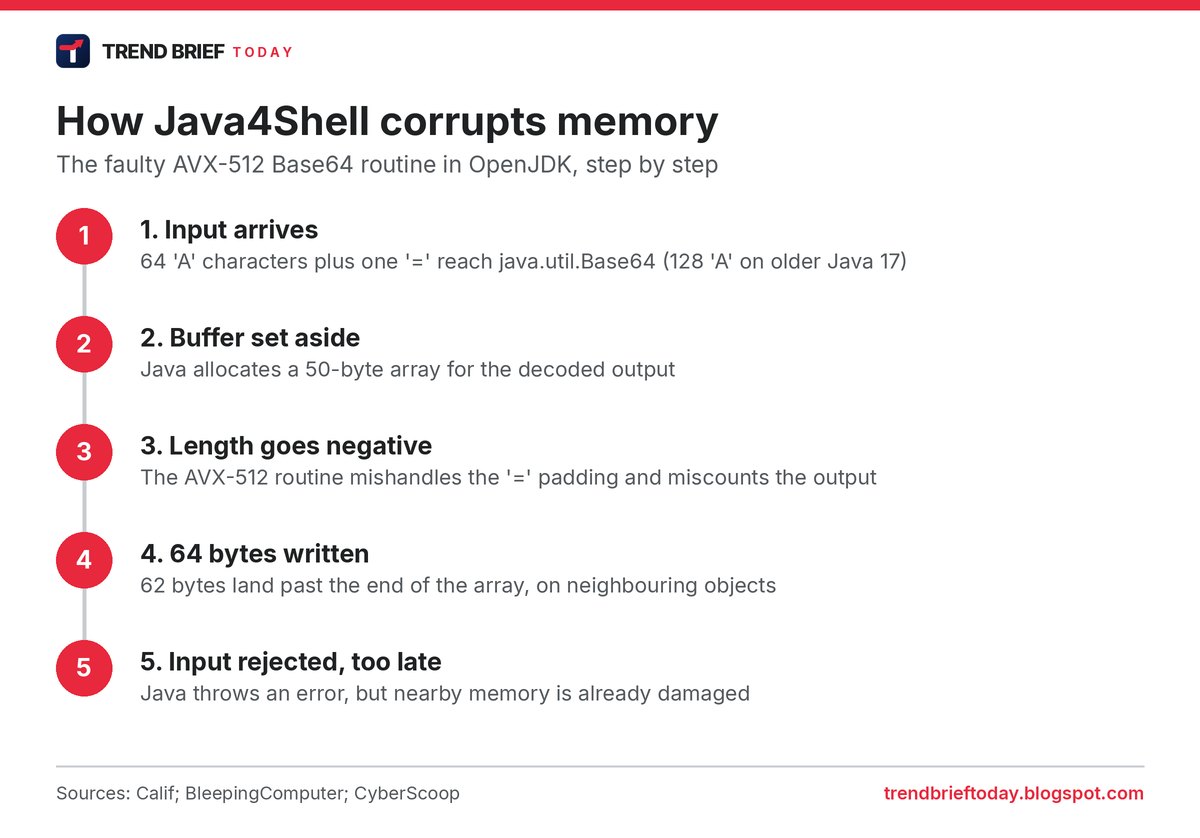
To decode Base64 text faster, OpenJDK's HotSpot virtual machine swaps the normal Java decoder for a hand-tuned machine-code routine, called an intrinsic, once the decoder has been used often enough. On x86-64 processors that support a set of instructions called AVX-512 VBMI, that routine handles 64 bytes at a time. Calif found that it gets the length wrong when the end of the input is padding, the "=" character that Base64 uses to round out a block.[1][6]
The trigger is tiny: 64 letter "A" characters followed by a single "=". For that 65-character input, Java sets aside a 50-byte output buffer, but the faulty routine writes a full 64 bytes, so 62 bytes land past the end of the buffer. Java rejects the bad input a moment later, but by then the memory next to it may already be damaged. On older OpenJDK 17 builds the trigger is 128 "A" characters and "=".[1][2][3]
Base64 is everywhere in server software. It carries login tokens, file uploads and network messages, which is why ordinary features such as sign-in pages can feed attacker data straight into the faulty decoder.[1][2]
Which Java versions are affected?
Calif says Java4Shell affects OpenJDK 17.0.6 and every newer release, and all the popular distributions built from that code: Amazon Corretto, Eclipse Temurin, the Microsoft Build of OpenJDK, Azul Zulu, BellSoft Liberica, SAP SapMachine, Red Hat OpenJDK, Oracle OpenJDK, Oracle Java SE and Oracle GraalVM for JDK.[1][2] Rapid7's early alert on Tuesday likewise described a pre-authentication remote code execution bug in Java 17 and above.[7]
Oracle's own CVE record lists these affected builds: Oracle Java SE 8u511b33-perf, 17.0.21.0.3, 21.0.13.0.3, 25.0.5.0.3 and 27.0.1.0.3; Oracle GraalVM for JDK 17.0.21.0.3 and 21.0.13.0.3; and GraalVM Enterprise Edition 21.3.20.0.3.[4][1] The only Java 8 entry is the Enterprise Performance Pack build, and early code reviews by the security firms Upwind and Equixly found the faulty routine in Java 17, 21, 25 and 27 but not in standard Java 8 or 11.[5][4]
Oracle is also telling its customers to move every supported line to new builds, because the same 17 November update fixed 11 Java SE flaws in total. The Hacker News listed the replacement builds from Oracle's ops.java site, and Oracle's 17.0.21.1 release notes link the fix to its November advisory.[5][6]
| Java line | Hit by Java4Shell? | Oracle build to move to |
|---|---|---|
| Java 8 | Only the 8u511 Performance Pack build is listed[4] | 8u513[5] |
| Java 11 | Not listed as affected[4][5] | 11.0.33.1[5] |
| Java 17 | Yes, from 17.0.6[1] | 17.0.21.1[5][6] |
| Java 21 | Yes[1][4] | 21.0.13.1[5] |
| Java 25 | Yes[1][4] | 25.0.5.1[5] |
| Java 27 | Yes[1][4] | 27.0.1.1[5] |
If you use Corretto, Temurin, Zulu or another vendor build, the Oracle numbers above do not apply: install that vendor's November 2026 security release instead.[1][2]
Which CPUs are affected?
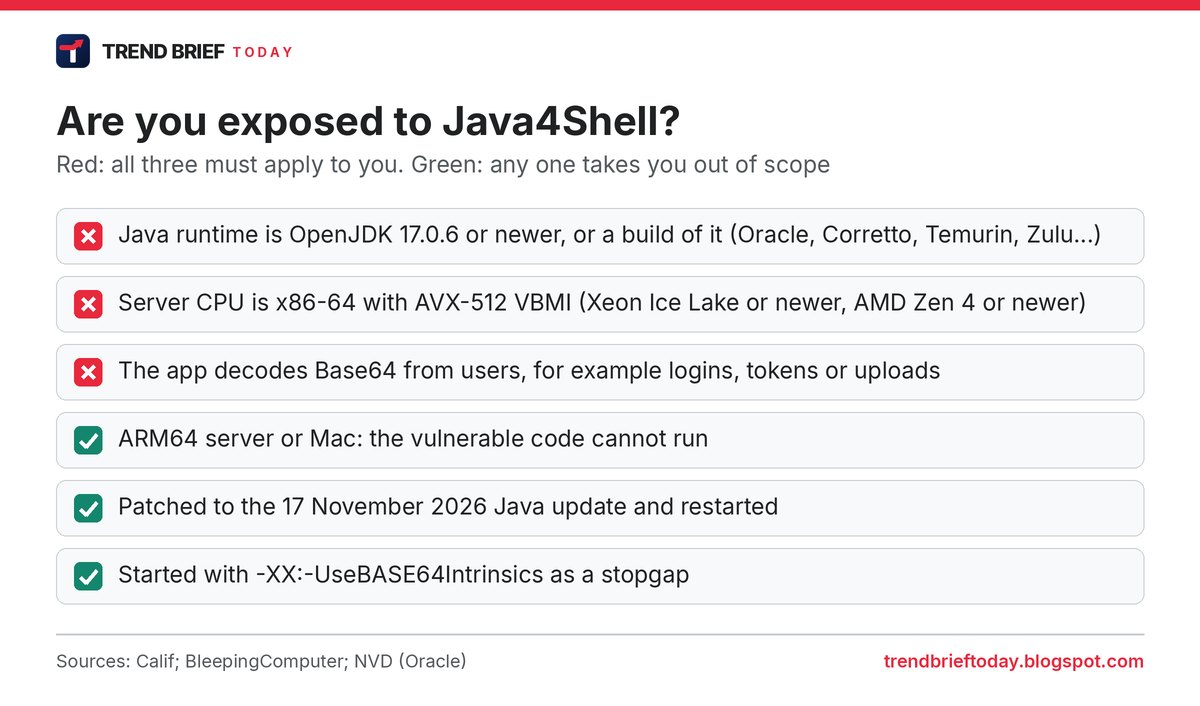
This is the part that makes Java4Shell smaller than its name suggests. The faulty code only runs on x86-64 processors with AVX-512 VBMI support. ARM64 processors are not affected at all.[1][2][3]
According to Calif, the common chips that meet the requirement are Intel Xeon Ice Lake, Sapphire Rapids, Emerald Rapids and Granite Rapids, and AMD EPYC and Ryzen processors on Zen 4 or newer.[1][6] Many current cloud servers use those chips, so "it is only some CPUs" is not a reason to skip the update.
On Linux, Calif gives this check, and all four flags must appear for a machine to be at risk:[1]
grep -m1 '^flags' /proc/cpuinfo | tr ' ' '\n' | grep -E '^(avx512f|avx512bw|avx512vbmi|bmi2)$'
We ran it on the ARM64 cloud server that builds this site. It printed nothing, which is what Calif's advice predicts for ARM: the vulnerable routine cannot run there. On an x86-64 server you should see avx512f, avx512bw, avx512vbmi and bmi2 listed if the hardware qualifies.
Which apps can be hacked?
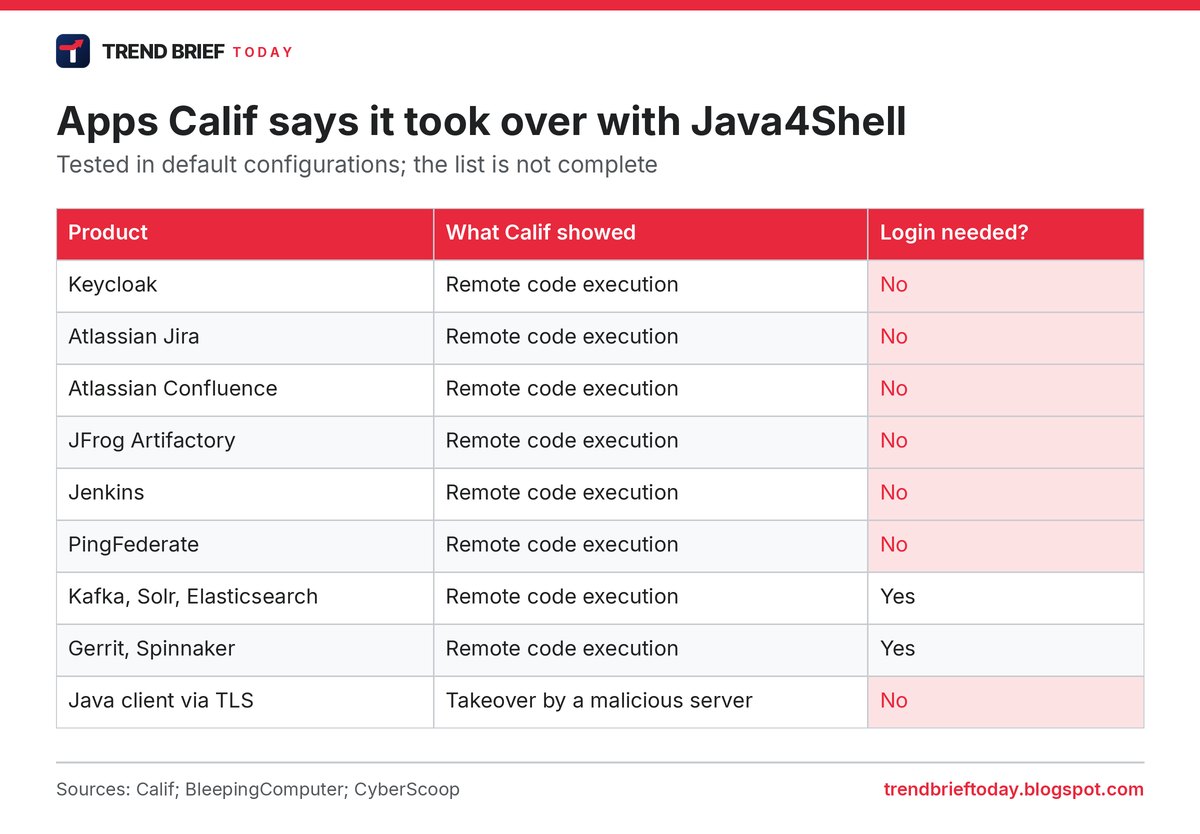
Calif says it got remote code execution, meaning it could run its own commands on the server, in widely used Java products in their default settings:[1][2]
- Without logging in: Keycloak, Atlassian Jira, Atlassian Confluence, JFrog Artifactory, Jenkins and PingFederate.[1][2]
- With a valid account: Apache Kafka broker, Apache Solr, Elasticsearch, Gerrit and Spinnaker.[1][2]
- Sample apps: test applications built on Apache Struts and Spring Boot.[1][2]
The lists are not complete, Calif says. A Java program does not even need to run a server to be at risk: a separate exploit by the researcher samczsun showed that a Java client opening a TLS connection to a malicious server can be compromised.[1][3]
Before code execution, the same trick lets an attacker read chunks of the Java heap, much as the 2014 Heartbleed bug leaked memory from web servers. Calif calls that stage "JavaBleed" and warns the heap can hold personal data, private keys and tokens.[1][3]
How hard is it to exploit?
Harder than the scary headline, but not hard enough to wait. Oracle rates it "difficult to exploit", with high attack complexity, but says an attacker needs no account and success means full takeover of the Java runtime.[4][6] Calif agrees there is no universal exploit: each product needs its own recipe, the attack is sensitive to network delay, and a bad attempt can crash the Java process, though the attacker can often just try again.[1][2]
Before Calif's write-up went live, Upwind and Equixly read the patch and expected a crash rather than code execution, because the bytes written past the buffer are fixed and not chosen by the attacker.[5] Calif's answer was to use that small fixed write to change the length field of a nearby array, which turned it into a write of its own choosing.[1]
Calif is keeping its product-specific exploit chains private "until everyone has had a chance to upgrade". Gal Elbaz, co-founder of Oligo Security, told CyberScoop the barriers are "clearly surmountable" and that organisations should treat it as a serious exposure.[1][3]
Found with AI in one hour
Calif says its researcher Quang Luong found the bug in about an hour while pointing OpenAI's Codex at the JIT compiler, intrinsics, cryptography and other parts of HotSpot, and built the first working exploit in two more hours. The total AI cost was under $200, and AI agents built most of the later exploit chains almost on their own.[1][2][3]
It is the firm's second big AI-assisted find in a few weeks, after PHP2Shell. Calif argues the real lesson is about unused code: the AVX-512 speed-up helps a few programs that decode huge amounts of data, but it ships to everyone and became a risk for all of them.[1][3] We have seen the same pattern this month in Google's report of the first fully automated AI cyberattack and the SSHole OpenSSH bug.
Is Java4Shell the new Log4Shell?
The name invites the comparison, but the two bugs are different in ways that matter for anyone deciding how fast to act.
| Point | Log4Shell (2021) | Java4Shell (2026) |
|---|---|---|
| CVE | CVE-2021-44228[8] | CVE-2026-114938[4] |
| Where the bug is | Log4j logging library (JNDI lookups)[8] | Java runtime's Base64 intrinsic[1] |
| Top score | 10.0 (CVSS 3.1)[8] | 8.1 (CVSS 3.1), 9.2 (CVSS 4.0)[4][2] |
| Hardware limit | None[8] | x86-64 with AVX-512 VBMI only[1] |
| Exploit | One crafted log string[8] | Custom chain per product[1][2] |
| Fix | Upgrade a library inside each app[8] | Upgrade the Java runtime itself[1][6] |
In short, Java4Shell is harder to use at scale than Log4Shell, but the fix sits lower in the stack: you patch the Java installation, not each application's libraries. Apps that bundle their own Java runtime, which many vendor products do, need their own updates too.[1][2]
How to fix it
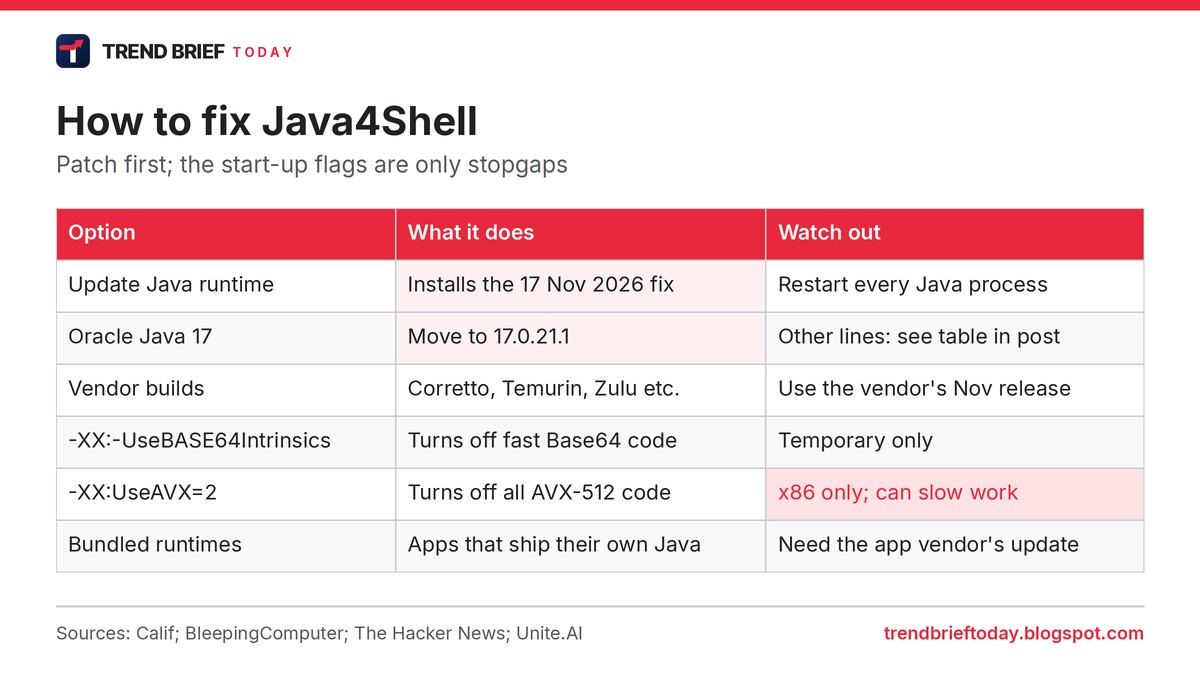
Install the Java update from whoever supplies your runtime, then restart every Java process, because a running program keeps using the old code until it restarts. Calif's advice is that "all Java users should update immediately".[1][2]
If you cannot patch yet, Calif lists two temporary start-up options for the Java command line:[1][2]
-XX:-UseBASE64Intrinsicsturns off the hardware-accelerated Base64 code.-XX:UseAVX=2turns off all AVX-512 code paths. Use it only on x86-64 hosts: Java on ARM does not recognise it and will refuse to start, and turning off AVX-512 can slow other work.[1][5]
BleepingComputer stresses that these are stopgaps and every developer should still update the runtime.[2] CyberScoop also reported that CISA issued a notice late on Tuesday calling for the patch.[3]
Frequently asked questions
What is CVE-2026-114938?
It is the CVE number for Java4Shell, a memory-corruption flaw in OpenJDK's hardware-accelerated Base64 decoder that can leak memory or let a remote attacker run code.[1][4]
Am I affected by Java4Shell?
Only if you run OpenJDK 17.0.6 or newer (or a build of it) on an x86-64 CPU with AVX-512 VBMI. Run the CPU check above and java -version to find out.[1][2]
Is Java 8 or Java 11 affected?
Calif and OpenJDK point to Java 17 and later. Oracle's list includes only the Java 8 Performance Pack build, not standard Java 8 or Java 11.[1][4][6]
Are Macs or ARM servers affected?
ARM64 processors, including Apple silicon Macs and ARM cloud servers, cannot run the vulnerable code path, so they are not affected.[1][2]
Is Java4Shell being exploited?
No attacks in the wild had been reported when CyberScoop published, and the bug was not on CISA's Known Exploited Vulnerabilities list at that time.[3]
Does it affect Minecraft or Java on my PC?
The demonstrated attacks were against servers and a Java client connecting to a malicious server. A PC is only exposed if its CPU has AVX-512 VBMI, such as AMD Ryzen chips on Zen 4 or newer, and it runs Java 17.0.6 or later. Updating Java is sensible either way.[1][3]
Who found Java4Shell?
Quang Luong of the security firm Calif, with exploit improvements by Jenish Rakholiya. Oracle also credits Albert Yang.[1][6]
References
- Quang Luong and Calif. "CVE-2026-114938 Java4Shell: Write once, RCE everywhere". Calif. 17 November 2026. Retrieved 18 November 2026.
- Lawrence Abrams. "Critical Java4Shell flaw allows RCE attacks on major Java applications". BleepingComputer. 17 November 2026. Retrieved 18 November 2026.
- Greg Otto. "A vulnpocalypse bug worthy of attention: Researchers disclose critical flaw in Java with help of AI". CyberScoop. 17 November 2026 (updated 6:00 p.m. ET). Retrieved 18 November 2026.
- National Vulnerability Database. "CVE-2026-114938" (description supplied by Oracle). NIST. Published 17 November 2026. Retrieved 18 November 2026.
- Swati Khandelwal. "Oracle to Patch 11 Java Flaws Today as Critical OpenJDK RCE (CVE-2026-114938) Report Emerges". The Hacker News. 17 November 2026. Retrieved 18 November 2026.
- Miles Okada. "Calif Uses AI to Find Java4Shell as OpenJDK and Oracle Ship Fixes". Unite.AI. 17 November 2026. Retrieved 18 November 2026.
- Rapid7. "CVE-2026-114938: Reported Critical Pre-authentication Remote Code Execution in Java 17". Rapid7. 17 November 2026. Retrieved 18 November 2026.
- National Vulnerability Database. "CVE-2021-44228" (Log4Shell). NIST. Published 10 December 2021. Retrieved 18 November 2026.