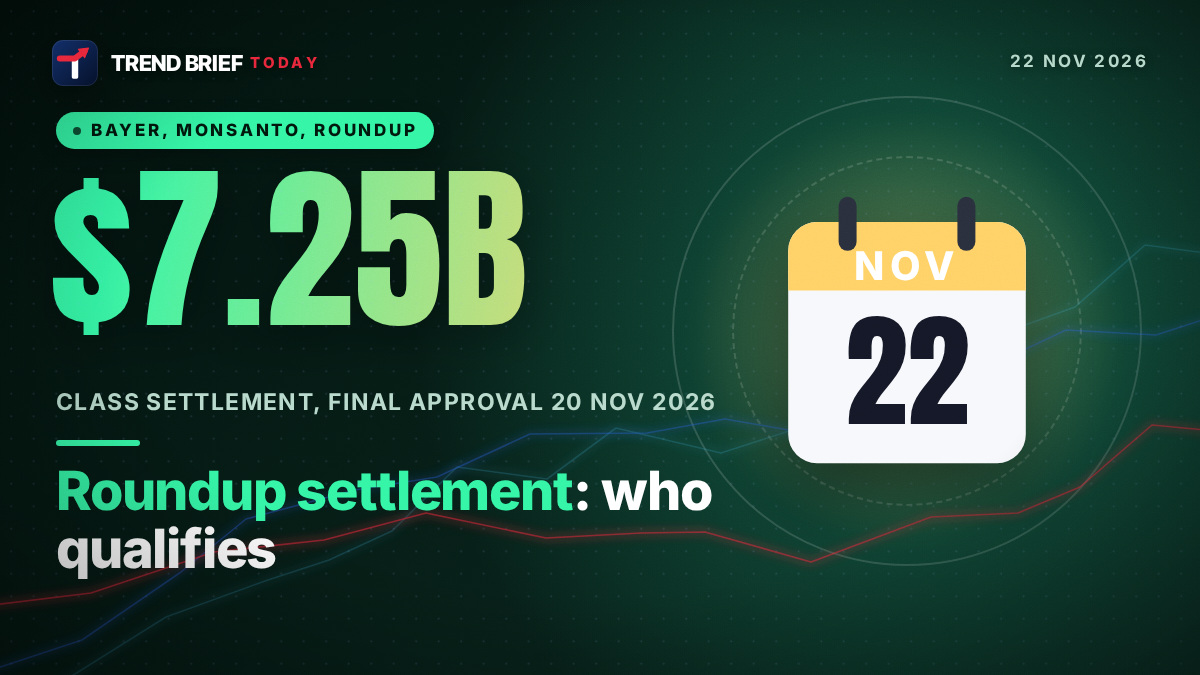
A Missouri judge gave final approval on Friday, 20 November 2026, to Bayer's $7.25 billion nationwide class settlement of Roundup cancer claims. It covers people in the US who were exposed to Roundup before 17 February 2026 and have been, or will be, diagnosed with non-Hodgkin lymphoma.[1][2][3] Payments are expected to range from about $10,000 to $165,000 per person, depending mainly on whether the exposure came through work, the age at diagnosis and the type of lymphoma.[1][2] Claims go through a portal run by the administrator BrownGreer, but payments can only start once any appeals are over.[2]
 | |
| Company | Monsanto, owned by Bayer since 2018[3] |
|---|---|
| Maximum cost | Up to $7.25 billion over the life of the deal[1][3] |
| Court | St. Louis City Circuit Court, Missouri (Judge Timothy Boyer)[3] |
| Final approval | Friday 20 November 2026[1][4] |
| Who it covers | US residents exposed before 17 February 2026 with non-Hodgkin lymphoma now or diagnosed within 16 years[2][3] |
| Typical awards | About $10,000 to $165,000 before adjustments[1][2] |
| Administrator | BrownGreer PLC (online claims portal)[2] |
| Admits liability? | No. Bayer and Monsanto deny that glyphosate causes cancer[1][2] |
What was approved on 20 November?
Judge Timothy Boyer of the St. Louis City Circuit Court approved the settlement after rejecting a long list of objections. He found the agreement "fair, reasonable, and adequate" and called it "among the largest in the history of mass tort personal-injury class action settlements".[1][2]
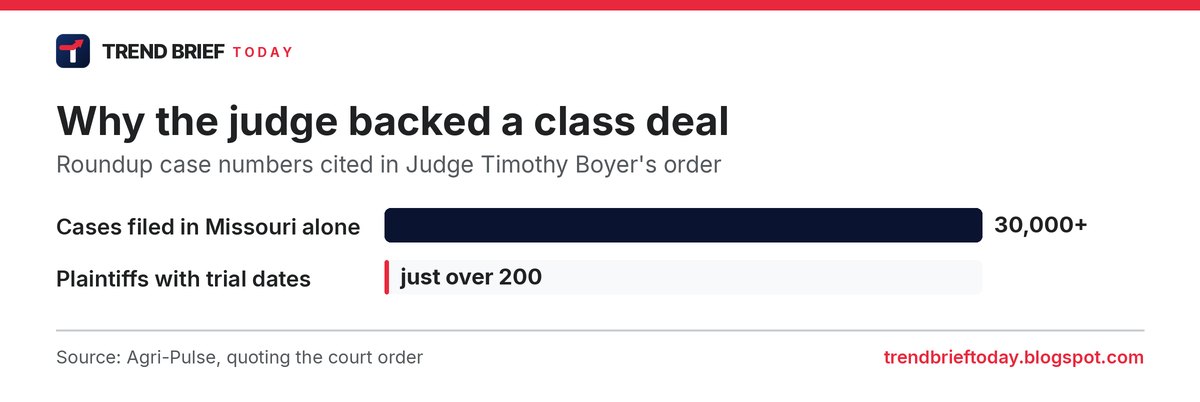
The settlement is meant to deal with both pending and future Roundup cases in one go. The judge said there are more than 30,000 cases filed in Missouri courts alone, and tens of thousands more pending elsewhere or covered by tolling agreements, while "just over 200 plaintiffs have trial dates". In his words, "it is simply impossible for the vast majority of claimants to obtain a trial date in the foreseeable future."[3]
He also said he saw no evidence of collusion, which some objectors had alleged, describing the negotiations as "extensive, hard-fought and at arm's length" over more than 18 months.[3]

Who qualifies for the Roundup settlement?
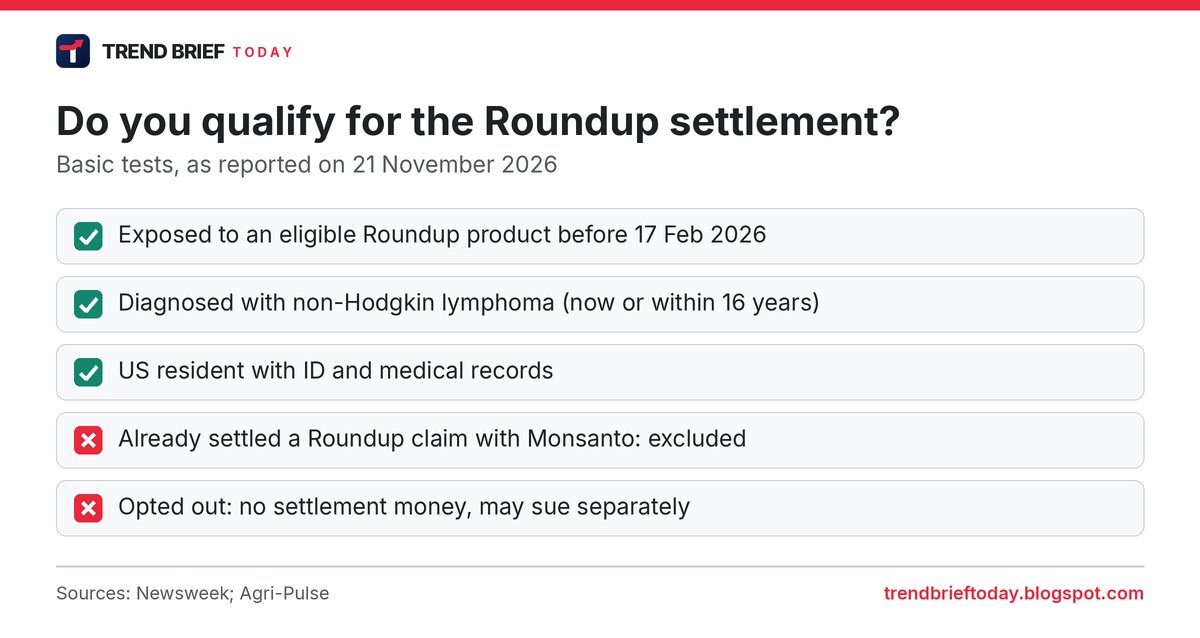
The class is split into two subclasses.[3]
- Subclass 1 (diagnosed now): people who say they were exposed to Roundup before 17 February 2026 and already have a medical diagnosis of non-Hodgkin lymphoma (NHL), a blood cancer.[2][3]
- Subclass 2 (future diagnoses): people exposed before that date who are diagnosed with NHL during the settlement's 16-year coverage period. Anyone who is never diagnosed in that time is released from the agreement and receives no money.[2][3]
To be paid, a claimant has to show a qualifying NHL diagnosis with medical records, identification, proof of US residency and enough information about their Roundup exposure.[2] People who have already settled a Roundup claim with Monsanto are excluded, according to the lead lawyer for future claimants, Eric Holland. Some earlier written agreements may also be taken into account when a payment is worked out, so anyone who signed a release in the past should check what it covers.[2]
How much could you get?
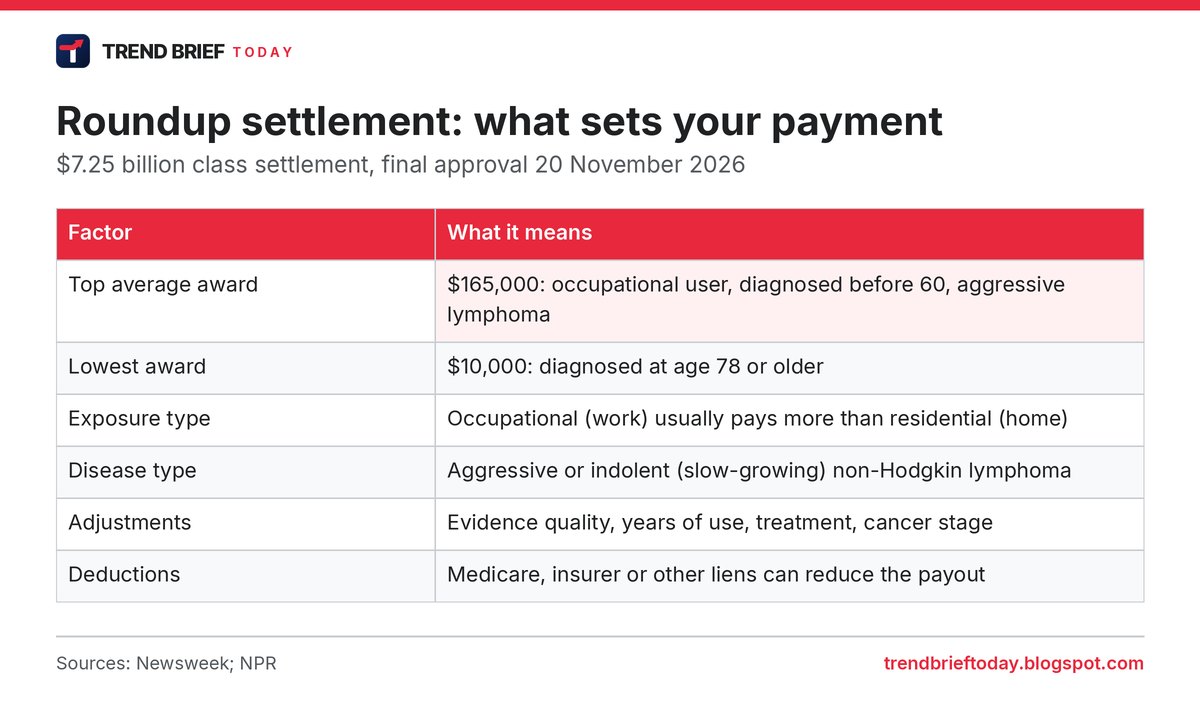
NPR reports that awards will run from about $10,000 to $165,000.[1] Newsweek's reading of the plan is that there are nine tiers, which set the starting value of each claim:[2]
- Highest: an average of $165,000 for an occupational claimant diagnosed before age 60 with an aggressive type of lymphoma.[2]
- Lowest: $10,000 for anyone diagnosed at age 78 or older.[2]
- In between: the tiers depend on age at diagnosis, whether the disease is aggressive or indolent (slow-growing), and whether the exposure was at work or at home.[1][2]
An allocation special master can then move the figure up or down based on the quality of the exposure evidence, how long the person used Roundup, how intensive their treatment was, the cancer stage and certain other medical conditions.[2] Medicare, health insurers and other payors can claim reimbursement for treatment costs, so liens may reduce what actually reaches the claimant.[2]
Class counsel Christopher Seeger told Newsweek that average awards would be "more than double" those paid through the earlier Feinberg settlement programme in the federal court litigation.[2]
Occupational or residential: which are you?
The split matters because work exposure usually means a bigger award. Under the plan, occupational status generally needs more than 80 hours of exposure at work in agriculture, industry, turf or ornamental work, plus earned income from that work of either more than half of total income or over $15,000 in at least one year.[2] Everyone else who meets the rules is treated as a residential user, for example someone who sprayed Roundup in their own garden.[2]
Bayer removed glyphosate, Roundup's main ingredient, from the US products it sells for home use several years ago. It is still used in farming.[1]
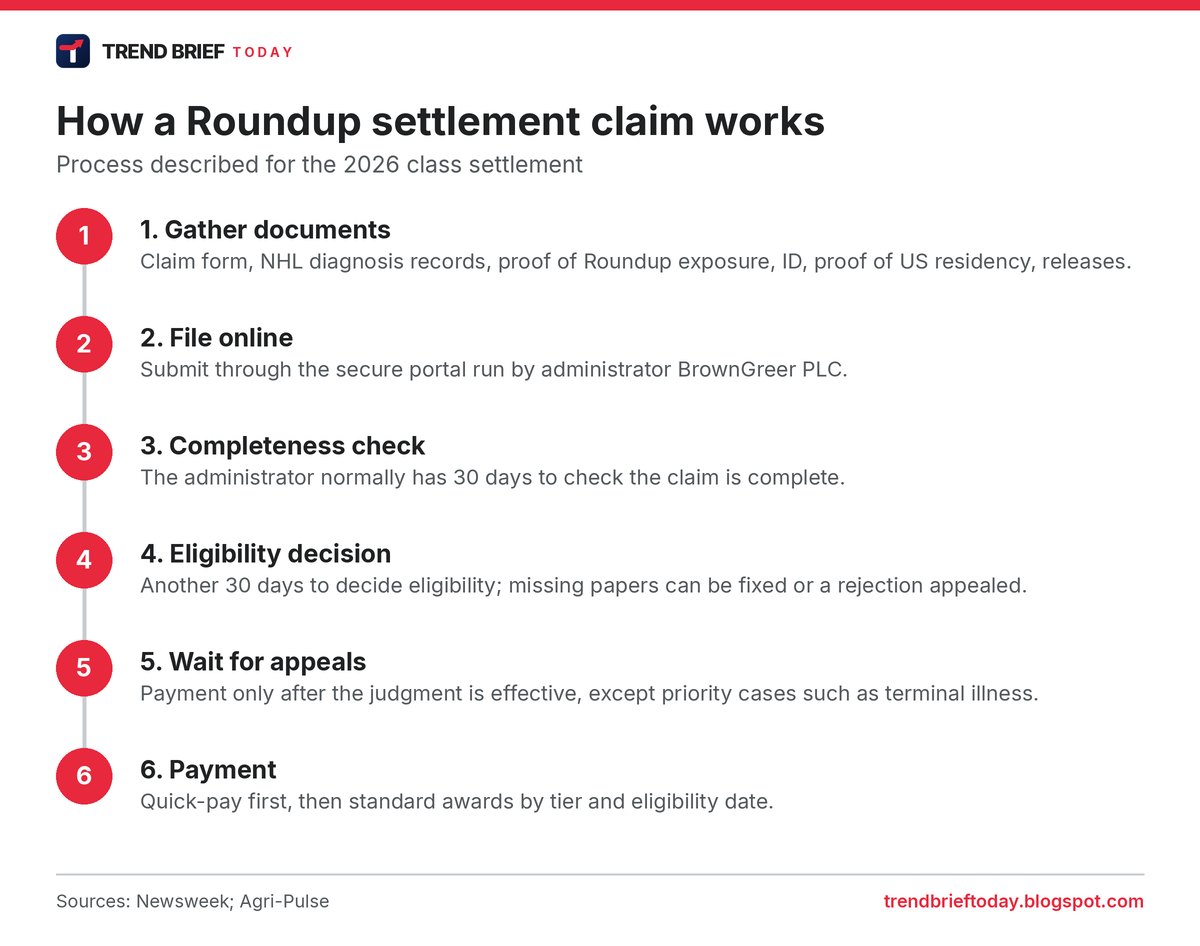
How do you file a claim, and when will payments start?
Claims are filed through a secure online portal run by the settlement administrator, BrownGreer PLC. A complete claim needs the claim form, diagnosis records, proof of exposure and the required releases.[2] The administrator normally has 30 days to check that a claim is complete and another 30 days to decide whether it is eligible. Future claimants face an extra two-year wait before their eligibility date.[2]
The key point on timing is appeals. Submissions can begin after final approval, but payment cannot happen until the judgment becomes effective once any appeals are resolved.[2] Bayer has said an appeal would pause its further payments into the fund until it is decided. Holland said claimants in "exigent circumstances", such as people who are terminally ill or at risk of losing their home, would still be paid even if an appeal were filed.[2]
The funding is spread out. The judge noted that subclass 1 lawyers secured $3 billion of funding in the first five years plus faster payment options, while subclass 2 lawyers won long-term funding, bankruptcy protections, inflation adjustments and the right to leave the deal later in some cases.[3] Quick-pay awards get priority, and standard awards are paid by tier and then by eligibility date, so an accepted claim may not be paid at once if that year's fund has run out.[2]
What if you opted out?
A person who validly opted out gets no money from the settlement and is not bound by it, so they keep the right to bring their own case.[2] That route is harder than it was. In June 2026 the US Supreme Court ruled 7-2 in the Durnell case that federal pesticide law, FIFRA, blocks state-law "failure-to-warn" claims, which the judge called "the principal legal theory on which Roundup litigation has been based".[2][3]
Bayer said the class settlement and the Durnell ruling are "mutually reinforcing pillars" of its plan to contain the litigation.[3]
Does Roundup cause cancer?
That question is still disputed, and the settlement does not answer it. In 2015 the World Health Organization's cancer agency, IARC, classed glyphosate as "probably carcinogenic" to humans.[1][4] The US Environmental Protection Agency has said it "did not identify risks of concern from glyphosate uses, including for cancer", although it is now reviewing the human health evidence again.[1] The EPA position, as usually summarised, is that glyphosate is unlikely to cause cancer when used as directed.[4]
Bayer denies that Roundup causes cancer, and the settlement includes no admission of liability or wrongdoing.[1][2]
What Bayer and the lawyers said
- Bill Anderson, Bayer chief executive: the approval is "a decisive milestone in the company's strategy to mitigate the risks of both pending and future Roundup litigation".[3][4]
- Christopher Seeger, class counsel for subclass 1: "Today's final approval order delivers guaranteed compensation to Roundup cancer victims who have waited more than a decade for justice."[1][4]
- Eric Holland, counsel for future claimants: some payments would be processed "in the near term", though an appeal could delay the wider process.[2]
This deal comes on top of an earlier settlement in which Bayer agreed to pay roughly $10 billion to $11 billion to resolve more than 100,000 Roundup claims.[1]
Frequently asked questions
Was the Roundup settlement approved?
Yes. Judge Timothy Boyer in St. Louis gave final approval on Friday 20 November 2026.[1][3]
How much is the Roundup settlement?
Up to $7.25 billion in total, paid over many years.[1][3]
How much will I get from the Roundup settlement?
Typical starting values run from about $10,000 to $165,000, depending on occupational or residential exposure, age at diagnosis and the type of lymphoma, before adjustments and any liens.[1][2]
Do I need a cancer diagnosis to be paid?
Yes. Only people diagnosed with non-Hodgkin lymphoma are paid. People exposed before 17 February 2026 who are diagnosed later, within the 16-year period, can claim then.[2][3]
When will Roundup settlement payments be made?
Not until the judgment is effective after any appeals, apart from priority cases such as terminally ill claimants. No payment date has been announced.[2]
I already settled with Monsanto. Can I claim again?
People who have already settled a Roundup claim are excluded, according to counsel for future claimants. Check the terms of any release you signed.[2]
References
- NPR, "Bayer agrees to pay Roundup claims in settlement that could cost billions", 21 November 2026.
- Newsweek (Sam Stevenson), "Bayer Roundup Settlement: Who Qualifies and How Much Could They Get?", 21 November 2026.
- Agri-Pulse, "Judge approves $7.25B settlement covering current, future Roundup claims", 20 November 2026.
- NTD (Rudy Blalock), "Judge Approves $7.25 Billion Bayer Settlement Over Claims Roundup Caused Cancer", 20 November 2026.