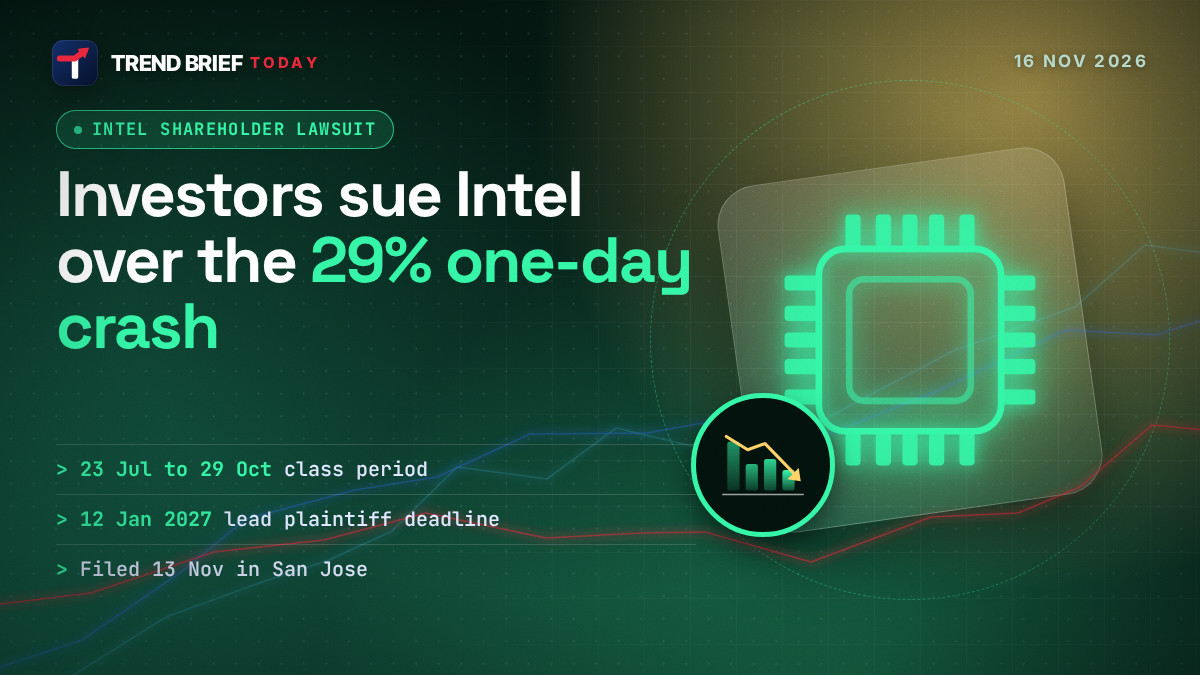
Intel shareholders have filed a proposed class action lawsuit against the chipmaker, saying it hid how badly a slump in PC sales was hurting the business before its shares fell 28.6% in a single day on 30 October 2026. The case was filed on 13 November in federal court in San Jose, California, and covers people who bought Intel stock between 23 July and 29 October 2026. Investors who want to lead the case have until 12 January 2027 to ask the court.[1][2][3][4][5]
 | |
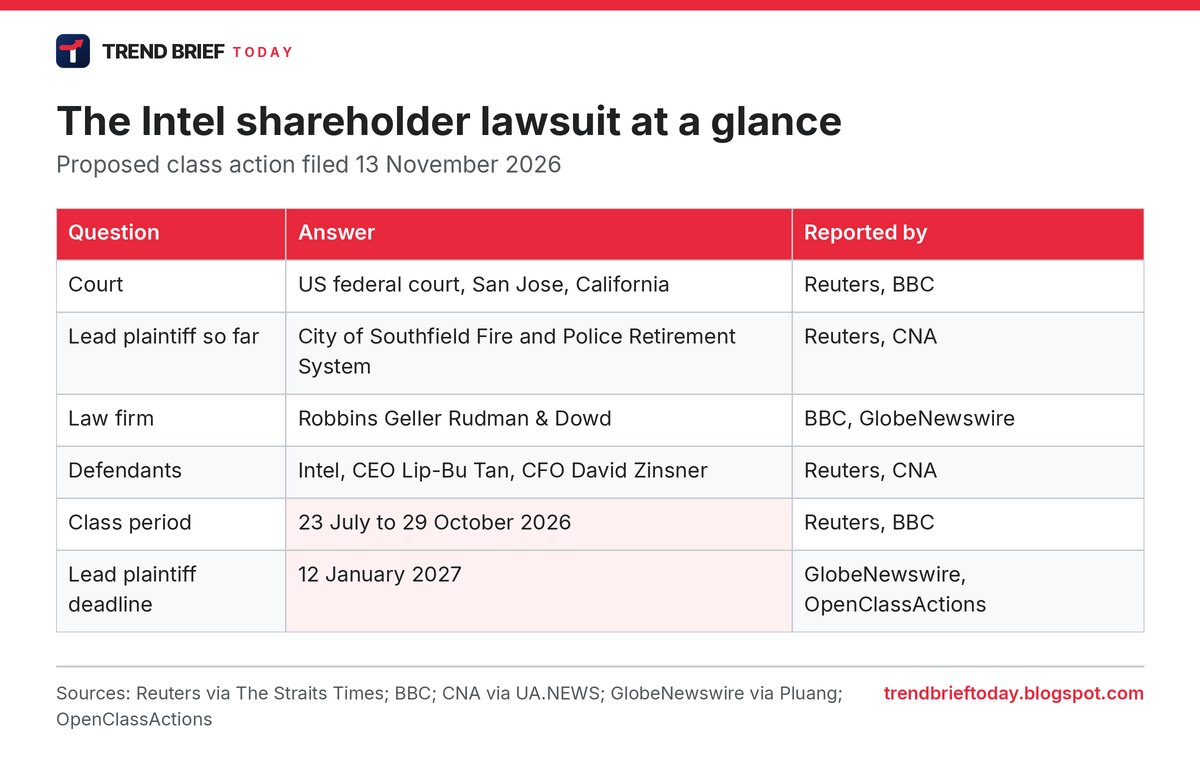
| Type | Proposed securities class action[1][4] |
|---|---|
| Court | US federal court, San Jose, California[1][2] |
| Filed | 13 November 2026[2][4] |
| Lead plaintiff so far | City of Southfield Fire and Police Retirement System (Michigan)[2][3] |
| Defendants | Intel, CEO Lip-Bu Tan, CFO David Zinsner[2][3] |
| Class period | 23 July to 29 October 2026[1][2][4] |
| Lead plaintiff deadline | 12 January 2027[4][5] |
| Damages sought | Not specified[2][3] |
Why shareholders are suing Intel
The complaint says Intel was too slow to tell investors how much a slowdown in personal computer sales would hurt its revenue.[1][2] According to the shareholders, the PC business was being hit harder than Intel said, and PC makers and other partners were sitting on more unsold stock than the market knew.[2][4][6]
They argue that those problems outweighed the gains Intel was getting from data centre building and the AI boom.[2][3] The suit accuses the company of making "materially false and/or misleading" statements during the class period.[1][6]
A key part of the case is the timing of a share sale. In mid-August, about halfway through the third quarter, Intel sold roughly $23 billion of new stock at $95 a share.[2][3] The shareholders say this gave the company a motive to keep the bad news quiet.[2][3]
The case was brought by Robbins Geller Rudman & Dowd, with a Michigan public pension fund as the named plaintiff.[1][2][5] Intel has not yet given a public response to the claims.[3][4]
What happened to Intel stock
Intel reported third-quarter results on 29 October. Revenue in its client computing and physical AI group, which sells chips for PCs, came in at $8.1 billion, lower than a year earlier.[1][7] Its data centre and AI business did much better, with revenue up 78% to $7.3 billion.[5][7]
The problem was the outlook. Intel guided to fourth-quarter revenue of $15 billion to $16 billion and adjusted earnings of 25 cents a share, when Wall Street had expected about $17 billion in revenue.[5][7] Finance chief David Zinsner said he expected the PC slowdown to last at least through the first half of 2027.[5][7] The forecast also reflected a long shutdown at Intel's factory in Israel after an accident there.[5][7]
Chief executive Lip-Bu Tan blamed manufacturing shortages and what he called an "unprecedented memory crunch".[1][2] Memory chips are being pulled towards AI data centres, which has made PCs more expensive and hit demand.[1][2]
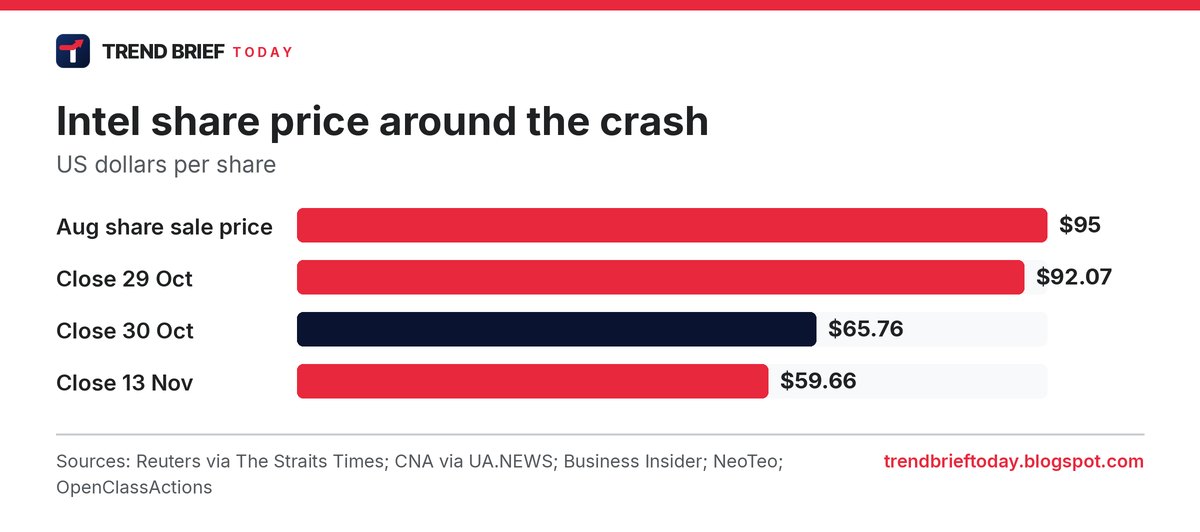
The next day the shares fell from $92.07 to $65.76, a drop of 28.6%.[4][9][10] It was the stock's worst day since the 1970s and wiped about $140 billion off Intel's market value.[2][8][10][11] By 13 November the shares had slipped further, to $59.66.[2][3] Even so, Intel is still well up for the year as a whole after a strong run earlier in 2026.[1][2]
The fall came during a rough patch for AI-linked stocks. We covered the wider sell-off in why data centre stocks have lost $4.2 trillion, and the turmoil at another chip giant in Nvidia stock after Jensen Huang resigned.
Timeline of the Intel case
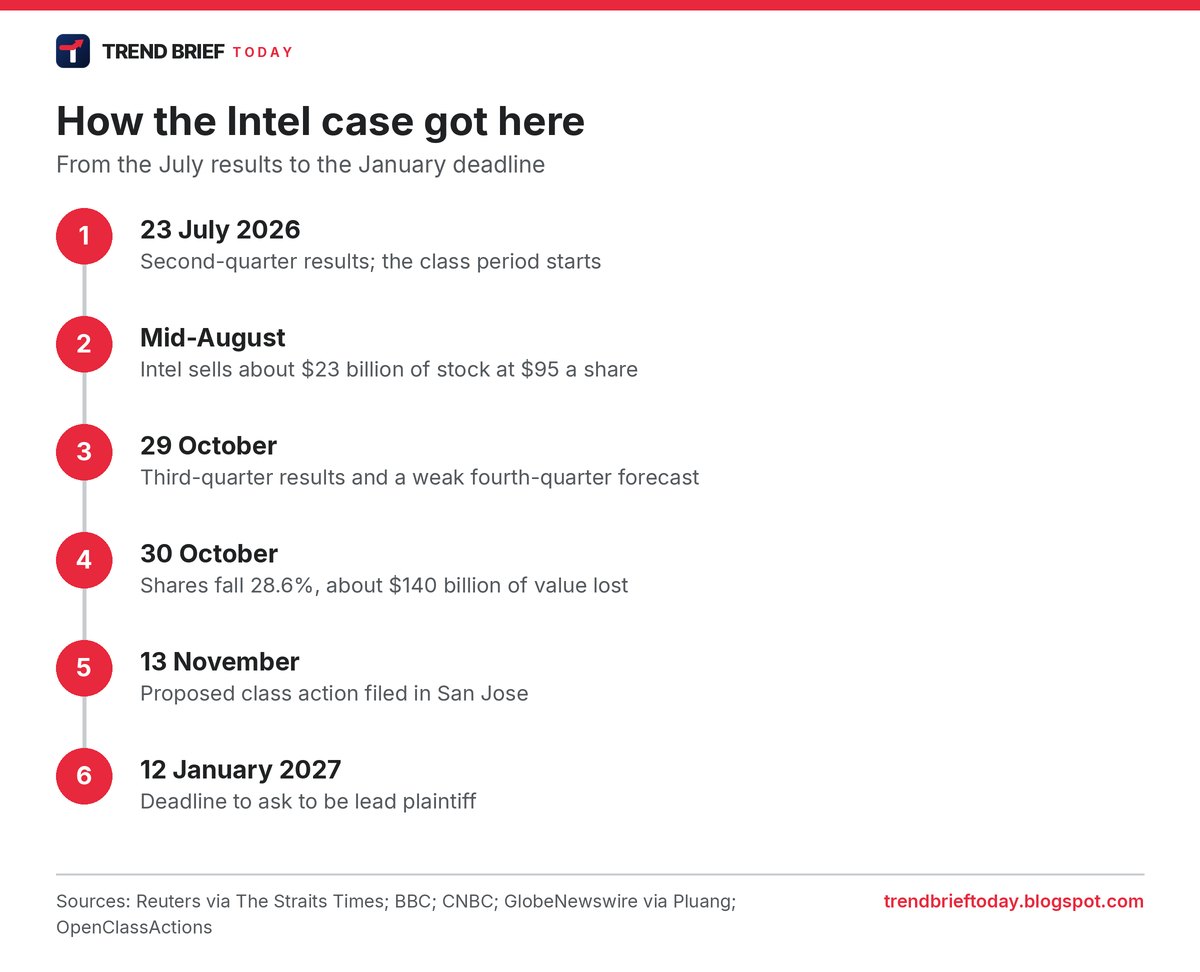
| Date | Event | Sources |
|---|---|---|
| 23 July 2026 | Second-quarter results; the class period begins | [2][4] |
| Mid-August 2026 | Intel sells about $23 billion of stock at $95 a share | [2][3] |
| 29 October 2026 | Third-quarter results and a weak fourth-quarter forecast; the class period ends | [4][7] |
| 30 October 2026 | Shares fall 28.6% to $65.76 | [4][10] |
| 13 November 2026 | Proposed class action filed in San Jose | [2][4] |
| 12 January 2027 | Deadline to ask the court to be appointed lead plaintiff | [4][5] |
Who is covered and what shareholders can do
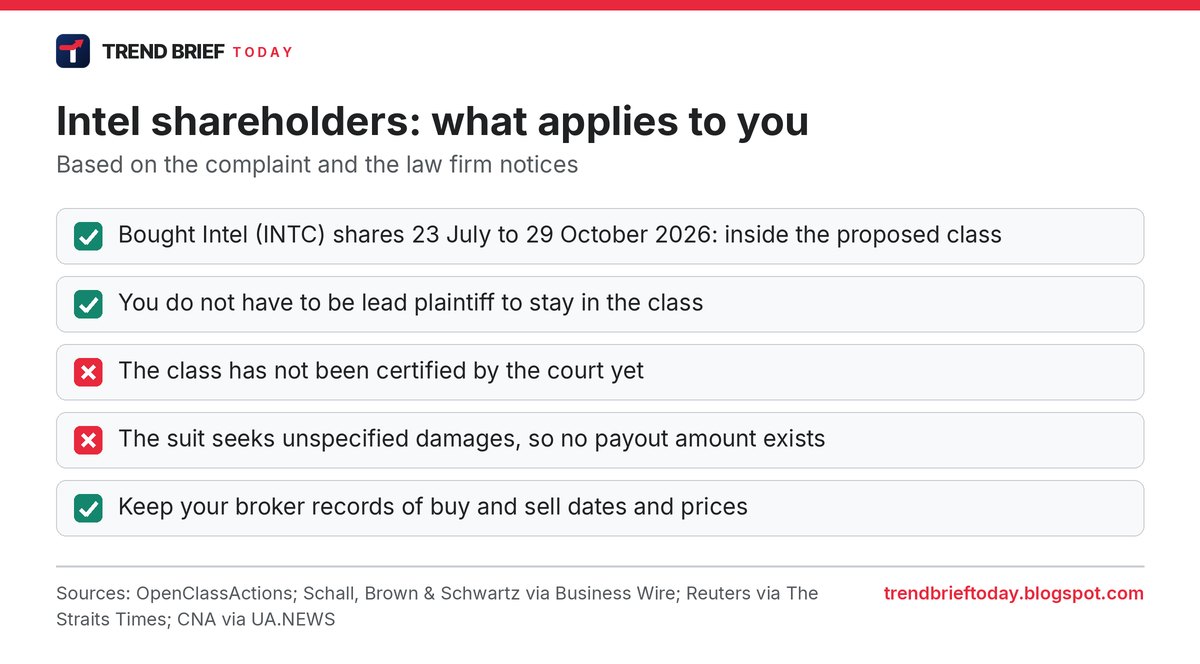
The proposed class is people who bought Intel common stock, ticker INTC on Nasdaq, between 23 July and 29 October 2026.[2][4][5] If you bought only before or only after those dates, you fall outside the class as it is described now.[4][5]
The 12 January 2027 date is for investors who want to be appointed lead plaintiff, the shareholder who runs the case on behalf of everyone else.[4][5] You do not need to take that role, or do anything at this stage, to remain part of the class.[4][6] Several law firms have published notices inviting Intel investors to get in touch, so expect to see more of these adverts.[5][6]
The class has not been certified yet.[4][6] The suit asks for unspecified damages, so there is no payout figure, no fund and no claim form.[2][3][4] Shareholders would only be paid if the case ends in a settlement or a court judgment, and if that happens a notice would explain how to claim.[4][6]
What happens next
After the January deadline the court will pick a lead plaintiff, who then chooses the lawyers for the class, subject to the court's approval.[4][6] Intel has not yet responded in court, and nothing in the complaint has been proven.[3][4] We will update this page if Intel responds publicly or the court appoints a lead plaintiff. For more money stories, see all Trend Brief Today explainers.
Frequently asked questions
Can I join the Intel class action lawsuit?
If you bought Intel shares between 23 July and 29 October 2026, you fall inside the proposed class. You do not need to sign up to stay in it.[4][6]
What is the Intel class action deadline?
12 January 2027 is the deadline to ask the court to be lead plaintiff. It is not a deadline to claim money.[4][5]
Why are investors suing Intel?
They say Intel hid how much a PC sales slowdown and excess stock at its partners would hurt revenue, while it raised about $23 billion by selling shares at $95.[2][3]
How much did Intel stock fall?
28.6% on 30 October 2026, from $92.07 to $65.76, its worst day since the 1970s.[4][8][10]
Is there an Intel settlement?
No. The case was only filed on 13 November 2026 and no damages figure has been set.[2][4]
References
- Osmond Chia, BBC News, Investors sue chip giant Intel after 29% stock plunge, 16 November 2026.
- The Straits Times (Reuters), Intel sued by shareholders over PC sales slowdown, 16 November 2026.
- Fedir Kryshtovskyi, UA.NEWS (citing CNA), Shareholders sue Intel after 28.6% stock drop, 16 November 2026.
- Steve Levine, OpenClassActions, Intel Securities Class Action (INTC), 14 November 2026.
- Pluang (GlobeNewswire), Lawsuit filed against Intel over alleged misleading statements about PC market slowdown and financial impacts, 14 November 2026.
- Schall, Brown & Schwartz LLP via Business Wire, INTC Investors Have Opportunity to Lead Intel Corporation Securities Fraud Lawsuit, 14 November 2026.
- Katie Tarasov, CNBC, Intel stock plunges as chipmaker blames PC slowdown for weak guidance, 29 October 2026.
- Katie Tarasov, CNBC, Amazon, Intel shares fall after earnings amid AI spending concerns, 30 October 2026.
- Pete Syme, Business Insider, Intel plunges 30% as surging memory costs and PC weakness bite, 30 October 2026.
- NeoTeo, Intel Stock Plunge: Why Shares Fell 28.58% on Oct. 30, 1 November 2026.
- Vivek Dubey, The Times of India, Intel sued by shareholders after stock plunges 29% in a single day, wipes out $140 billion, 16 November 2026.