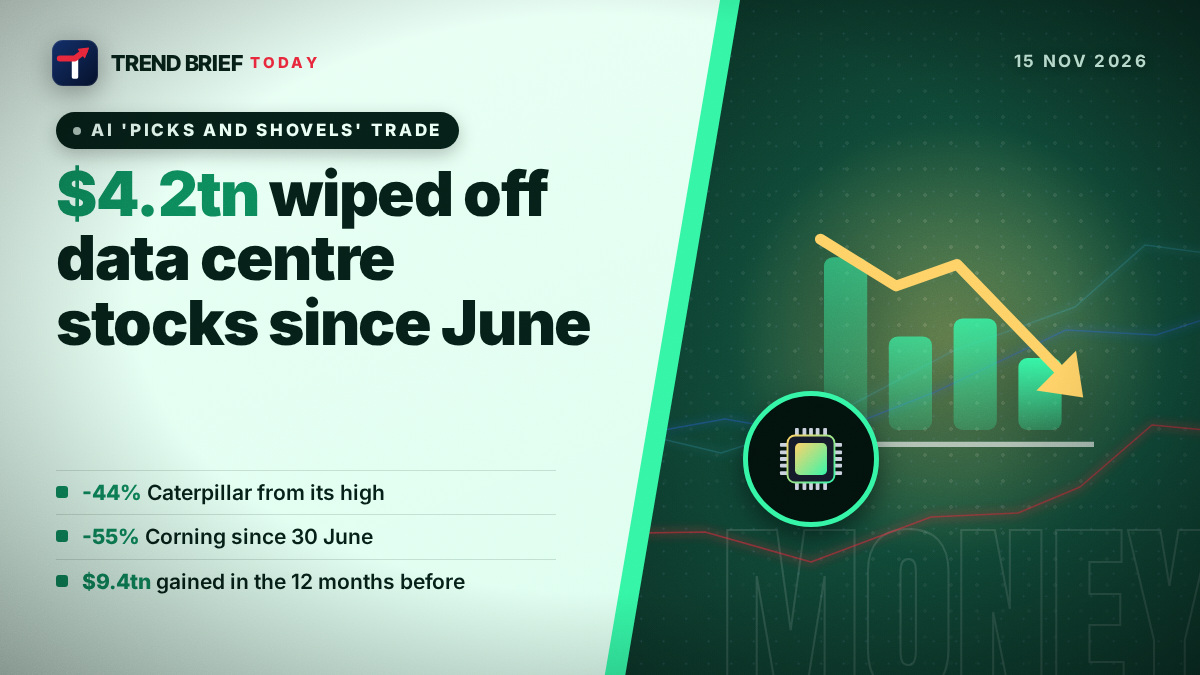
Shares in companies that supply the AI data centre build-out have lost about $4.2 trillion of market value since June 2026, the Financial Times reported on Sunday, 15 November. That is close to half of the $9.4 trillion the same group gained in the 12 months before.[1][2] Makers of generators, cooling systems, power gear and fibre optic cable, along with utilities and miners, took the biggest hits as investors lost faith in the AI "picks and shovels" trade.[1][2]
 | |
| Value lost | About $4.2 trillion since June[1][2] |
|---|---|
| Value gained before | $9.4 trillion in the previous 12 months[1][2] |
| Who is hit | Manufacturers, utilities and mining companies tied to data centre construction[1][2] |
| Caterpillar | Down 44% from its 30 June record, about $214bn of value lost[1][2][4] |
| Corning | Down 55% since 30 June[4] |
| Oklo | Down about half since June[1][2][4] |
| Analysis by | Financial Times, with FactSet data[1][2][5] |
| Our price check | Yahoo Finance daily closes to 13 November[4] |
What happened
For most of the past year, investors who wanted a piece of the AI boom without paying for Nvidia bought the companies that build and power data centres. The FT described them as everything from jet engines adapted to power huge data centres to the advanced fibre optics that link AI server racks.[2] Those stocks rose fast and, in many cases, were valued like technology growth companies.[1]
Since the summer, that has gone into reverse. The FT's count, based on FactSet data, puts the loss in market value since June at $4.2 trillion, close to half of the $9.4 trillion added over the previous 12 months.[1][2] Industrials, the sector most tied to data centre building, have been the second-worst performer in the S&P 500 since the summer, behind only technology.[2]
Which stocks have fallen the most?
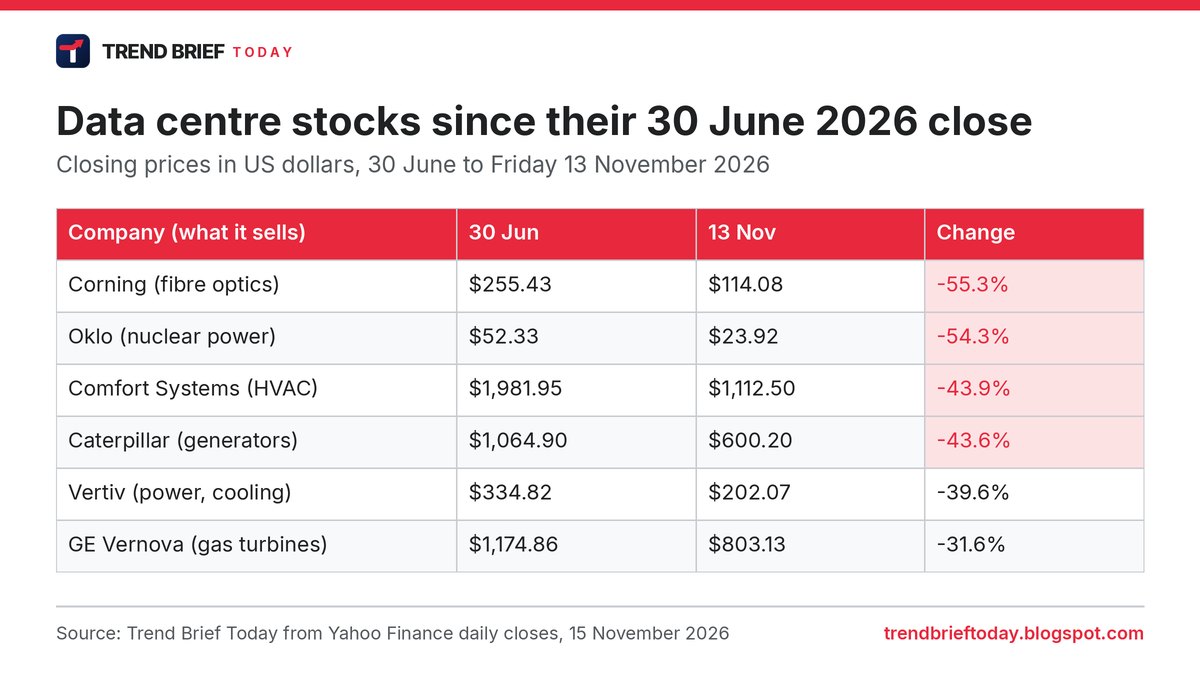
Caterpillar, a big supplier of gas generators for data centres, has lost $214 billion of market value since its record high on 30 June, a fall of 44%, according to FactSet figures cited by the FT.[1][2] Our own check of closing prices matches that: Caterpillar closed at $1,064.90 on 30 June and $600.20 on Friday, 13 November, a drop of 43.6%.[4]
The FT also named the nuclear start-up Oklo, which it said had fallen 49% despite a power deal with Meta, and said Comfort Systems USA, which installs heating, cooling and ventilation, and the fibre optic maker Corning had each lost about half their value.[1][2] On our numbers, Corning is down 55.3% from its 30 June close and Comfort Systems 43.9%.[4] We also checked two other popular data centre names the FT did not mention in the coverage we saw: Vertiv, which makes power and cooling equipment, is down 39.6% since 30 June, and GE Vernova, which sells gas turbines, is down 31.6%.[4]
How big was the run-up?
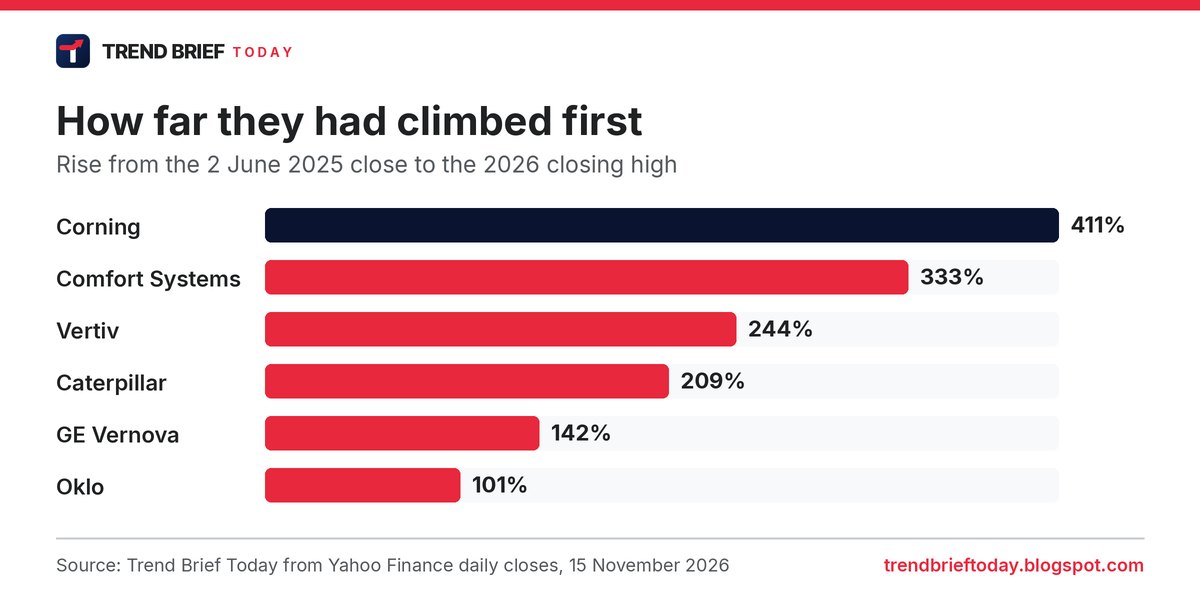
The size of the fall makes more sense next to the size of the rise. From the start of June 2025 to their 2026 closing highs, Corning rose about 411%, Comfort Systems 333%, Vertiv 244% and Caterpillar 209%, by our calculation from daily closes.[4] Four of the six hit those highs in the last nine days of June 2026.[4]
Paul Kedrosky, a venture investor and research fellow at the Massachusetts Institute of Technology, told the FT that investors made a basic mistake by treating old-economy industrial firms like chip companies. "When you talk to hedge fund people, there was this endless idea that everything is a growth stock now," he said. "It's a ridiculous idea."[1]
Brett Ryan, senior US economist at Deutsche Bank, said: "A lot of institutional money went blindly into these investments, which is why some company valuations were probably formed too optimistically."[1]
Why now? Debt, bond yields and Nvidia
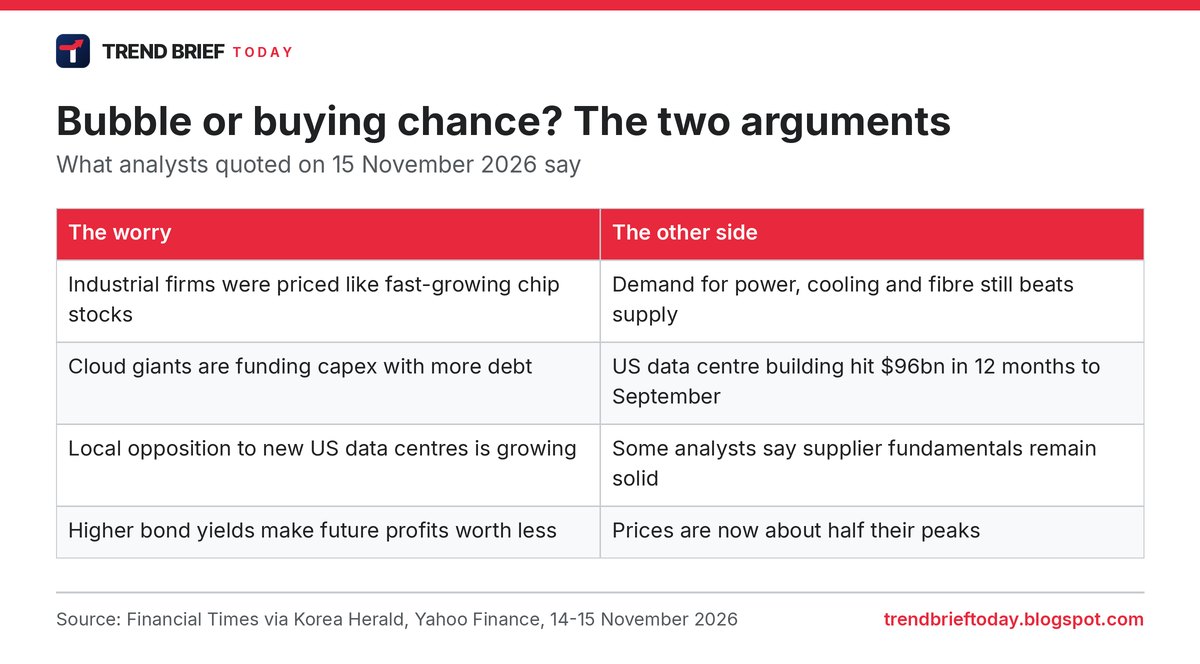
Three worries have come together. First, the big cloud companies have been paying for their data centre spending with more and more borrowing, and local political opposition to new data centres in the US has grown.[1][2]
Second, the bond market has turned. Yahoo Finance reported that the 10-year US Treasury yield rose about 30 basis points last week to about 5.15%, its biggest weekly rise since April 2025, as the October inflation figures came in hot and a Federal Reserve governor opened the door to a half-point rate rise.[3] During the earlier chip sell-off from 22 October to 6 November, yields fell on every down day for chips; last week they rose on every down day instead.[3] Higher yields make profits far in the future worth less today, which hits the most richly valued stocks hardest.
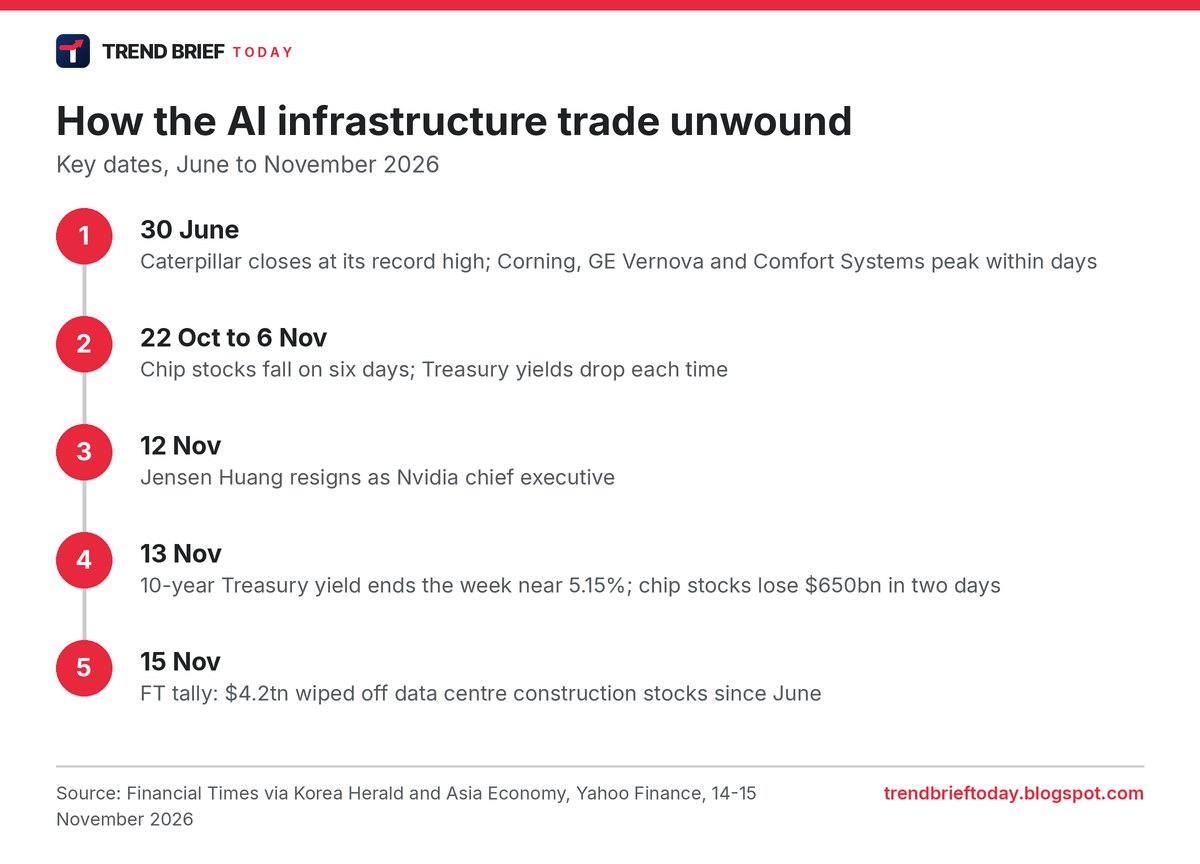
Third, Nvidia, the company at the centre of the AI trade, is in turmoil. Its shares fell about 13% in the week Jensen Huang resigned as chief executive, the sixth weekly fall in a row and the longest losing run since 2012, and a Yahoo Finance basket of 62 chip stocks lost more than $650 billion of value from Wednesday's close to Friday.[3] We have covered that in our explainers on why Jensen Huang resigned as Nvidia CEO and what has happened to Nvidia stock.
Is the AI build-out actually slowing?
Not on the government numbers so far. Some analysts quoted in the coverage argued that the business behind these stocks is still strong, with demand for the equipment and materials data centres need still well ahead of supply.[1] The latest US government figures put spending on data centre construction at $96 billion over the 12 months to September, and that excludes IT equipment and chips.[1]
So the sell-off is mostly about price, not orders: investors are paying much less for the same expected growth. Whether that is a bubble deflating or a buying chance depends on whether the cloud companies keep spending at this pace in 2027. Results from Nebius this week showed how sensitive the market is to any sign of a slowdown; see our Nebius Q3 2026 earnings explainer.
What to watch next
US markets reopen on Monday, 16 November. The Federal Reserve's next decision is on 9 December, and Yahoo Finance reported that Polymarket traders put the chance of a rate rise at about 98% by Friday.[3] Nvidia's next quarterly results and any update on its leadership will matter for the whole AI supply chain. For the companies in this explainer, the key numbers to watch are order backlogs and any change to the cloud companies' spending plans for 2027.
Frequently asked questions
How much have data centre stocks lost?
About $4.2 trillion of market value since June 2026, according to the Financial Times.[1][2]
What are AI "picks and shovels" stocks?
Companies that sell the physical things AI needs rather than AI itself: generators, turbines, cooling, power equipment, fibre optic cable, electricity and raw materials. The name comes from the gold rush, when sellers of picks and shovels made money whoever struck gold.[1][2]
How much has Caterpillar stock fallen?
About 44% from its 30 June 2026 record, from $1,064.90 to $600.20 at Friday's close, a loss of about $214 billion of market value.[1][4]
Why are data centre stocks falling?
Analysts point to valuations that treated industrial firms like fast-growing tech stocks, heavy borrowing by cloud companies, local opposition to new data centres, rising bond yields and the turmoil at Nvidia.[1][3]
Is data centre construction still growing?
US spending on data centre construction was $96 billion in the 12 months to September 2026, according to the latest government data cited in the coverage.[1]
Is this investment advice?
No. This is a news explainer. Share prices can move sharply in either direction.
References
- An Hyo-jung, The Korea Herald (Herald Business), AI 'picks and shovels' fever cools, wiping $4.2tr from data center stocks (reporting the Financial Times via Yonhap), 15 November 2026.
- Asia Economy, AI Investment Cools... $4.2 Trillion Wiped Off Data Center Construction Stocks (reporting the Financial Times), 15 November 2026.
- Jared Blikre, Yahoo Finance, The bond market just turned on the AI trade, and chip stocks lost more than $650 billion in two days, 14 November 2026.
- Trend Brief Today calculation from Yahoo Finance daily closing prices for CAT, GLW, OKLO, FIX, VRT and GEV, 2 June 2025 to 13 November 2026, checked 15 November 2026.
- Financial Times, Data centre construction stocks lose $4.2tn as boom in AI trade unravels, 15 November 2026 (subscription).