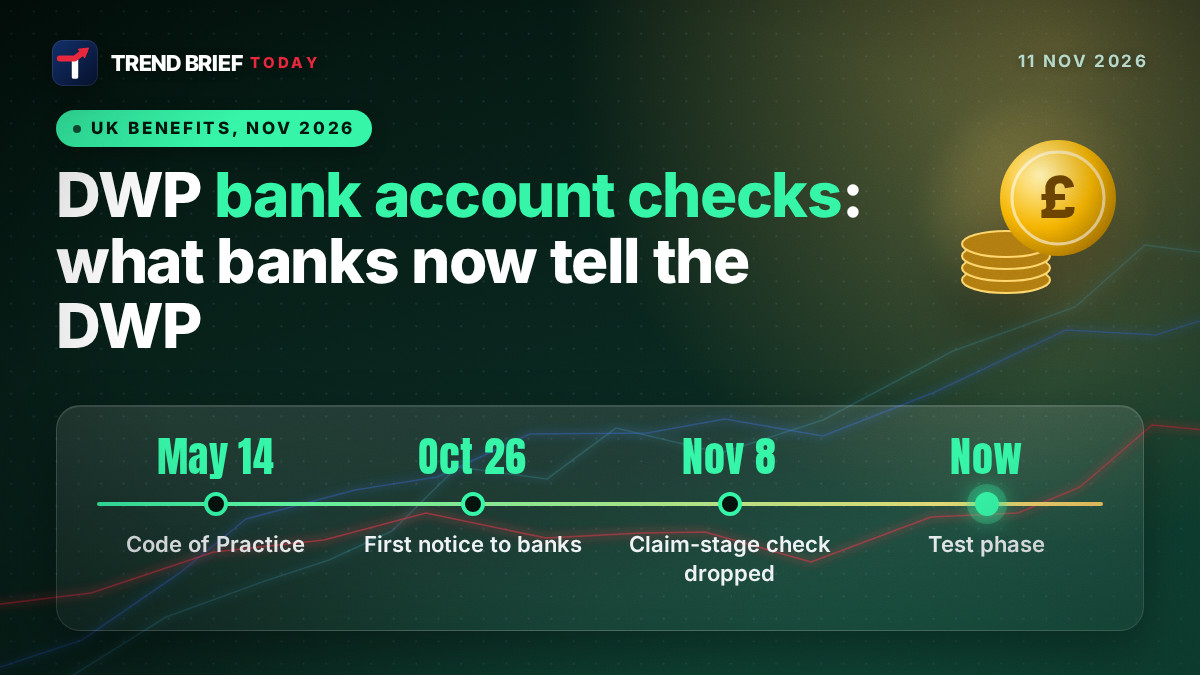
Yes, the DWP can now have banks check the accounts of some benefit claimants. Since October 26, 2026, banks have been under the first Eligibility Verification Notice, which tells them to flag accounts receiving Universal Credit, Pension Credit or New Style ESA that seem to break two rules: too much in savings, or too long spent abroad. The DWP does not see your statements or your spending, a flag is not proof of fraud, and State Pension is excluded by law. What was dropped this week is a different idea: a check on the savings of people applying for Universal Credit, which press reports say the Chancellor has scrapped. This guide explains both, what a bank is allowed to pass on, and what to do if the DWP gets in touch.[1][2][5]
 | |
| Official name | Eligibility Verification Measure (EVM) |
|---|---|
| Law | Public Authorities (Fraud, Error and Recovery) Act 2025 |
| First notice to banks | October 26, 2026 |
| Benefits covered | Universal Credit, Pension Credit, New Style ESA |
| Not covered | State Pension (excluded by law) |
| What banks look for | Savings above benefit limits; long periods abroad |
| Can the DWP see spending? | No: no statements, transactions or locations |
| Expected saving | £1.2 billion by 2030/31 (DWP) |
| Who decides | DWP staff, never the bank |
| Oversight | Independent reviewer, reports to Parliament |
What changed, and what was scrapped?
Two stories about DWP bank checks are running at the same time, and they point in opposite directions, so it is worth separating them.
The checks that have started. On October 26 the Department for Work and Pensions said it had issued its first Eligibility Verification Notice, the legal instruction that makes banks and other financial institutions check certain accounts. The department says the aim is to find claimants with undeclared savings or who stay abroad longer than the rules allow, which it calls "two major drivers of fraud and error", and it expects the measure to save £1.2 billion by 2030/31.[2] The minister in charge, Lilian Greenwood, told Parliament the same day that the notice had been issued under the 2025 Act, according to the Telegraph and Argus.[3]
The plan that was dropped. Over the weekend the Telegraph reported that Chancellor John Healey had abandoned a separate plan, first announced by Rachel Reeves when she was Chancellor, that would have let DWP officials see the savings of people applying for Universal Credit. The Press Association and the Manchester Evening News both carried the report. They say the claim-stage check has been replaced by bank checks on people who are already receiving the benefit, which is the system described below.[5][6] We have not seen a government statement confirming the change in its own words, so treat the "scrapped" part as reported, not official.
Put simply: if you already get one of the three benefits, the bank checks apply to you now. If you are about to apply, the extra check at the start of your claim appears to be off the table.
Which benefits are affected?
Only three, all named in the Act: Universal Credit, Pension Credit and New Style Employment and Support Allowance. The government says these were picked because incorrect payments are highest there. Other benefits could be added later, but only if Parliament votes for new regulations. The State Pension is excluded outright and cannot be added by regulations.[1][4]
The checks are not only about the person who claims. The DWP's guidance says banks must look at the account the benefit is paid into and at any linked accounts, and that the account "may belong to either a claimant or a non-claimant". A joint account with a partner, or an account a carer manages, can therefore come up.[1][3]
What can banks tell the DWP?
The DWP sends banks a set of "eligibility indicators" based on benefit rules. The bank checks its own data against them and only reports accounts that match. For those accounts it may share the names of all account holders, which accounts they hold (including linked and joint ones), account numbers and sort codes, how much money is in the accounts and the dates of transactions made in another country.[1]
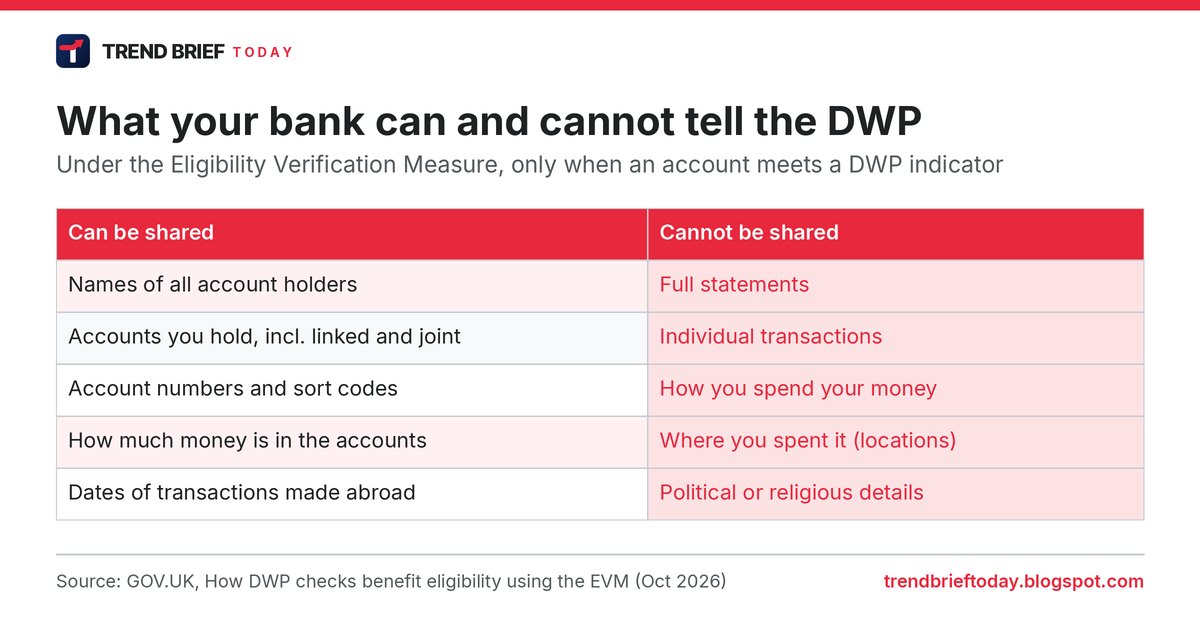
The list of what banks cannot share is just as important. No full statements, no individual transactions, nothing about how you spend your money, no locations of purchases and no sensitive background details such as religion or politics. Banks can be fined if they hand over more than they should. The DWP also says it cannot log into your online banking or watch your account in real time.[1][4]
"We are not interested in where people do their weekly shop or how much they're spending on new clothes," Greenwood said in the DWP's announcement.[2]
What savings and travel rules are banks checking?
The government's own examples are the capital limit and time abroad. For Universal Credit, the limits are set out on GOV.UK:[7]
- £6,000 or less in money, savings and investments does not affect your payment.
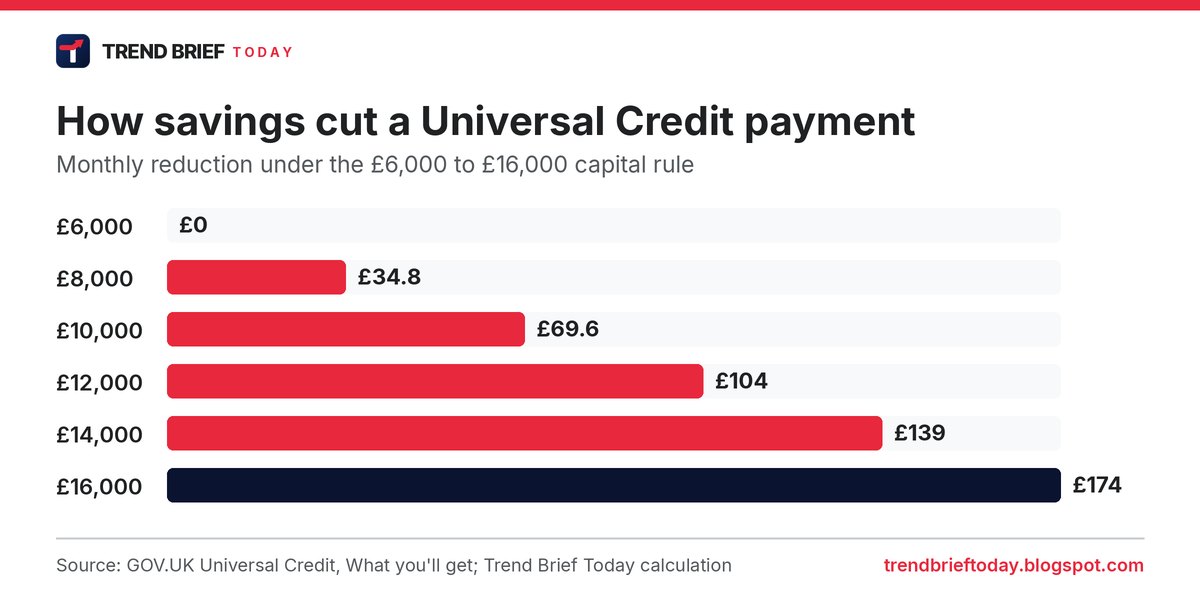
- Between £6,000 and £16,000, your payment drops by £4.35 for every £250 (or part of £250).
- Above £16,000, you cannot get Universal Credit.
To show what that means in pounds, we worked the rule through at £2,000 steps. Someone with £10,000 saved loses £69.60 a month; at £16,000 the cut reaches £174 a month, and one pound more ends the claim.
Pension Credit works differently. GOV.UK says savings of £10,000 or less do not affect it, and above that every £500 counts as £1 a week of income, so £11,000 counts as £2 a week. There is no hard cut-off, which is why a bank flag for a pensioner is more likely to mean a recalculation than a stopped claim.[8]
On travel, Universal Credit claimants must report going outside Great Britain "for any length of time".[7] That is why banks can share the dates of transactions abroad: a run of card payments in another country is the kind of signal the DWP wants to follow up.
Does a flag mean my benefits will stop?
No. The DWP says a flag "does not indicate fraud or wrongdoing" and that no decision can be made on bank information alone.[2] Greenwood's statement to Parliament says the information will act "only as a prompt for further checks", and that decisions will still be made by trained staff.[3] The government's factsheet adds that "a human will always be involved" in any decision that affects an award.[4]
What a flag can lead to is a review of your claim. That review might find you are not eligible, or that you are being paid the wrong amount. If you were overpaid, you may be asked to pay it back.[1]
What to do if the DWP contacts you
GOV.UK says the DWP will use your Universal Credit online journal if you have one, and otherwise phone, letter or text. It asks you to reply "as soon as possible", because a slow reply can delay or stop payments.[1]
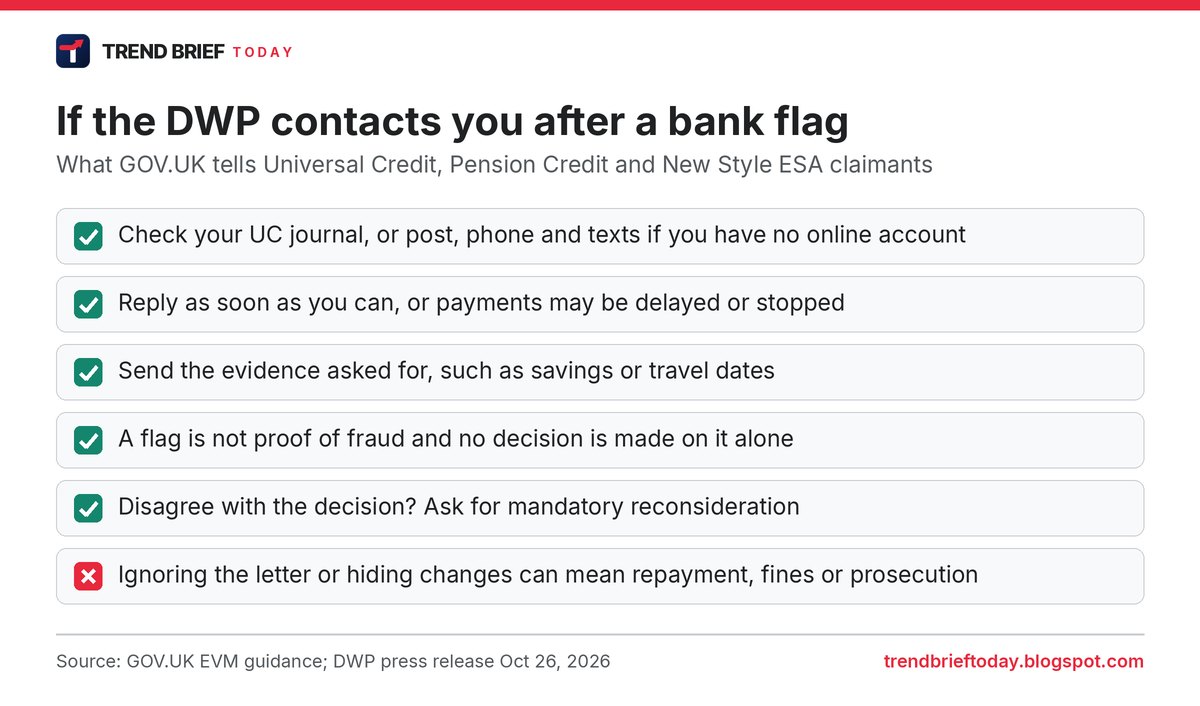
- Do not ignore it. Reply through the channel the DWP used.
- Gather proof. Savings that are excluded from the rules, money held for someone else or a trip abroad you already reported will all need paperwork.
- Report any change you missed. Savings, gifts, refunds, compensation, people moving in or out and trips abroad are all changes of circumstances.[1]
- Challenge a decision you think is wrong. Ask for a mandatory reconsideration first.[1]
- Get free advice. Citizens Advice and local welfare rights services can help with reviews and overpayments.
The Universal Credit helpline is 0800 328 5644 and the Pension Service helpline is 0800 731 0469, both Monday to Friday, 8am to 6pm.[1]
How many people could be caught?
The DWP estimates that fraud and error linked to undeclared savings and time abroad in Universal Credit and Pension Credit cost £1.5 billion in 2025-26 alone, and it puts the overall fraud and error rate at 3.2%.[2] When the measure is fully rolled out, the department expects to find between 50,000 and 100,000 overpayments a year.[4][9]
One detail stands out when you compare the documents. The 2025 factsheet said the Office for Budget Responsibility had validated savings of "up to £940m over the next 5 years".[4] The October 2026 announcement says £1.2 billion by 2030/31.[2] The DWP has not explained the higher figure in the pages we read, so it is fair to treat it as a target rather than a proven result.
Timeline
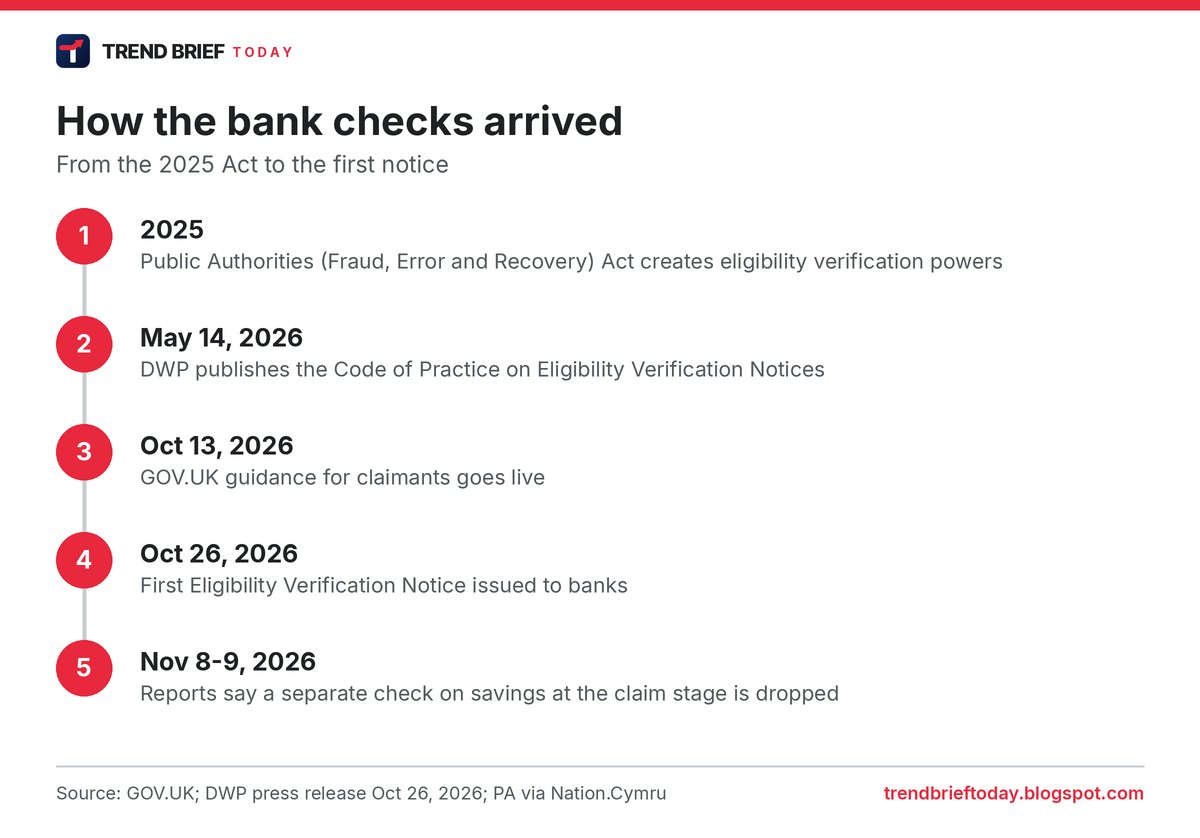
| Date | Event |
|---|---|
| December 2, 2025 | Public Authorities (Fraud, Error and Recovery) Act receives Royal Assent, creating eligibility verification powers[11] |
| May 14, 2026 | DWP publishes the Code of Practice on Eligibility Verification Notices[10] |
| October 13, 2026 | GOV.UK guidance for claimants published[1] |
| October 26, 2026 | First Eligibility Verification Notice issued to banks[2][3] |
| November 8-9, 2026 | Telegraph, PA and MEN report the claim-stage savings check has been scrapped[5][6] |
| Next | Test-and-learn phase, then wider rollout; more anti-fraud measures expected at the Budget[2] |
Why critics are worried
Privacy campaigners have called the powers "bank spying" because the checks run on every account that receives a covered benefit, not only on people already suspected of fraud.[9] MPs have raised concerns too. In February the Commons Public Accounts Committee warned the DWP to use its new powers "effectively and proportionately", and its chair, Sir Geoffrey Clifton-Brown, said the risk of overreach had to be "mitigated against right from the outset".[11] The government's answer is the safeguards above: a fixed list of data, fines for banks that overshare, a human decision on every case and an independent reviewer who reports to Parliament each year.[1][4]
For more money stories that affect household budgets, see our explainers on the US SNAP eligibility rule, the UKHSA cold-health alert and Macquarie's savings-rate penalty.
Frequently asked questions
Can the DWP check my bank account?
Not directly. The DWP cannot log in or see statements. It can require your bank to say whether an account receiving Universal Credit, Pension Credit or New Style ESA matches its savings or time-abroad indicators, and then share limited details.[1]
Are State Pension bank accounts checked?
No. State Pension is excluded in the Act and cannot be added by regulations. If you get Pension Credit as well, that payment is covered.[4]
Did the government scrap the DWP bank checks?
No. Reports on November 8 and 9 say a different plan, checking savings when people apply for Universal Credit, was scrapped. The checks on people already receiving the three benefits started in October.[2][5]
How much savings can I have on Universal Credit?
Up to £6,000 has no effect, £6,000 to £16,000 reduces your payment by £4.35 a month per £250, and over £16,000 you are not eligible.[7]
Will a joint account with my partner be checked?
It can be. The guidance covers linked and joint accounts, including ones held by people who are not claimants.[1]
References
- "How DWP checks benefit eligibility using the Eligibility Verification Measure". GOV.UK (Department for Work and Pensions). October 13, 2026. gov.uk
- "Government unleashes £1.2 billion crackdown as part of anti-fraud drive". GOV.UK (DWP press release). October 26, 2026. gov.uk
- "DWP confirms first bank checks on benefit claimants: here's what happens next". Telegraph and Argus. November 11, 2026. thetelegraphandargus.co.uk
- "DWP's Eligibility Verification powers in the Public Authorities (Fraud, Error and Recovery) Bill: Factsheet". GOV.UK. 2025. gov.uk
- "Plans to allow DWP to snoop on benefit claimant bank accounts scrapped: reports". Nation.Cymru (Press Association). November 9, 2026. nation.cymru
- "Andy Burnham government scraps plans for DWP bank account measures". Manchester Evening News. November 9, 2026. manchestereveningnews.co.uk
- "Universal Credit: eligibility, what you'll get and changes of circumstances". GOV.UK. Accessed November 11, 2026. gov.uk
- "Pension Credit: eligibility". GOV.UK. Accessed November 11, 2026. gov.uk
- "How the DWP now checks bank accounts under new benefit rules". EDP24. November 11, 2026. edp24.co.uk
- "Code of Practice on Eligibility Verification Notices". GOV.UK. May 14, 2026. gov.uk
- "UK's DWP warned by MPs over new bank account-checking legal powers". Global Government Finance. February 11, 2026. globalgovernmentfinance.com