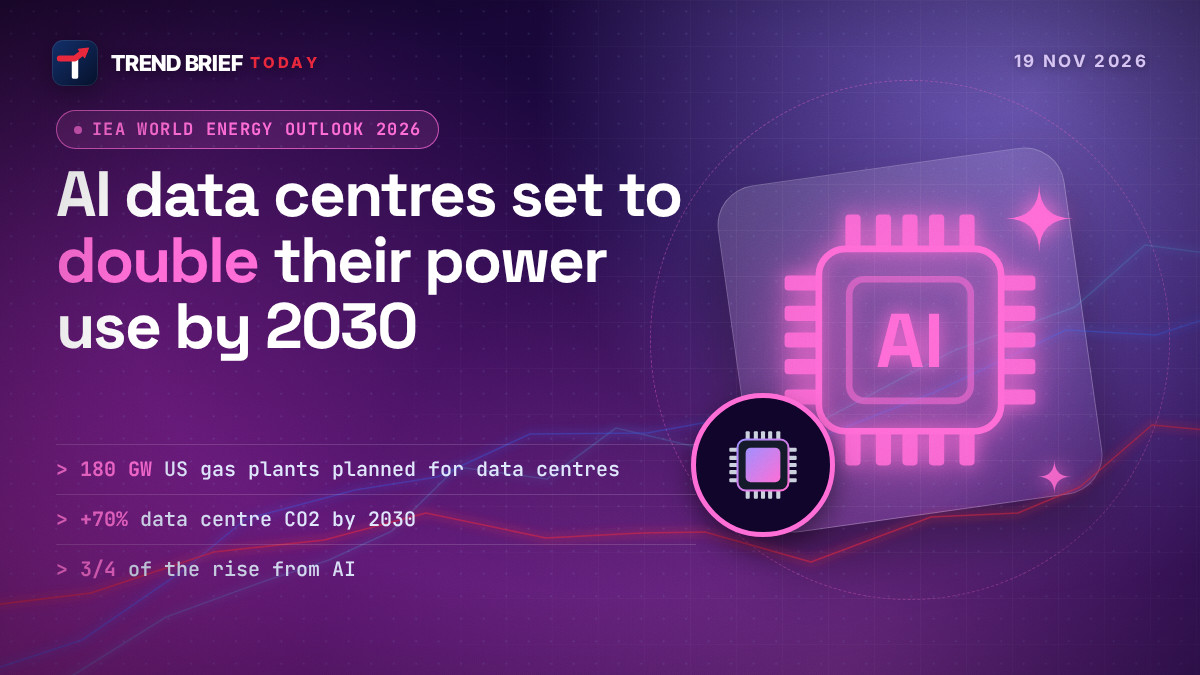
The world's data centres will use about 1,000 terawatt-hours of electricity a year by 2030, roughly double today's level, according to the International Energy Agency's World Energy Outlook 2026, published on 19 November.[1][5] Artificial intelligence accounts for about three quarters of that increase, and because the US is leaning on gas and China on coal to power it, the IEA expects data centre carbon emissions to rise by about 70%.[4][6] Below: where the extra power comes from, why America's 180 GW gas pipeline matters, our own maths on what 1,000 TWh costs and how many homes it could run, and what it could mean for your electricity bill.
 | |
| Report | World Energy Outlook 2026, IEA[1] |
|---|---|
| Published | 19 November 2026[1] |
| Data centre use, 2030 | About 1,000 TWh a year (STEPS)[1] |
| Change | Roughly double today[1][5] |
| Share of rise from AI | About three quarters, about 350 TWh[4] |
| Data centre CO2, 2030 | Up about 70%[4][6] |
| Capacity | 120 GW today, plus 120 GW by 2030[4] |
| US gas plants planned | About 180 GW (August 2026)[4] |
| Peak demand, 2035 | Up 40% to 50%, all scenarios[5] |
What the IEA actually said
The headline line sits in the report's overview chapter, and it is short: the boom in AI investment "is pushing up electricity consumption by data centres, which doubles to reach 1 000 terawatt-hours by 2030" in the Stated Policies Scenario. The same paragraph adds that the boom is "revealing several constraints related to grids, supply chains and, in some cases, public acceptance."[1]
The Guardian's reporting on the full report fills in the detail. The IEA says AI accounts for three quarters of the growth, adding about 350 TWh a year within four years. To build its estimate for an industry that rarely publishes its power use, the agency tracked AI server shipments, which have risen eighteen-fold since 2020, and used satellite images to follow 93 large "AI factories" under construction around the world.[4] Those AI sites already total about 17 GW, ten times what they were two years ago, and should reach about 50 GW when finished.[4]
All data centres together, including ordinary cloud and enterprise sites, have about 120 GW of capacity today, 80% of it in China, the US and the EU. The IEA expects another 120 GW to be built by the end of the decade, three quarters of it for AI.[4]
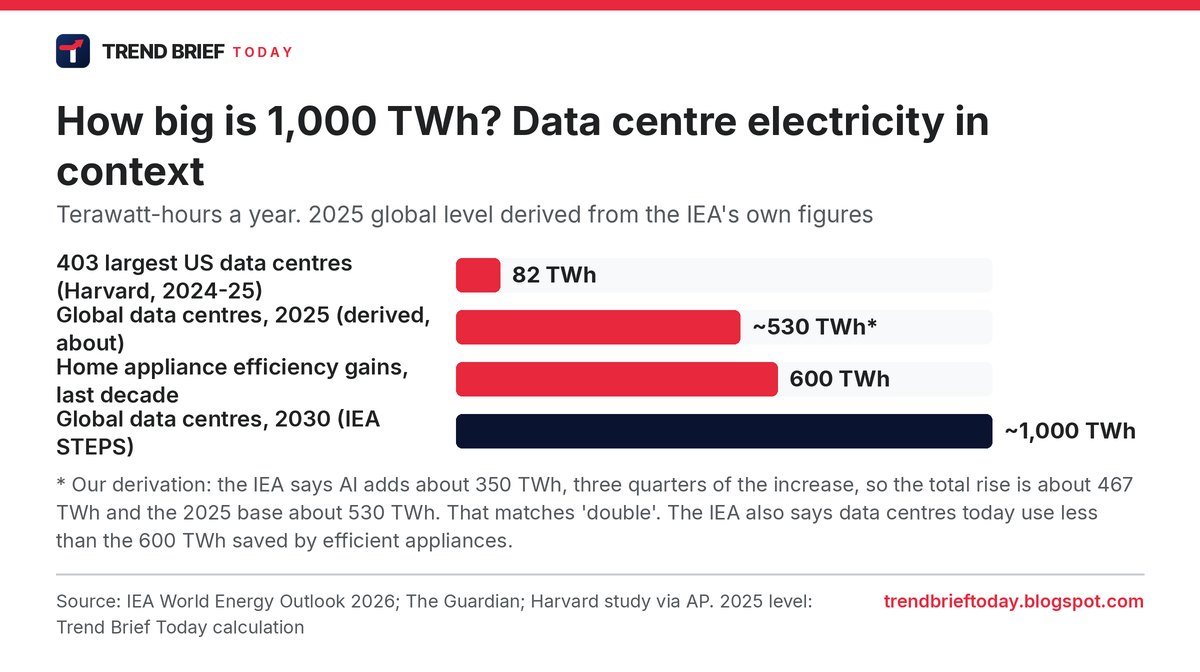
One thing the IEA does not hand you is today's exact total in the overview text, so we worked it back from its own figures. If AI's 350 TWh is three quarters of the rise, the whole rise is about 467 TWh. Take that from 1,000 and the starting point is about 530 TWh. That fits "doubles", and it also fits the executive summary, which says the 600 TWh saved by more efficient lights, TVs and fridges over the past decade is bigger than the world's yearly data centre consumption.[2][4] Treat 530 TWh as our estimate, not an IEA number.
America's AI power runs on gas
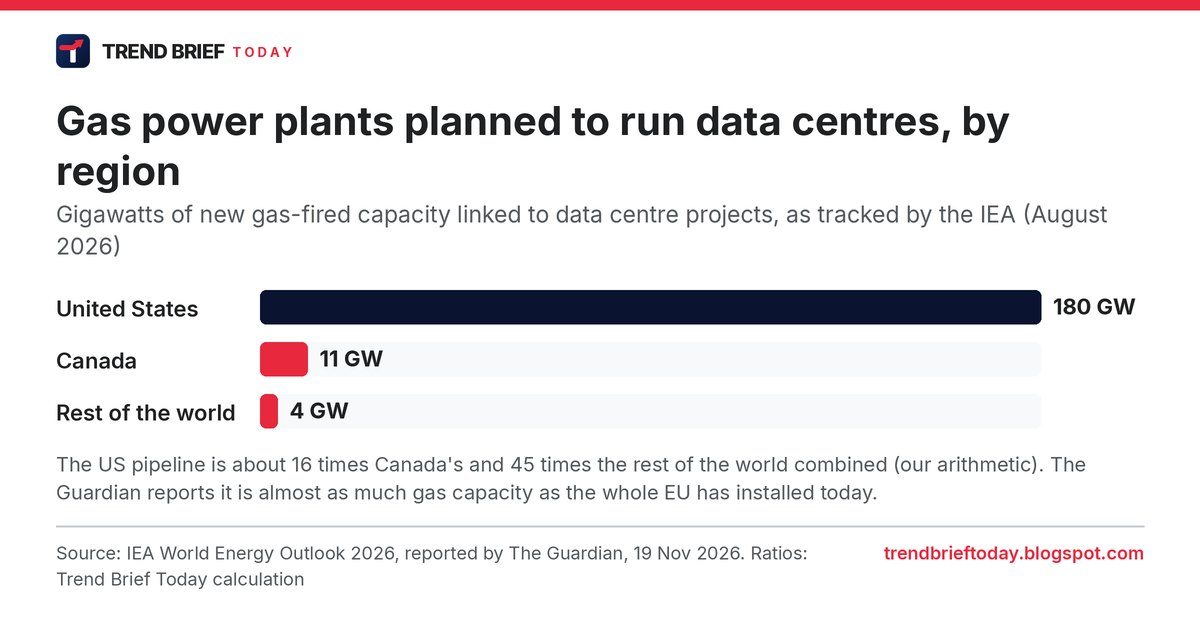
This is the part of the report that matters most for the US. The IEA expects gas to supply about 60% of the electricity used by American data centres by 2030.[4][6] In August 2026 it counted plans for about 180 GW of new gas-fired plants linked to US data centre projects. The Guardian notes that is almost as much gas capacity as the entire European Union has installed today.[4]
Compare that with the neighbours. Canada has about 11 GW of planned gas generation for servers, and the rest of the world combined about 4 GW.[4] By our arithmetic the US pipeline is about 16 times Canada's and 45 times everyone else's put together.
Why gas? Mostly speed. Grid connections in the busiest regions take years, and the IEA says that in several places the data centres waiting to connect already add up to more than the region's current peak demand. CNBC's summary of the report names Texas, Virginia, Finland and the UK as places with large project pipelines.[5] A gas turbine on or near the site is the quickest way around that queue, even if it is not the cleanest.
China leans on coal, Europe on renewables
The picture flips depending on the grid. In China, about half the electricity for AI data centres is expected to come from coal plants by 2030, with most of the rest from renewables, some nuclear and very little gas.[4][6] In the EU, renewables should cover about 70% of data centre demand, followed by nuclear and gas, with almost no coal.[4]
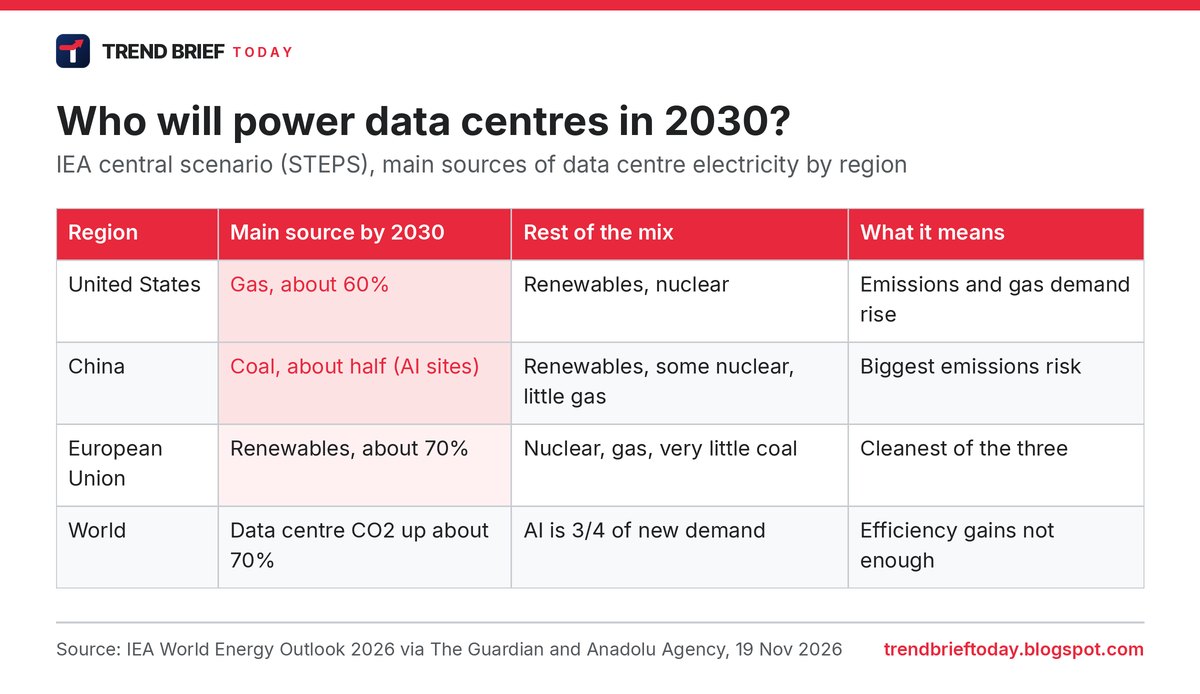
Put those mixes together and you get the 70% rise in data centre emissions by 2030.[4][6] It happens even though data centre operators are the biggest corporate buyers of renewable power in the world, as The Guardian points out.[4] Buying solar and wind contracts is not the same as running on them every hour of the day, and the new demand is simply arriving faster than clean supply.
A separate study published this week gives a sense of scale for the US. Harvard researchers modelled the 403 largest American data centres between May 2024 and April 2025 and estimated they used 82 TWh of electricity, more than half from fossil fuels, and emitted about 25.7 million metric tons of CO2. The AP reports that is more than the whole of Denmark emits in a year.[7] The IEA's 2030 global figure is about 12 times that 82 TWh.
| Measure | Figure | Source |
|---|---|---|
| Global data centre electricity, 2030 (STEPS) | About 1,000 TWh a year | IEA[1] |
| Extra demand from AI data centres | About 350 TWh, three quarters of the rise | IEA via The Guardian[4] |
| AI server shipments since 2020 | Up eighteen-fold | IEA via The Guardian[4] |
| Large AI sites tracked by satellite | 93, about 17 GW now, about 50 GW when complete | IEA via The Guardian[4] |
| US data centre power from gas, 2030 | About 60% | IEA via The Guardian, Anadolu[4][6] |
| China AI data centre power from coal, 2030 | About half | IEA via The Guardian, Anadolu[4][6] |
| EU data centre power from renewables, 2030 | About 70% | IEA via The Guardian, Anadolu[4][6] |
| New power lines needed by 2035 (STEPS) | 26 million km, plus 16 million km upgraded | IEA via CNBC[5] |
Our maths: what 1,000 TWh really means
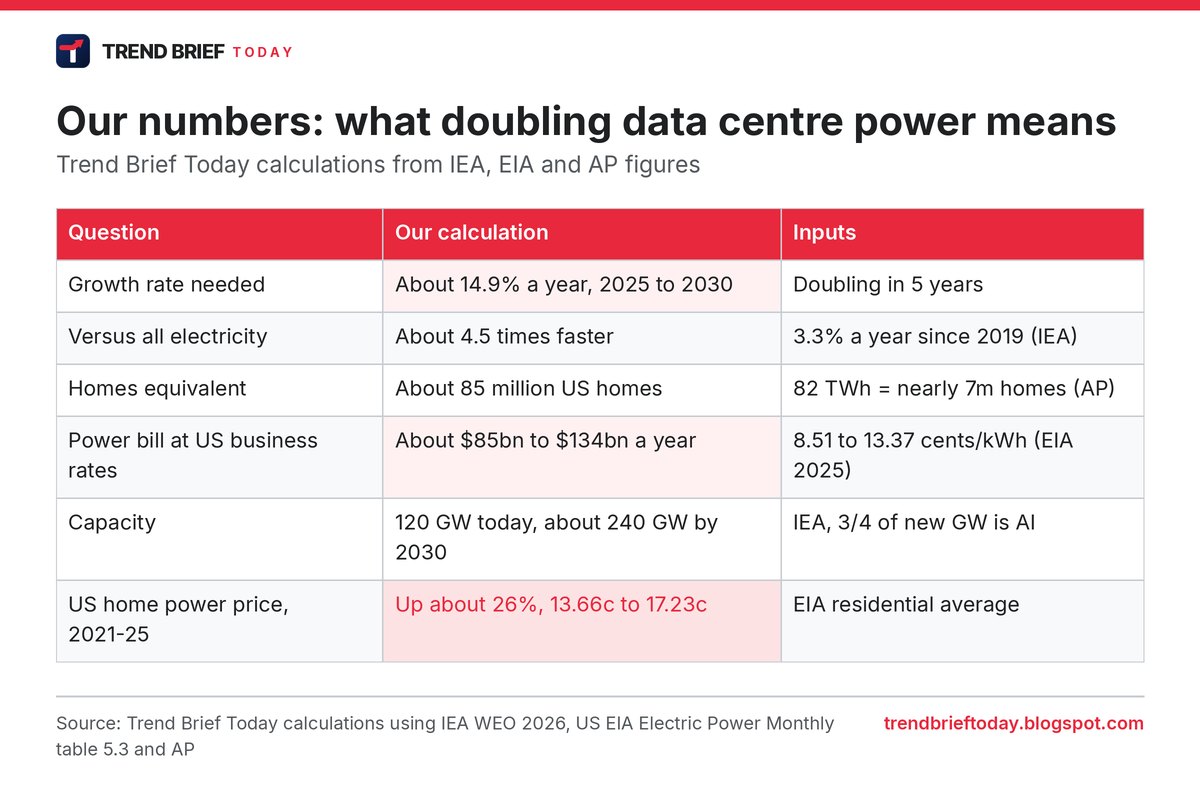
Big energy numbers are hard to picture, so here are four ways we tried to make this one concrete. All of these are our calculations, using the inputs shown.
The growth rate. Doubling in five years, from 2025 to 2030, needs growth of about 14.9% a year. The IEA says global electricity demand as a whole has grown 3.3% a year since 2019, already faster than the economy.[2] So data centres would be growing roughly four and a half times as fast as electricity in general.
Homes. The AP says the 82 TWh used by the 403 biggest US data centres is enough to power nearly 7 million homes for a year.[7] That works out at a little under 12,000 kWh per home. On the same basis, 1,000 TWh would power about 85 million American homes.
The bill. Data centres buy power at business rates, not household ones. The US Energy Information Administration's average for 2025 was 8.51 cents per kWh for industrial customers and 13.37 cents for commercial ones.[8] At those prices, 1,000 TWh would cost somewhere between about $85 billion and $134 billion a year. That is a rough guide only: big operators sign long contracts, and much of the 2030 demand will be outside the US.
Capacity. 120 GW today plus 120 GW more by 2030 means the world's data centre fleet roughly doubles in size, in step with its electricity use.[4]
Will AI data centres push up your electricity bill?
The honest answer is: it depends where you live, and the IEA is careful not to say yes outright. Its warning is about the grid. Peak electricity demand is projected to rise 40% to 50% by 2035, about 26 million kilometres of new lines are needed, and copper, cables and transformers are already in short supply.[5] Under current policies alone, grid spending rises 75% over the next decade.[5] Grid costs are usually recovered through network charges, which land on household bills as well as business ones.
The US numbers show prices were already climbing before the AI build-out peaked. The EIA's average residential price rose from 13.66 cents per kWh in 2021 to 17.23 cents in 2025, an increase of about 26%, including a rise from 16.48 to 17.23 cents between 2024 and 2025.[8] Data centres are not the only reason, as fuel costs and grid repairs matter too, so we would not blame all of that on AI. But a region where data centres want more power than its whole current peak, as the IEA describes in parts of Texas and Virginia, is one where utilities will be building, and someone pays for building.[5]
In the UK the household bill is set by a different system. The January 2027 energy price cap forecast is being driven by wholesale gas after the Iran war, not by data centres, though the UK is one of the four places CNBC says has a large data centre pipeline.[5] That war is also the backdrop to this whole report: the IEA calls the Hormuz disruption the biggest shock energy markets have seen, which we follow in our Iran war latest page.[3][4]
Our take
The 1,000 TWh number will get the headlines, but the more useful finding is the split between regions. The same AI chip, running the same model, has a very different footprint in Virginia, northern China or Finland, and the IEA's data says the US build-out is being wired to gas at a scale nobody else is attempting. That is a choice driven by speed, not by price, and it ties the AI boom to the gas market at the exact moment the Iran war has made gas the most volatile fuel in the world.
It also explains why local fights over data centres keep growing, from protests in Europe to US elections. People are being asked to accept new power lines and gas plants for a product many of them do not use directly. The IEA's own list of constraints, grids, supply chains and "public acceptance", reads like a forecast of where the next delays will come from.[1] If those delays bite, the 2030 figure could arrive late. If they do not, the 70% emissions rise is the price.
Frequently asked questions
How much electricity will data centres use in 2030?
About 1,000 TWh a year in the IEA's Stated Policies Scenario, roughly double today's level.[1][5]
How much of the increase is because of AI?
About three quarters, or about 350 TWh a year of extra demand from AI data centres within four years, according to the IEA.[4]
Where will US data centres get their power?
The IEA expects gas to supply about 60% of US data centre electricity by 2030, with about 180 GW of new gas plants planned for data centres as of August 2026.[4][6]
Will data centres raise my electricity bill?
Not automatically, but they add to grid costs. The IEA says grid spending rises 75% over the next decade even under current policies, and peak demand climbs 40% to 50% by 2035.[5] US household prices already rose about 26% from 2021 to 2025 (our calculation from EIA data).[8]
Is 1,000 TWh a forecast?
No. The IEA says its scenarios are not forecasts. This one assumes governments carry out policies they have announced; outcomes depend on grids, supply chains and politics.[1][5]
References
- International Energy Agency. "World Energy Outlook 2026: Overview and key findings". IEA. 19 November 2026. Licence CC BY 4.0.
- International Energy Agency. "World Energy Outlook 2026: Executive summary". IEA. 19 November 2026.
- International Energy Agency. "As an unprecedented shock reshapes the energy world, its duration will determine the scale of the change". IEA press release. 19 November 2026.
- Jillian Ambrose. "AI datacentres set to drive 70% rise in carbon emissions by 2030, IEA warns". The Guardian, via Irish Examiner. 19 November 2026.
- Natalie Feary. "Data center electricity use could double by 2030, IEA says". CNBC. 19 November 2026.
- Beril Canakci. "Data center carbon emissions projected to rise 70% by 2030: IEA". Anadolu Agency. 19 November 2026.
- Seth Borenstein and Jennifer McDermott (AP). "400 largest U.S. data centers produced more carbon dioxide in a year than Denmark, study finds". PBS NewsHour. 17 November 2026.
- U.S. Energy Information Administration. "Electric Power Monthly, Table 5.3: Average Price of Electricity to Ultimate Customers". EIA. Accessed 19 November 2026.
- CNBC, Trump vows to stop U.S. companies from building data centers abroad, threatens 'tremendous tax', 20 November 2026.
- Associated Press (via Yahoo News), Trump seeks to penalize US companies that build AI data centers abroad, even as they face backlash, 20 November 2026.