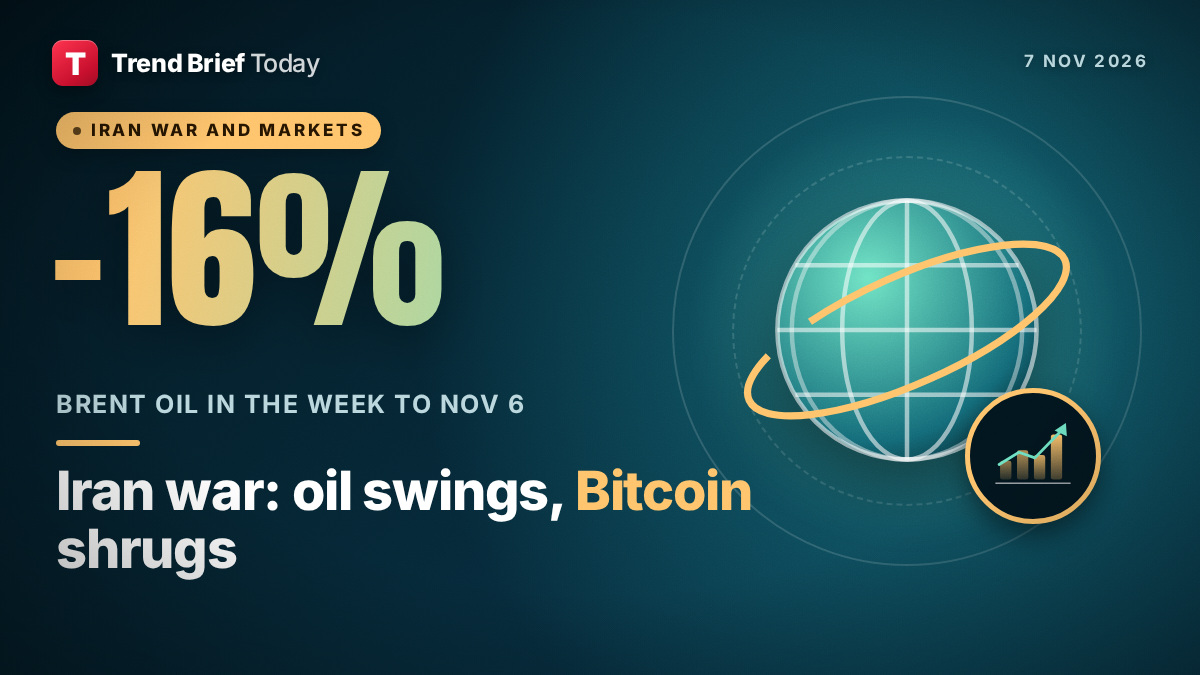
The war between the United States, Israel and Iran has not ended, but it is now a mix of limited strikes, tanker attacks and talks through Qatar. On November 2 and again on November 6, 2026, US forces hit targets on Iran's Qeshm Island near the Strait of Hormuz, and Iran says at least five tankers caught fire in the strait on November 4 and 5. At the same time Iran has sent a new proposal through Qatar. Markets have reacted most clearly through oil: Brent crude fell more than 16% in the week to November 6, closing at $98.32. Bitcoin, at about $75,900 on November 7, has followed US tech stocks and interest-rate fears far more than the war. On November 8 the conflict spread further into the Gulf when Houthi missiles fired at Riyadh left an Aramco office tower in the city's financial district damaged.[4][5][6][15] Then on November 8 Trump told CNN that new strikes are "highly unlikely" if talks make progress, and on Monday, November 9, Brent held steady near $98 while Bitcoin slipped below $74,000.[27][30][18] After meeting Qatar's prime minister on the evening of November 9, Trump said the war is "militarily ... effectively over" and that the US is "keeping it the status quo", meaning the naval blockade stays; Iran called the talk of negotiations "fake news". The same day Saudi Arabia's East-West pipeline, the main route around Hormuz, was attacked again near Medina, and Wall Street had its best day since April.[32][33][34][35][36]
 | |
| Sides | United States and Israel against Iran and its allies (Hezbollah, the Houthis, Iraqi armed groups) |
|---|---|
| War began | February 28, 2026 |
| Iran's leaders | Supreme Leader Mojtaba Khamenei; President Masoud Pezeshkian |
| Main mediator now | Qatar |
| Current state | Limited US strikes, Iranian attacks on shipping, US naval blockade of Iranian ports, indirect talks |
| Latest | Nov 10 (midday GMT): US KC-135 tankers leave RAF Mildenhall over a reported Iran threat; Brent dips below $90. Nov 10: Trump holds off on new strikes "at the behest" of Gulf neighbours, keeps the Hormuz blockade; Brent settles at $92.57 (down 5.85%). Nov 9 evening: Trump says the war is "militarily effectively over", blockade stays; East-West pipeline attacked near Medina (limited fire, flows unaffected). Nov 8-9: Trump says new strikes "highly unlikely" if talks progress; Qatar PM at the White House Nov 9; Houthi missiles damaged an Aramco tower in Riyadh Nov 8 |
| Strait of Hormuz | Heavily restricted by Iran; carried about one-fifth of world oil before the war |
| Brent crude | Below $90 on Nov 10 (about $89.70 to $90.14 in European trading), first time since August; $98.32 on Nov 6 |
| Bitcoin | About $75,900 (Nov 7), +12.5% since the day before the war |
| Gold | About $4,060 an ounce (Nov 7), down from nearly $5,600 in January |
| Next dates | US CPI inflation data (Nov 10, 13:30 GMT); Eisenkot's 28 days to form an Israeli government (from Nov 8); US Fed meeting in December |
Two things changed the picture this week. The first was the US midterm election on November 3, where Democrats won both chambers of Congress and Vice President JD Vance said openly that "the reason we lost is the war." The second was a run of tanker attacks in and around the Strait of Hormuz, which reminded traders that the shipping lane is still far from open. Prices have swung between those two stories every day.[3][6]
Where the war stands now
The fighting began on February 28, 2026, when the US and Israel launched air strikes on Iran. Supreme Leader Ali Khamenei was killed in the first strikes and his son Mojtaba Khamenei replaced him. Iran answered with missile and drone attacks on Israel and on US bases and energy sites across the Gulf, and it sharply restricted traffic through the Strait of Hormuz. The US later put a naval blockade on Iranian ports.[8]
Since then the war has moved in waves. A ceasefire and talks in the spring led to a memorandum of understanding in June, but that broke down on July 8, when Iran attacked three tankers and US Central Command struck "over 80 targets" in Iran. Fighting slowed in August and picked up again from September.[9][8]
In early November the US is carrying out small, targeted strikes instead of a full air campaign. On November 2 a US official called strikes on Qeshm Island "a defensive measure" against Iranians "using surface to air missiles against US assets." On November 6 President Donald Trump said, "We do minor strikes," describing the target as "a little bit of an anti-aircraft device." He also said, "this is a war that we may have been there for seven months, but we probably fought for three or four weeks, really fought."[2][5]
Iran's state media reported two missiles hitting the Suza area of Qeshm on November 6, and Iran's army said its air defences shot down a US MQ-9 drone over the island. US Central Command described the situation as "relatively calm."[7]
The Strait of Hormuz
On November 5 Iran's Revolutionary Guard and army said at least five oil tankers and a tugboat caught fire after hitting mines or being struck near the strait. Separately, the UK Maritime Trade Operations agency (UKMTO) said a tanker was hit by two projectiles about 50 nautical miles north of Qatar's coast late on November 4. No one claimed that attack. UKMTO has said it is "struggling to accurately report" the real number of attacks because most ships no longer report them.[6]
The weekend brought more of the same. On the evening of November 7 the US military said its aircraft had fired at the stern of a St. Kitts-flagged cargo ship in the Gulf of Oman and disabled it as it tried to get through the blockade. Iran's Revolutionary Guard navy said two oil tankers caught fire after hitting mines on what it called an "unauthorized route" through the strait, and UKMTO reported a tanker on fire about 8 nautical miles northwest of Khasab, Oman. The UAE said it rescued 22 crew from a burning cargo ship in the Sea of Oman. Iranian state TV suggested blasts heard on Qeshm that evening came from Iran's own military activity, not new US strikes.[22][24]
Iran says the strait will stay closed to what it calls hostile shipping until the US meets its conditions. Those include lifting sanctions, unfreezing Iranian assets, ending the naval blockade and guaranteeing an end to attacks.[7]
The talks
Diplomacy has not stopped. On November 2 President Masoud Pezeshkian said the Supreme Leader had given the government authority to seek a solution through dialogue, and Foreign Minister Abbas Araghchi said a deal is possible if Washington "demonstrates goodwill." On November 5 Iran sent a new nuclear and peace proposal through Qatar, which a senior Iranian official told Reuters could only be discussed once the US meets Tehran's demands. Qatar's foreign ministry spokesperson, Majed al-Ansari, rejected online claims that the talks had failed.[1][7]
The threats have not stopped either. Trump said on November 5 the US may have to "destroy" the rest of Iran, and Axios reported that Central Command is ready to resume major operations once ordered. An Iranian Revolutionary Guard spokesman warned that "any country or force that helps America attack Iran can be a legitimate target." The US State Department has also offered up to $20 million for information on Iran's nuclear programme.[7]
On November 7 US Central Command announced Task Force Iron Gate, a small unit based in Tampa that will try to stop weapons, dual-use technology and sanctioned goods moving across Iran's land borders and the Caspian Sea. It extends the sea blockade to land routes. The Revolutionary Guard dismissed it as "just a play on words." Qatar, meanwhile, denied reports that the US and Iran had failed to reach a deal and said both sides were still working towards one.[24][25]
Israel, Lebanon and the Houthis
Israel is in a political gap of its own. Its October 27 election left neither Prime Minister Benjamin Netanyahu nor former army chief Gadi Eisenkot with a majority. In consultations, 67 of 120 lawmakers backed Eisenkot and 46 backed Netanyahu, and on November 7 President Isaac Herzog chose Eisenkot, not Netanyahu, to form the next government. Eisenkot has 28 days, plus a possible 14-day extension, to build a coalition of at least 61 seats (full explainer).[12][20]
On November 3 Trump said the US would stop its roughly $4 billion a year in military aid to Israel after the end of the year. Al Jazeera noted that Congress, not the president, controls that money, and Israel did not confirm the change.[10]
In Lebanon, Hezbollah joined the war in March and Israel still occupies land in the south. Families in Lebanon are packing bags and stocking food in case a new US-Iran round also brings heavier Israeli strikes. Lebanon's health ministry says Israel has killed around 9,000 people in Lebanon since October 2023. In Yemen, the Houthis have fired missiles and drones at Saudi airports and oil sites, which puts a second shipping chokepoint, the Bab al-Mandeb, at risk.[11][8]
Trump's "highly unlikely" remark and the Qatar meeting (November 8-9)
The biggest change over the weekend was in tone. In a CNN interview on Sunday, November 8, Trump said a return to full-scale war was "highly unlikely" as long as talks to limit Iran's nuclear programme and reopen the Strait of Hormuz keep moving. "It depends on whether or not they sign a very strong agreement," he said. He did not rule strikes out: he said three US aircraft carriers in the region were "fully locked and loaded" and that the US had "38 bridges" in its sights that could be destroyed "in literally one hour."[27][28]
Not everyone in Washington sounded so hopeful. Secretary of State Marco Rubio, leaving for a G7 foreign ministers' meeting in Paris, said negotiations had made little progress, that he did not see a breakthrough coming soon, and called some of Iran's demands "outrageous and ridiculous." In Tehran, Foreign Minister Abbas Araghchi said mediators had not travelled since the US election and that Iran was waiting to see how Washington digests the result. Trump is due to meet Qatar's prime minister and foreign minister, Sheikh Mohammed bin Abdulrahman Al Thani, at the White House on Monday, November 9, with Vice President JD Vance also meeting him.[28][31]
The strait itself stayed tense. Iranian state media reported explosions on Qeshm Island late on Sunday; a provincial official called it a US attack and said no vital infrastructure was hit. On Monday an unnamed Revolutionary Guard navy official said navigation aid systems in the south of the strait had been destroyed and that no "unauthorized" ships passed through overnight. Neither claim has been independently confirmed.[29]
What it means for prices. Markets treated Trump's words as a mild calming signal rather than a turning point. Brent was up just 3 cents at $98.35 a barrel early on Monday, November 9, after its steepest weekly fall since the start of the Covid pandemic, and WTI was at $91.30. One analyst quoted by Reuters said the market is "still waiting to see" whether the midterms have really changed Trump's approach. JPMorgan, in a note on Friday, said the oil market is heading back into surplus as Middle East flows recover. Bitcoin did not get any lift: it was about $73,900 at 07:56 GMT on November 9, down about 2.6% in 24 hours, while gold (PAX Gold) was near $4,075, slightly up.[30][18]
The Houthi attack on Riyadh (November 8)
Early on Sunday, November 8, the Saudi-led coalition fighting the Houthis said its air defences had destroyed ballistic and cruise missiles fired at Riyadh and other parts of the kingdom, including the Eastern Province and the south. Saudi Civil Defence had sounded an alert in the Riyadh region shortly before loud blasts were heard. Saudi Arabia's Energy Ministry said an administrative building owned by Saudi Aramco in the capital was hit by "falling shrapnel" from the attempted attack, causing "minor damage," with no deaths or injuries.[21][22][23]
The building is an Aramco tower in the King Abdullah Financial District (KAFD), Riyadh's main business hub. Witnesses quoted by the Associated Press described damage across several floors, with some floors appearing heavily damaged, which is a bigger picture than the ministry's wording. Aramco itself did not comment straight away.[22]
Houthi military spokesman Yahya Saree claimed the group had targeted King Khalid International Airport, Aramco oil storage and "the Financial Centre" in Riyadh with ballistic and cruise missiles and drones, and said a separate attack caused fires at Aramco's Abqaiq facilities. Saudi Arabia has not confirmed any damage at Abqaiq, so treat that part as a claim. On November 7 the group had already claimed attacks on Riyadh airport, Aramco sites in Riyadh and Khurais, and a pumping station in Dawadmi.[23]
Why it matters: this is a separate war inside the wider one. A UN-brokered truce in Yemen that had largely held since 2022 collapsed in July, and since then the Houthis have struck Saudi airports, refineries at Ras Tanura and Rabigh, and other Aramco sites. A strike on Riyadh airport on October 10 killed at least 13 people. Saudi-led coalition air strikes near Sanaa on November 7 killed at least 33 people, according to the Houthi-run health ministry, and the UN says more than 1,600 people have been killed in Yemen since July. The AP also reports that Syria is preparing to send about 600 special forces to Saudi Arabia, according to officials speaking anonymously.[21][23][26]
For markets, the Riyadh attack landed on a weekend, so oil prices had not reacted when this update was written. Strikes on Saudi energy sites are exactly the kind of risk TD Securities' Ryan McKay pointed to when he said the war premium in oil would not disappear while tanker and Houthi attacks continue.[3]
"Effectively over": Trump after the Qatar meeting (November 9)
Trump and Vice President JD Vance hosted Qatar's prime minister, Sheikh Mohammed bin Abdulrahman Al Thani, at the White House on Monday. In a surprise briefing afterwards Trump said the war "militarily, is effectively over" but that "we're just keeping it the status quo." By status quo he meant the US naval blockade of Iranian ports and the new Task Force Iron Gate, which targets Iran's land and Caspian Sea trade. He said Qatar, Saudi Arabia, the UAE, Bahrain and Kuwait "would prefer the status quo," and he refused to promise a lasting ceasefire: "I don't guarantee anything."[32][33]
Sheikh Mohammed wrote on X that the two sides "discussed the situation in the region and ways to progress the US-Iran talks" and that he was "grateful for the positive discussions on reaching a deal." In a short phone call with Reuters, Trump said Qatar and Saudi Arabia "would rather see a peaceful solution" but "we're ready to go anytime we want," adding that he was in no rush while the blockade holds.[32][33][34]
Tehran was dismissive. Mohsen Rezaei, secretary of Iran's Supreme National Security Council, told Washington on social media to "STOP manufacturing FAKE NEWS about imaginary talks." President Masoud Pezeshkian said Supreme Leader Mojtaba Khamenei had called for an end to the current state of "neither war nor peace."[32]
East-West pipeline attacked again (November 9)
Saudi Arabia's energy ministry said the East-West pipeline was targeted in the Medina region on Monday. The attack caused a "limited fire" that emergency teams put out; there were no injuries and pipeline operations were not affected. No one was named as the attacker.[35][36] The 1,200 km pipeline carries crude from the east of the kingdom to Yanbu on the Red Sea, and Al Jazeera reports that Riyadh has moved about 4 million barrels a day through it since Hormuz was squeezed, roughly 4% of world supply. It was shut for several days in September after drone attacks Saudi Arabia said came from Iraq.[36] On Monday Canada's prime minister and the Arab League also condemned Houthi attacks on Saudi Arabia.[37]
Separately, France on November 9 blamed a cyber unit linked to Iran's Revolutionary Guards, named by the Paris prosecutor as Shahid Kaveh, for the October hack that warmed fridges and freezers in hundreds of French supermarkets. Foreign Minister Jean-Noël Barrot summoned Iran's ambassador and promised sanctions.[38]
Markets on November 9
Wall Street read the day as calming. Oil fell sharply as Trump played down new strikes, and the Dow Jones rose 1,104 points (2.15%) to 52,389.75, the S&P 500 gained 2.35% and the Nasdaq 2.74%. The S&P's gain was its biggest in a day since April 8. Nvidia, hit by questions about its chief executive, was the main faller.[34] Bitcoin barely moved: CoinGecko showed about $75,150 at 23:35 GMT, down 0.1% in 24 hours, while PAX Gold was about $4,122, up 1.6%.[18] Markets still price a better than 80% chance of a Fed rate rise in December, according to CME FedWatch as cited by Reuters, which is why Tuesday's US CPI inflation report matters for Bitcoin and gold too.[34]
Strikes on hold, blockade stays (November 10)
In a Reuters interview and later from the White House briefing room on Monday evening (early Tuesday GMT), Trump said he would hold off on new military strikes against Iran "for the time being" because the country's neighbours had asked him to. He named Qatar, Saudi Arabia, the United Arab Emirates, Bahrain and Kuwait. "We're just keeping it the status quo," he said, adding that the US was "fully locked and loaded" but did not think "there's going to be any reason to use it." Renewed attacks were "highly unlikely", he said, and he spoke of "positive momentum" towards a deal.[39][40]
The naval blockade of Iranian ports stays for now. Asked why he would not formally declare the war over, Trump said some Gulf allies could still face Iranian attacks and that the blockade helped keep the region safer.[39][40]
Tehran's line has not changed. Security council chief Mohsen Rezaei said it was "time to surrender to the seven conditions Iran has repeatedly set out", and Foreign Ministry spokesman Esmaeil Baghaei on November 10 called Iran's plan the most reasonable offer on the table. That plan asks the US to lift its blockade of Iranian ports, remove some sanctions and stop bombing, in return for Iran ending its own squeeze on Hormuz, with nuclear talks to follow. Washington has rejected it, and Rubio called the conditions "outrageous and ridiculous" on November 8.[39]
| Benchmark | Settled Nov 9 | Change | Early Nov 10 (01:02 GMT) |
|---|---|---|---|
| Brent | $92.57 | -$5.75 (-5.85%) | $92.33 |
| WTI | $86.85 | -$3.98 (-4.38%) | $86.50 |
Brent's settlement was its lowest since August 31, after a 16% fall the week before, the steepest weekly drop since the start of the Covid-19 pandemic.[41][42] Bitcoin hardly reacted again: CoinGecko showed about $74,730 at 04:45 GMT on November 10, down 0.2% in 24 hours, with PAX Gold near $4,100.[18] The next big test for both is the October CPI report at 13:30 GMT. Cheaper crude is also feeding through to the pump: see our explainer on US gas prices falling below $4.
US tankers leave RAF Mildenhall, Brent below $90 (November 10, midday)
The war reached Britain again on Tuesday. The Wall Street Journal reported that the US military had moved aircraft out of RAF Mildenhall in Suffolk "in the wake of a threat from Iran", and that US security at Mildenhall and nearby RAF Lakenheath had been raised to FPCON Charlie, the second-highest level in the Pentagon's force protection scale, used when intelligence suggests an attack is likely.[43] A US official confirmed to NBC News that several aircraft had left as the security posture went up, saying they were operating under "enhanced force protection measures", but would not describe the threat.[44]
Flight tracking gives slightly different counts. NBC News counted at least eight air refuelling tankers and three Ospreys leaving on Monday, with tankers going to bases in Germany and Spain and the Ospreys moving the short distance to Lakenheath. BBC Verify counted at least 10 KC-135 tankers, two of which flew first towards Germany and Italy before landing at Spangdahlem in Germany. One tanker that landed at Prestwick in Scotland belongs to the Nebraska Air National Guard and may simply have been on a routine stop home.[44][45]
| Who | What they said |
|---|---|
| US official (to NBC News) | "We take proactive measures to ensure our aircraft, our people, and our installations remain safe and secure." |
| US Air Force / European Command | Aircraft "rotate between installations and operating locations for a variety of reasons"; no further detail "due to operations security" |
| UK Ministry of Defence | "We do not routinely comment on the activity of other nations. Aircraft and other assets move regularly according to operational requirements." |
| Lucy Powell, Education Secretary (BBC Breakfast) | Could not comment on operations; "we will always act on security intelligence when we need to" |
| Lord Ricketts, former UK National Security Adviser (Radio 4) | Tankers are "large targets" on a long perimeter; "I suspect part of it is an abundance of caution" |
It is the second time in a few weeks that US aircraft have left a British base. After five men were detained near RAF Fairford in Gloucestershire on September 27, the US pulled its B-1 bombers from that base; two men were later charged under the National Security Act. Iran has denied any plot, but its Revolutionary Guard said in July that any base used to attack Iranian territory was a legitimate target.[43][44] The BBC found little aircraft movement and no visible extra security at Mildenhall on Tuesday morning. About 3,000 US personnel are based there, around 80 miles (130 km) north of London.[45]
Markets kept reading Trump's "status quo" remarks as a sign the fighting is winding down. Brent fell below $90 a barrel for the first time since August: OilPrice.com had the front-month contract at $89.70 in early European trade and CNBC had it at $90.14, down 2.65%, at 5:33am ET, after the January contract dipped under $90. WTI traded below $85. Brent is now about 25% below its late-October peak above $117.[46][47] A Saudi energy ministry official said the latest Houthi strike on the East-West pipeline caused only a "limited fire" that was put out.[47] Bitcoin stayed flat at about $74,190 (down 0.7% in 24 hours) and PAX Gold was near $4,065 on CoinGecko at 12:30 GMT.[18]
| Point | Price | Source |
|---|---|---|
| Late-October peak | Above $117 | OilPrice.com |
| November 6 close | $98.32 | CNBC |
| November 9 settlement | $92.57 | Reuters |
| November 10, early Europe | $89.70 | OilPrice.com |
| November 10, 5:33am ET | $90.14 (-2.65%) | CNBC |
Timeline
| Date (2026) | Event |
|---|---|
| February 28 | US and Israel strike Iran; Ali Khamenei killed; Iran restricts Hormuz |
| Early March | Hezbollah joins; Israel bombs and later occupies parts of south Lebanon |
| April 8 | First ceasefire begins |
| June | US and Iran sign a memorandum starting a 60-day negotiation process |
| July 8 | Ceasefire collapses after attacks on three tankers; US strikes over 80 targets |
| September | Attacks resume; tanker war in the Gulf intensifies |
| October 27 | Israel holds an election with no clear winner |
| November 2 | US "defensive" strikes on Qeshm; Iran's leaders authorise talks; oil drops over 7% |
| November 3 | US midterms: Democrats win both chambers; Trump says Israel aid will end after the year |
| November 4 | Vance blames the war for the defeat; Brent falls 8.7% |
| November 5 | Iran reports at least five tankers on fire; new Iranian proposal sent via Qatar |
| November 6 | New "minor" US strikes on Qeshm; Iran says it shot down a US drone |
| November 7 | Herzog picks Eisenkot in Israel; US launches Task Force Iron Gate and disables a cargo ship in the Gulf of Oman; Iran says two tankers hit mines |
| November 8 | Houthi missiles fired at Riyadh; Aramco tower in the financial district damaged by debris, no casualties reported; Trump tells CNN new strikes are "highly unlikely" if talks progress; Rubio sees no breakthrough |
| November 9 | Iran says navigation aids in the strait were destroyed after blasts on Qeshm; Brent opens near $98 but settles 5.85% lower at $92.57; Trump meets Qatar's prime minister at the White House, then says the war is "militarily effectively over" and the blockade stays; Iran calls it "fake news"; East-West pipeline attacked near Medina; Dow up 1,104 points |
| November 10 | Trump says he will hold off on new strikes at the request of Gulf neighbours and keep the blockade; Iran says its own plan is the most reasonable offer[39][40] |
Compiled from CNBC, Al Jazeera, AP and The National reporting.[1][3][6][8][9]
How Bitcoin, gold and oil reacted
The table below lines up the war's turning points with prices on either side. Bitcoin, Ether and gold use CoinGecko's daily snapshot at 00:00 UTC (gold through PAX Gold, a token backed by one ounce of gold, which tracks the spot price closely). Brent uses the US Energy Information Administration's daily spot price for older dates and the futures close reported by CNBC for November. Treat them as a rough guide, not exact trade prices.[18][19]
| Event | Bitcoin | Ether | Gold | Brent oil |
|---|---|---|---|---|
| War begins (Feb 27 to Mar 2) | $67,497 to $65,824 (-2.5%), back to $68,816 on Mar 3 | $2,028 to $1,940 (-4.3%) | $5,195 to $5,426 (+4.4%) | $71.32 to $77.24 (+8.3%), $95.74 by Mar 6 |
| First ceasefire (Apr 7 to Apr 8) | $68,672 to $71,662 (+4.4%) | $2,101 to $2,236 (+6.4%) | $4,638 to $4,819 (+3.9%) | $138.21 to $122.11 (-11.6%) |
| Ceasefire collapses (Jul 7 to Jul 9) | $64,001 to $62,247 (-2.7%) | $1,799 to $1,742 (-3.2%) | $4,150 to $4,070 (-1.9%) | $71.78 to $76.50 (+6.6%) |
| Talks signal, Qeshm strike (Nov 2 to Nov 3) | $78,294 to $76,709 (-2.0%) | $2,274 to $2,250 (-1.1%) | $3,908 to $3,948 (+1.0%) | -7.6% to $104.77 on Nov 2 |
| Midterms, Vance comment (Nov 4 to Nov 5) | $77,385 to $80,443 (+4.0%) | $2,274 to $2,423 (+6.6%) | $3,941 to $4,060 (+3.0%) | -8.7% to $94.62 on Nov 4 |
| Tanker fires, tech sell-off (Nov 5 to Nov 7) | $80,443 to $75,937 (-5.6%) | $2,423 to $2,242 (-7.5%) | $4,060 to $4,062 (flat) | $98.32 on Nov 6 (+3.9% from Nov 4) |
| Whole war (Feb 27 to Nov 7) | +12.5% | +10.6% | -21.8% | +37.9% (to Nov 6) |
Bitcoin, Ether and gold from the CoinGecko API; Brent from EIA via FRED and from CNBC.[1][3][4][18][19]
Oil: the clearest link
Oil is the one market that moves almost one-for-one with war news, for an obvious reason: the Strait of Hormuz carries a large share of the world's crude. Brent nearly doubled from about $71 before the war to a spot high of $138 on April 7, the day before the first ceasefire. In October it gained more than 10% as traders priced in a possible strike after the midterms, then gave much of that back this week on talk of a deal.[1][19]
Analysts do not agree on what comes next. Bob McNally of Rapidan Energy Group puts the chance of fighting resuming at 80% and expects both benchmarks to go back above $100. Rebecca Babin of CIBC said the sell-off "could be getting a bit overdone." Ryan McKay of TD Securities said that as long as tanker and Houthi attacks continue, he does not expect diplomacy headlines alone to wipe out the war premium.[1][3][4]
Bitcoin: following stocks, not the war
Bitcoin is up about 12.5% since the day before the war, but the path tells a different story. It hit its low of the war period, about $58,600, on July 1, a week before the ceasefire collapsed, and its high, about $86,600, on September 22, after fighting had already resumed. If Bitcoin were acting as a war hedge or a war casualty, those dates would make little sense.[18]
This week shows the same pattern. Bitcoin rose above $80,000 after the midterms, which crypto trader Joshua Lim of FalconX called a relief rally "driven by a lot of short-covering." It then fell about 5% on November 5 as AI and chip stocks crashed, with the Philadelphia Semiconductor Index down 12% and the Nasdaq 100 down 6.4%. Carlos Guzman of GSR said, "The midterms appear to have triggered this sell-off." More than $1 billion of crypto bets were liquidated, and on November 6 Bitcoin touched $74,780, its lowest since August 21.[14][15]
Other forces are also in play. A record hack at Binance in late October, put at $6.43 billion by NPR citing Elliptic, led to large outflows from Bitcoin funds. A strong US jobs report on November 6, 165,000 jobs against an estimate of 59,000, raised bets that the Federal Reserve will raise interest rates in December. Higher rates usually weigh on speculative assets like crypto.[13][15][16][17]
Where the war does reach Bitcoin, it is mostly through oil. Expensive oil keeps inflation high, which keeps the Fed leaning towards tighter policy. That is an indirect link, and on any single day it is easily outweighed by tech stocks or fund flows.
Gold: why the safe haven fell
Gold is the surprise. It rose in the first days of the war, as safe havens usually do, but it is now about 22% lower than on February 27 and fell below $4,000 an ounce this week, after nearly reaching $5,600 in January. Planet Money co-host Jeff Guo put it down to rising US Treasury yields: gold pays no interest, while inflation-protected government bonds now do. "The main effect of the war so far seems to be raising the price of oil," he said, "and higher oil prices are one of the factors pushing interest rates up, making bonds more attractive relative to gold."[13]
The Fed held rates on October 28, but Seema Shah of Principal Asset Management said the central bank "is still taking back some of last year's rate cuts" and that she expects a hike in December and another in early 2027.[17]
Correlation is not causation
It is tempting to read every price move as a reaction to the war. The numbers above do not support that, except for oil. Over this one week Bitcoin moved with the Nasdaq, gold moved with bond yields and the dollar, and oil moved with Hormuz and the talks. Several of these things happened on the same days, so a simple before-and-after comparison cannot separate them. The fairest summary is that the war sets the background (expensive energy, sticky inflation, higher rates), while day-to-day crypto prices are driven by other things.
What to watch
- US bases in Britain. Whether the Mildenhall tankers return, whether FPCON Charlie is lowered, and whether UK police announce any arrests linked to the reported threat.
- Any return to large-scale US strikes. Analysts expect oil to jump first; Bitcoin's reaction in past escalations has been small and short.
- Qatar's mediation. Qatar called the November 9 White House talks "positive", but Iran denies there are real negotiations. A deal that reopens Hormuz would likely push oil down sharply.
- The East-West pipeline. It is Saudi Arabia's main way around Hormuz. A hit that actually stops flows would matter far more for oil than the November 9 fire.
- US inflation on November 10. October CPI comes out at 8:30am ET (13:30 GMT) and feeds straight into the Fed's December decision.
- Tanker attacks. UKMTO notices and insurance costs show whether shipping is really getting through.
- Israel's next government. Whether Eisenkot can build a coalition after Herzog picked him on November 7.
- The Fed in December. A rate hike matters more for Bitcoin and gold than most war headlines.
- Saudi energy sites. Confirmed damage at Aramco plants such as Abqaiq, not just office buildings, would hit oil supply directly.
- Lebanon and the Red Sea. A new front with Hezbollah or wider Houthi attacks would widen the energy risk.
Frequently asked questions
Is the US still at war with Iran?
Yes, though at a lower level than in the spring. The US is carrying out limited strikes and a naval blockade, Iran is attacking shipping, and both sides are talking indirectly through Qatar.
Why did US planes leave RAF Mildenhall?
The Wall Street Journal reported the move followed a threat from Iran, and a US official told NBC News the aircraft left as security was raised. Neither the US nor the UK has said what the threat was, and the BBC said it had not independently confirmed the Iran link.[43][44][45]
Why did oil prices fall this week?
Traders bet that the midterm result would push the White House towards a deal. Brent fell 7.6% on November 2 and 8.7% on November 4, and lost more than 16% over the week.
Did the Iran war make Bitcoin go up or down?
Neither in a clear way. Bitcoin is up about 12.5% since the war began, but its biggest recent moves came from US tech stocks, interest-rate expectations, fund outflows and the Binance hack.
Why is gold falling during a war?
Higher oil prices have kept inflation and US interest rates high. Bonds now pay a real return, which makes gold, which pays nothing, less attractive.
Was the Aramco tower in Riyadh hit?
An Aramco administrative building in Riyadh's King Abdullah Financial District was damaged on November 8. Saudi Arabia says it was hit by falling debris after missiles were intercepted and that no one was hurt. The Houthis say they targeted the area directly.
Is the Iran war over?
Not officially. On November 9 Trump said the war is "militarily ... effectively over", but the US naval blockade continues, he would not guarantee a ceasefire, and Iran rejected his comments. No agreement has been signed.[32][33]
Will the US strike Iran again?
Trump said on November 8 that new strikes are "highly unlikely" if talks make progress, and on November 9 he called a resumption "quite unlikely", but he also said the US military is ready and named bridges and power plants as possible targets. Rubio said the talks have made little progress, so the risk has not gone away.
Is the Strait of Hormuz open?
Not normally. Iran restricts traffic and says ships are hitting mines, while the US Navy escorts some tankers through. Iran says it will reopen the strait only if its conditions are met.
Is this a good time to buy Bitcoin or gold?
This article does not give investment advice. Prices are volatile, and war news can change them quickly in either direction.
References
- "Crude oil prices sell off more than 7% on Iran peace talk hopes ahead of U.S. midterms". CNBC. November 2, 2026.
- "U.S. strikes Iran's Qeshm Island as Vance hopes for 'negotiated settlement' with Tehran". CNBC. November 3, 2026.
- "Crude oil prices fall below $90 a barrel as Vance blames GOP election defeat on Iran war". CNBC. November 4, 2026.
- "Oil prices tumble for the week as investors weigh Iran conflict risk after midterm elections". CNBC. November 6, 2026.
- "Trump says U.S. carried out 'minor strikes' on Iran as missiles hit Qeshm Island". CNBC. November 7, 2026.
- "Iran says tankers struck in Hormuz amid fears of new US attack". Al Jazeera. November 5, 2026.
- "Will Trump strike nuclear sites again as Iran engages 'cognitive warfare'?". Al Jazeera. November 7, 2026.
- "US-Iran war, then and now: How the landscape has changed since February". Al Jazeera. October 23, 2026.
- "Why have US-Iran strikes resumed and what does it mean for peace?". Al Jazeera. July 8, 2026.
- "Trump says US will stop giving Israel aid after year-end". Al Jazeera. November 3, 2026.
- "Lebanese pack bags and stock up amid fears of new Israeli escalation". Al Jazeera. November 6, 2026.
- "President Herzog faces key choice as Israel struggles to form government". Al Jazeera and AP. November 7, 2026.
- "Why gold prices are surprisingly low". NPR, The Indicator from Planet Money. November 6, 2026.
- "Bitcoin tumbles to $76,000 as collapsing AI trade drags stocks sharply lower". CoinDesk. November 5, 2026.
- "Crypto Liquidations Top $1 Billion as Bitcoin Tests 11-Week Low". Decrypt. November 6, 2026.
- "October jobs report". CNBC. November 6, 2026.
- "Fed rate decision: takeaways from Warsh". CNBC. October 28, 2026.
- Bitcoin, Ethereum and PAX Gold daily historical prices. CoinGecko. Retrieved November 7 and 9, 2026.
- "Crude Oil Prices: Brent - Europe" (DCOILBRENTEU), US Energy Information Administration. FRED, Federal Reserve Bank of St. Louis. Retrieved November 7, 2026.
- "Israel's president picks Eisenkot over Netanyahu to form next government". Al Jazeera. November 7, 2026.
- "Saudi Aramco building in Riyadh damaged in 'attempted' attack". Al Jazeera. November 8, 2026.
- "Saudi Arabia intercepts missiles as Aramco building in Riyadh is damaged, and other Mideast news". Associated Press via ABC News. November 8, 2026.
- "Aramco building in Riyadh damaged in attempted attack, ministry says". The National. November 8, 2026.
- "Iran suggests blasts are not U.S. attacks as both sides report ships hit". CNBC (Reuters). November 8, 2026.
- "US task force to cut off Iran's transport of advanced weapons: What we know". Al Jazeera. November 8, 2026.
- "Saudi Arabia turns to Syria for help as fighting with Houthis escalates". Associated Press via ABC News. November 8, 2026.
- "Trump says renewed Iran strikes 'highly unlikely' if talks progress but warns he could still strike". CNBC. November 8, 2026.
- "Iran: Trump says strikes unlikely if peace talks keep moving". DW. November 8, 2026.
- "Iran says no unauthorized vessels transited Strait of Hormuz overnight after navigation aids destroyed". Arab News (Reuters). November 9, 2026.
- "Oil steadies after Trump signals restraint on Iran, Hormuz risks persist". Arab News (Reuters). November 9, 2026.
- "Trump to meet Qatar's prime minister as Iran diplomacy faces hurdles". Arab News (Reuters). November 9, 2026.
- "Trump says war on Iran 'effectively over' after talks with Qatar's PM". Al Jazeera. November 9, 2026.
- "Trump says Iran war is militarily 'effectively over' after Qatar PM talks". Arab News. November 9, 2026.
- "Trump tells Reuters that Qatar, Saudi Arabia want peaceful Iran deal, US ready for strikes if needed". Reuters via The Straits Times. November 9, 2026. Also: "US stocks jump as oil slide cools inflation worries; Nvidia slumps". Reuters via The Straits Times. November 9, 2026.
- "East-West pipeline targeted in Madinah region, Saudi energy ministry says". Arab News. November 9, 2026.
- "Saudi Arabia reports new attack on key East-West pipeline". Al Jazeera, AFP and Reuters. November 9, 2026.
- "Canadian PM condemns Houthi attacks on Saudi Arabia". Arab News. November 9, 2026.
- "France accuses Iran of supermarket fridge hacking". BBC News. November 9, 2026.
- "Trump says US will hold off on new Iran strikes after appeals from Middle East neighbours". Reuters, via The Straits Times. November 10, 2026.
- "Trump says more US attacks on Iran 'highly unlikely'". BBC News. November 10, 2026.
- "Oil down over USD7 a barrel in post settlement trade". Reuters, via Business Recorder. November 10, 2026.
- "Oil falls as Trump downplays prospect of escalation with Iran". Reuters, via The Economic Times. November 10, 2026.
- "US moves aircraft from second UK base over 'threat from Iran'". Reuters, via Al Jazeera. November 10, 2026.
- "U.S. moves military aircraft from British base amid Iran threats". NBC News. November 10, 2026.
- "US military aircraft leave second UK base". BBC News. November 10, 2026.
- "Brent crude falls below $90 for first time since August on Iran war de-escalation hopes". CNBC. November 10, 2026.
- "Brent Crude Falls Below $90 for First Time Since August". OilPrice.com. November 10, 2026.