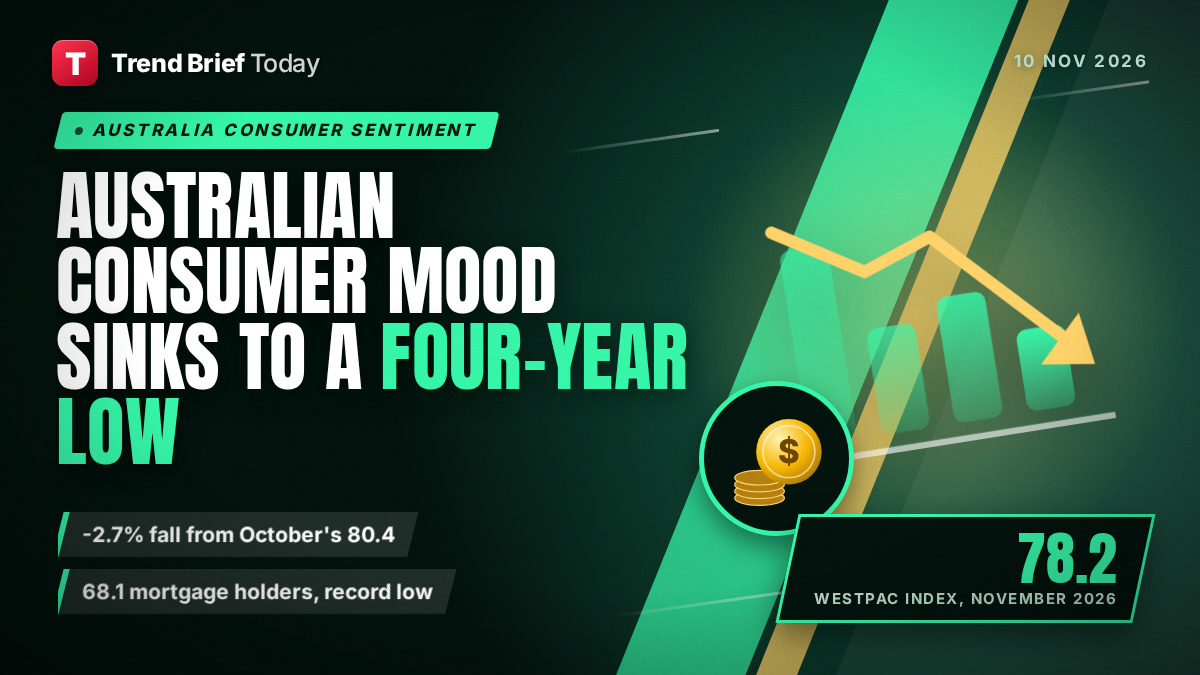
Australian consumer sentiment fell 2.7% to 78.2 in November 2026, its lowest level in four years, according to the Westpac-Melbourne Institute index released on November 10. People with a mortgage took the hardest hit: their sentiment dropped 11.6% to 68.1, the weakest reading for that group since records began in 1994. Westpac blamed petrol near A$2.40 a litre, 4.3% inflation and the Reserve Bank's fifth rate hike of the year, which took the cash rate to 4.85%.[1][2][3]
 | |
| Index | Westpac-Melbourne Institute Consumer Sentiment Index |
|---|---|
| Released | November 10, 2026 (10:30am AEDT) |
| November reading | 78.2 (October: 80.4) |
| Monthly change | -2.7% (October: -4.7%) |
| Annual change | -24.6% (November 2025: 103.8) |
| Mortgage holders | 68.1, down 11.6%, record low since 1994 |
| Survey dates | November 2-6, 2026 (1,200 adults) |
| RBA cash rate | 4.85% (raised November 3, 2026) |
| Annual inflation | 4.3% (CPI, 12 months to September 2026) |
| Next RBA meeting | December 7-8, 2026 |
| Next survey | December 2026 |
What the Westpac consumer sentiment index measures
The Westpac-Melbourne Institute Consumer Sentiment Index is Australia's longest-running monthly read on how households feel. It is built from five questions: how family finances compare with a year ago, how they will look in 12 months, how the economy will do over the next 12 months and the next five years, and whether now is a good time to buy a major household item.[2] A score of 100 means optimists and pessimists are evenly balanced. Anything below 100 means pessimists are in charge, and the long-run average over the full history of the survey is 100.1.[2]
The November survey interviewed 1,200 adults across Australia between November 2 and 6. That window matters, because the Reserve Bank of Australia announced its rate decision on Tuesday, November 3, in the middle of the fieldwork.[2][6]
The November 2026 numbers
The headline index slipped from 80.4 in October to 78.2. Westpac's Matthew Hassan said readings this weak have only been seen at the economy's "darkest moments": the start of the COVID pandemic, the height of the global financial crisis, the early 1990s and early 1980s recessions, and the inflation shock of late 2022.[1][4]
The fall came mostly from one place. The "economy, next 12 months" sub-index dropped 10.2% to 70.3, its weakest level since August 2020, when Melbourne had just gone into its second lockdown.[2][3] The five-year economic outlook slipped only 1%, and assessments of family finances compared with a year ago actually rose 3% to 68.8. Even so, both family finance measures sit about 19 points below their long-run averages.[2]
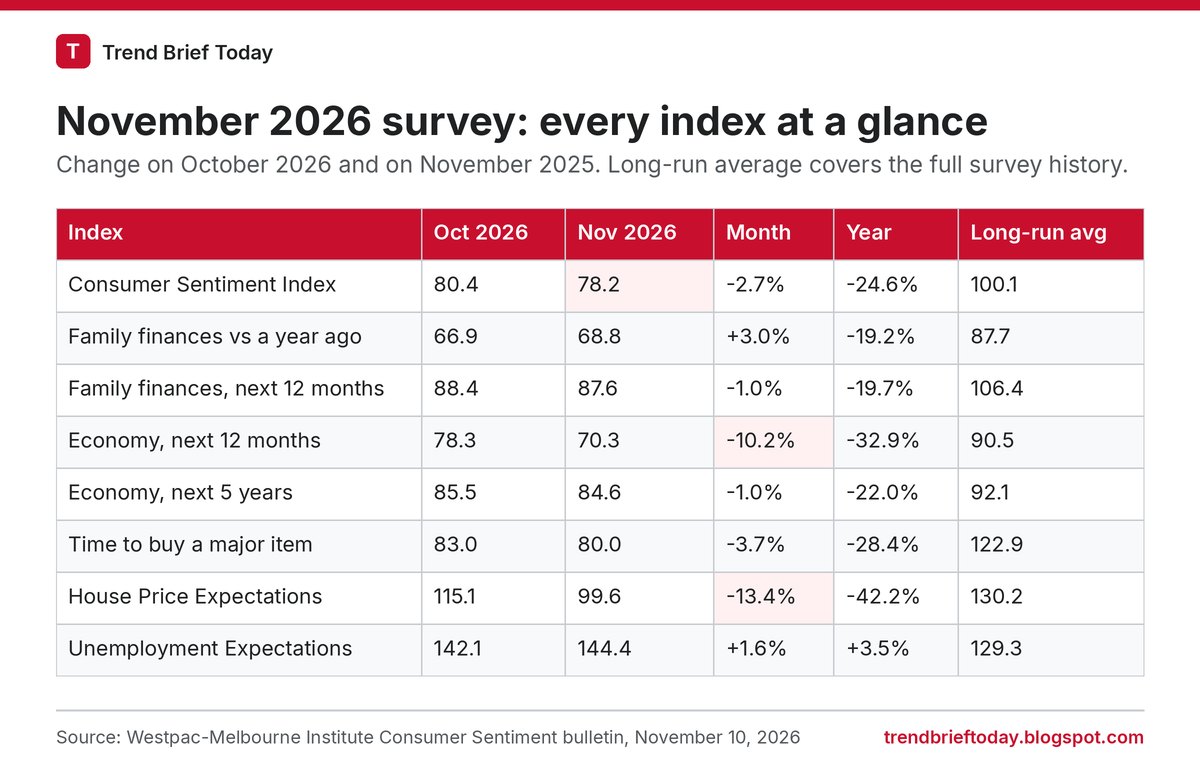
The "time to buy a major household item" index fell 3.7% to 80.0, more than 40 points below its long-run average of about 123. Westpac said only 15 of the 623 surveys run since the mid-1970s have produced a weaker result on that question.[2][3]
Why mortgage holders are the gloomiest
The split by household type is the most striking part of the release. Sentiment among people with a mortgage plunged 11.6% in a single month to 68.1. Westpac's mortgage-holder series goes back to 1994, and it has never been this low.[1][3] Westpac did not publish separate November figures for renters or outright owners in its bulletin, so we cannot say how far behind the rest of the country borrowers now sit.
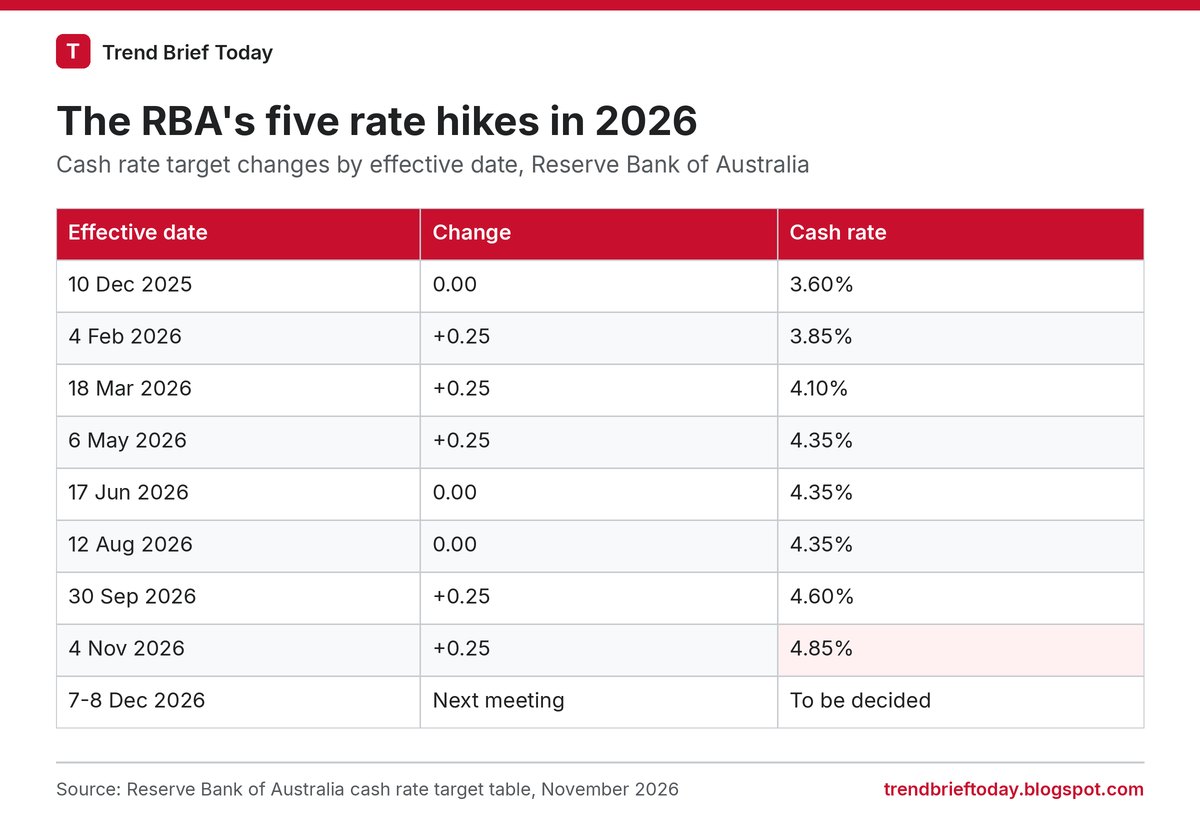
The reason is not hard to find. The RBA has lifted the cash rate five times in 2026, from 3.60% at the start of the year to 4.85% now, an 18-year high.[5][1] On a variable home loan, most of each hike usually flows straight through to repayments.
To show what that means in dollars, here is our own example. On a A$600,000, 30-year principal-and-interest loan, a rate rising from 5.85% to 7.10% (the same 1.25 percentage points the cash rate has climbed this year) lifts the monthly repayment from about A$3,540 to about A$4,032. That is roughly A$493 more a month, or about A$5,900 a year. Your own lender's rate and how much it passed on will differ, so treat this as an illustration, not a quote.
Borrowers also expect more pain. Among people surveyed after the November 3 decision, 72% said they expect mortgage rates to rise further over the next 12 months, down from 80% in October but up from 64% in September.[1][3] The Mortgage Rate Expectations Index eased 1.1% to 177.8 but stays close to its recent peaks.[2]
What is driving the gloom
Westpac named three pressures from the past month.[1][4]
- Petrol. Prices pushed towards A$2.40 a litre. Fuel has been expensive all year because of the war on Iran and disruption to oil shipping; our Iran war and oil price explainer tracks that story, and the US version of the squeeze is in our piece on US gas prices falling below $4.
- Inflation. The Australian Bureau of Statistics said in late October that the CPI rose 4.3% in the 12 months to September, up from 4.0% in August. Trimmed mean inflation, the RBA's preferred core measure, was 3.6%. Transport prices were up 8.7% over the year.[7]
- Interest rates. The RBA's Monetary Policy Board raised the cash rate by 25 basis points on November 3. Its statement said inflation was "broadly based", that the forecast had been "revised materially higher", partly because of fuel prices linked to the conflict in the Middle East, and that inflation is not expected to reach the top of the 2-3% target band until late 2027.[6]
Hassan added that any lift from abroad, such as the US midterm results, had been "swamped by inflation and interest rate concerns".[1]
How 2026 compares with past lows
Sentiment has been below 100 for all of 2026. It started the year at 92.9 in January, then crashed 12.5% to 80.1 in April. Westpac's April bulletin linked that drop to the spike in fuel prices after the US-Israel war on Iran and another rate rise.[8] The index recovered to 88.9 in August before sliding for three months in a row.[2]
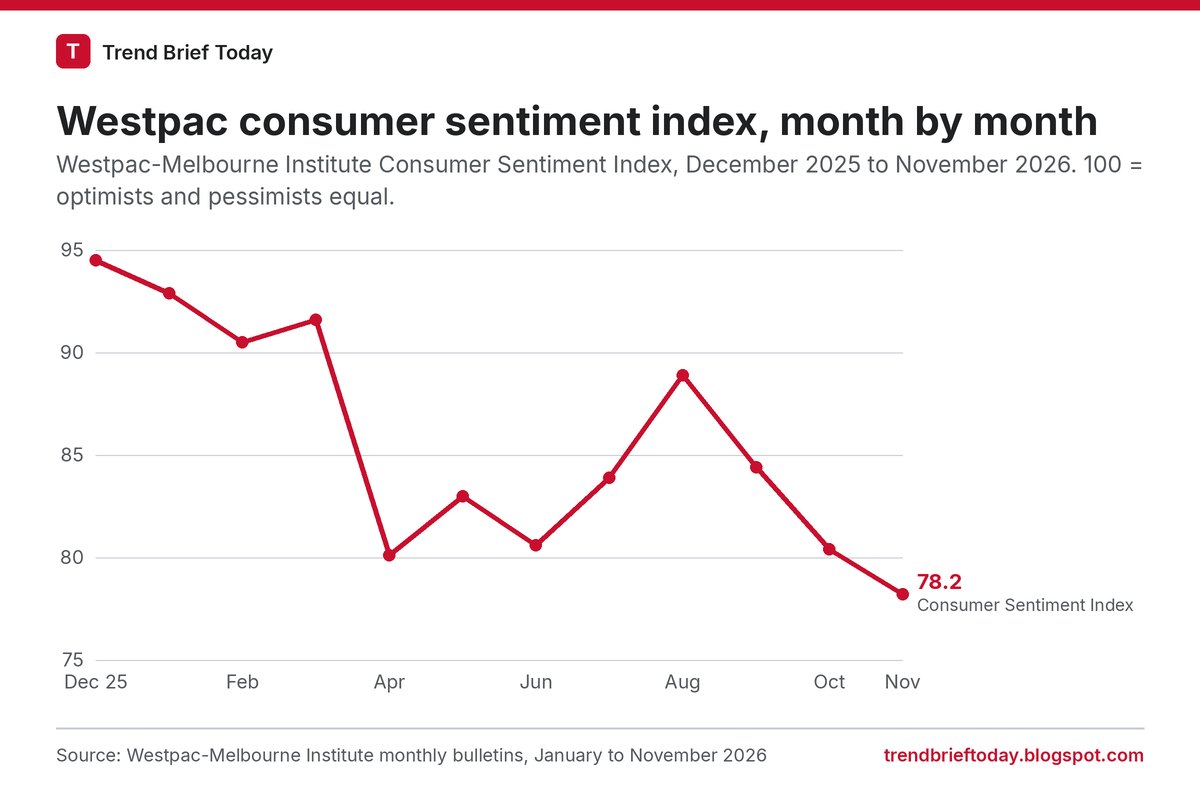
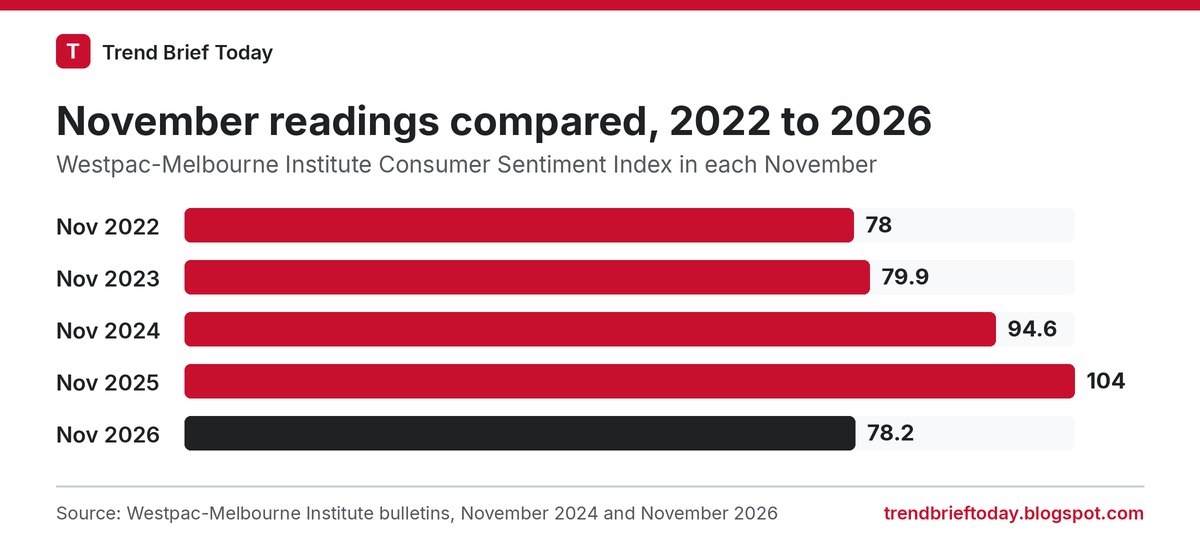
The best comparison is late 2022, when inflation was running close to 8% and the RBA lifted rates by about 4 percentage points in little more than a year. The index read 78.0 in November 2022 and 79.9 in November 2023.[9][2] This month's 78.2 is essentially back at that level, a long way from the 103.8 recorded in November 2025, when optimists briefly outnumbered pessimists.[2]
| Month | Index | Note |
|---|---|---|
| January | 92.9 | Year starts below 100 |
| February | 90.5 | RBA's first 2026 hike (Feb 4) |
| March | 91.6 | Second hike (Mar 18) |
| April | 80.1 | -12.5% after the Iran war fuel spike |
| May | 83.0 | Third hike (May 6) |
| June | 80.6 | |
| July | 83.9 | |
| August | 88.9 | Best reading since March |
| September | 84.4 | Fourth hike (Sep 30, after the survey) |
| October | 80.4 | -4.7% |
| November | 78.2 | Fifth hike (Nov 3); lowest since late 2022 |
Sources for the table: Westpac-Melbourne Institute monthly bulletins[2][8] and the RBA cash rate table.[5]
Housing: price expectations turn negative
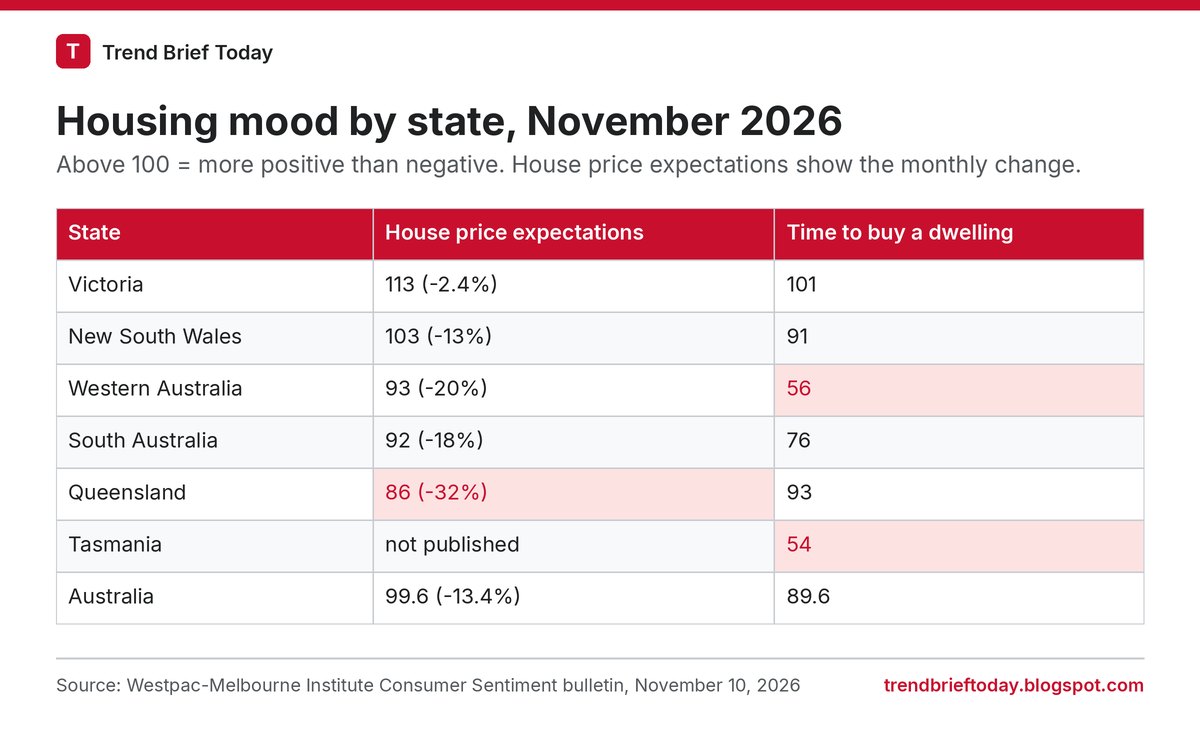
The Westpac-Melbourne Institute House Price Expectations Index fell 13.4% to 99.6. That is the first reading below 100 since November 2022, which means slightly more Australians now expect prices to fall than to rise. Just over 38% expect declines, 38% expect a rise and 19% expect no change.[2][3] The RBA itself said on November 3 that housing prices "have fallen significantly".[6]
Queensland saw the steepest drop, with price expectations down 32% to 86. Victoria held up best at 113. Some buyers see lower prices as a chance: the "time to buy a dwelling" index rose 1.3% to 89.6, although it is still very weak in Western Australia (56) and Tasmania (54).[2]
Jobs and Christmas spending
Job-loss fears are creeping up rather than spiking. The Unemployment Expectations Index rose 1.6% to 144.4 (a higher number means more people expect unemployment to rise). Westpac said that, apart from a brief jump after the war in Iran began, this is the worst reading since the COVID period, but it described consumers as "on edge" rather than alarmed.[2][3]
For retailers, the November survey asked about Christmas. Just over 38% of people plan to spend less on gifts than last year, 46% about the same and 14% more. A year ago, 36% planned to cut back, and the 20-year average is 34%. Among mortgage holders, 92% plan to spend the same or less.[2][3]
What happens next: the RBA in December
The RBA's Monetary Policy Board next meets on December 7-8, 2026. Westpac reads the Governor's comments after the November meeting as a sign the board will pause in December to see how the five hikes are working. It expects February 2027 to be the next meeting where a hike is actively considered, and on balance does not expect one then, while warning that high inflation "will continue to test the RBA's resolve".[2][4]
investingLive noted that the survey, together with the NAB business survey released the same morning, strengthens the case for a December pause and leaves the Australian dollar with little support from rate expectations.[4] These are forecasts, not decisions, and this article is not financial advice. For another big data release from the region on the same day, see our explainer on China's $1 trillion trade surplus, Australia's largest trading partner.
Frequently asked questions
What is the Westpac consumer sentiment index for November 2026?
It is 78.2, down 2.7% from 80.4 in October. It is the lowest reading since late 2022.[1]
Why did consumer confidence fall in Australia?
Westpac pointed to petrol near A$2.40 a litre, 4.3% annual inflation and the RBA's November 3 rate hike to 4.85%. The biggest single drop was in expectations for the economy over the next year.[1][2]
What does a reading below 100 mean?
It means pessimists outnumber optimists. A reading of 78.2 means pessimists outnumber optimists by a wide margin.
How low is mortgage holder sentiment?
It fell 11.6% to 68.1, the lowest since the series began in 1994.[1][3]
When is the next RBA meeting?
December 7-8, 2026. Westpac expects the RBA to leave the cash rate at 4.85% then.[2]
When is the next Westpac consumer sentiment release?
The survey is published monthly, usually on a Tuesday in the second or third week of the month. The December 2026 release will show the first reaction to the December RBA decision.
References
- "Consumer sentiment sinks to new low". Matthew Hassan, Westpac IQ. November 10, 2026.
- "Westpac-MI Consumer Sentiment Bulletin, November 2026" (PDF). Westpac Economics and Melbourne Institute. November 10, 2026.
- "Australia Westpac Consumer Sentiment Hits Four-Year Low as Mortgage Holders Sink to Record Pessimism". Action Forex. November 10, 2026.
- "Australian consumer sentiment sinks to four-year low as rates and living costs bite". Eamonn Sheridan, investingLive. November 10, 2026.
- "Cash Rate Target". Reserve Bank of Australia. Accessed November 10, 2026.
- "Statement by the Monetary Policy Board: Monetary Policy Decision". Reserve Bank of Australia, media release 2026-30. November 3, 2026.
- "Consumer Price Index, Australia, September 2026". Australian Bureau of Statistics. October 2026.
- "Westpac-MI Consumer Sentiment Bulletin, April 2026" (PDF). Westpac Economics. April 14, 2026.
- "Westpac-MI Consumer Sentiment Bulletin, November 2024" (PDF). Westpac Economics. November 12, 2024.