Israel's President Isaac Herzog has asked opposition leader Gadi Eisenkot, not Prime Minister Benjamin Netanyahu, to form the next government. Herzog told Eisenkot of his decision on the evening of Saturday, November 7, 2026, and formally handed him the mandate at a ceremony in Jerusalem on Sunday, November 8. At that ceremony Eisenkot said Likud and Smotrich's Religious Zionism were welcome to back his government.[12][13] Eisenkot then has 28 days, plus a possible 14-day extension, to put together a coalition of at least 61 of the Knesset's 120 seats. Neither side won a majority in the October 27 election, so this is a first chance, not a win.[1][3][4]
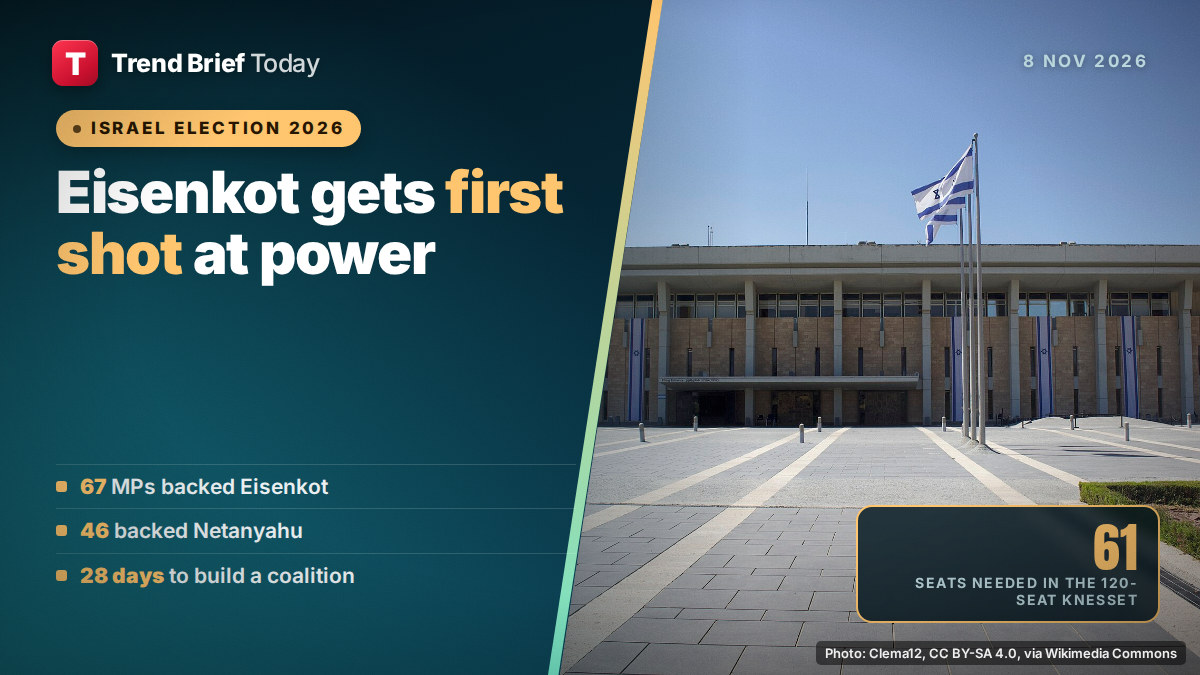 | |
| Cover photo: Clema12, CC BY-SA 4.0, via Wikimedia Commons. The cover image is shared under the same licence (CC BY-SA 4.0). | |
| Election | Tuesday, October 27, 2026 |
|---|---|
| Turnout | About 77.9% |
| Seats | 120 (61 for a majority) |
| Netanyahu's bloc | 53 seats |
| Eisenkot's bloc | 48 seats |
| Arab-led parties | 19 seats (a record) |
| Recommended Eisenkot | 67 lawmakers |
| Recommended Netanyahu | 46 lawmakers |
| Mandate holder | Gadi Eisenkot (Yashar) |
| Time limit | 28 days + up to 14 more |
| Caretaker PM | Benjamin Netanyahu |
Herzog's choice is a big moment because Netanyahu is Israel's longest-serving prime minister, and his Likud party still won the most seats. But a prime minister in Israel needs a majority in parliament, not the biggest party, and right now nobody has one. What follows is a short guide to the numbers, the rules and the ways this could end.[3]
Why Herzog picked Eisenkot
After the official results were certified, Herzog met every party in the new Knesset on November 4 and 5 and asked each one who should try to form a government. In Israel the president usually gives the first chance to the candidate backed by the most lawmakers.[7][8]
The count was not close. Parties holding 67 seats named Eisenkot, including both Arab-led parties, Ra'am and the Joint List. Parties holding 46 seats named Netanyahu. United Torah Judaism, an ultra-Orthodox party with 7 seats that has long sat with Netanyahu, recommended nobody. Al Jazeera, citing The Times of Israel, reported that its Degel HaTorah wing broke with Netanyahu because his government failed to pass a law exempting ultra-Orthodox men from military service.[1][7][8]
Those numbers add up: 67 plus 46 plus United Torah Judaism's 7 is 120. But a recommendation is not a coalition. The 67 includes 19 Arab-led seats that Eisenkot has said he will not bring into his government, which is why the hard part starts now.[1]
Who is Gadi Eisenkot?
Eisenkot was chief of staff of the Israel Defense Forces, the country's top military post, from 2015 to 2019. After the Hamas attacks of October 7, 2023 he joined Netanyahu's emergency war cabinet as an observer, then left in 2024, accusing Netanyahu of failing to make progress on ending the Gaza war and bringing hostages home. His son Gal, a reservist, was killed in Gaza, as were two of his nephews.[3]
He then founded his own party, Yashar (the name means "straight"), on an anti-corruption and government reform platform, and led a four-party opposition alliance into the election. NPR describes him as centre-right. He is still seen as a security hawk: as a general he set out the "Dahiyeh doctrine" in 2008, which calls for disproportionate force against areas used to fire on Israel.[3][10][11]
Right after Herzog's announcement Eisenkot wrote on X: "This is the time to establish a national emergency government. I will do anything possible to prove us worthy."[2]
Election results by party
Eleven parties passed the threshold. Here is how the 120 seats split, grouped by the blocs the parties ran in.[5][6][9]
| Party | Leader | Seats | Bloc |
|---|---|---|---|
| Likud | Benjamin Netanyahu | 27 | Netanyahu |
| Otzma Yehudit | Itamar Ben-Gvir | 7 | Netanyahu |
| United Torah Judaism | (ultra-Orthodox) | 7 | Netanyahu (recommended nobody) |
| Shas | Aryeh Deri | 6 | Netanyahu |
| Religious Zionism | Bezalel Smotrich | 6 | Netanyahu |
| Yashar | Gadi Eisenkot | 21 | Opposition |
| B'Yachad ("Together") | Naftali Bennett | 12 | Opposition |
| The Democrats | Yair Golan | 8 | Opposition |
| Yisrael Beiteinu | Avigdor Liberman | 7 | Opposition |
| Joint List | Yousef Jabareen | 11 | Arab-led |
| Ra'am | Mansour Abbas | 8 | Arab-led |
| Totals | 120 | 53 / 48 / 19 | |
Netanyahu's outgoing coalition held 68 seats in the last Knesset, against 53 for his bloc now. The bigger story was turnout among Palestinian citizens of Israel, who make up about a fifth of the population. Al Jazeera put Arab turnout at about 80%, and NPR, citing the Central Elections Committee, said Arab-led parties got 64% more votes than at the previous election. Overall turnout was about 77.9%.[6][9][10]
Likud and its allies claimed, without public evidence, that Arab parties had "stolen" the vote. The elections committee said it had checked all fraud claims and found "no evidence of irregularities that compromised the integrity of the election or affected its results", and Herzog accepted the certified results on November 4.[7][10]
The coalition math: four ways it could go
Eisenkot's alliance starts with 48 seats, 13 short of 61. Reporting from Al Jazeera, AP and NPR points to four realistic routes, and each one costs somebody a campaign promise.
| Route | Seats | The catch |
|---|---|---|
| Opposition + Shas + United Torah Judaism | 48 + 13 = 61 | Exactly 61, with no room to spare, and the ultra-Orthodox parties want military service exemptions that much of the opposition campaigned against[1][2] |
| Minority government backed from outside by Arab-led parties | 48 in government, up to 67 in a confidence vote | The Joint List says it will vote with Eisenkot but not join him. Some of his own partners reject any reliance on Arab parties[1][2][9] |
| Ra'am inside the coalition | 48 + 8 = 56 | Still short, and Eisenkot demands partners call Hamas a terrorist group. Ra'am leader Mansour Abbas would not use that wording when Herzog asked him[8][9] |
| Unity government with Likud | Well over 61 | Netanyahu called for a "national unity government" on November 7, but the two men disagree on the draft exemptions and an official inquiry into the October 7 failures[2] |
A government with fewer than 61 members is allowed in Israel. What matters is winning the confidence vote in the Knesset, and a party can help by voting yes or simply by not voting against. That is the idea behind the "external support" model that Joint List figures such as Ahmad Tibi have talked about.[1][9]
Only one Arab party has ever sat in an Israeli governing coalition: Ra'am, in 2021, and that government lasted less than two years. Netanyahu has spent the campaign and the days since warning against any such deal, calling the Arab-led parties "terrorist supporters". Herzog, in accepting the results, said he condemned "the coarseness and racist expressions that we have heard recently".[2][7][9]
The November 8 mandate ceremony
Herzog handed over the mandate on Sunday evening at the president's residence in Jerusalem. He said a majority of Knesset members had backed giving Eisenkot the task, and he pointed to what he called "the new political situation in the United States" after the midterms as one reason Israel needs a stable government quickly.[12][13]
The surprise in Eisenkot's speech was an open door to the right. "If members of Likud and the Religious Zionist Party truly believe this is a time for unity, as they told the president, I cannot conceive of any reason why they would not support a government under my leadership and the principles I have presented," he said. In other words, he answered Netanyahu's call for a unity government by inviting Likud to join one that Eisenkot leads, not the other way round.[12]
AP listed the four conditions Eisenkot has set for any partner:[13]
- recognise Israel as a Jewish and democratic state;
- accept the declaration of independence;
- support military, national or civil service for all citizens;
- declare Hamas a terrorist group.
The third condition is the problem for the ultra-Orthodox parties, which want to keep draft exemptions, and the fourth is the problem for the Arab-led parties. AP reported that Ra'am has said it will support Eisenkot, though its 8 seats are not enough on their own, and that Yisrael Beiteinu, one of his own partners, has said it will not sit in a coalition with Arab-led parties. United Torah Judaism has left the door open.[13]
Netanyahu has kept up his unproven claim that Arab parties "stole" the election. AP noted that the Shin Bet security service is looking into possible foreign interference, but the Central Elections Committee and Herzog say the result is valid. Al Jazeera's Nour Odeh pointed out that time is on Netanyahu's side: he stays caretaker prime minister while the talks run, and also through any repeat election.[12][13]
What happens if Eisenkot fails?
Israeli law sets out a fixed ladder. Each step has a clock, and Netanyahu stays on as caretaker prime minister the whole time.[1][3][10]
- Eisenkot gets 28 days, which Herzog can extend by up to 14 days.
- If he fails, Herzog picks a second candidate, possibly Netanyahu, who gets 28 days.
- If that fails too, a majority of the Knesset can back a third candidate, who gets a final 14 days.
- If nobody succeeds, a new election must be held within 90 days, which would mean early 2027.
Counted from the November 8 ceremony, the first deadline falls around December 6, 2026, or around December 20 with the full extension. The new Knesset is sworn in on November 10 whatever happens in the talks.[6][9]
Timeline
| Date (2026) | Event |
|---|---|
| October 27 | General election. No bloc reaches 61 seats[1] |
| October 30 | Central Elections Committee publishes final results; turnout about 77.9%[6] |
| November 2 | Arab-led parties signal they will back Eisenkot to remove Netanyahu[9] |
| November 4 | Herzog accepts the certified results and starts consultations[7] |
| November 5 | Ra'am and the Joint List recommend Eisenkot; United Torah Judaism recommends nobody[8] |
| November 7 | Netanyahu calls for a unity government; Herzog picks Eisenkot[2][4] |
| November 8 | Herzog formally hands Eisenkot the mandate in Jerusalem; Eisenkot invites Likud and Religious Zionism to back him[3][12][13] |
| November 10 | New Knesset sworn in[9] |
| Around December 6 | End of the first 28 days (extension possible to around December 20) |
Why it matters outside Israel
Whoever leads the next government will inherit the wars of the past three years in Gaza and beyond, the confrontation with Iran, and a relationship with the United States that NPR's Tel Aviv correspondent described as badly strained. Mairav Zonszein of the International Crisis Group told NPR the US-Israel relationship was unravelling "at a very accelerated pace because of Gaza, because of Iran", and that the next prime minister would have to rebuild ties, especially with US Democrats after their midterm wins.[11][2]
For now, the practical answer is that Netanyahu remains in charge as caretaker, and nothing about Israel's policy changes until a new government wins a confidence vote.
Frequently asked questions
Who won the Israeli election 2026?
No one won outright. Likud was the largest party with 27 seats, but Netanyahu's bloc got 53 seats and Eisenkot's 48, both short of the 61 needed. Arab-led parties won 19.
Is Gadi Eisenkot now Israel's prime minister?
No. He has the first chance to form a government. He only becomes prime minister if his government wins a confidence vote in the Knesset. Until then Netanyahu is caretaker prime minister.
How long does Eisenkot have to form a government?
28 days from receiving the mandate on November 8, so around December 6, 2026. The president can add up to 14 days, which makes six weeks in total.[13]
Why didn't Herzog choose Netanyahu?
More lawmakers recommended Eisenkot: 67 against 46 for Netanyahu. The president normally picks the candidate with the most support.
Will Arab parties join Eisenkot's government?
Not formally, for now. The Joint List says it would vote with him from outside but will not join while the occupation of the West Bank continues. Ra'am has been open to joining, but disagrees with Eisenkot's demand to call Hamas a terrorist group.
Is Eisenkot willing to work with Netanyahu?
He has said Likud and Religious Zionism would be welcome to support a government under his leadership and on his principles. That is not the same as sharing power with Netanyahu as prime minister, and no talks between the two had been reported by November 9.[12]
Will Israel hold another election?
Only if no candidate forms a government through all the stages. In that case a new vote would be held within 90 days, likely in early 2027.
References
- "Israel's president picks Eisenkot over Netanyahu to form next government". Al Jazeera. November 7, 2026.
- "Israel's president taps opposition candidate Eisenkot to form a government, in setback for Netanyahu". Associated Press, via PBS NewsHour. November 7, 2026.
- "Israel's president taps opposition candidate, not Netanyahu, to form a government". NPR. November 7, 2026.
- "Israeli president tasks Gadi Eisenkot with forming government". Wesley Rahn, DW (with AP, AFP). November 7, 2026.
- "Election results: 26th Knesset". i24NEWS. Retrieved November 8, 2026.
- "Israel election results: Netanyahu's Likud bloc wins 53 seats, opposition 48, Arab parties 19". IANS, via Morung Express. October 30, 2026.
- "Israel's Herzog accepts vote results, opens talks on forming a government". Al Jazeera. November 5, 2026.
- "Arab parties back Eisenkot, but path to Israeli coalition remains fraught". Thomas Helm, The National. November 5, 2026.
- "Arab parties back Eisenkot: What's the latest in Israel's coalition talks?". Al Jazeera. November 2, 2026.
- "Israel's Palestinian citizens vote in record numbers". NPR. November 6, 2026.
- "Israeli president invites Netanyahu's opposition leader to broker new government". All Things Considered, NPR. November 7, 2026.
- "Eisenkot open to Netanyahu joining Israel's next government". Al Jazeera. November 8, 2026.
- "Israel's president formally gives Eisenkot the first chance to form the next government". Associated Press, via PBS NewsHour. November 8, 2026.
Image credits: Cover photo: Clema12, CC BY-SA 4.0, via Wikimedia Commons. The cover image is shared under the same licence (CC BY-SA 4.0).