The cheapest Nvidia RTX Spark mini PC you can buy in the US costs $4,399: the MSI EdgeMesa N AI+ with 64 GB of memory, after MSI quietly cut $300 off its launch price on November 18.[5] The Asus ProArt GR1X starts at $4,499 for the same 64 GB and 1 TB setup.[3][7] Doubling the memory to 128 GB costs $7,499 on the MSI.[5] Dell's model has no public price yet, and Acer, Gigabyte, HP and Microsoft follow later.[1][14] Our maths says the box only pays for itself against cloud AI fees if you keep it busy most of the day.
 | |
| Chip | RTX Spark N1X superchip[1] |
|---|---|
| CPU | 20-core Nvidia Grace (Arm)[1] |
| GPU | Blackwell RTX, 6,144 CUDA cores[1] |
| Memory | 64 GB or 128 GB unified LPDDR5X, up to 300 GB/s[4][9] |
| AI performance | Up to 1 petaflop (FP4)[1][4] |
| Power | Up to 140 W sustained[4][13] |
| Cheapest model | MSI EdgeMesa N AI+, $4,399[5] |
| Asus ProArt GR1X | From $4,499[3] |
| On sale | November 18, 2026 (US)[1][7] |
| Coming later | Acer, Gigabyte, HP, Lenovo, Surface RTX Spark Dev Box[7][9] |
What is an RTX Spark mini PC?
RTX Spark is Nvidia's first full push into Windows PCs. The chip, called N1X, puts a 20-core Arm processor and a Blackwell graphics chip with 6,144 CUDA cores on one package, and lets both share a single pool of memory.[1] The first RTX Spark laptops went on sale in October. On November 18 the same chip arrived in small desktop boxes from Asus, Dell and MSI.[1][8]
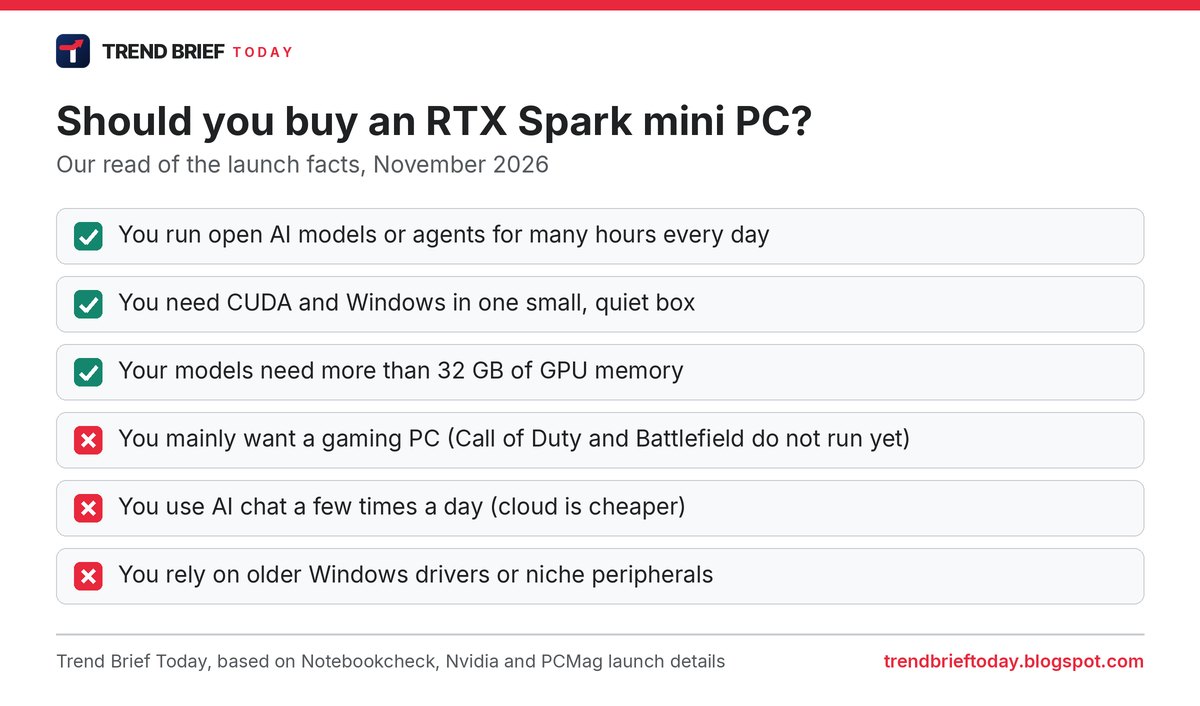
The selling point is memory. A normal gaming graphics card has its own fixed memory, and even the most expensive consumer cards stop at 32 GB. Here the GPU can use most of a 64 GB or 128 GB pool, which is why Nvidia says one desktop can run an AI model with 120 billion parameters on the device, with no cloud bill for that work.[8][9] Nvidia pitches them as "a dedicated Windows PC for local models and always-on agents".[1][7]
Every desktop uses the full version of the chip. The laptops come in a cut-down 18-core, 5,120-core GPU variant as well, which is how laptop prices start lower; the mini PCs do not.[10][9]
RTX Spark mini PC prices compared
Here is every price we could confirm on November 19. Where a store lists a model but we could not see a price in a source we trust, we say so instead of guessing.
| Model and setup | US price | Notes |
|---|---|---|
| MSI EdgeMesa N AI+, 64 GB, 1 TB | $4,399 | Cut from $4,699 on November 18[5] |
| Asus ProArt GR1X, 64 GB, 1 TB | $4,499 | ASUS eShop, silver; Best Buy and Micro Center also list it[2][3] |
| Asus ProArt GR1X, 64 GB, 2 TB | Not confirmed | Listed at Best Buy, Micro Center, Central Computers, Amazon[2] |
| Asus ProArt GR1X, 128 GB, 2 TB | Not confirmed | Listed on Amazon in black and silver[2] |
| MSI EdgeMesa N AI+, 128 GB, 4 TB | $7,499 | Cut from $7,999; out of stock at MSI and Micro Center[5] |
| Dell Creator Edition Desktop | Not published | Dell says "coming soon"[14] |
| Surface RTX Spark Dev Box | Not published | Due to start shipping this month[7] |
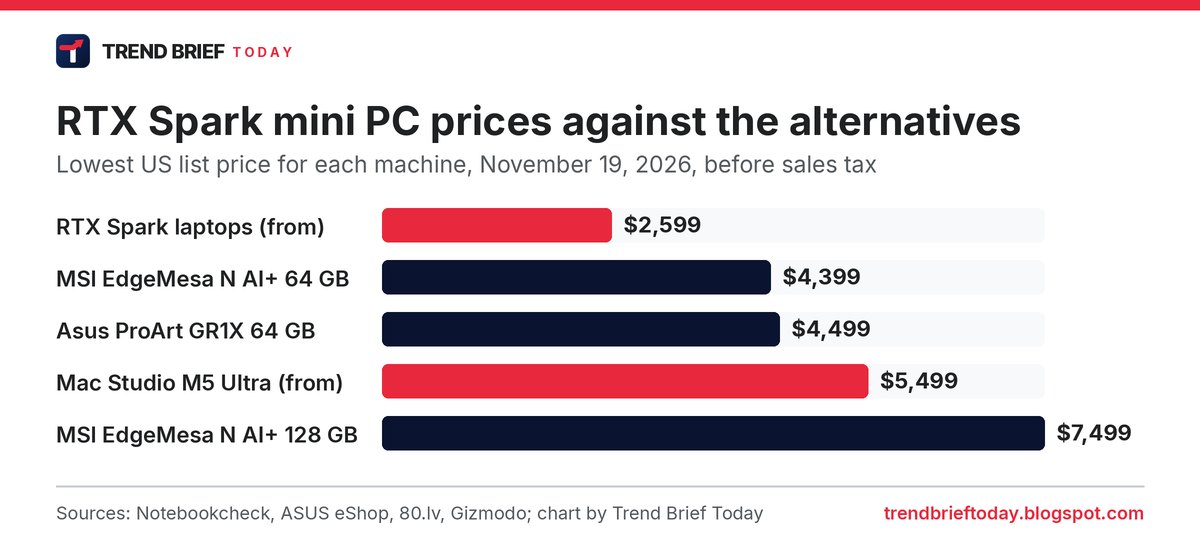
Two things stand out. First, MSI launched its box on November 11, a week before everyone else, at $4,699. The day Asus arrived at $4,499, MSI dropped to $4,399, and Notebookcheck reads the MSI store change as permanent.[5] That is a $300 cut, or 6.4%, within a week of launch. Prices this fluid in launch week usually keep moving, so anyone who is not in a hurry should watch them through Black Friday.
Second, the jump from 64 GB to 128 GB is steep. On the MSI it costs $3,100 more, though that also buys 3 TB of extra storage.[5] Per gigabyte of memory, the small model works out at about $68.73 and the big one at about $58.59, so the 128 GB box is better value per gigabyte, but only if you need the memory. If your models fit in 64 GB, the extra $3,100 buys you nothing you will notice.
MSI EdgeMesa N AI+ vs Asus ProArt GR1X
Both use the identical chip and both run up to 140 W, so speed should be close. The differences are in storage, ports and size.[4][11][12]
| Feature | MSI EdgeMesa N AI+ | Asus ProArt GR1X |
|---|---|---|
| Starting price | $4,399[5] | $4,499[3] |
| Memory options | 64 GB or 128 GB[5] | 64 GB or 128 GB[2] |
| Storage | One M.2 slot; 1 TB or 4 TB[11][5] | Two M.2 slots (PCIe 5.0/4.0); 1 TB or 2 TB, up to 4 TB[2][3] |
| USB-C | Four 20 Gbps ports[11] | Four USB 3.2 Gen 2x2 (20 Gbps)[2] |
| Network | 10 GbE, Wi-Fi 7, Bluetooth 5.4[11] | 10 GbE, Wi-Fi 7, Bluetooth 5.4[2] |
| Displays | Up to four, HDMI 2.1[11] | Up to four 4K, HDMI up to 8K[2] |
| Cooling | Two blower fans over a vapour chamber, 240 W power brick[12] | Twin fans with 218 blades in total[4] |
| Size and weight | Not stated in our sources | 150 x 150 x 51 mm, 1.48 kg[2] |
| UK price | £4,099 (64 GB), £6,999 (128 GB)[11] | No UK price yet |
Our take: the MSI is the cheaper way in and the only one with a 4 TB build today. The Asus costs $100 more but has a second SSD slot, which matters if you plan to add storage later rather than pay MSI's price for the 4 TB version. Notebookcheck also found the Asus "very quiet" in early testing, which is worth something for a box that is meant to run all day.[6]
Is the laptop chip slower?
Only a little. Windows Central, as quoted by The Next Web, found graphics up to 22% faster in the Asus desktop than in the laptop chip, but only about 5% more processor speed.[8] Notebookcheck saw the same pattern: processor scores "essentially identical", with the GPU drawing up to 95 W and running "on par with a laptop GeForce RTX 5070".[6] The laptops run the chip at 45 to 80 W; the desktops allow 140 W.[13]
So what does the extra money buy? Mostly the right to leave the machine running. RTX Spark laptops start at $2,599, but that buys the smaller chip; The Next Web, citing Windows Central's review, puts the desktops at about $700 more than RTX Spark laptops.[15][8] You are paying for a cooler, quieter, always-on box with 10 GbE networking, not for a big jump in speed.
Does local AI really pay for itself?
This is the part of the launch pitch worth checking. PCMag, reporting Nvidia's own example, says one RTX Spark desktop can produce 61 million output tokens a month for about $20 of electricity, while the same output from Anthropic's Claude Sonnet 5.5 Medium through the cloud would cost about $1,200 in API fees.[9]
We ran the numbers behind that claim:
- 61 million tokens a month is about 23.5 tokens every second, 24 hours a day, for 30 days. That is a box that never rests.
- $1,200 for 61 million tokens works out to about $19.67 per million output tokens, the cloud price Nvidia's comparison assumes.
- The $20 power bill checks out. 140 W for 720 hours is 100.8 kWh; at an assumed 18 cents per kWh that is about $18. At an assumed 25p per kWh in the UK it would be about £25.
- At full use, the $4,399 MSI pays back in about 3.7 months ($4,399 divided by a $1,180 monthly saving).
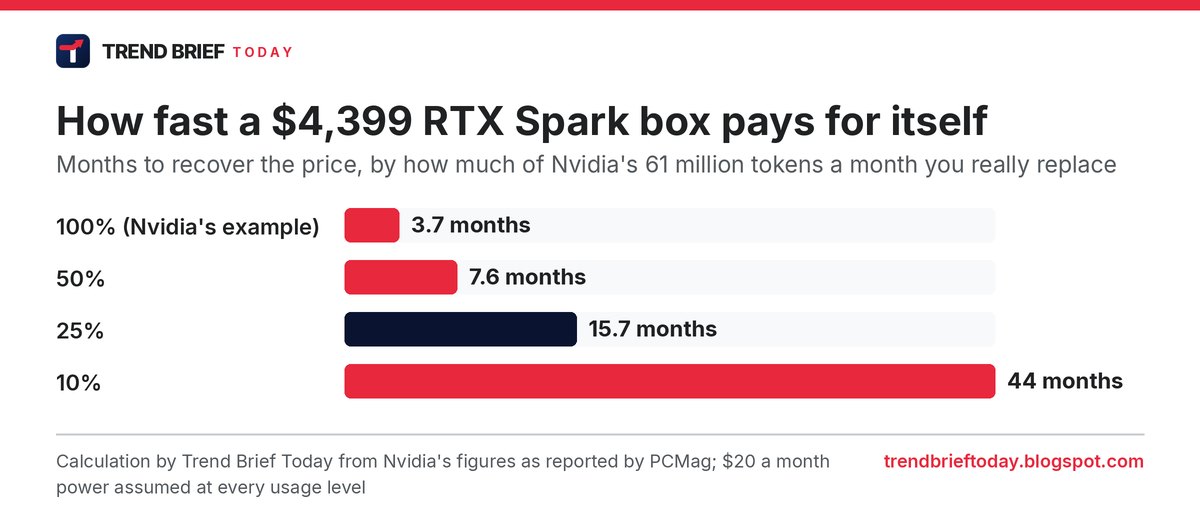
The catch is the word "full". If you only replace a quarter of that workload, you save about $280 a month and the payback stretches to nearly 16 months. At a tenth, it is about 44 months, close to four years, by which time a newer chip will be out. We kept the $20 power cost fixed in every case; a box that works less also draws less power, so light users would recover their money a little faster than the chart shows, but not by much.
There is a second catch the comparison skips. The local box is not running Claude. It runs open models such as the ones PCMag mentions, and the saving is only real if their answers are good enough for the job.[9] For coding agents and batch jobs that run overnight, they often are. For one-off questions where quality matters most, the cloud model may still win, and a $20 monthly subscription is far cheaper than $4,399. If you want to see what cloud prices look like now, our Gemini 4 Neon price breakdown shows how fast per-token costs are falling, which also lengthens the payback.
Prices in the UK, Canada and Australia
The UK has an official MSI price. KitGuru reports £4,099 for 64 GB and £6,999 for 128 GB.[11] UK prices include 20% VAT and US prices do not include sales tax, so a straight conversion is misleading. Strip out the VAT and the UK 64 GB model costs £3,416, which is about $4,498 at the November 18 reference rate of $1 = £0.75939.[16]
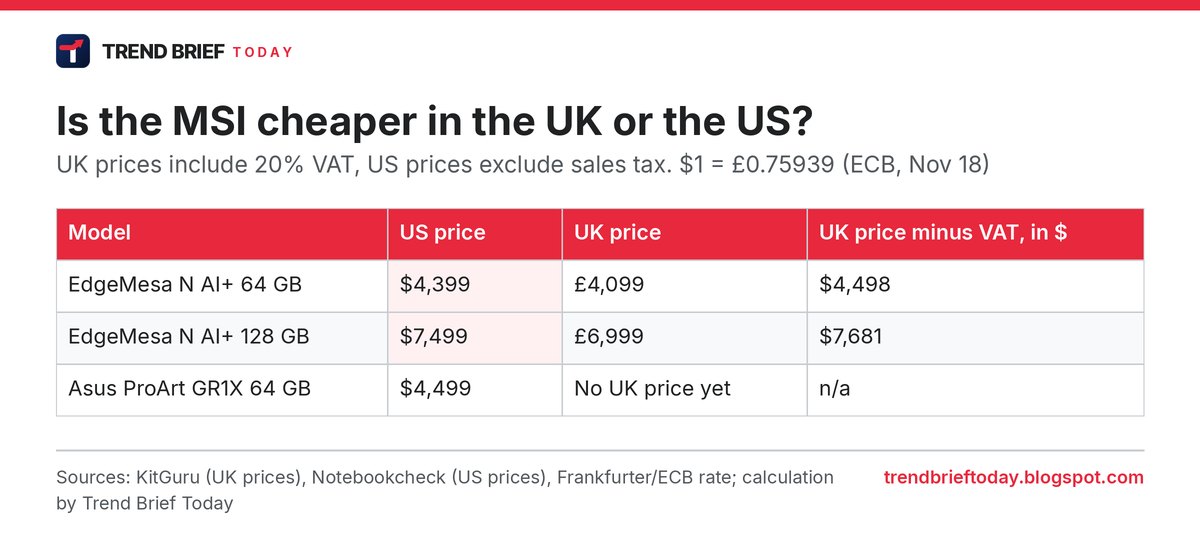
That puts the UK about $100 above the new US price for 64 GB and about $180 above it for 128 GB. Against MSI's original US prices of $4,699 and $7,999, though, the UK was the cheaper market, which suggests the UK price was set before the US cut. If MSI matches the cut in Britain, the 64 GB model would land near £4,009 with VAT. That is our estimate, not an announced price.
We found no official Canadian or Australian prices yet, and the ASUS US eShop says it does not ship internationally.[3] For a rough idea only, $4,399 converts to about C$6,293 or A$6,535 before local taxes, and $4,499 to about C$6,436 or A$6,684.[16] Local prices are usually set separately and often run higher.
Can you game on it?
Yes, with limits. The chip supports DLSS, ray tracing and G-Sync, and PCMag counts DLSS 4.5 and DLSS 5 among supported features.[9] But it runs Windows on Arm, and Notebookcheck found that Call of Duty, Battlefield and F1 2025 do not run.[6] Wccftech's review of the MSI found AMD's Strix Halo chips ahead in plain rasterised games without ray tracing.[12] The Verge put it plainly: at these prices, gaming is "not a realistic reason to pick one up yet".[7]
Creative apps are in better shape. Nvidia says Adobe Illustrator and InDesign now run natively on Arm, Photoshop gets native Camera Raw, Substance 3D Painter 12.2 is in native public beta, and Blender 5.3 adds DLSS 4.5 Ray Reconstruction.[1][15]
RTX Spark vs Mac Studio and Mac mini
Nvidia and its partners point at Apple's small desktops as the rival.[13][10] Gizmodo notes the Mac Studio with Apple's M5 Ultra starts at $5,499, which is $1,100 more than the cheapest RTX Spark box, while lower Mac Studio configurations start at $2,500.[10] Gizmodo's view is that RTX Spark, even fully loaded, cannot match Apple's latest M-series chips on raw CPU and GPU power.[10]
| Machine | US starting price | Why pick it |
|---|---|---|
| MSI EdgeMesa N AI+ | $4,399[5] | CUDA and Windows, cheapest RTX Spark box |
| Asus ProArt GR1X | $4,499[3] | CUDA and Windows, two SSD slots |
| Mac Studio (M5 Ultra) | $5,499[10] | Raw CPU and GPU speed, macOS |
| Mac Studio (lower chips) | $2,500[10] | Cheaper, but less memory for large models |
The honest split is software. If your tools need CUDA, the Nvidia box is the only small machine here that runs them natively, and that alone justifies the price for many developers. If you work in macOS and do not need CUDA, the Mac is the safer bet.
Where to buy and what about Black Friday?
In the US, Asus lists the ProArt GR1X on its own eShop, Best Buy, Micro Center, Central Computers and Amazon.[2] The ASUS eShop offers free ground shipping to the 48 continental states and says most orders ship within 24 hours.[3] MSI sells through its own store and Micro Center, where the 128 GB model was out of stock on launch day.[5]
No maker has announced a Black Friday price for these desktops. MSI's early cut shows prices can drop without one, and Black Friday falls on November 27 this year. If you are not buying for a project that starts this week, waiting eight days costs you nothing.
Frequently asked questions
How much does an Nvidia RTX Spark mini PC cost?
From $4,399 for the MSI EdgeMesa N AI+ with 64 GB, and $4,499 for the Asus ProArt GR1X with 64 GB. The 128 GB MSI costs $7,499.[5][3]
Is Dell's RTX Spark desktop on sale?
Nvidia lists Dell among the launch makers, but Dell's own line for the Creator Edition Desktop is "coming soon", with no published price.[1][14]
Can it run a 120 billion parameter model?
Nvidia says yes, with 128 GB of memory, and PCMag adds a context window of up to 1 million tokens for that setup.[8][9] The 64 GB models are better suited to smaller models.
Does it run Linux?
The boxes ship with Windows 11, and Linux tools run through Windows Subsystem for Linux.[7][2]
Is it worth it over a cloud AI subscription?
Only for heavy, daily use. On Nvidia's own figures the $4,399 model pays back in under four months at full load, but at a quarter of that load it takes about 16 months.
References
- NVIDIA, "NVIDIA RTX Spark Compact Desktops Out Now", press release published by TechPowerUp, November 18, 2026.
- ASUS, "ASUS Announces Availability of the ProArt GR1X", press release published by TechPowerUp, November 18, 2026.
- ASUS eShop USA, "ProArt GR1X (GR1X-VG0003AN)", product listing, checked November 19, 2026.
- ASUS, "ProArt GR1X Mini PC", product page, checked November 19, 2026.
- Alex Alderson, "MSI undercuts Asus with first Nvidia RTX Spark mini-PC release", Notebookcheck, November 18, 2026.
- Andreas Osthoff, "Hands-on with the Asus ProArt GR1X Mini-PC with Nvidia RTX Spark N1X and 128 GB of RAM", Notebookcheck, November 18, 2026.
- Stevie Bonifield, "The first Nvidia RTX Spark mini PCs launch today from Asus, Dell, and MSI", The Verge, November 18, 2026.
- Darius Popa, "Nvidia's RTX Spark mini PCs go on sale for local AI, from $4,399", The Next Web, November 18, 2026.
- Brian Westover, "Nvidia and Microsoft Bring RTX Spark to Compact Desktops", PCMag, November 18, 2026.
- Kyle Barr, "Nvidia's RTX Spark Desktops Imagine They Can Actually Compete With the Mac Studio", Gizmodo, November 18, 2026.
- Matthew Wilson, "MSI unveils EdgeMesa N AI+ RTX Spark mini PC", KitGuru, November 18, 2026.
- Hassan Mujtaba, "MSI EdgeMesa N AI+ X Mini PC Review", Wccftech, November 18, 2026.
- C. da Costa, "Nvidia RTX Spark Compact Desktops Are Here, Starting at $4,499", Gadget Review, November 18, 2026.
- Ali Jennings, "Dell Creator Edition Desktop joins the RTX Spark mini PC line-up", Camera Jabber, November 16, 2026.
- 80 Level, "NVIDIA Expands RTX Spark Lineup With Compact Desktops for Developers, Creators, and AI Enthusiasts", 80.lv, November 18, 2026.
- Frankfurter, "Latest reference rates, USD to GBP, CAD and AUD" (European Central Bank data), November 18, 2026.