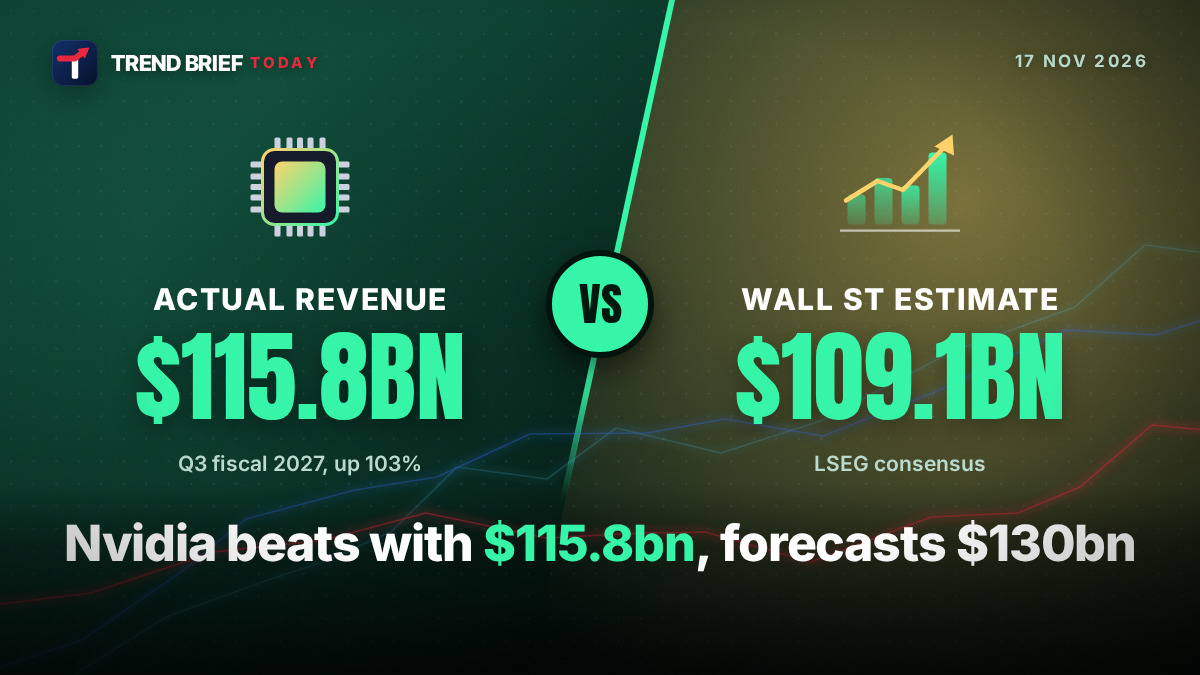
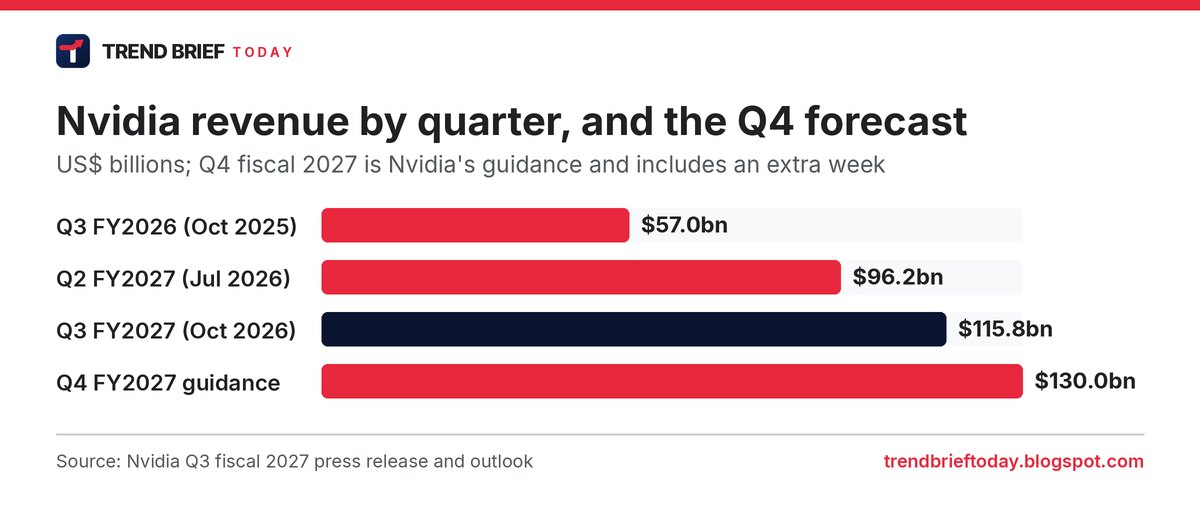
Yes, Nvidia beat. In its first earnings report since Jensen Huang resigned, Nvidia said on Tuesday 17 November 2026 that revenue for its third quarter of fiscal 2027 was $115.8 billion, up 103% from a year earlier, against about $109.1 billion expected. Adjusted earnings were $2.68 a share against $2.48 expected, and the company forecast about $130 billion for the current quarter, well above the roughly $125 billion analysts had pencilled in. The shares rose about 2% to 3% in after-hours trading.[1][2][3]
 | |
| Reported | 17 November 2026, about 21:20 GMT (4:20 p.m. ET)[1] |
|---|---|
| Quarter | Q3 fiscal 2027, ended 25 October 2026[1] |
| Revenue | $115.8 billion (+103% year on year)[1] |
| Estimate | $109.1 billion (LSEG)[2][3] |
| Adjusted EPS | $2.68 vs $2.48 expected[1][2] |
| GAAP EPS | $2.70[1] |
| Data Center | $107.6 billion (+110%)[1] |
| Net income | $65.3 billion[1][3] |
| Q4 forecast | $130 billion, plus or minus 3%[1] |
| Stock reaction | Up about 2% to 3% after hours[2][3] |
| Interim CEO | Colette Kress[1] |
Did Nvidia beat earnings?
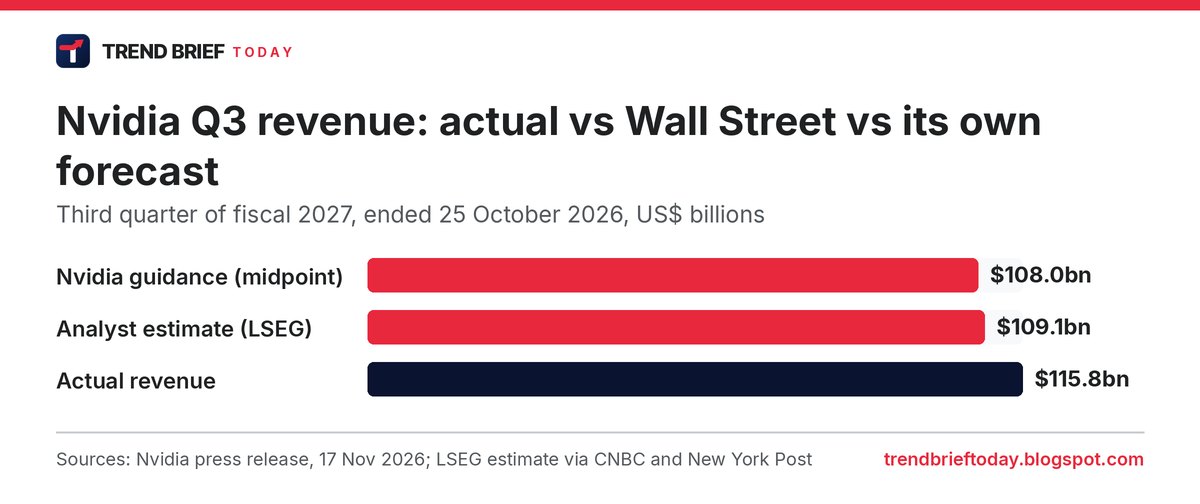
On every number Wall Street was watching, yes. Revenue of $115.8 billion was about $6.7 billion more than the LSEG consensus of $109.1 billion and about $7.8 billion above the middle of Nvidia's own forecast of $108 billion, plus or minus 2%, which it gave in August.[1][2][3] That forecast range topped out at about $110.2 billion, so the result cleared even the top of it.
Adjusted earnings per share came in at $2.68, 20 cents more than the $2.48 LSEG estimate. Under standard accounting rules (GAAP) Nvidia earned $2.70 a share, helped by gains on investments.[1][2] Net income was $65.3 billion, more than double the $31.9 billion of a year earlier.[1][3]
One thing to know when comparing with older reports: since the first quarter of fiscal 2027, Nvidia's adjusted figures no longer leave out stock-based pay. That makes its "non-GAAP" profit lower than it would have been under the old method, and it is the reason the adjusted and GAAP numbers sit so close together.[1]
Nvidia Q3 results vs estimates
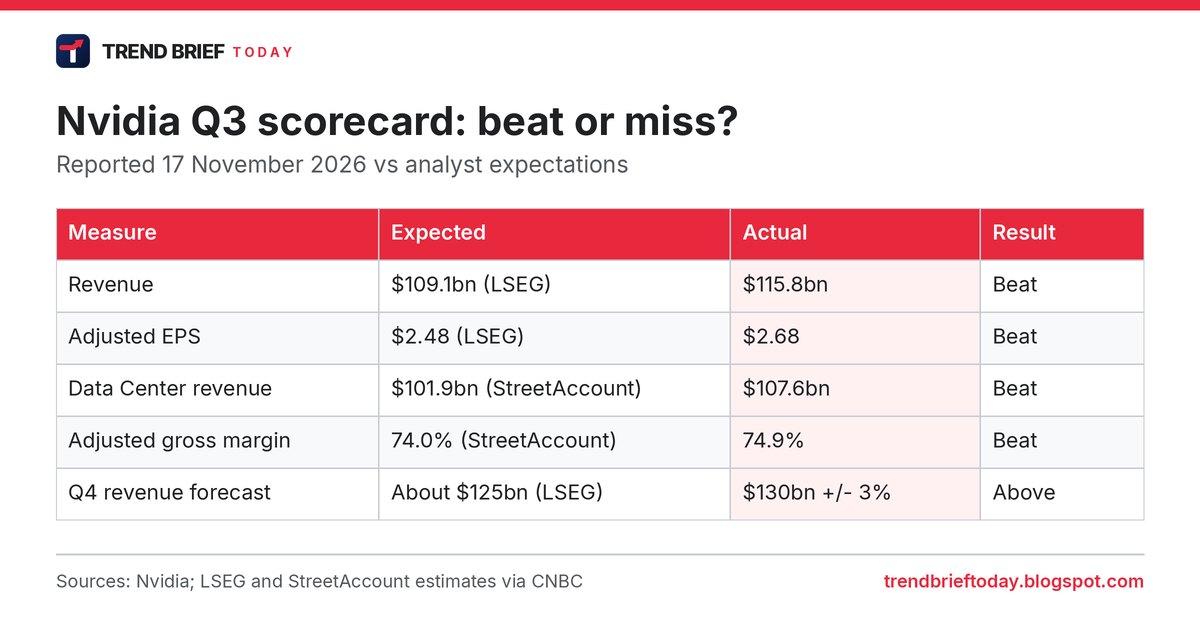
The table sets out the main lines from the press release next to what analysts expected. Estimates are the LSEG and StreetAccount figures quoted by CNBC.[1][2]
| Measure | Expected | Reported |
|---|---|---|
| Revenue | $109.1 billion | $115.8 billion |
| Adjusted EPS | $2.48 | $2.68 |
| Data Center revenue | $101.87 billion | $107.6 billion |
| Adjusted gross margin | 74.0% | 74.9% |
| Q4 revenue forecast | About $125.1 billion | $130.0 billion, plus or minus 3% |
The New York Post, using Wall Street figures, put the Q4 expectation slightly higher at $125.5 billion. Either way, the new forecast is above it.[3]
Data Center and the rest of the business
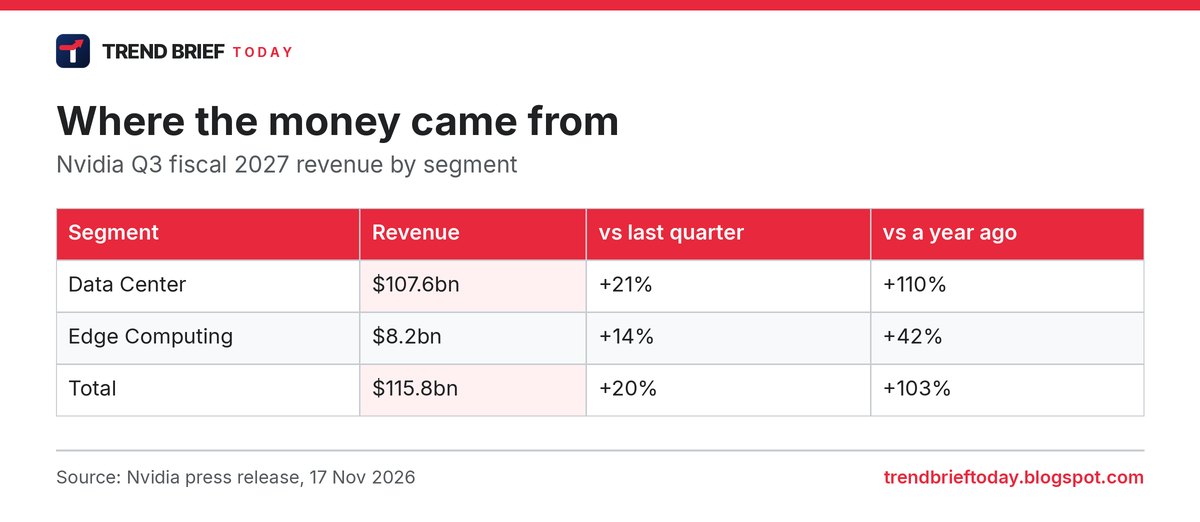
Data Center, the division that sells AI chips, full server racks and networking to cloud companies and AI labs, brought in $107.6 billion. That is 21% more than in the previous quarter and 110% more than a year earlier, and about 93% of all sales.[1] Analysts had expected about $101.9 billion.[2]
The rest of Nvidia now sits in a segment the company calls Edge Computing, which takes in gaming graphics cards, PCs, cars and robots. It made $8.2 billion, up 14% on the quarter and 42% on the year.[1]
The headline product in the release is Vera Rubin NVL72, Nvidia's next-generation rack system. The company says it has started shipping it in what it calls "the fastest product ramp in the company's history", with racks running at CoreWeave, Google Cloud, Microsoft Azure, Oracle Cloud Infrastructure and Nebius.[1] Nvidia also listed an agreement to buy Hugging Face, the open-source AI model platform, and wider access for Anthropic to its Grace Blackwell and Vera Rubin capacity through cloud providers.[1]
Gross margin slipped slightly from the previous quarter, to 74.9% on an adjusted basis from 75.0%. CNBC reports that Nvidia put this down to the cost of ramping up production of its Rubin chips. It was still ahead of the 74% StreetAccount estimate.[2]
Nvidia Q4 guidance: $130 billion
For the fourth quarter of fiscal 2027, which ends in late January and includes an extra week, Nvidia expects revenue of $130.0 billion, plus or minus 3%. That works out to a range of about $126.1 billion to $133.9 billion, by our calculation.[1] CNBC says the forecast implies growth of roughly 90% from a year earlier.[2]
The company expects gross margins of 71% to 72%, both on a GAAP and an adjusted basis.[1] That lower level is not a surprise. In August, Kress had already said margins would bottom out in that range in the fourth quarter because memory chips are getting more expensive (see our Nvidia earnings preview).
What Nvidia said about China
As in recent quarters, the outlook assumes no Data Center compute revenue from China at all.[1] The press release says nothing new about China sales beyond that line.
China still hangs over the stock. On Monday the US Commerce Department issued an interim rule that requires data centre operators in countries including Singapore, Indonesia, Malaysia and Thailand to get a licence before exporting advanced AI chips, aimed at Chinese firms that rent Nvidia chips remotely through third countries.[2][5] China's commerce ministry said on Tuesday it "firmly opposes" the move and threatened countermeasures.[2] We explain the rule in the AI chip export rule loophole.
On Tuesday morning Nvidia's board also set up a National Security and Export Control Oversight Committee, chaired by director Suzanne Nora Johnson, to oversee export compliance and trade risk.[5][6]
The first report without Jensen Huang
Huang resigned as chief executive on 12 November after reports of affairs, including one with a woman connected to Megaspeed, a Singapore-based Nvidia partner that US officials suspect of helping chips reach China.[3][5] Colette Kress, Nvidia's finance chief, is running the company as interim CEO, and the board has said it is searching for a permanent successor.[3]
Kress chose to open the release on confidence: "Our momentum is real. NVIDIA is an exceptional technology leader, powered by the relentless innovation of our people," she said. "Vera Rubin is off to an explosive start, our roadmap is on track and our ambition has never been greater."[1]
Hours before the numbers, Huang released his first statement since leaving. He said he had made "serious mistakes" in his personal life and that he would be "honored" to return as CEO if the board decided that was in the interest of shareholders, staff, the company and America.[2][5] People familiar with the matter told CNBC and the New York Post that the board is not considering bringing him back.[2][3] Huang is due to appear before three House committees on 1 December, and Nvidia's general counsel Tim Teter on 2 December.[5] For the full background see Jensen Huang resigns as Nvidia CEO.
There was one more piece of bad news just before the release. The Wall Street Journal reported that the Securities and Exchange Commission is investigating whether Nvidia broke investor disclosure rules, and the New York Post repeated the report minutes before the numbers came out. Nvidia's release does not mention it.[3]
What Nvidia said on the earnings call
The call started at 22:00 GMT, and the first voice was not Kress but Harvey Jones, Nvidia's new board chair. He said Huang had resigned after disclosing personal behaviour "inconsistent with the company's code of conduct, standards and cultural norms", and that "the Nvidia board unanimously accepted his resignation and does not intend to reinstate Jensen as CEO."[2][7] That answer came only hours after Huang said he would be "honored" to return, and it was reported by CNBC, The Verge, CBS News and the Associated Press.[2][7][8][9]
Jones also set the limits of the call: "We will not be addressing or taking questions on today's call regarding the circumstances of Jensen's resignation and the ongoing investigation."[7] So analysts did not get answers on the CEO search, the internal probe or the Securities and Exchange Commission investigation reported by The Wall Street Journal earlier in the day.[3][10]
The biggest number from the call was for next year. Going in, investors wanted to know whether Nvidia would keep its earlier forecast of about 70% revenue growth for the fiscal year that ends in January 2028. Kress raised it instead, to about 75%.[2] She said the outlook takes into account data centre readiness, "the strength and durability of end customer demand, and our customers access to capital", and CBS News reported that she tied the $130 billion fourth-quarter forecast to strong demand for AI infrastructure.[2][8]
On China, nothing changed. Nvidia's commentary repeats that it is "not assuming any Data Center compute revenue from China" in its outlook, so the new Commerce Department licence rule does not cut into the forecast as written.[1][2] Kress also confirmed that the purchase of Hugging Face is still going ahead.[1][2]
How did Nvidia stock react?
Nvidia shares closed down 0.4% in regular trading on Tuesday after swinging between gains and a loss of as much as 3.7%, according to the Associated Press. It was the stock's fourth straight daily fall.[4][5] The wider market had a bad day: the Dow Jones Industrial Average fell 848 points, or 1.6%, and the S&P 500 lost 1%.[4]
After the results came out, the shares rose about 2% to 3% in extended trading, and they were still up by about that much after the call: CNBC put the gain at about 2% and CBS News at nearly 3%.[2][3][8] That is small next to what options traders had priced in: going into the week, options implied a move of roughly 9% to 10% either way (see our earnings preview for the sources).
Context matters here. Nvidia's stock was down 24% in November before the report and had just had six straight losing weeks, its longest run since 2012.[2][3] A beat this large can still leave the shares far below where they were before the Huang scandal.
Wednesday 18 November, regular session. The relief did not last. Nvidia opened higher and rose as much as 2.7%, then erased the gain and finished with a loss of 2.9%, according to the Associated Press.[13] The shares ended at $150.96, down from $155.46 on Tuesday, according to Yahoo Finance market data. It was the fifth losing day in a row.[15] Reuters, which put the fall at 2.8%, said analysts are now more upbeat on earnings but more careful on the stock: the average forecast for adjusted net income in Nvidia's next fiscal year rose to $393 billion from $380 billion, according to LSEG data, while price targets came down.[14] The wider market was mixed. The Dow fell 561 points, or 1.1%, the S&P 500 slipped 0.2% and the Nasdaq rose 0.4%.[13]
Buybacks and dividend
Nvidia returned $28.1 billion to shareholders during the quarter through buybacks and dividends, and still had about $227.3 billion left under its buyback authorisation at quarter end, after the board added $150 billion in September.[1] The next quarterly dividend of $0.25 a share will be paid on 23 December 2026 to shareholders on the register on 2 December.[1]
Timeline
| Date (2026) | Time | Event |
|---|---|---|
| 12 November | Jensen Huang resigns as CEO; Colette Kress becomes interim CEO[3] | |
| 16 November | Commerce Department rule on remote access to AI chips; Megaspeed probe confirmed[2][5] | |
| 17 November | Morning US | Board forms national security and export control committee; Huang statement[5][6] |
| 17 November | 21:00 GMT | US market closes; Nvidia down 0.4% on the day[4] |
| 17 November | 21:20 GMT | Q3 results released: $115.8 billion revenue, $130 billion Q4 forecast[1] |
| 17 November | 22:00 GMT | Earnings call: Jones says the board will not reinstate Huang; Kress lifts the fiscal 2028 growth outlook to about 75%[2][7] |
| 18 November | 14:30 GMT | First full trading session after the results |
| 1 and 2 December | Huang, then general counsel Tim Teter, before House committees[5] |
Frequently asked questions
Did Nvidia beat earnings expectations?
Yes. Revenue of $115.8 billion beat the $109.1 billion estimate, and adjusted EPS of $2.68 beat the $2.48 estimate.[1][2]
What was Nvidia's revenue for Q3 2026?
$115.8 billion for the quarter that ended on 25 October 2026, which Nvidia calls the third quarter of fiscal 2027. It was up 20% from the previous quarter and 103% from a year earlier.[1]
What is Nvidia's guidance for next quarter?
About $130 billion in revenue, plus or minus 3%, with gross margins of 71% to 72%. The quarter has an extra week.[1]
Is Nvidia stock up after earnings?
Yes, at first. The shares rose about 2% to 3% in after-hours trading on 17 November.[2][3] In the regular session on Wednesday 18 November the gain did not hold: the stock closed down 2.9% at $150.96.[13][15]
Who led Nvidia's earnings call?
Interim CEO Colette Kress, who is also Nvidia's chief financial officer. Board chair Harvey Jones gave the opening remarks.[1][2][7]
Will Jensen Huang return as Nvidia CEO?
Not according to the board. On the call, chair Harvey Jones said the board "does not intend to reinstate Jensen as CEO", even though Huang said earlier on 17 November that he would be honored to return.[2][7][9]
When will Jensen Huang testify to Congress?
On December 1, in a closed-door transcribed interview with the House Foreign Affairs, Intelligence and China Select committees. Nvidia general counsel Tim Teter is due on December 2.[11][12] The background is in our Jensen Huang resignation explainer.
Does the forecast include China?
No. Nvidia says it is not assuming any Data Center compute revenue from China in its outlook.[1]
When is Nvidia's next earnings report?
Nvidia has not set a date. Its fourth-quarter fiscal 2027 report would normally come in late February 2027, and the replay of Tuesday's call stays online until then.[1]
References
- NVIDIA. "NVIDIA Announces Financial Results for Third Quarter Fiscal 2027". NVIDIA Newsroom. 17 November 2026. Retrieved 17 November 2026.
- Kif Leswing. "Nvidia (NVDA) Q3 2027 earnings report: Live updates". CNBC. 17 November 2026. Retrieved 17 November 2026.
- Thomas Barrabi. "Nvidia reports strong earnings as embattled AI giant reels from Jensen Huang scandal". New York Post. 17 November 2026. Retrieved 17 November 2026.
- The Associated Press. "Wall Street shakes again as Nvidia and other jittery AI stocks swing lower". AP via WTOP. 17 November 2026. Retrieved 17 November 2026.
- Kai Nicol-Schwarz and Caleigh Keating. "Nvidia closes lower ahead of earnings as company reels from Huang resignation". CNBC. 17 November 2026. Retrieved 17 November 2026.
- NVIDIA. "NVIDIA Board of Directors Establishes National Security and Export Control Oversight Committee". NVIDIA Newsroom. 17 November 2026. Retrieved 17 November 2026.
- Hayden Field. "Nvidia says it does not intend to reinstate Jensen Huang as CEO". The Verge. 17 November 2026. Retrieved 17 November 2026.
- Megan Cerullo. "Nvidia records strong growth in first earnings report without Jensen Huang". CBS News. 17 November 2026. Retrieved 17 November 2026.
- The Associated Press. "Nvidia chairman says board does not intend to reinstate Jensen Huang as CEO". AP via WTOP. 17 November 2026. Retrieved 17 November 2026.
- Eamonn Sheridan. "SEC reportedly probes Nvidia disclosures as Bessent demands answers within 10 days". investingLive. 17 November 2026. Retrieved 17 November 2026.
- Caitlin Yilek, CBS News, Ex-Nvidia CEO Jensen Huang agrees to testify as Congress raises concerns about affair with suspected Chinese spy, 17 November 2026.
- CNBC, Jensen Huang, Nvidia lawyer to appear before House panels in December, 17 November 2026.
- The Associated Press. "Wall Street zigzags as Nvidia and other AI stocks keep swinging". AP via Daily Press. 18 November 2026. Retrieved 18 November 2026.
- Anhata Rooprai and Shashwat Chauhan. "Nvidia retreats as strong outlook fails to dispel uncertainty". Reuters via MSN. 18 November 2026. Retrieved 18 November 2026.
- "NVIDIA Corporation (NVDA) historical prices". Yahoo Finance. Close of 18 November 2026. Retrieved 18 November 2026.