The US has moved to close the "AI chip loophole" that let Chinese companies use Nvidia's most advanced chips by renting them in data centres outside China. A Commerce Department rule issued on Monday 16 November 2026 requires a licence to send advanced AI chips to Indonesia, Malaysia, Singapore, Thailand and Brazil, and a licence before data centres can give remote access to China-based companies.[1][2] It is the Trump administration's first policy response to the Nvidia scandal.[1]
 | |
| Issued | Monday 16 November 2026[1][2] |
|---|---|
| Takes effect | On Federal Register publication, scheduled for Thursday 19 November 2026[5][6] |
| US buyers | Exempt in the five countries if the exporter files monthly reports[5][6] |
| Agency | Bureau of Industry and Security (BIS), US Commerce Department[1][2] |
| Type | Interim final rule[1][2] |
| Written at the direction of | Treasury and the National Security Council[1][2] |
| Countries | Indonesia, Malaysia, Singapore, Thailand, Brazil[1][2] |
| Remote access | Licence needed to serve China-based firms; 90 days for existing customers[1] |
| Comments | 60 days from publication (docket BIS-2026-0628)[1][5] |
| Also | Rescinds the Biden AI Diffusion Rule regulations[1] |
What is the AI chip loophole?
US export controls stop Nvidia's most advanced chips from being sold to China. They did not stop a Chinese company from renting the same chips somewhere else. China-based firms have reportedly rented computing power from data centres in Southeast Asia to get around the restrictions.[1]
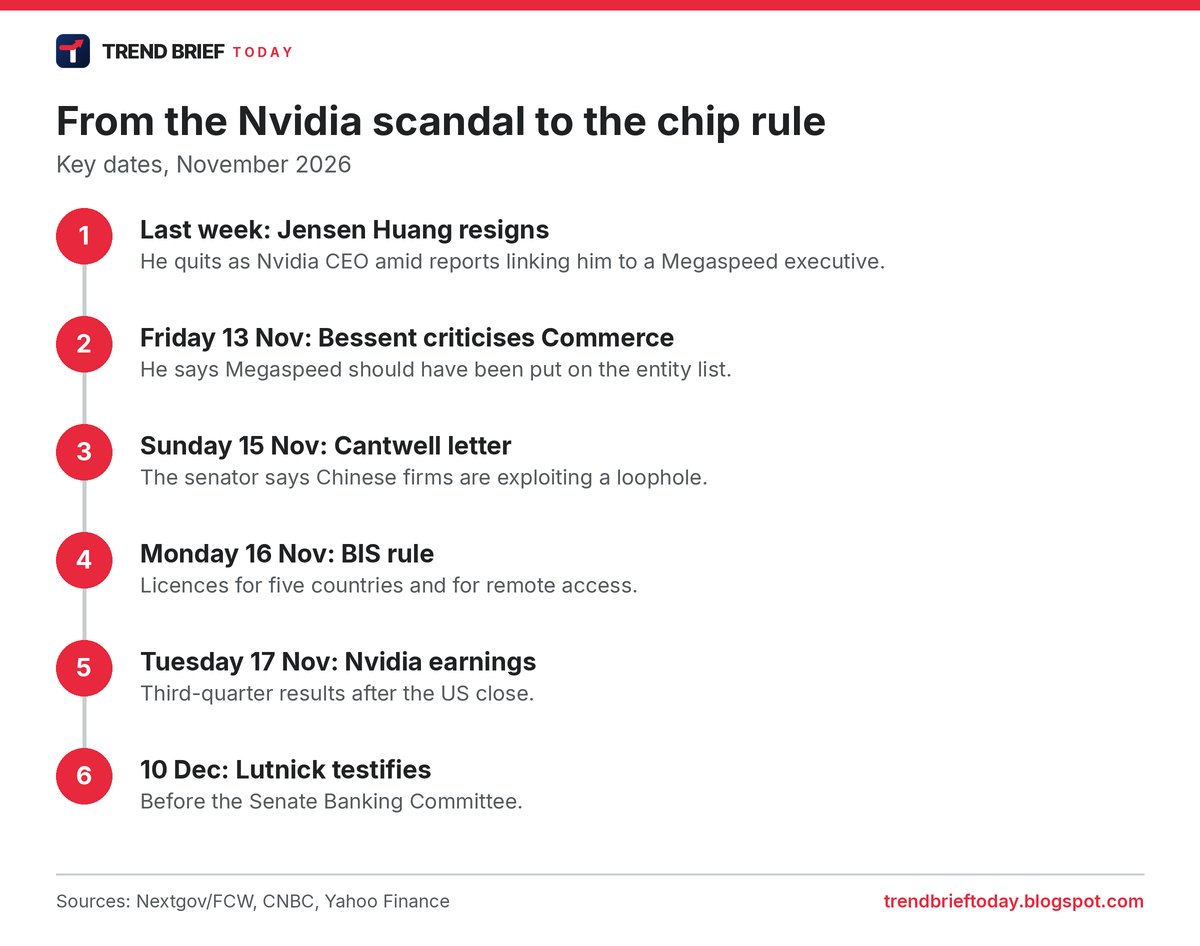
Senator Maria Cantwell said Alibaba and ByteDance used advanced Nvidia chips in overseas data centres to train AI models.[2] In a letter to Commerce Secretary Howard Lutnick sent the day before the rule, she wrote: "These companies are exploiting a loophole in U.S. export controls."[1][2]
What the new rule does
The rule has two main parts. First, it requires a licence to export, re-export or transfer advanced chips within five countries: Indonesia, Malaysia, Singapore, Thailand and Brazil.[2] The Bureau of Industry and Security says these countries carry a higher than normal risk of chips being diverted, and the Commerce Secretary can add more countries after talking to the Secretary of State or the national security adviser.[2]
Second, it covers renting rather than buying. A data centre will need a licence before it gives remote access to companies headquartered in China or other restricted places. Data centres that already serve such companies get 90 days from the rule's effective date to apply.[1]
When it takes effect, and the exception for US companies
The rule, titled "Addressing Remote Access to Advanced Semiconductors", was filed for public inspection at the Federal Register on Monday afternoon and is scheduled for publication on Thursday 19 November 2026. The text says it "is effective" on the date of publication, and that comments are due 60 days after that.[5] The rule was published as planned on 19 November 2026, as Federal Register document 2026-23529, and its "Dates" line confirms it is effective that day. Comments must reach BIS "no later than January 19, 2027".[7] (We had counted 18 January before the text was final.) Ninety days from the effective date puts the licence deadline for existing data centre customers at 17 February 2027, by our count.
The licence requirement for Indonesia, Malaysia, Singapore, Thailand and Brazil "will not apply to semiconductors destined to companies headquartered in, or whose ultimate parent company is headquartered in, the United States, provided certain reporting requirements are met."[5] Those reports are monthly: the exporter must send BIS the names and addresses of every party and parent company, the final destination and product details, due by the first business day of the month after each shipment.[5][6] In practice, that means a US cloud company building a data centre in Malaysia or Singapore can keep receiving chips without a licence, while a local or Chinese-owned buyer cannot.
The rule also warns that Commerce will watch for countries that "tolerate evasion" and could respond with import restrictions, new licence requirements, a lower export control status or Entity List designations.[5]
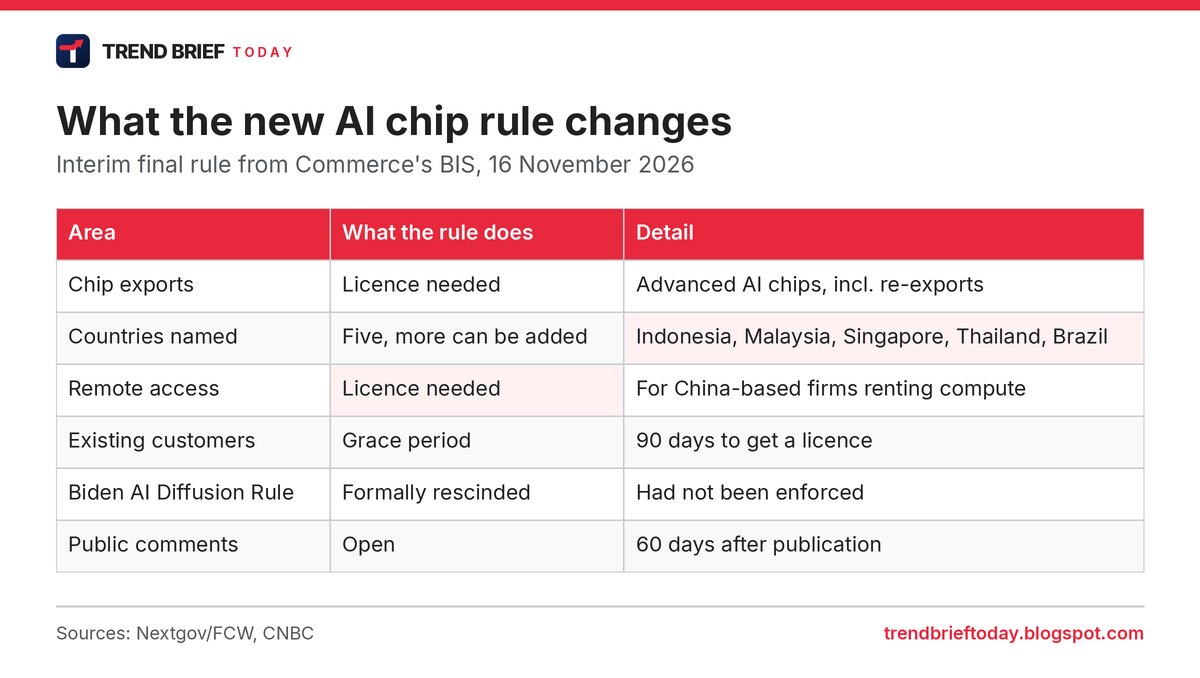
The rule also formally cancels the regulations behind the Biden administration's AI Diffusion Rule, which the Trump administration had already said it would not enforce.[1] Commerce said the new rule was "written by and at the direction of the Department of Treasury and the National Security Council".[1][2]
| Country | Region | Why it matters here |
|---|---|---|
| Malaysia | Southeast Asia | Megaspeed imported billions of dollars of Nvidia equipment into Malaysia, the NYT reported[2] |
| Singapore | Southeast Asia | Home of Megaspeed, the cloud firm at the centre of the scandal[1][2] |
| Thailand | Southeast Asia | Named as a higher diversion risk[2] |
| Indonesia | Southeast Asia | Named as a higher diversion risk[2] |
| Brazil | South America | The only country named outside Asia[1][2] |
Why now: Megaspeed and the Nvidia scandal
The rule follows Jensen Huang's resignation as Nvidia chief executive last week, after reports of affairs, including one with a woman reported to be a Chinese spy. China denies the spy claim.[1][2] The woman, Alice Huang, is an executive linked to Megaspeed, a Singapore cloud computing company that is one of Nvidia's biggest Asian customers. She and Jensen Huang are not related.[2]
According to The New York Times, as reported by CNBC, US authorities began looking at Megaspeed in 2024 after it brought billions of dollars of Nvidia AI equipment into Malaysia. It built data centres in Southeast Asia to serve Chinese customers including Alibaba. The Times said that was legal, but that some chips may have been illegally routed into China.[2]
On Friday, Treasury Secretary Scott Bessent blamed Commerce for not putting Megaspeed on the "entity list" of restricted companies.[1][2] Lutnick faces questions from both parties about whether he slowed down export limits, and he has agreed to testify to the Senate Banking Committee on 10 December.[3]
Trump: "two different views"
President Trump said there are "two different views" among his aides on how to handle the Nvidia situation and that he will make the final decision.[3] Before leaving for Asia he said: "I don't think you want to insult China just before you get there," and "We're having a very good relationship with China right now." He did not talk directly about the new rule.[3]
Trump defended Lutnick and said he is not looking to replace him. On Huang, he said: "I think he learned a good lesson," and appeared open to him returning as CEO.[3] Bessent has taken the other side, describing a "culture of noncompliance" at Nvidia and calling for a new chief executive from "outside the company".[3]
Chris McGuire, a former National Security Council official now at the Council on Foreign Relations, called the rule "a major step forward to countering Chinese smuggling of and access to advanced AI chips".[2] At least eight congressional committees have announced investigations.[3]

The third part: foundries, packagers and the TSMC and Samsung pause
Most early coverage focused on the five countries and on remote access. The published rule has a third part that matters just as much for chipmakers. In the Federal Register's own summary, it "amends the presumptions which front-end chips fabricators and chip packagers face when exporting advanced-node logic chips", reducing "the number of pathways" for chip designers in restricted destinations to get around those presumptions.[7] In plain terms, a Chinese chip designer can no longer get an advanced chip made and cleared through an approved packaging and testing firm without the foundry needing a licence.[8][9]
The effect showed up within days. The Financial Times reported on 19 November that TSMC and Samsung had told Chinese customers that some deliveries would be paused while they apply for US licences; the report was carried by Stocktwits and BeInCrypto on Yahoo Finance.[8][9] Consumer electronics customers were told too, because the rule removes exemptions that had been used to show some advanced chips were for non-AI uses such as smartphones. TSMC makes phone processors for Xiaomi, Oppo and Vivo, and an industry insider told the FT that licences for phone chips will probably be approved, but with significant delays.[8]
The money at stake for TSMC is smaller than the share move suggests. Customers based in China were 5% of TSMC's third-quarter net revenue, roughly $2.3 billion, down from 8% a year earlier, and only part of that is covered by the rule.[9] TSMC stock still fell about 5% in Taipei between Monday's close and Thursday's, while Samsung ended flat; Alibaba lost about 8% in Hong Kong over the same sessions.[9] By our arithmetic, if $2.3 billion is 5% of the quarter, TSMC's total was about $46 billion, so even losing all China revenue for a full quarter would be a single-digit hit; the bigger risk is delay for Chinese buyers, not lost sales for TSMC.
Market reaction: Nasdaq falls 2.5%
Nvidia shares fell after the rule was announced on Monday morning, and Micron, Intel and AMD fell too.[2] By the close, Nvidia was down 4.1% and the Nasdaq Composite had lost 2.49% to 24,509.76, its third losing day in a row.[4] The S&P 500 fell 1.92% to 7,416.59 and the Dow dropped 739.38 points, or 1.41%, to 51,608.17.[4]
| Index or stock | Move | Close or note |
|---|---|---|
| Nasdaq Composite | -2.49%[4] | 24,509.76[4] |
| S&P 500 | -1.92%[4] | 7,416.59[4] |
| Dow Jones | -739.38 points (-1.41%)[4] | 51,608.17[4] |
| Nvidia | -4.1%[4] | Earnings Tuesday after the close[4] |
| Micron, Intel | More than -7%[4] | Memory and chip makers hit hardest[4] |
| AMD | -5%[4] | Named by CNBC as falling after the rule[2] |
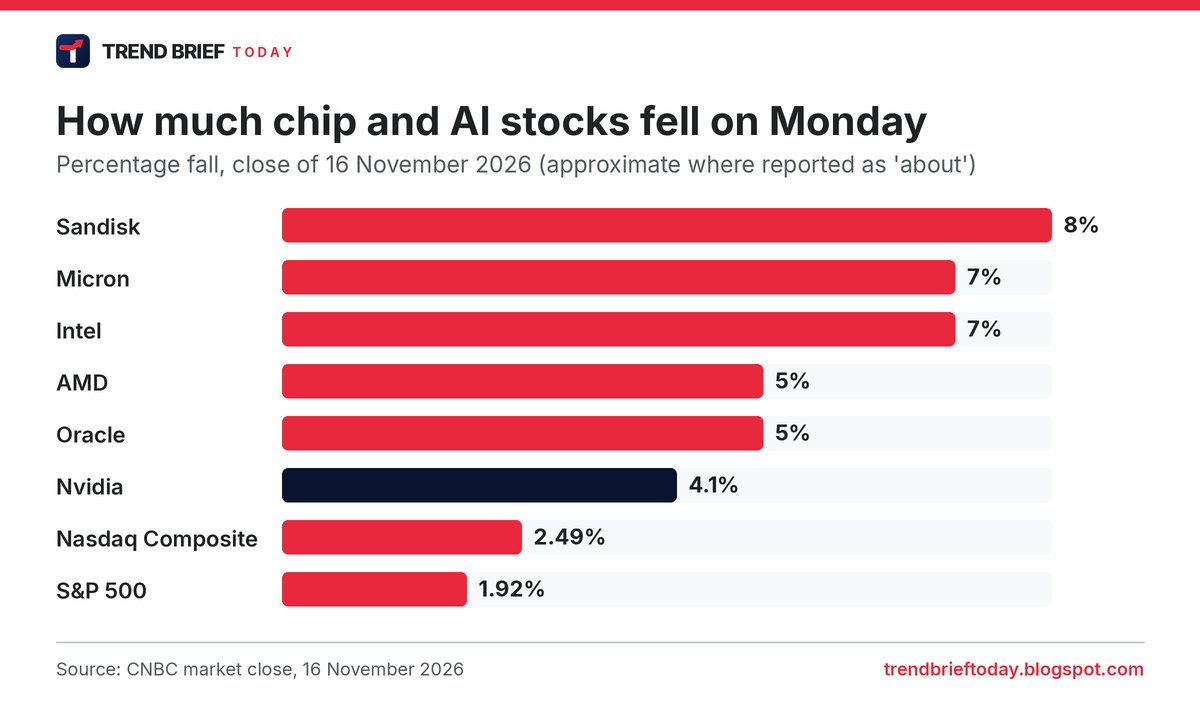
The rule was not the only reason. A source told CNBC that Nvidia's board is not discussing bringing Huang back, and the selling spread to banks later in the day.[4] Jay Woods of Freedom Capital Markets said: "Strong results won't resolve the questions surrounding Jensen's departure."[4]
Frequently asked questions
What is the new AI chip export rule?
An interim final rule from the Commerce Department's Bureau of Industry and Security, issued on 16 November 2026. It requires licences for advanced AI chips going to Indonesia, Malaysia, Singapore, Thailand and Brazil, and for data centres that give remote access to China-based companies.[1][2]
Which countries need a licence for Nvidia chips now?
Indonesia, Malaysia, Singapore, Thailand and Brazil. The Commerce Secretary can add more. Buyers headquartered in the US, or with a US ultimate parent, are exempt if the exporter files monthly reports.[2][5][6]
When does the AI chip export rule take effect?
It took effect on Thursday 19 November 2026, the day it was published in the Federal Register as document 2026-23529.[7]
What is the remote access loophole?
Chinese companies could rent advanced chips in data centres outside China instead of buying them. The new rule needs a licence for that, with 90 days for data centres that already serve such firms.[1]
Why did Nvidia stock fall today?
Nvidia fell 4.1% on 16 November after the rule, reports that its board is not discussing Huang's return, and a wider sell-off in AI stocks.[2][4]
When are Nvidia earnings?
Third-quarter results are due after the US market close on Tuesday 17 November 2026.[4]
Can people comment on the rule?
Yes. Comments must be received by 19 January 2027, through regulations.gov under docket BIS-2026-0628.[7]
Why did TSMC and Samsung stop some chip shipments to China?
Because the rule changed how foundries and chip packagers can clear advanced chips for designers in restricted countries. Both companies reportedly paused some deliveries to Chinese customers while they apply for licences.[7][8]
References
- Dille, Grace (16 November 2026, 2:32 p.m. ET). "Commerce Department moves to close AI chip loophole". Nextgov/FCW.
- Mangan, Dan (16 November 2026). "Nvidia fallout: Commerce targets loophole for China's data center use". CNBC.
- Werschkul, Ben (16 November 2026, 11:36 a.m. EST). "Trump acknowledges 'different views' among aides as his administration advances new limits on semiconductor exports". Yahoo Finance.
- Conlon, Sean; Leask, Hugh; Imbert, Fred (16 November 2026, updated 4:18 p.m. EST). "Nasdaq falls more than 2%, extending slide to third day as Nvidia drags down AI trade". CNBC.
- Bureau of Industry and Security (filed 16 November 2026, 4:15 p.m. ET; scheduled publication 19 November 2026). "Addressing Remote Access to Advanced Semiconductors", interim final rule, document 2026-23529. Federal Register public inspection.
- Stan, Alina Maria (16 November 2026, 5:53 p.m. GMT). "US curbs China's remote access to AI chips through overseas data centres". The Next Web.
- Bureau of Industry and Security. "Addressing Remote Access to Advanced Semiconductors". Federal Register, 91 FR 74970, document 2026-23529. 19 November 2026.
- Harshita Tyagi (Stocktwits). "TSMC, Samsung Reportedly Suspend Some Chip Deliveries To Chinese Customers Amid New US Export Rules". Yahoo Finance. 19 November 2026.
- Harsh Notariya (BeInCrypto). "TSMC Stock Falls 5% on China Chip Pause: What Is at Risk?". Yahoo Finance. 19 November 2026.