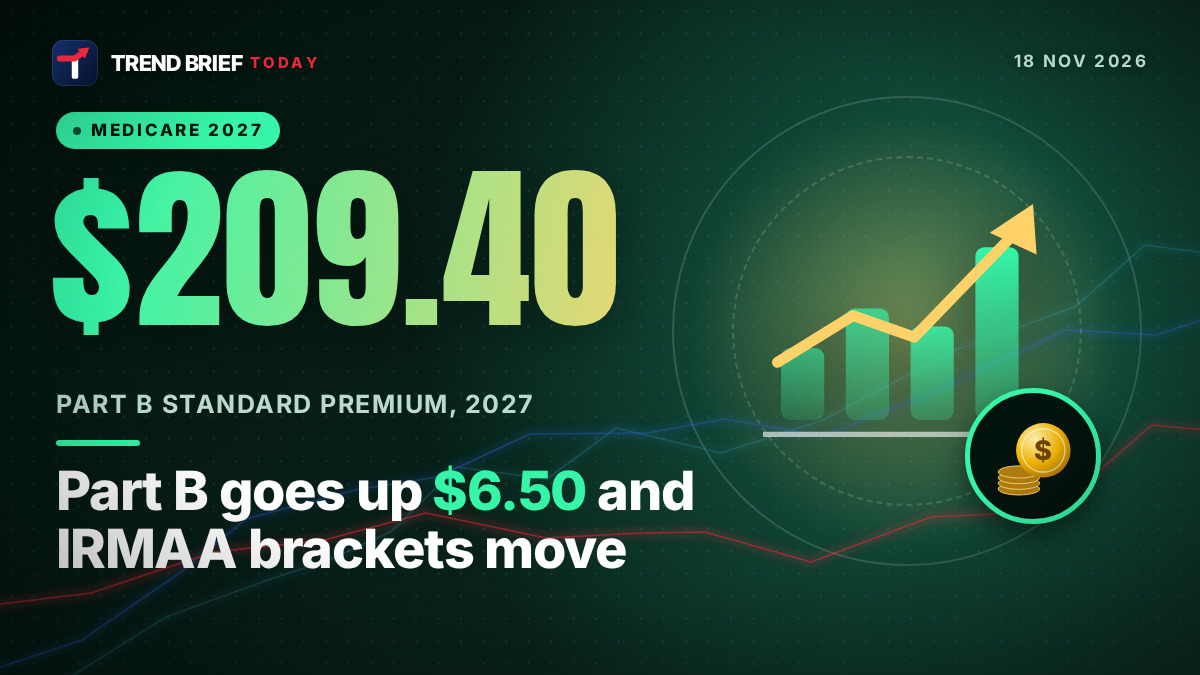
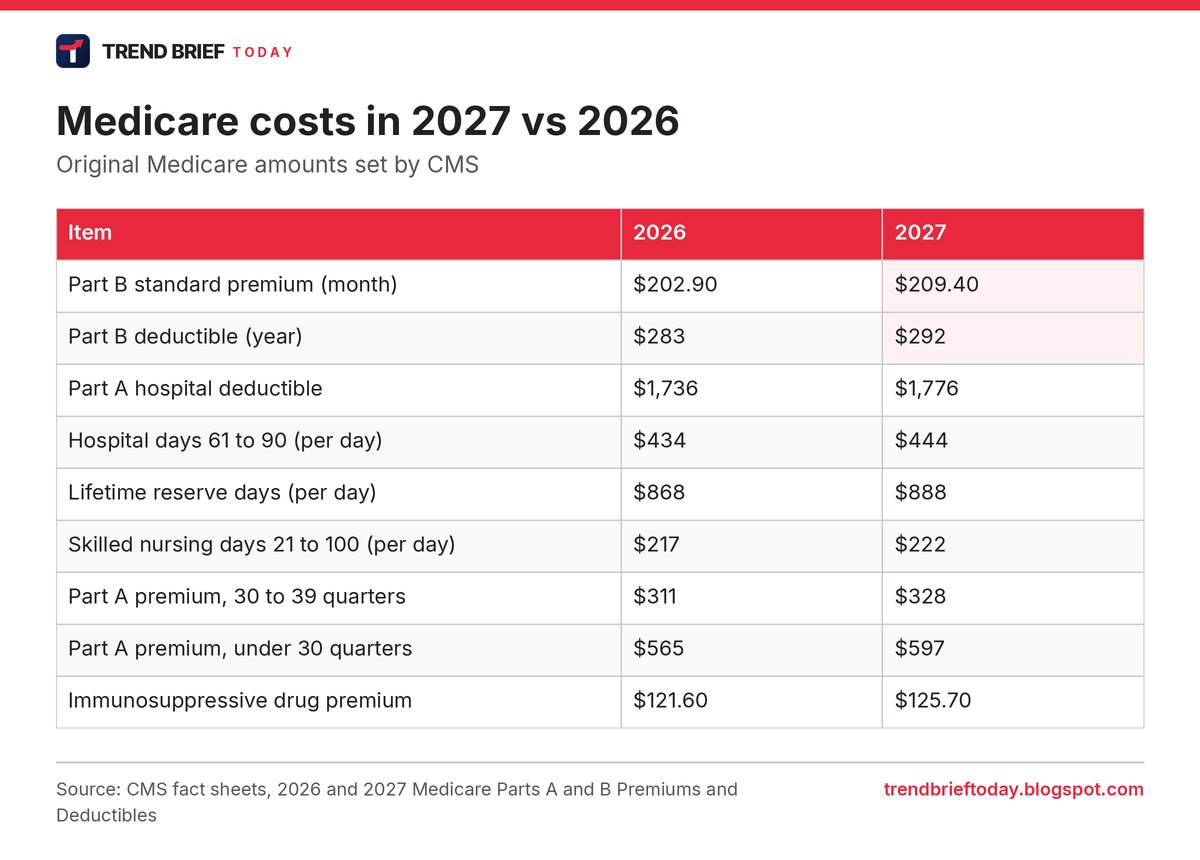
The Medicare Part B premium for 2027 is $209.40 a month, up $6.50 from $202.90 in 2026, and the annual Part B deductible rises $9 to $292. The Centers for Medicare & Medicaid Services (CMS) published the figures on 17 November 2026. Higher earners pay more: the income-related surcharge (IRMAA) now starts above $112,000 for a single filer and $224,000 for a married couple filing jointly, and the top premium is $711.80 a month. For most retirees the increase takes only a small bite out of the 3.6% Social Security raise that starts in January.[1][3][4]
 | |
| Standard premium | $209.40 a month (2026: $202.90)[1] |
|---|---|
| Increase | $6.50 a month, about 3.2%[1][3] |
| Per year | $2,512.80 per person[3] |
| Part B deductible | $292 (2026: $283)[1] |
| IRMAA starts | Above $112,000 single, $224,000 joint[1] |
| Top premium | $711.80 a month[1] |
| Income year used | 2025 tax return (MAGI)[3][4] |
| Part A deductible | $1,776 per benefit period[1] |
| Social Security COLA | 3.6% from January 2027[5] |
| Announced | 17 November 2026 by CMS[1] |
What is the Medicare Part B premium for 2027?
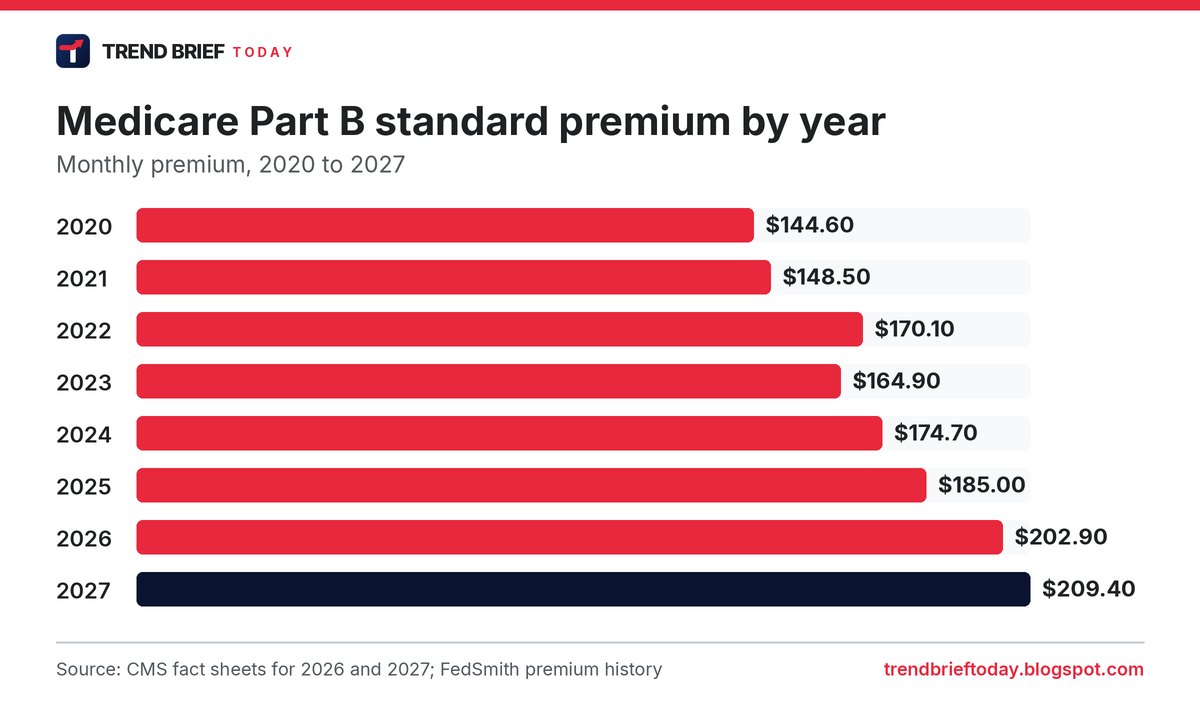
The standard monthly premium for Medicare Part B will be $209.40 in 2027. That is $6.50 a month more than the $202.90 people pay in 2026, or $78 more over a full year. Most people with Part B pay the standard amount.[1][4]
CMS gave a one-line reason: the rise is "mainly due to projected increases in healthcare spending". It did not say which services were driving it.[1][3] The final figure came in 10 cents below the $209.50 that the Medicare Trustees had projected earlier in the year, and the $292 deductible matched their projection.[3][4]
By recent standards this is a small rise. The 2026 premium jumped $17.90, close to 10%, after CMS said spending on skin substitutes would otherwise have pushed it about $11 higher still.[2] The 3.2% increase for 2027 is the smallest since 2021, leaving aside 2023, when the premium actually fell.[3]
Part B deductible 2027
The annual Part B deductible will be $292, up $9 from $283. You pay this amount for Part B services each year before Medicare starts paying its share.[1]
People who keep only Part B coverage of immunosuppressive drugs after a kidney transplant pay a separate standard premium of $125.70 a month in 2027, up from $121.60.[1][2]
2027 IRMAA brackets: who pays more
If your income is above a set level, you pay an income-related monthly adjustment amount, usually called IRMAA, on top of the standard premium. CMS says it affects roughly 9% of people with Part B, up from about 8% a year earlier.[1][2]
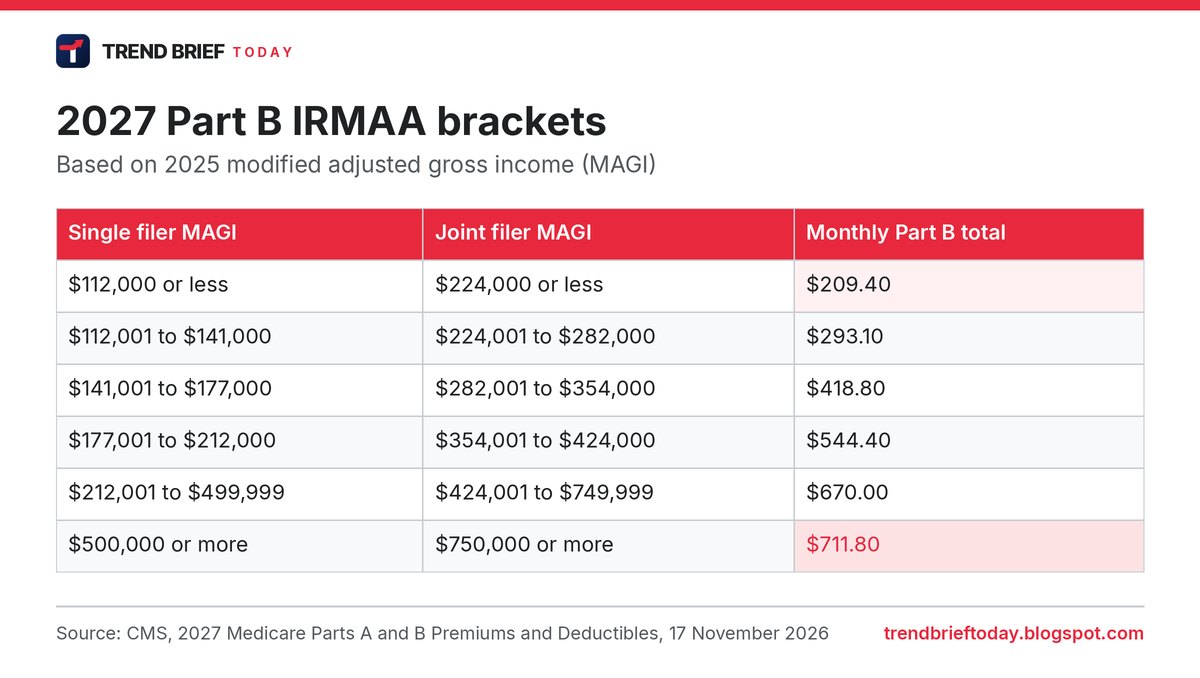
Social Security uses your modified adjusted gross income (MAGI) from two years back. So the 2027 surcharge is based on your 2025 tax return.[3][4] The thresholds rose by $3,000 for single filers ($109,000 to $112,000) and $6,000 for joint filers ($218,000 to $224,000).[1][2]
| Bracket (single / joint MAGI in 2025) | 2026 total a month | 2027 total a month |
|---|---|---|
| Up to $112,000 / $224,000 | $202.90 | $209.40[1][2] |
| Over $112,000 to $141,000 / over $224,000 to $282,000 | $284.10 | $293.10[1][2] |
| Over $141,000 to $177,000 / over $282,000 to $354,000 | $405.80 | $418.80[1][2] |
| Over $177,000 to $212,000 / over $354,000 to $424,000 | $527.50 | $544.40[1][2] |
| Over $212,000, under $500,000 / over $424,000, under $750,000 | $649.20 | $670.00[1][2] |
| $500,000 or more / $750,000 or more | $689.90 | $711.80[1][2] |
The 2026 column uses that year's own brackets, which started lower, at $109,000 and $218,000. Married people who lived with their spouse at any time in the year but file separate returns face a much steeper scale: $670.00 a month above $112,000 and $711.80 at $388,000 or more.[1]
Part D IRMAA 2027
The same income brackets apply to prescription drug coverage. On top of your Part D plan premium, higher earners pay an extra $15.40, $39.70, $64.00, $88.30 or $96.40 a month in 2027, depending on the bracket. In 2026 the range was $14.50 to $91.00. This surcharge is taken from Social Security or paid to Medicare even when you pay the plan premium itself directly to the plan.[1][2][4]
The bracket shift can save money
Because the thresholds moved up but your income year moved forward too, some people drop out of a bracket without doing anything. Take a single retiree whose MAGI was $110,000 in both 2024 and 2025. In 2026 that income put them in the first surcharge bracket ($284.10 a month). In 2027 the same income sits under the new $112,000 line, so they pay the standard $209.40. That is $74.70 a month, or $896.40 a year, less. The reverse also happens: a one-off 2025 event such as a large retirement account withdrawal or a Roth conversion can push 2027 premiums up.[1][2][3]
If your income fell because of a "life-changing event", such as retiring, you can ask Social Security to use a more recent year's income by filing form SSA-44.[3][4]
How much of your Social Security raise does Part B take?
Social Security payments rise 3.6% from January 2027. The increase takes effect on 1 December 2026 and first shows up in January payments.[5] Most people have their Part B premium taken straight out of their Social Security check, so the higher premium comes off the raise before the money arrives.[3][4]
For someone on the standard premium, the extra $6.50 is a small slice. A $2,000 monthly benefit goes up about $72, and after the premium increase the deposit is about $65.50 higher.[3] Our worked examples for other benefit levels are in the chart below.
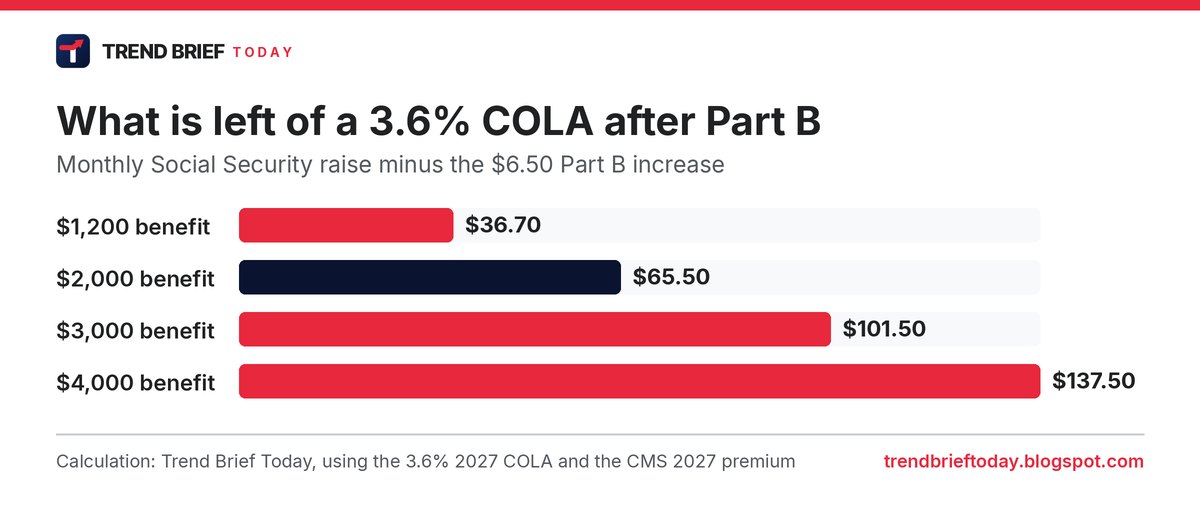
A rule called "hold harmless" stops the Part B increase from making a Social Security check smaller than the year before. It only matters when the dollar COLA is smaller than the premium rise. With a $6.50 increase and a 3.6% COLA, that only happens on very small benefits. Hold harmless does not cover people who pay IRMAA or people who are new to Medicare.[4]
Federal retirees in FERS get a smaller 2.6% COLA on their annuities, because the FERS formula takes one point off when the Social Security COLA is above 3%.[3][5]
For the longer-term picture on benefits, see our explainer on the Social Security trust fund and the 2032 benefit cut warning.
Part A costs in 2027
About 99% of people on Medicare pay no premium for Part A, the hospital insurance, because they or a spouse worked at least 40 quarters. The amounts that go up for everyone are the hospital costs:[1]
- Hospital deductible: $1,776 per benefit period, up $40 from $1,736. It covers your share of the first 60 days in hospital.[1]
- Days 61 to 90: $444 a day, up from $434.[1]
- Lifetime reserve days: $888 a day, up from $868.[1]
- Skilled nursing facility, days 21 to 100: $222 a day, up from $217.[1]
If you have to buy Part A, the premium is $328 a month with 30 to 39 quarters of work, up $17, or $597 a month with fewer than 30 quarters, up $32.[1][4]
What to do now
- Check your plan before 7 December. Medicare open enrollment runs from 15 October to 7 December 2026. It is the window to switch between Original Medicare and Medicare Advantage or to change a Part D plan.[4]
- Read your Social Security letter. Social Security usually mails COLA notices in December, showing the new benefit and the premium that will be taken off.[5]
- Look at your 2025 income. If it was near a bracket edge, or a one-off event pushed it up, you will see it in your 2027 premium. If your circumstances changed, consider an SSA-44 request.[3]
- Plan 2026 and 2027 income with 2028 and 2029 in mind. Withdrawals and conversions this year feed into the premium you pay two years from now.[3][4]
Medicare costs are rising in a year when overall prices are also climbing. Our page on US CPI for October 2026 has the latest inflation figures, and Fed rate hike December 2026 covers what that means for interest rates.
Timeline
| Date | Event | Detail |
|---|---|---|
| 14 November 2025 | 2026 rates announced | Part B $202.90, up $17.90[2] |
| 2026 (Trustees Report) | 2027 projection | $209.50 premium, $292 deductible[3][4] |
| October 2026 | 2027 COLA announced | 3.6% for Social Security[5] |
| 15 October 2026 | Open enrollment opens | Runs to 7 December[4] |
| 17 November 2026 | CMS releases 2027 rates | Part B $209.40, deductible $292[1] |
| 7 December 2026 | Open enrollment closes | Last day to change plans for 2027[4] |
| 1 January 2027 | New amounts apply | First higher Social Security payments too[1][5] |
Frequently asked questions
What will the Medicare Part B premium be in 2027?
$209.40 a month for most people, up from $202.90 in 2026.[1]
What is the Part B deductible for 2027?
$292 a year, up from $283.[1]
What are the IRMAA brackets for 2027?
Surcharges start when 2025 MAGI is above $112,000 for single filers or $224,000 for joint filers. Total Part B premiums are $293.10, $418.80, $544.40, $670.00 and $711.80 a month across the five higher brackets.[1]
Which year's income is used for 2027 IRMAA?
Your 2025 modified adjusted gross income, from the tax return you filed in 2026.[3][4]
How much will my Social Security go up after the Part B premium?
Social Security rises 3.6%. On a $2,000 benefit that is about $72 a month, and about $65.50 after the $6.50 Part B increase, if you pay the standard premium.[3][5]
When do the new Medicare premiums start?
On 1 January 2027. The premium taken from your January Social Security payment will be the new amount.[1][4]
Why did the Part B premium go up?
CMS said the increase is mainly due to projected increases in healthcare spending.[1]
References
- "2027 Medicare Parts A & B Premiums and Deductibles". Centers for Medicare & Medicaid Services (fact sheet). 17 November 2026.
- "2026 Medicare Parts A & B Premiums and Deductibles". Centers for Medicare & Medicaid Services (fact sheet). 14 November 2025.
- Smith, Ian. "What Federal Retirees Will Pay For Medicare Part B In 2027". FedSmith. 17 November 2026.
- "2027 Medicare Part B Premium Rates". My Federal Retirement. 17 November 2026.
- "2027 CSRS / FERS COLA: 3.6% for CSRS & Social Security, 2.6% for FERS". My Federal Retirement. Updated 16 October 2026.