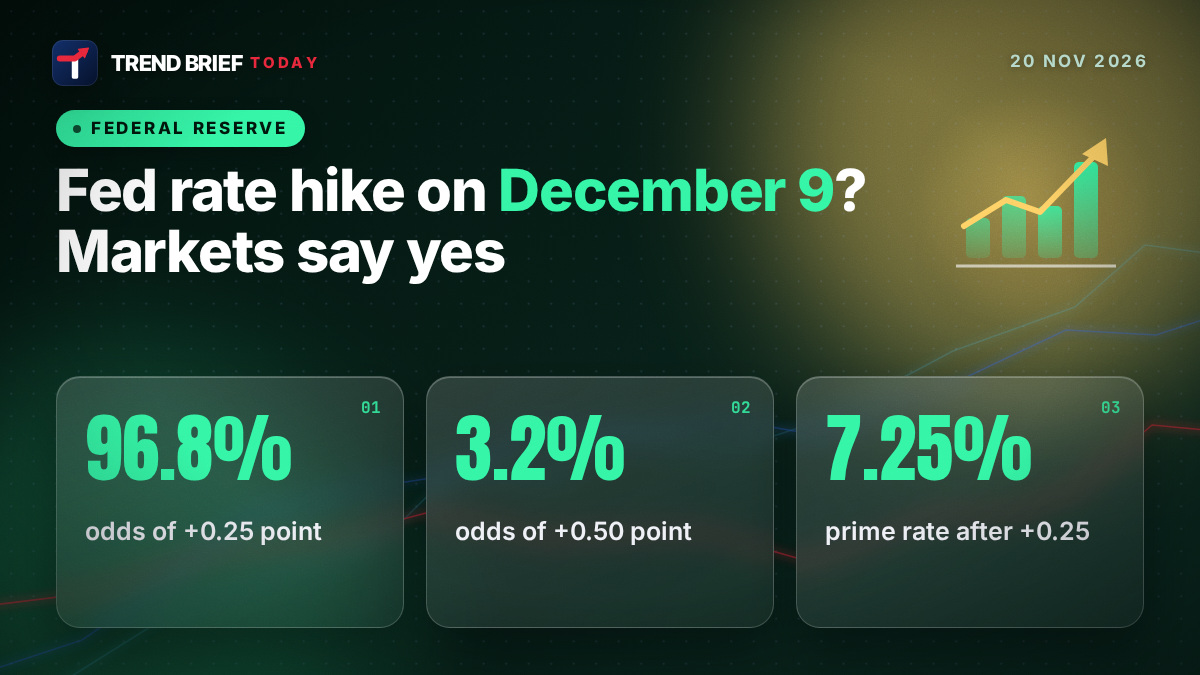
Markets now treat a Fed rate hike in December 2026 as close to certain. Futures traders now put a 96.8% chance on a quarter-point rise at the meeting that ends on Wednesday 9 December, and 3.2% on a half-point rise, up from about 91% and 9% on Monday.[18][5] That would lift the Fed's target range from 3.75% to 4% today to 4% to 4.25%, or 4.25% to 4.5%.[1] The bets pushed the US dollar to its highest level since April 2025 on Monday.[4][5]
 | |
| Meeting | 8 and 9 December 2026[12][4] |
|---|---|
| Decision | Wednesday 9 December[4][6] |
| Current range | 3.75% to 4.00%[1][2] |
| Last change | Hike of 0.25 point, September 2026[1][9] |
| October vote | Hold, 10 to 2 (two wanted a hike)[2][13] |
| Odds of +0.25 | 96.8% (CME FedWatch, 20 Nov), up from about 91% on 16 Nov[18][5] |
| Odds of +0.50 | 3.2% (20 Nov), down from about 9% to 10%[18][5][4] |
| October minutes | Released 18 November: almost all officials see more hikes ahead[14][15] |
| Fed chair | Kevin Warsh[6][8] |
| Dollar index | 103.50, highest since 2 April 2025[4][5] |
| Prime rate now | 7.00%[9][12] |
Will the Fed raise rates in December 2026?
If the futures market is right, yes. CME Group's FedWatch tool, which turns fed funds futures prices into odds, showed a 91% chance of a 25 basis point hike and a 9% chance of a 50 basis point hike on Monday, Reuters reported.[5] A later Reuters reading carried by The Korea Times put the quarter-point odds at 93.4%, with nearly 10% on the bigger move.[4] Add the two together and the market sees almost no chance that the Fed stands still. The Motley Fool, using the same CME tool, said the odds of some hike had reached 100% by 12 November, up from 67% a week earlier.[6]
Odds are not a decision. They are a price that changes with every data release, and they were far lower a month ago. CNBC reported odds of 87% on 10 November, against about 70% a month before that.[7] Still, a central bank rarely goes against a market that is this sure, because a surprise would shake bonds, stocks and the dollar at once.
A quarter point (0.25 percentage point) is the size most traders expect. A half point is the tail risk, and it is the one Wall Street worries about. Fed Governor Christopher Waller said earlier this month that "a 50-basis-point hike in the policy rate should be considered at the December meeting" if October inflation came in hot, adding that "hiking only 25 basis points would put our credibility at risk".[6] Reuters notes that the October data appeared to clear the bar Waller set.[4]
Why a hike, after cuts in 2025?
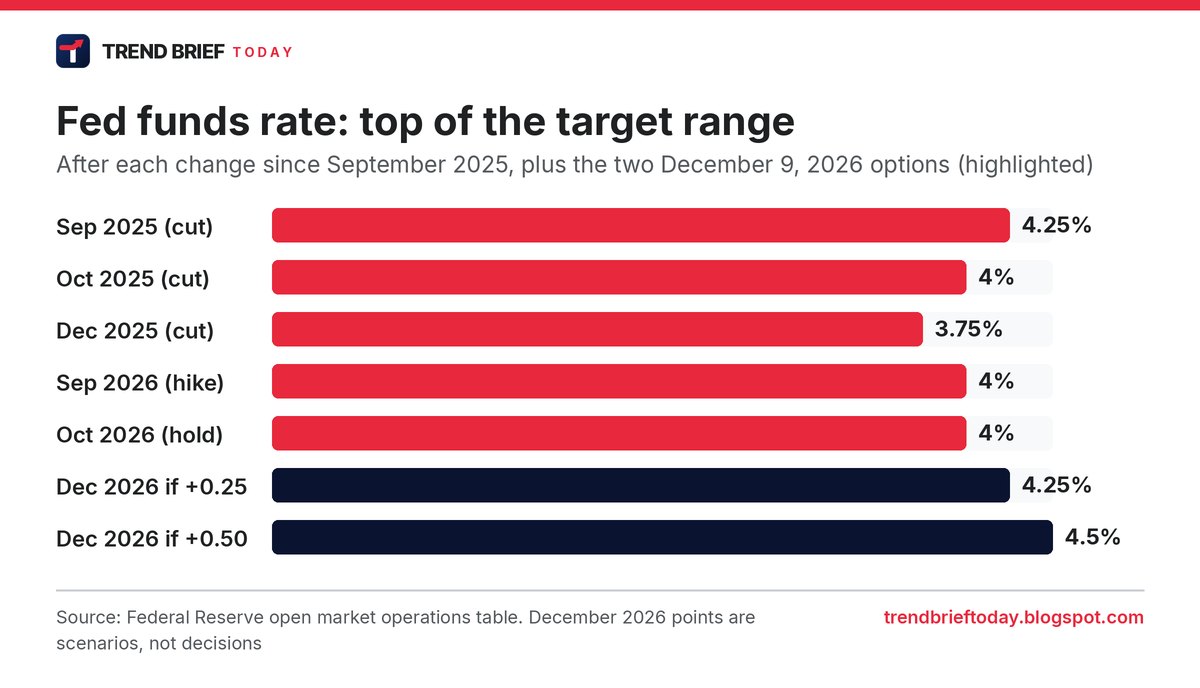
The Fed cut three times in late 2025, taking the top of its range down to 3.75% by December. It then reversed course and raised rates by a quarter point in September 2026, to 3.75% to 4%.[1] Reuters described that as the Fed's first hike since 2023.[9] In October it held, but the vote was 10 to 2. Governors Lisa Cook and Beth Hammack voted for another quarter-point rise, and the statement said plainly that "inflation remains elevated".[2][13]
Three things have pushed the odds up since then:
- Hot October prices. Consumer prices rose more than forecast in October, the third monthly increase in a row, according to CNBC and The Korea Times.[7][4] We broke the numbers down in our US CPI October 2026 explainer.
- Hawkish Fed speakers. Besides Waller, Dallas Fed President Lorie Logan signalled unease about inflation.[7] Over the weekend Kansas City Fed President Jeff Schmid said inflation remained too high, and San Francisco Fed President Mary Daly said persistent price pressure, especially in services, reinforces the case for further hikes, Reuters reported.[5]
- Tariffs and the Iran war. The Motley Fool points to tariff policy and the war with Iran as sources of sticky inflation, and CNBC's markets report linked some of the dollar's strength this year to safe-haven buying during the war.[6][7]
What Chair Kevin Warsh has not done is spell out the December move. At a Fed conference in San Francisco on Monday he spoke about artificial intelligence instead, warning it could cost jobs or simply "disappoint", and saying it "will have significant impact on the economy, with important implications for monetary policy down the road", CNBC reported.[8] After the October meeting he declined to say whether a December hike was being prepared, according to CNN's live coverage.[13]
What the October minutes said
The Fed released the minutes of its 27 and 28 October meeting at 2:00 p.m. Eastern (19:00 GMT) on 18 November, three weeks after the meeting.[14][15] They are the clearest signal yet. Looking ahead, "almost all participants" judged that, on their central forecasts for inflation and jobs, further action to raise the federal funds rate would likely be appropriate to bring inflation back to 2%.[14] The AP read that as nearly every official expecting a quarter-point rise in December, with more likely early next year.[15]
The minutes also show how close October was. Most officials backed the hold, but "some" wanted a 25 basis point hike at that meeting, and a few of those who backed the hold called it "a close call". Two voters, Governor Lisa Cook and Cleveland Fed President Beth Hammack, dissented in favour of a hike.[14][15] Looking to December, "a couple of participants" said a move of more than 25 basis points could be considered if inflation data came in unfavourable.[14] The minutes do not name them, and the AP notes the second official may not be a voter this year.[15]
Inflation worries ran through the document. Most officials said price pressures were broad based, the vast majority saw upside risks to the inflation outlook from energy prices and refined fuel supply, and many called the AI buildout "a material source of inflation risk". On financial stability, almost all of them discussed what would happen if returns on AI investment disappointed investors.[14]
Officials are split in public on the size of the next step. On the morning of 18 November Waller told CNBC that inflation is "headed in the wrong direction" and repeated his case for a half-point hike in December, while New York Fed President John Williams told Axios a day earlier, "I don't think the situation calls for dramatic action."[15] St. Louis Fed President Alberto Musalem said several increases would likely be needed before spring 2027.[15]
| October minutes | What they say |
|---|---|
| Decision | Hold at 3.75% to 4.00%, vote 10 to 2[14] |
| Dissents | Lisa Cook and Beth Hammack, both for +0.25[14][15] |
| Next steps | "Almost all" see further hikes as likely appropriate[14] |
| Bigger move | "A couple" said more than 0.25 could be considered in December[14][15] |
| Main risk named | Inflation staying high; AI buildout a "material" risk for many[14] |
| Market odds after | Near 95% for a December hike (CME FedWatch, via AP)[15] |
What a 0.25 or 0.5 point hike would mean
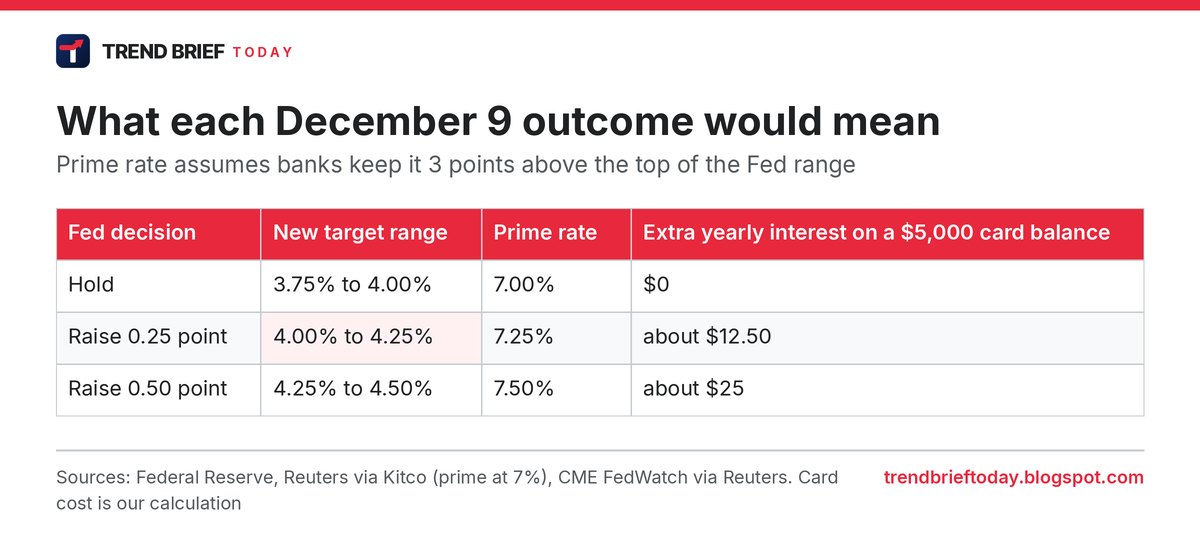
The Fed's target range has a lower and an upper end, and US banks set their prime lending rate 3 points above the upper end. When the Fed raised in September, JPMorgan, KeyCorp and BNY moved prime from 6.75% to 7% the next day, Reuters reported.[9] Yahoo Finance's guide to the December meeting also uses the 4% upper bound and describes prime as a fixed margin above it.[12] So the three outcomes look like this:
| Decision on 9 December | New target range | Prime rate if banks follow |
|---|---|---|
| Hold | 3.75% to 4.00% | 7.00% |
| Raise 0.25 point (most likely) | 4.00% to 4.25% | 7.25% |
| Raise 0.50 point | 4.25% to 4.50% | 7.50% |
A 4.25% upper bound would match the level after the September 2025 cut, undoing two of the three 2025 cuts. A half point to 4.5% would undo all three and return the range to where it sat from December 2024 to September 2025.[1]
Credit cards, mortgages and savings
Credit cards and other variable debt
Most US credit cards charge a variable rate tied to prime, so a hike reaches cardholders within one or two billing cycles. The Fed's own G.19 data put the average card rate at 21.19% across all accounts in the latest quarter, and 22.36% on accounts that actually paid interest.[10] Yahoo Finance cites the same 21.19% figure, up from 20.94% in May.[12]
Here is our own maths. A quarter-point rise adds $2.50 a year in interest for every $1,000 you carry, so $12.50 on a $5,000 balance and $25 on $10,000. A half point doubles that. Yahoo Finance reached the same $12.50 figure for a $5,000 balance.[12] The hike is small next to the rate you already pay: $5,000 at 22.36% costs about $1,118 a year before the Fed moves. If you pay your card off in full each month, the hike costs you nothing.[12] Home equity lines of credit (HELOCs) and some private student loans are also usually tied to prime and move the same way.
Mortgages
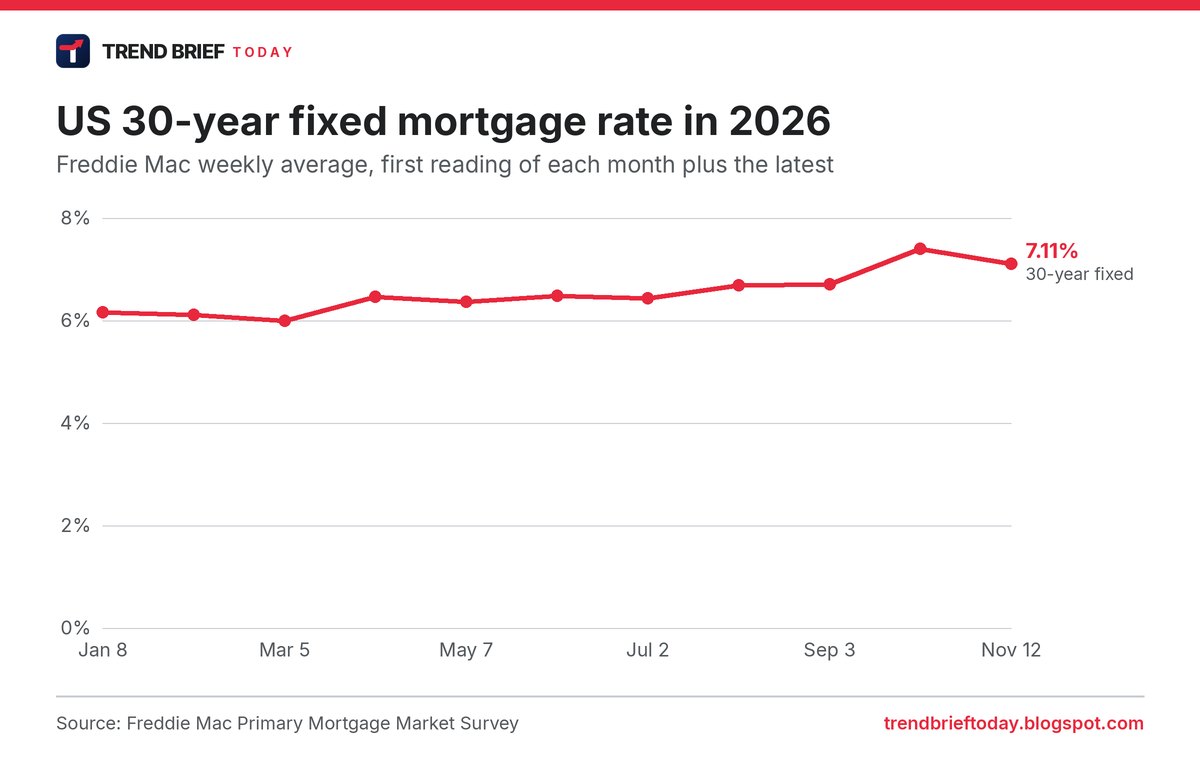
A fixed-rate mortgage does not follow the Fed directly. It follows long-term bond yields, and those already price in the expected hike. Freddie Mac's survey shows the 30-year fixed rate at 7.11% in the week to 12 November, down from a 2026 peak of 7.40% in October but well above 6.24% a year earlier.[11] The 15-year rate was 6.45%.[11] The 10-year Treasury yield, the main guide for mortgage pricing, was about 5.13% on Monday after touching 5.174% on Friday, CNBC reported.[8]
That is why mortgage rates have eased for four weeks in a row even as the December hike odds rose.[11][7] A hike that the market already expects tends to be in the price. A surprise half point, or a hint of more hikes in 2027, could push long yields and mortgage rates back up. Anyone on an adjustable-rate mortgage that resets soon is more exposed than someone on a fixed loan.
Savings and CDs
Savers gain, but slowly. Banks raise loan rates faster than deposit rates, a point Reuters made when banks lifted prime in September.[9] Yahoo Finance reports that the FDIC's national average yield on a 12-month CD was 1.76% in October, up from 1.52% in March, while short Treasury bills paid close to 4%.[12] The gap between the average bank account and the best online accounts is far bigger than any single Fed move, so shopping around matters more than the hike itself.[12]
The US housing market is already feeling higher rates. Our report on October existing-home sales falling to a 16-year low has the regional detail.
The dollar, gold and readers outside the US
Higher US rates pull money into the dollar. The dollar index, which measures the US currency against six others, rose to 103.50 on Monday, its highest since 2 April 2025, just before the "Liberation Day" tariffs knocked it down.[4] Reuters, via Zawya, also reported that the dollar was near its strongest since April 2025.[5] That works out to about a 19-month high.
| Market | Level reported | What it means |
|---|---|---|
| Pound (GBP/USD) | $1.319 on 16 Nov, down 0.2%[4] | US trips and dollar shopping cost UK buyers more |
| Euro (EUR/USD) | $1.101 on 16 Nov, below the $1.11 low of 10 Nov[4][7] | Macro Hive sees $1.08 as possible by year end[4] |
| Japanese yen | 159.48 per dollar on 16 Nov[4] | Close to levels where officials are believed to have stepped in this year[4] |
| Australian dollar | $0.685 on 10 Nov[7] | One of the few currencies holding up against the dollar this year[7] |
| Gold | $3,874 an ounce, low since October 2025[5] | Gold pays no interest, so higher rates hurt it[5] |
| Bitcoin | $64,110 on 16 Nov, after a weekend four-month low[4] | Risk assets are under pressure[4] |
For readers in the UK, Canada and Australia, a strong dollar means imported dollar-priced goods, US holidays and US software subscriptions get dearer, while exporters and anyone earning in dollars gain. The pound is also waiting for UK jobs and inflation data later this week, Reuters noted.[4]
Wall Street now expects three hikes in a row
On 19 November, JPMorgan economists led by Michael Feroli dropped their "December and done" view. They now expect quarter-point rises at the December, January and March meetings. "These hikes aren't to deliver a bad labor market, but to preserve credibility when they have no compelling narrative for a pause," the bank wrote, adding that Fed Chair Kevin Warsh has left policy without an "overarching narrative".[16] BofA Global Research and Deutsche Bank also expect hikes at each of the next three meetings.[16][17] They got there first. Deutsche Bank added a January hike to its December and March call on 10 November, straight after the hot October inflation report, and Bank of America did the same on 13 November, lifting its peak forecast from 4.25% to 4.50% up to 4.50% to 4.75%.[21][7][20] JPMorgan, the biggest US bank, was the last of the three to move.
Futures pricing agrees on December: CME FedWatch showed a 92.7% chance of a quarter point and 7.2% for a half point, with about 73% odds of another rise in January.[17] By early Friday, 20 November, the quarter-point reading had climbed to 96.8% and the half-point reading had fallen to 3.2%, so traders are now betting on a normal-sized move rather than a jumbo one.[18] From today's 3.75% to 4.00% range, three quarter-point moves would take the target to 4.50% to 4.75%.[17]
| Meeting | JPMorgan forecast | Range after (our arithmetic) |
|---|---|---|
| 8-9 December 2026 | +0.25 point | 4.00% to 4.25% |
| 26-27 January 2027 | +0.25 point | 4.25% to 4.50% |
| 16-17 March 2027 | +0.25 point | 4.50% to 4.75% |
What that would mean at home, by our arithmetic: banks set the prime rate 3 points above the top of the Fed range, so prime would climb from 7% to 7.75% by spring. Most credit cards float on prime, so a card carrying a $5,000 balance would cost roughly $37.50 more in interest a year than it does now. Treat this as a forecast, not a decision. The Fed decides one meeting at a time, and the first call is on 9 December.
What to watch before 9 December
- Tuesday 17 November: US retail sales for October at 8:30 a.m. ET, with economists expecting a 0.6% rise, CNBC reported.[8] Nvidia also reports on Tuesday, and traders are watching it for risk appetite.[4] See our Nvidia earnings guide for times by country.
- Wednesday 18 November (done): the October minutes showed almost all officials expect more hikes, and a couple open to more than a quarter point in December.[14][15]
- Early December: the November jobs and inflation figures, the last big data before the decision. Goldman Sachs expects hikes in December and March, and Deutsche Bank in December, January and March, CNBC reported.[7]
- Wednesday 9 December: the decision. The Fed releases its statement at 2:00 p.m. Eastern (19:00 GMT), as it did in October.[2]
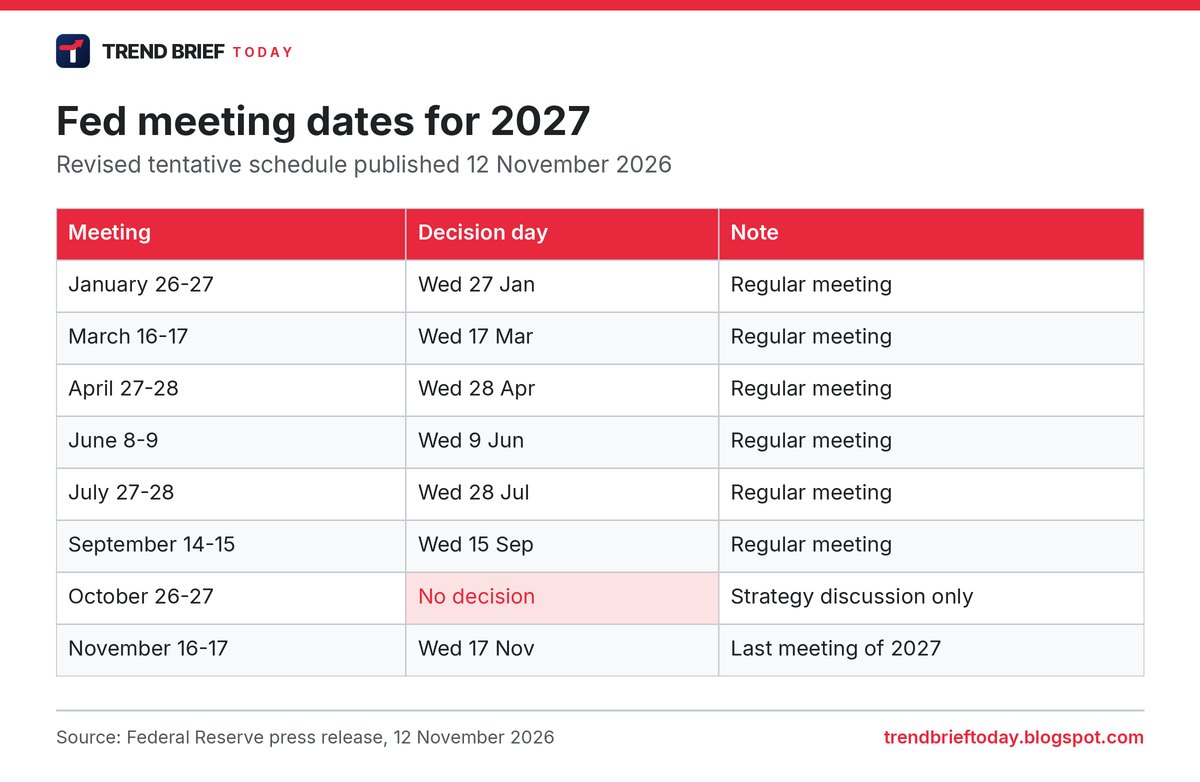
Fed meeting dates 2027
On 12 November the Fed published a revised tentative calendar for 2027. It has eight meetings, but only seven with a rate decision. The October 26-27 meeting "will be dedicated to the discussion of broad monetary policy strategy issues", with no policy announcement, and there is no December meeting at all.[3] The first meeting of 2028 is set for 25 and 26 January.[3]
| 2027 meeting | Decision day | Note |
|---|---|---|
| 26 and 27 January | Wednesday 27 January | First meeting after the December 2026 decision |
| 16 and 17 March | Wednesday 17 March | Goldman and Deutsche both expect a hike here[7] |
| 27 and 28 April | Wednesday 28 April | Regular meeting |
| 8 and 9 June | Wednesday 9 June | Regular meeting |
| 27 and 28 July | Wednesday 28 July | Regular meeting |
| 14 and 15 September | Wednesday 15 September | Regular meeting |
| 26 and 27 October | No decision | Strategy discussion only[3] |
| 16 and 17 November | Wednesday 17 November | Last decision of 2027[3] |
Frequently asked questions
Will the Fed raise interest rates in December 2026?
Markets expect it. CME FedWatch showed about a 91% chance of a 0.25 point hike and about 9% for 0.5 point on 16 November.[5][4] After the October minutes on 18 November the AP put the odds of a December hike near 95%,[15] and on 20 November CME FedWatch showed 96.8% for a quarter point and 3.2% for a half point.[18] The Fed itself has not committed.
What did the Fed minutes say?
The minutes of the 27 and 28 October meeting, released on 18 November, said almost all officials expect further rate rises to be appropriate, some wanted a hike already in October, and a couple said a move bigger than 0.25 point could be considered in December if inflation data are bad.[14][15]
When is the next Fed meeting?
8 and 9 December 2026, with the decision on Wednesday 9 December.[12][4]
What is the Fed interest rate now?
The target range is 3.75% to 4.00%, set in September 2026 and kept in October.[1][2]
What will the prime rate be after a December hike?
7.25% after a quarter point, or 7.50% after a half point, if banks keep prime 3 points above the top of the Fed range as they did in September.[9][1]
Will mortgage rates go up if the Fed raises rates?
Not automatically. Fixed rates follow bond yields, which already expect a hike, and the Freddie Mac 30-year rate has fallen from 7.40% to 7.11% since October.[11][8] Adjustable loans and HELOCs are more directly affected.
Why is the dollar so strong?
Bets on higher US rates, hot inflation data and safe-haven buying. The dollar index hit 103.50, its highest since April 2025.[4][7]
Is there a Fed meeting in December 2027?
No. The 2027 calendar ends with the 16-17 November meeting, and the next one is 25-26 January 2028.[3]
References
- "Open Market Operations: FOMC's target federal funds rate or range". Board of Governors of the Federal Reserve System. Retrieved 17 November 2026.
- "Federal Reserve issues FOMC statement" (28 October 2026). Board of Governors of the Federal Reserve System.
- "Federal Reserve announces revised tentative schedule of Federal Open Market Committee meetings in 2027" (12 November 2026). Board of Governors of the Federal Reserve System.
- "Dollar hits highest since April 2025 as Fed rate bets lend support" (17 November 2026). The Korea Times, via Reuters and Yonhap.
- Sherin Sans (16 November 2026). "Gold hits over one-year low on resilient dollar as hawkish Fed bets build". Reuters, via Zawya.
- "There's Now a 100% Chance of a Fed Rate Hike in December, but That's Not the Worst News for Wall Street" (16 November 2026). The Motley Fool.
- "Dollar climbs as traders raise December Fed hike bets" (11 November 2026). CNBC.
- "Treasury prices catch a small bid as stock market weakens and Warsh says AI might 'disappoint'" (16 November 2026). CNBC.
- Arasu Kannagi Basil (16 September 2026). "US banks raise prime rate after Fed decision". Reuters, via Kitco.
- "Consumer Credit, G.19". Board of Governors of the Federal Reserve System. Retrieved 17 November 2026.
- "Primary Mortgage Market Survey", weekly history to 12 November 2026. Freddie Mac.
- Austin Smith (13 November 2026). "What a December Rate Hike Would Mean for Your Savings, Your CD and Your Credit Card". Yahoo Finance.
- "Fed keeps interest rates unchanged, but two officials dissented in favor of a rate hike" (28 October 2026). CNN Business.
- "Minutes of the Federal Open Market Committee, October 27-28, 2026". Board of Governors of the Federal Reserve System. Released 18 November 2026.
- Rugaber, Christopher. "Fed minutes: Higher interest rates needed in December as inflation worries mount". Associated Press (via News4JAX). 18 November 2026.
- Reuters. "JP Morgan sees Fed rate hikes at next three meetings as inflation persists". Via The Standard (Hong Kong). 19 November 2026.
- "JPMorgan now expects Fed rate hikes at the next three meetings as Jefferson says the AI buildout is pushing up inflation". MLQ.ai. 19 November 2026.
- Reuters. "Gold Set for Worst Week in Eight Months as Firm Dollar, Fed Hike Bets Weigh". Via Asharq Al-Awsat. 20 November 2026.
- "A trader just placed a $11K bet against the Fed increasing rates by 25 bps in December 2026". Quiver Quantitative (Polymarket data). 19 November 2026.
- Estefano Gomez. "Bank of America forecasts Fed rate hikes in December 2026, January and March 2027". Crypto Briefing. 13 November 2026.
- "Deutsche Bank forecasts 3 straight Fed hikes through March". crypto.news (citing Reuters, 10 November). 10 November 2026.