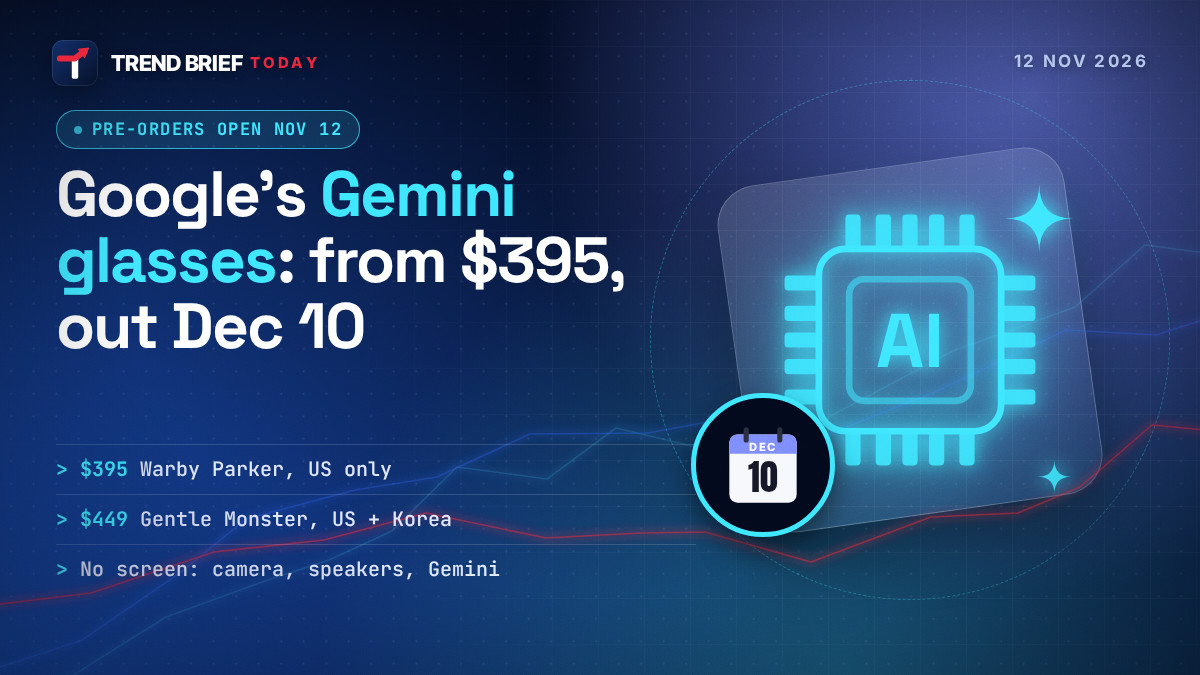
Google's first Gemini smart glasses went on pre-order on Thursday, November 12, 2026, and reach stores on December 10. Built by Samsung with frames from Warby Parker and Gentle Monster, they start at $395 (Warby Parker, US only) and $449 (Gentle Monster, US and South Korea). There is no screen: you talk to Gemini through open-ear speakers, and a 12-megapixel camera lets it see what you see.[1][2][3] They work with the iPhone 13 Pro or newer, the Pixel 7 or newer and Samsung Galaxy S or Z phones on One UI 9, but not with most other Android phones.[2][4]
 | |
| Made by | Samsung (hardware), Google (software), Warby Parker and Gentle Monster (frames)[1][4] |
|---|---|
| Pre-orders | Opened November 12, 2026[1][3] |
| In stores | December 10, 2026[1][2] |
| Price | From $395 (Warby Parker), from $449 (Gentle Monster)[1][5] |
| Markets | US; Gentle Monster also in South Korea[1][2] |
| Display | None; audio and camera only[2][4] |
| Battery | Up to 9 hours, case gives about 7 recharges[1][4] |
| Phones | iPhone 13 Pro+, Pixel 7+, Galaxy S/Z on One UI 9+[2][4] |
| Rival | Meta's Ray-Ban glasses[4][5] |
What Google launched
Google calls the product "Intelligent Eyewear". Shahram Izadi, the vice president and general manager who runs Google's XR unit, announced on Thursday that pre-orders were open on the Gentle Monster, Warby Parker and Google Store websites, with the glasses arriving in stores on December 10.[1][5] It is Google's second try at smart glasses after Google Glass, and the first pair built around its Gemini AI assistant.[2][3]
The work is split three ways. Samsung engineered the hardware, Google wrote the software, and the two eyewear brands designed the frames and will sell them, much as Meta teamed up with Ray-Ban for its glasses.[2][4] WIRED reports that the eyewear brand you buy from will handle customer service, including prescription problems.[4] Kering Eyewear, which owns brands such as Lindberg and Maui Jim, has also signed up to make Android XR glasses later, according to WIRED.[4]
These are not augmented reality glasses. There is no display in the lenses. Google has shown a version with a built-in display, but it is still being tested and has no release date.[4] The ones on sale now are closer to a pair of wireless earbuds with a camera, a microphone array and Gemini attached.[2][3]
Price: $395 is only the start
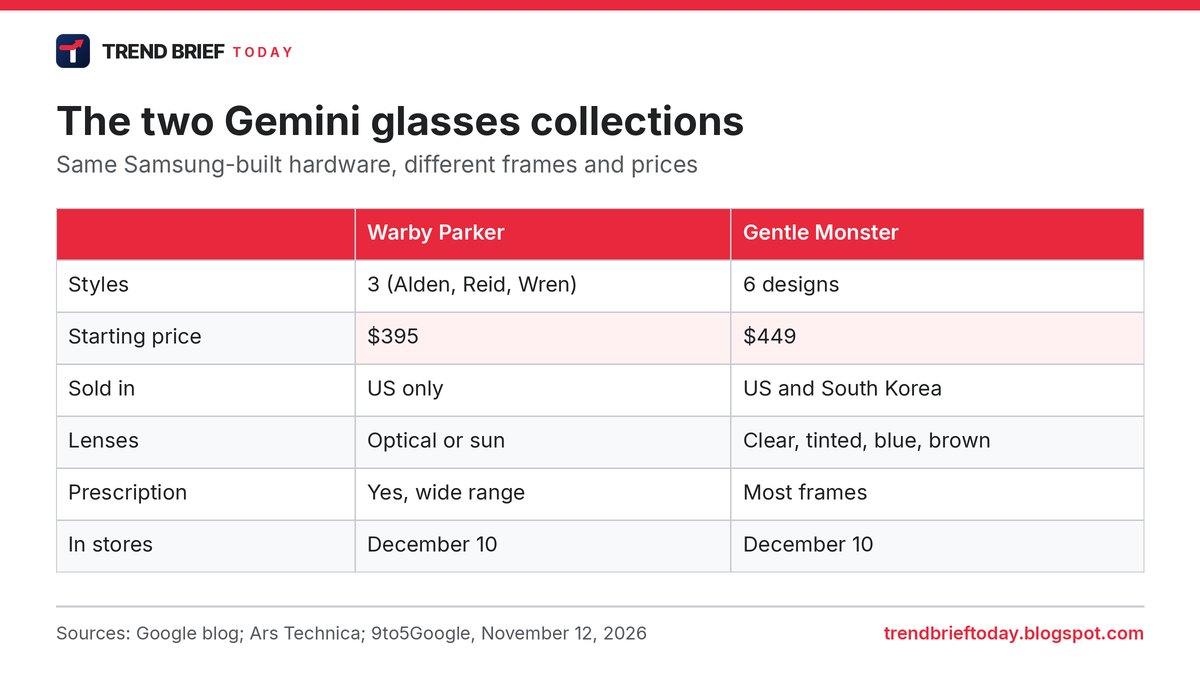
Warby Parker's collection has three frames, called Alden, Reid and Wren, in Pine, Saddle and Jet Black, as optical glasses or sunglasses from $395. Warby Parker sells them only in the US and offers guided demos in more than 360 of its stores.[1][3] Gentle Monster's collection has six bolder designs in colours such as dark red, pink, grey and yellow, starting at $449, and is sold in the US and South Korea.[1][2] The Next Web puts the Gentle Monster range at $449 to $489.[5]
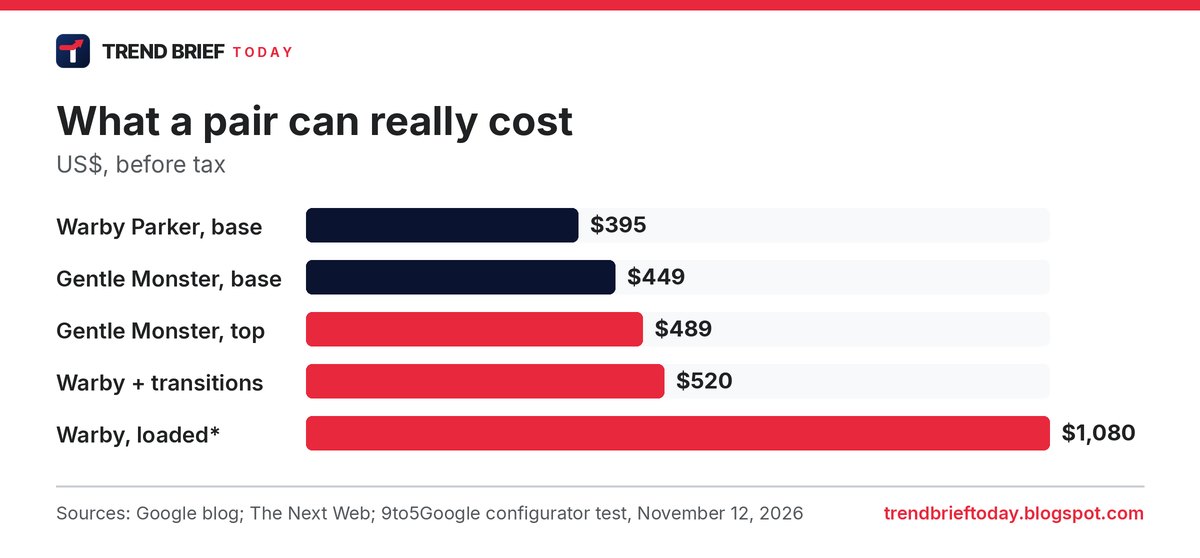
The headline prices are for non-prescription lenses. 9to5Google went through Warby Parker's online builder and found that prescription lenses add at least $100, transition lenses take a basic pair to $520, and a progressive, polarized build with thinner lenses and an anti-reflective coating came to $1,080.[6] That last figure is one outlet's test, not a list price, but it shows how quickly the bill grows for people who need strong prescriptions.
For comparison, The Next Web notes that Meta, which shipped 81% of AI glasses in the first half of the year by its count, sells its own-brand glasses from $299.[5] WIRED says Google's frames are about 10 grams lighter than Meta's new Gen 3 glasses.[4]
What the glasses can do
You wake Gemini by saying "Hey Gemini", a new wake word that debuts on these glasses, or by tapping the frame. Swiping along the temple changes the volume.[3][4] Google says you can ask about a mural you are walking past, get a book suggestion from a shelf, look at an event poster to check your calendar, or ask Gemini to add what you are looking at to a shopping list.[1]
- Directions. Google Maps gives turn-by-turn walking directions in your ear.[1][3]
- Translation. Google Translate offers real-time speech translation across more than 70 languages.[1][3]
- Music and calls. YouTube Music, Spotify, Apple Music and Audible play through two open-ear speakers, and you can take calls and reply to messages.[1][8]
- Photos and video. A button captures photos and videos of up to 90 seconds at up to 3K resolution.[4][8]
- Guided Vision. Gemini can describe surroundings for people who are blind or have low vision, and an Aira option connects the camera feed to a trained human interpreter.[1] Google's small print says Guided Vision works when the glasses are paired with compatible Android phones.[7]
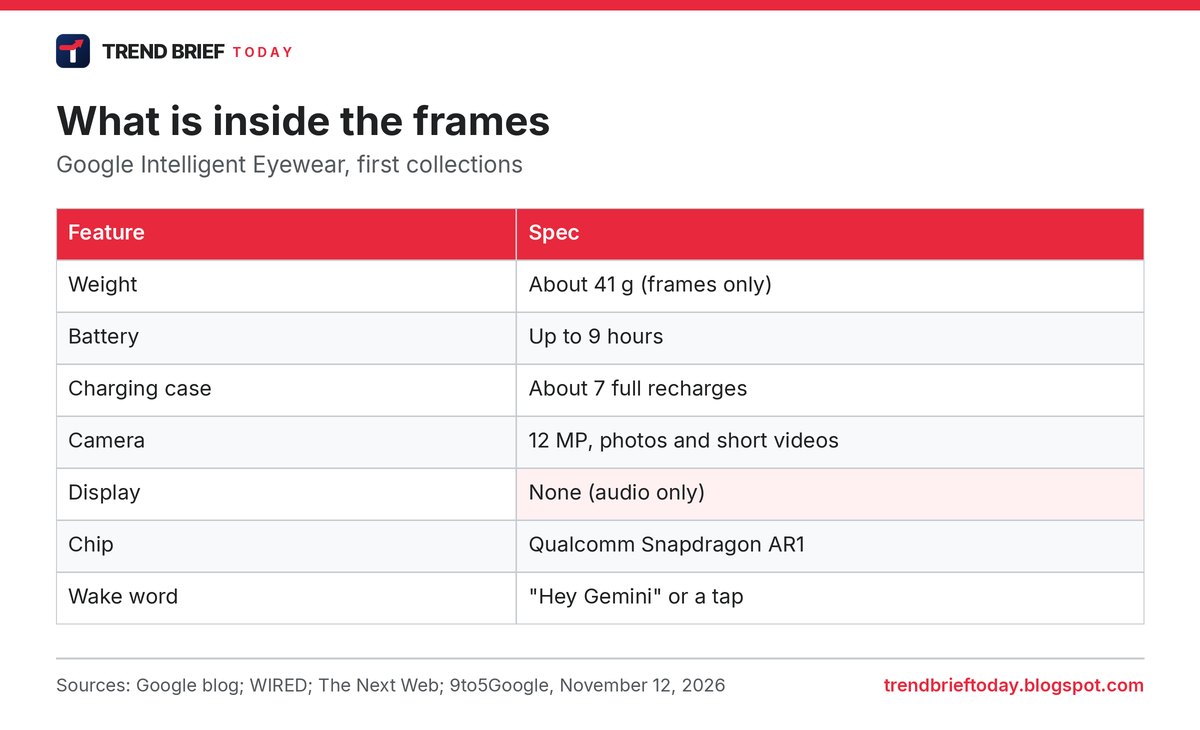
The hardware is the same in both collections: frames of about 41 grams before lenses, up to nine hours of battery life and a charging case that refills the glasses about seven times.[1][4] 9to5Google lists the frame weight at 40 to 44 grams depending on style, and The Next Web and 9to5Google both say they run on Qualcomm's Snapdragon AR1 chip.[3][5]
Ars Technica's reviewer adds a fair warning: the whole product depends on Gemini, which still gets simple things wrong, and with no screen it is harder to check what the assistant did.[2]
Which phones work with them?
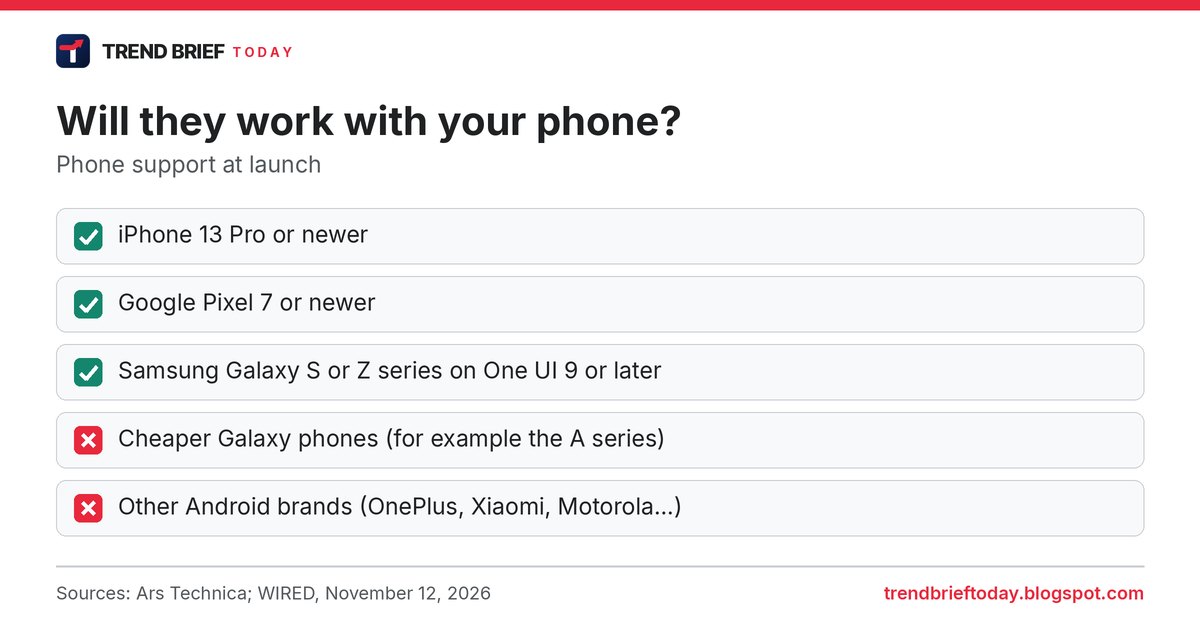
Support is narrow at launch. The glasses work with every iPhone from the 13 Pro onward, Google's Pixel 7 or newer, and Samsung Galaxy S or Z series phones running One UI 9 or later. Cheaper Galaxy phones and other Android brands are not supported yet.[2][4] A Google spokesperson told WIRED the company will share more about plans to support other phones in 2027.[4]
On iPhone, 9to5Google reports that Google's Glasses companion app has Made for iPhone certification, saves photos and videos to Apple Photos, and lets Gemini make calls and send one-to-one messages, including iMessage.[8] That makes this the rare Google gadget aimed squarely at iPhone owners too.
Privacy: Google's answer to the "creep" problem
Smart glasses with cameras have a privacy problem, and Google spent much of its launch on it. In a separate blog post, Izadi wrote that protections must cover "both the person behind the lenses and those in front of them".[7]
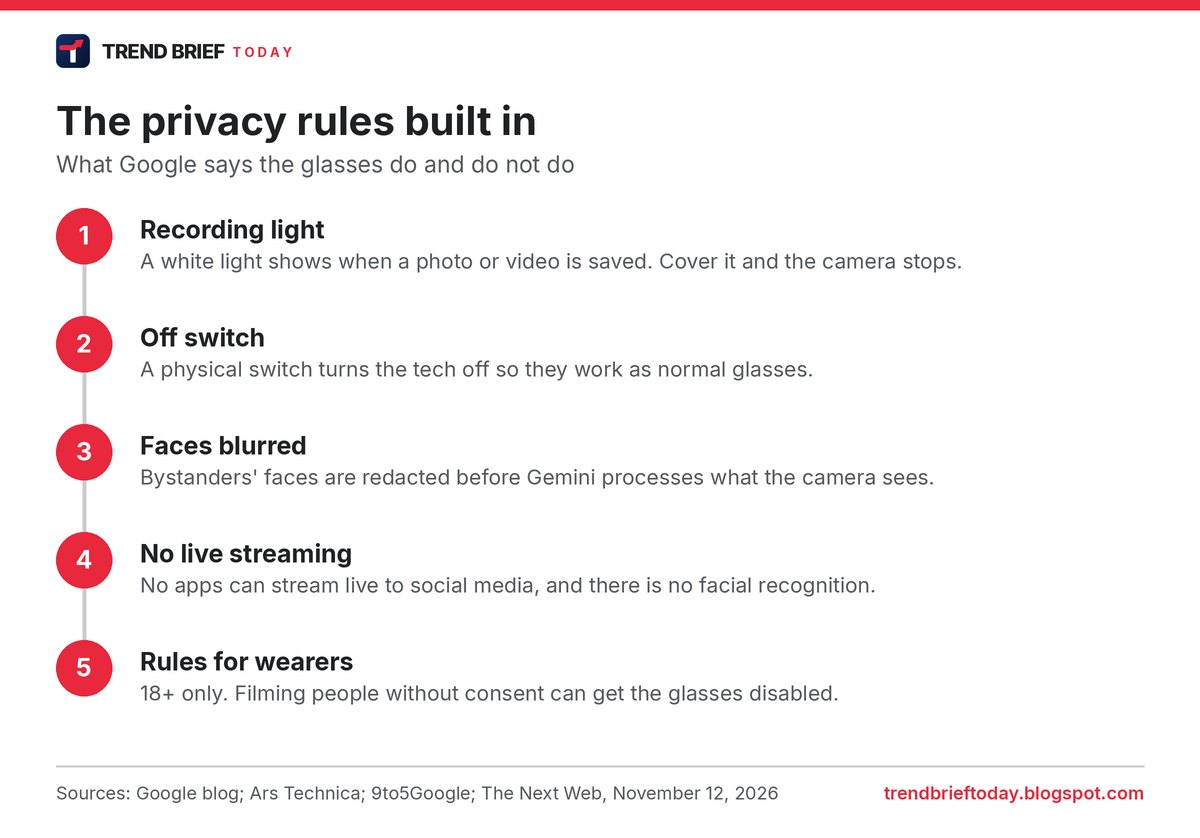
A white light shows when the glasses save a photo or video. If the light is covered or tampered with, the camera will not record, and Google says it runs a hardware check when the glasses charge.[2][3] Each pair has a physical off switch so it can be worn as ordinary glasses.[2][3] When Gemini uses the camera to answer a question, Google says faces of bystanders are redacted before processing, those images are not saved to Gemini history, and they are not used to train AI or to target ads.[3][7]
There are rules for wearers too. Users must be 18 or over and agree not to record people without consent or in sensitive places; Google says it may remotely disable glasses that break those terms.[2][5] Ars Technica reports that no Play Store app may live stream video from the glasses to social media, and real-time facial recognition is off the table.[2] The Next Web adds that Google has banned stickers sold to cover recording lights from its shopping and ad platforms, after Meta's light was beaten by a cheap sticker.[5]
Should you pre-order?
- Good fit: you already use Gemini, own a supported Pixel, Galaxy S or Z, or a recent iPhone, and want hands-free help, directions, translation and music without a screen.
- Wait: you need a strong or progressive prescription and want to see final prices first, you own an unsupported Android phone, or you want a display in the lens. Google has not given a date for display glasses.[4]
- Try first: Warby Parker offers in-store demos, and The Next Web says some Google and Samsung stores will have demos too.[1][5]
Read also: our guide to Gemini Live on Apple CarPlay, the other big Gemini rollout this week.
Frequently asked questions
How much are the Google Gemini glasses?
From $395 for Warby Parker frames and from $449 for Gentle Monster frames, with non-prescription lenses. Prescription and lens upgrades cost more.[1][2][6]
When do Google's smart glasses come out?
Pre-orders opened on November 12, 2026, and the glasses reach stores on December 10, 2026.[1][3]
Do the Google glasses have a screen?
No. This first collection is audio only, with a camera, microphones and speakers. Display glasses are still in testing.[2][4]
Do the Google Gemini glasses work with iPhone?
Yes, with the iPhone 13 Pro or newer, through Google's Glasses companion app.[2][8]
Can I buy them outside the US?
Only in South Korea, and only the Gentle Monster collection. Warby Parker's collection is US only.[1][2]
References
- Izadi, Shahram. "See our intelligent eyewear lineup and pre-order your pair". Google (The Keyword). November 12, 2026. blog.google
- "Google pushes privacy angle as Gemini-powered smartglasses debut starting at $395". Ars Technica. November 12, 2026. arstechnica.com
- Li, Abner. "Google launches Intelligent Eyewear glasses: $395+, pre-order today, ships Dec. 10". 9to5Google. November 12, 2026. 9to5google.com
- "Google and Samsung's Android XR Smart Glasses Are Finally Here". WIRED. November 12, 2026. wired.com
- "Google and Samsung's Gemini smart glasses go on preorder from $395". The Next Web. November 12, 2026. thenextweb.com
- Schoon, Ben. "The price of your Android XR glasses can quickly skyrocket with add-ons". 9to5Google. November 12, 2026. 9to5google.com
- Izadi, Shahram. "Designing for privacy on intelligent eyewear". Google (The Keyword). November 12, 2026. blog.google
- Li, Abner. "Google's new Android XR glasses work with iOS, Made for iPhone certified". 9to5Google. November 12, 2026. 9to5google.com