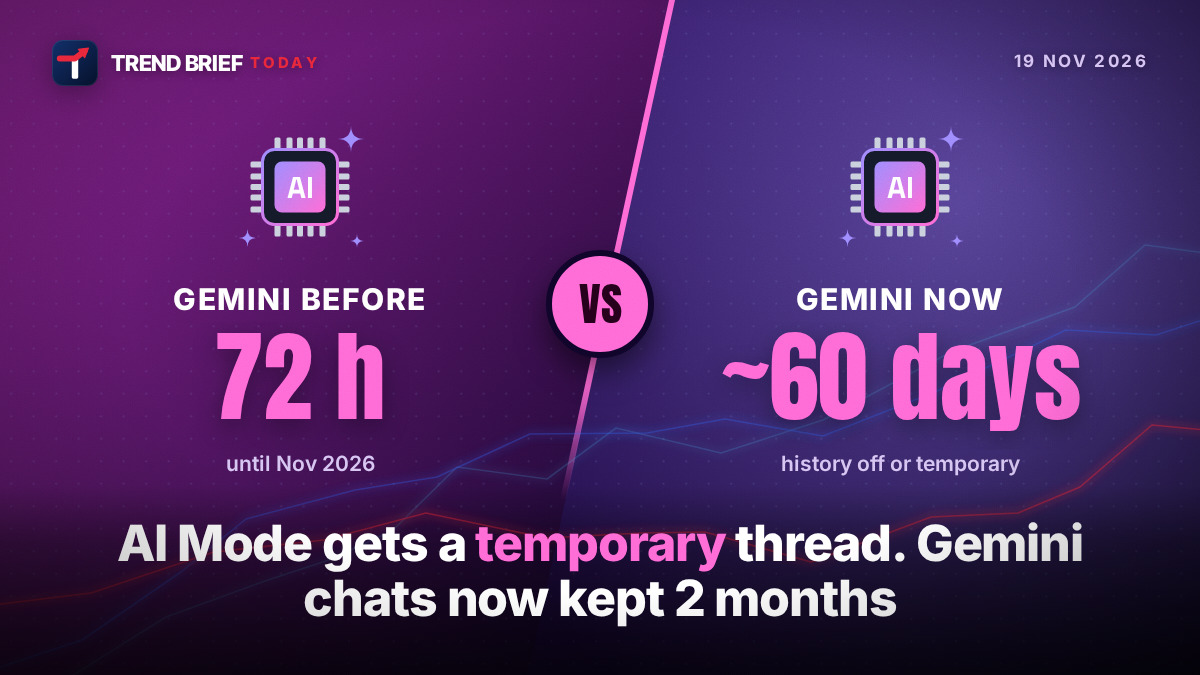
Google Search now has its own version of incognito for AI. Since November 17, 2026, AI Mode lets you open a "temporary thread": a conversation that stays out of your search history, ignores your past preferences and does not shape what Google recommends to you later.[1][2] The same week, Google quietly changed the Gemini app's privacy rules so that temporary chats, and chats you have with history switched off, are kept with your account for around two months instead of 72 hours.[3][4] Below: how to start a temporary thread, what it does and does not hide, and what the new two month rule means in plain numbers.
 | |
| What it is | A private, one-off conversation in Google Search's AI Mode[1] |
|---|---|
| Launched | November 17, 2026, rolling out worldwide[2] |
| Where | Desktop and mobile browsers, all AI Mode languages[1][2] |
| How to start | Dotted pen icon, top right of AI Mode[2] |
| Saved to history? | No, and it cannot be reopened after you close it[2] |
| Server retention | Not published by Google for AI Mode[5] |
| Gemini temporary chats | Kept around 2 months, up from 72 hours[3][4] |
| Used for AI training? | Gemini temporary chats: no[3] |
What is a temporary thread in AI Mode?
AI Mode is the chat-style tab inside Google Search, the one that writes you an answer instead of handing you ten blue links. Until this week it had no private option. Gemini, ChatGPT and Claude all let you start a throwaway chat, but if you were deep in a conversation in Search, everything you asked was tied to your account and your history.[1]
A temporary thread changes that. According to Google, as reported by TechCrunch, once you start one the session is "detached" from your account. The answers will not use your past preferences, and nothing in the thread feeds into future personalization.[1] 9to5Google puts it more simply: the thread will not appear in your conversation history, it will not influence future recommendations, and after you close it "there's no way to access it again."[2]
Who is this for? Think of the questions you would rather not have following you around. A medical symptom. A gift for your partner who shares the laptop. Debt, a divorce, a job you are thinking of leaving. Or just a one-off topic you do not want Google to decide is now one of your interests. TechCrunch makes exactly that last point: a temporary thread is useful when you want to learn about something once without Google treating it as a new main interest.[1]
It matters because of scale. Google's chief executive Sundar Pichai said at Google I/O in May 2026 that AI Mode had passed 1 billion monthly users, as Tech Times notes.[5] A setting that hides questions from personalization for that many people is not a small tweak.
How to start a temporary thread
You do not need to change any settings. The button is right there in AI Mode.[1]
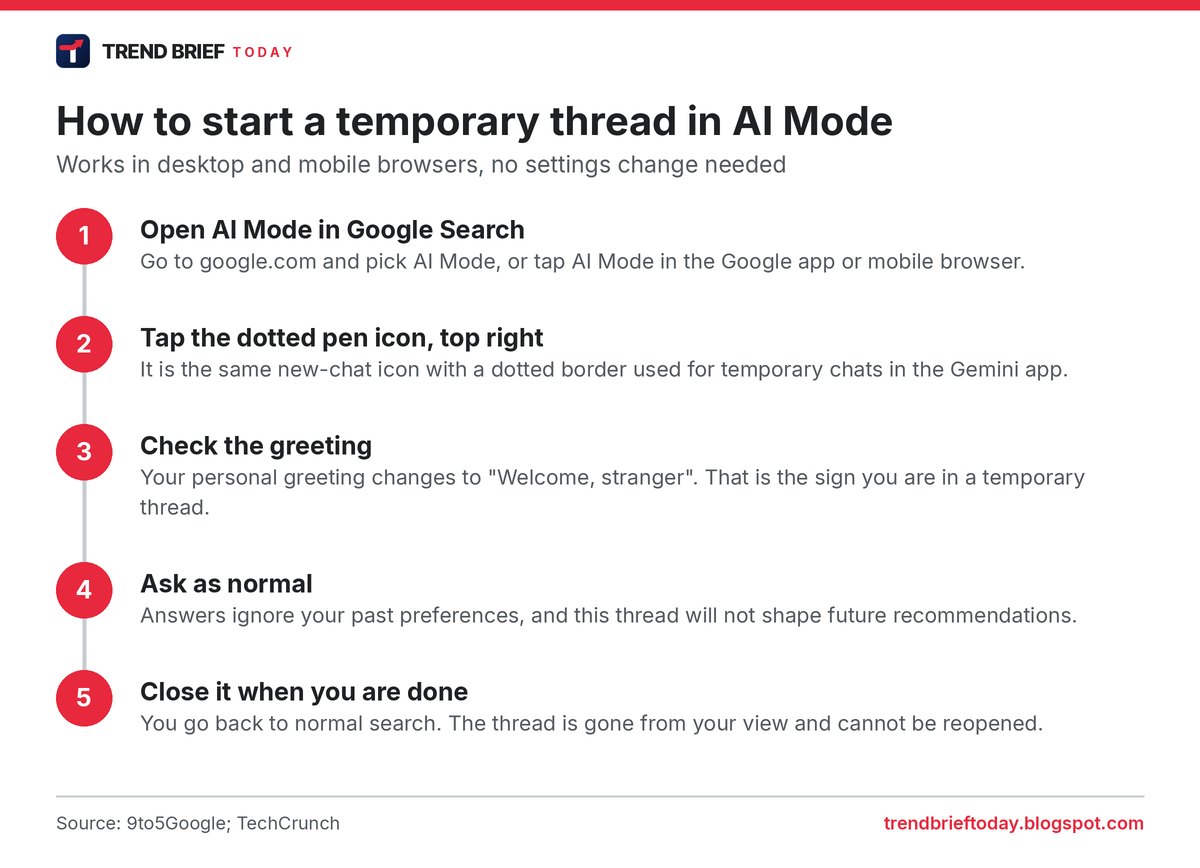
A couple of details from using it are worth knowing. The icon is a pen with a dotted border, the same one Gemini uses for its temporary chats, and the greeting at the top of the prompt box changes to "Welcome, stranger" so you can see at a glance that you are in private mode.[2] You can still use the model picker, which is the main reason to use this instead of simply opening google.com in a Chrome incognito window.[2] And when you close the thread you drop back into normal search with your history and personalization switched back on.[1]
One practical warning. Because the thread cannot be reopened, copy any answer you want to keep before you close it. There is no "recently closed" list to fall back on.[2]
The Gemini change: "temporary" now means about two months
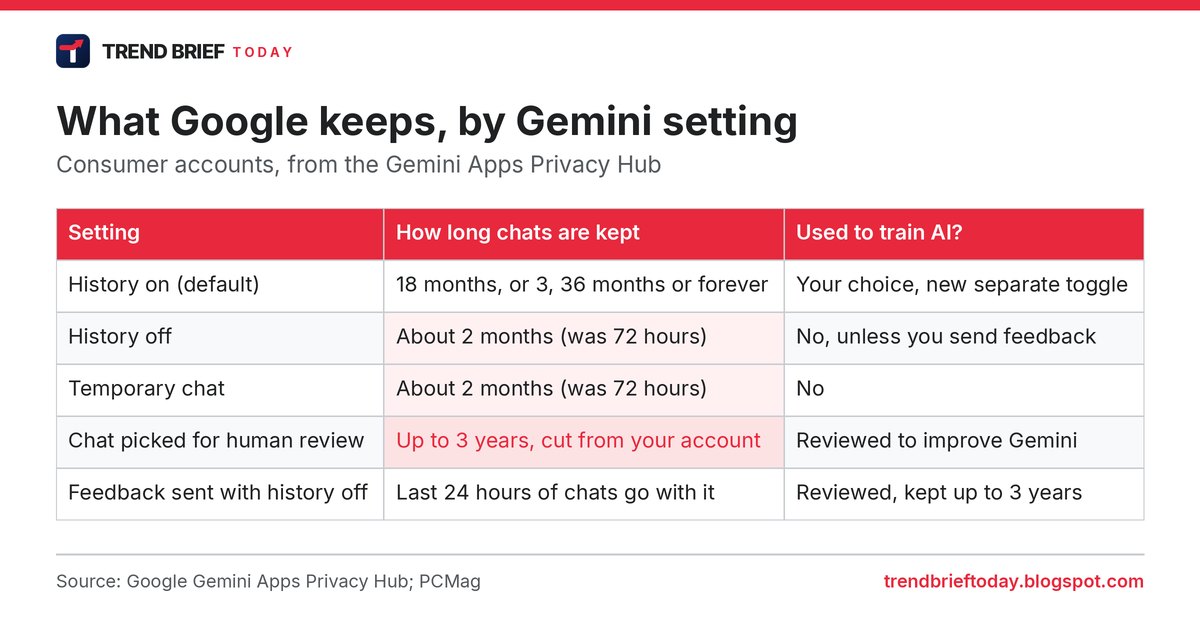
Here is the part that got less attention. In the same week, Google rewrote the retention rules for the Gemini app. Its Gemini Apps Privacy Hub, last updated November 17, 2026, now says temporary chats, and chats you have with your History setting turned off, "are retained with your account for around two months."[3] Before this change the figure was 72 hours.[4][5]
Google gives three reasons on the page. The chats are used to respond to you, using the last 24 hours of your chat as context; to process feedback; and to "help protect Google, our users, and the public." It also gives one concrete example: Google stores chats with your account for around two months "so they are available in case of a potential system failure."[3] In an email to users, quoted by PCMag, Google added that this is done "with help from human reviewers."[4]
What Google has not done is explain why the window grew from three days to roughly sixty. Yahoo Tech called it "disconcerting" that the company has not said why it is dramatically increasing chat storage.[7] Tech Times reports that Google framed the change as improving "safety and security as AI systems become more capable" and did not say what prompted it.[5]
There is good news in the same update. Google is splitting its old "Keep Activity" switch into two separate controls: one for whether your chats are saved in history, and one for whether your chats are used to train generative AI models.[4] For the first time you can keep your Gemini history and still say no to training. People who had Keep Activity turned off will find both new settings off by default.[5] Engadget also reports that Gemini now shows a "memory summary" you can read and edit line by line in settings.[6]
What two months actually means: our numbers
"Around two months" sounds vague, so we turned it into numbers. We use 60 days as a round figure; Google does not give an exact day count.[3]
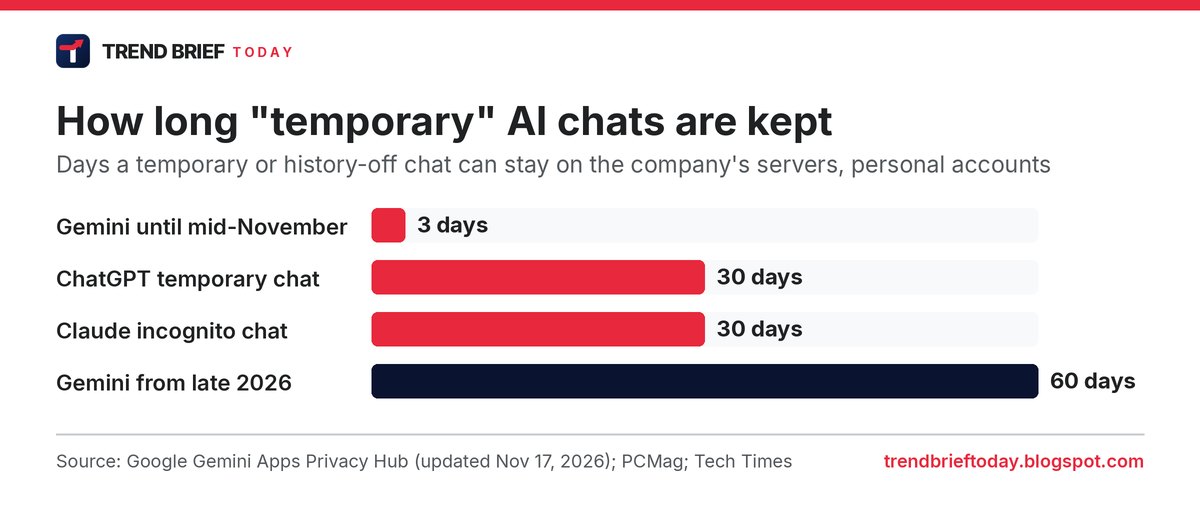
It is 20 times longer than before. The old window was 72 hours. Sixty days is 1,440 hours. 1,440 divided by 72 is 20. A history-off Gemini chat now lives with your account twenty times as long as it did a fortnight ago.
It is about double the main rivals. PCMag and TechCrunch report that OpenAI keeps temporary ChatGPT chats for up to 30 days, and Anthropic keeps Claude's equivalent for 30 days on personal accounts.[4][5] Gemini's two month figure is now the longest of the three, PCMag notes.[4]
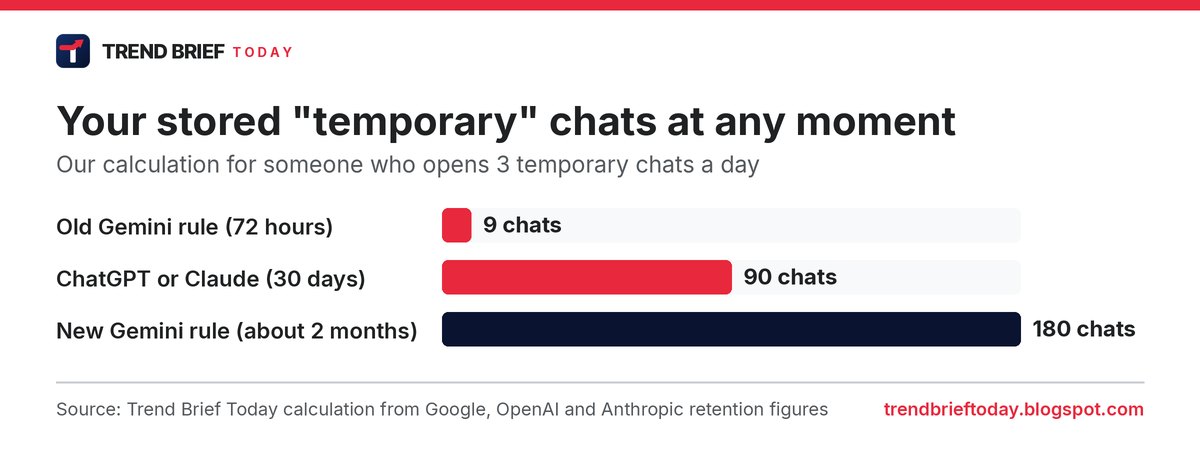
It changes how much is sitting there at any moment. The number of stored chats at a given time is roughly chats per day multiplied by days kept. Take someone who opens three temporary chats a day, which is not a heavy user. Under the old 72 hour rule, about 9 of those chats existed on Google's side at any moment. Under a 30 day rule like ChatGPT's it would be about 90. Under the new Gemini rule it is about 180.
Dates make it concrete. A temporary Gemini chat started today, November 19, 2026, would be held until roughly January 18, 2027 under a 60 day reading. If that chat happens to be one of the subset picked for human review, Google says reviewed chats are kept for up to three years, separated from your account.[3] Three years from today is November 2029.
| Rule | Hours a chat is kept | Chats stored at once (3 a day) |
|---|---|---|
| Old Gemini (72 hours) | 72 | 9 |
| ChatGPT or Claude (30 days) | 720 | 90 |
| New Gemini (about 60 days) | 1,440 | 180 |
| Human-reviewed chat (up to 3 years) | About 26,300 | Only chats picked for review |
Our calculation from figures in Google's Privacy Hub and in PCMag's report.[3][4] Three years is counted as 1,096 days.
Does the two month rule apply to AI Mode too?
This is the honest answer: nobody outside Google knows yet. The Gemini Privacy Hub does not mention AI Mode, and neither TechCrunch report gives a retention period for Search.[5] Google's own descriptions also point in slightly different directions. An AI Mode temporary thread is described as "detached" from your account.[1] A Gemini temporary chat, by contrast, is "retained with your account for around two months."[3]
So the fair reading, until Google publishes a number for Search, is this: a temporary thread is hidden from you and from personalization. Whether it is gone from Google's servers, and when, has not been stated.[5] Tech Times draws the same line, calling a temporary thread "hidden, not erased" until Google says otherwise.[5] Work and school accounts may follow different rules set by the account administrator.[5]
What a temporary thread hides, and what it does not
It helps to think of privacy here in three layers.[5]
| Layer | Temporary thread or chat | Source |
|---|---|---|
| Your visible history | Hidden. Not saved, cannot be reopened | [1][2] |
| Personalization and recommendations | Off. Past preferences ignored, nothing new learned | [1] |
| Training Google's AI models | Gemini temporary chats are not used for training | [3] |
| Storage on Google's servers | Gemini: around 2 months. AI Mode: not published | [3][5] |
| Human review | Possible for safety; reviewed chats kept up to 3 years | [3][4] |
| Your network, school or employer | Not hidden. Same as normal browsing | [5] |
The first two layers are what most people mean when they say "private," and the feature handles those well. The last three are where the word "temporary" can mislead. If you send feedback with History off, Google also collects the last 24 hours of your chats as context, and reviewed feedback is kept for up to three years.[3]
We have seen this before with Chrome incognito
Google has history with this kind of gap between the label and the storage. Chrome's incognito mode was always clear that websites, employers and internet providers could still see your activity, but many users assumed "private" meant invisible. That gap ended in a class action, which Google settled in December 2023, and Google later pledged to delete billions of data records.[5] No lawsuit has been reported over AI Mode temporary threads. The lesson is just that the documentation, not the name of the button, tells you what is kept.
Should you use it?
Yes, for what it is good at. If the goal is keeping a question out of your history and out of the ads and suggestions Google shows you later, a temporary thread does that with one tap.[1] It is a cleaner choice than logging out or opening a separate incognito window, and you keep the model picker.[2]
But do not treat it as a shredder. Our own rule after reading the Privacy Hub: anything you would not want a reviewer to read should not go into any AI chat, temporary or not. Google's page says it plainly: "Please don't enter confidential information that you wouldn't want a reviewer to see."[3] That means passwords, bank and card numbers, full medical records, client data and anything covered by a work confidentiality agreement.
And if training is your main worry, the more useful change this month is probably the new Gemini toggle that lets you turn off AI training while keeping your history.[4] Check it in Gemini settings once the rollout reaches your account.
Timeline
| Date | Event | Ref |
|---|---|---|
| December 2023 | Google settles the Chrome incognito tracking class action | [5] |
| May 19, 2026 | Pichai says AI Mode has passed 1 billion monthly users | [5] |
| November 12, 2026 | Archived Gemini Privacy Hub still says 72 hours | [5] |
| November 17, 2026 | AI Mode temporary threads start rolling out; Privacy Hub updated to around two months | [2][3] |
| November 17, 2026 | Gemini memory summary becomes viewable and editable | [6] |
| November 18, 2026 | Google emails users about the History and training split | [4][7] |
| Coming weeks | Gemini retention change reaches all accounts | [4] |
Frequently asked questions
How do I turn on incognito in Google AI Mode?
Open AI Mode and tap the pen icon with a dotted border in the top right corner. The greeting changes to "Welcome, stranger" when the temporary thread is on.[2]
Are AI Mode temporary threads saved?
They are not saved to your history and cannot be reopened after you close them.[2] Google has not published how long it keeps them on its servers.[5]
How long does Google keep Gemini temporary chats?
Around two months, according to the Gemini Apps Privacy Hub updated November 17, 2026. It was 72 hours before.[3][4]
Does Google train its AI on temporary chats?
For Gemini, no. Google says temporary chats are not used to train its AI models.[3]
Can a human at Google read my Gemini chats?
A subset of chats is reviewed by trained reviewers, including outside service providers. Reviewed chats are separated from your account and kept for up to three years.[3]
How does this compare with ChatGPT and Claude?
OpenAI keeps temporary ChatGPT chats for up to 30 days and Anthropic keeps Claude's for 30 days on personal accounts, so Gemini's new window is about twice as long.[4]
Is it available in the UK, Canada and Australia?
Yes. Temporary threads are rolling out globally in every language AI Mode supports.[1][2]
References
- Sarah Perez, "Google's AI feature in Search gets its own incognito mode", TechCrunch, November 18, 2026.
- Abner Li, "Google AI Mode rolling out temporary threads", 9to5Google, November 17, 2026.
- Google, "Gemini Apps Privacy Hub", Gemini Apps Help, last updated November 17, 2026 (read November 19, 2026).
- Jibin Joseph, "Google to save Gemini chats for 2 months, even with history turned off", PCMag, November 18, 2026.
- Jackie Manning, "Google AI mode temporary threads launch with no stated retention; Gemini chats now kept 2 months", Tech Times, November 19, 2026.
- Ian Carlos Campbell, "You can now see and edit what Google Gemini remembers about you", Engadget, November 17, 2026.
- Devesh Beri, "Google Will Hang on to Your Gemini Chats for 2 Months, Even With History Toggled Off", Yahoo Tech, November 18, 2026.