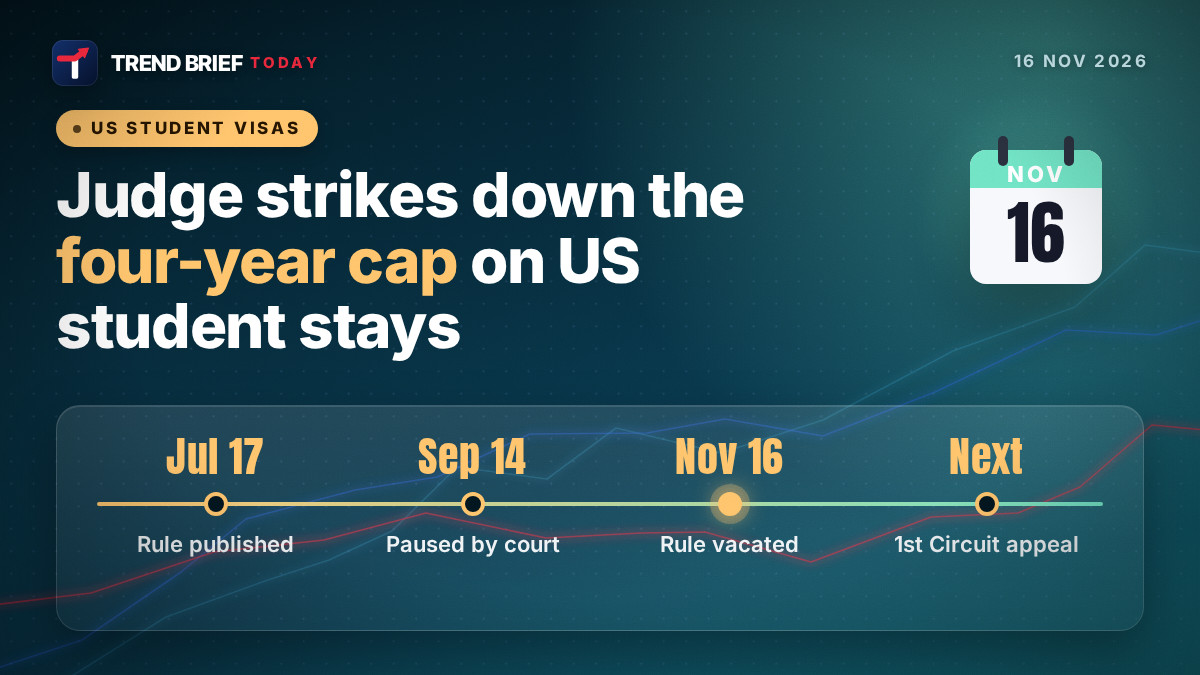
A federal judge has struck down the Trump administration's rule that would have ended "duration of status" for international students. On Monday 16 November 2026, Judge F. Dennis Saylor IV in Massachusetts vacated the Department of Homeland Security (DHS) rule that would have capped F-1 and J-1 stays at four years.[1][2][3] For now, students can stay for the length of their program, as they could before.[2][5]
 | |
| Rule | Fixed time period of admission for F, J and I visa holders[4][5] |
|---|---|
| Published | 17 July 2026[4][5] |
| Due to start | 15 September 2026 (never took effect)[4][6] |
| Case | Presidents' Alliance on Higher Education and Immigration v. DHS, No. 1:26-cv-13799[5][6] |
| Court | U.S. District Court, District of Massachusetts[1][2] |
| Judge | F. Dennis Saylor IV[1][3] |
| Ruling | Rule vacated, 16 November 2026[1][2][3] |
| Status now | Duration of status stays in place[1][2] |
What the judge decided
Judge Saylor vacated the rule, which means it is thrown out completely rather than paused.[1][3] Inside Higher Ed says the decision settles the question at the district court level.[1] AFP reports that he called the policy "arbitrary, capricious, an abuse of discretion, and otherwise not in accordance with law", the standard wording for a rule that breaks the Administrative Procedure Act.[3][2]
The judge also went further than process. He found that the limits on study went beyond what Congress allowed DHS to do. "The statute simply does not grant DHS such broad and open-ended authority to undermine the F-1 visa program," he wrote.[1][2] In another line quoted by both Inside Higher Ed and AFP, he said DHS was "seeking to prevent or discourage the very activity" that the student visa exists to allow.[1][3]
The case was brought in the summer of 2026 by a coalition led by NAFSA, the Presidents' Alliance on Higher Education and Immigration and AICUM, together with unions including the American Federation of Teachers, the UAW and the NewsGuild-CWA.[2][3]
What the rule would have changed
For decades, most international students have been admitted for "duration of status", written D/S on their records. It lets a student stay as long as they are enrolled and making progress toward their degree, with no fixed end date from immigration officials.[1][2] The July 2026 rule would have replaced that with a fixed stay.[4][5]
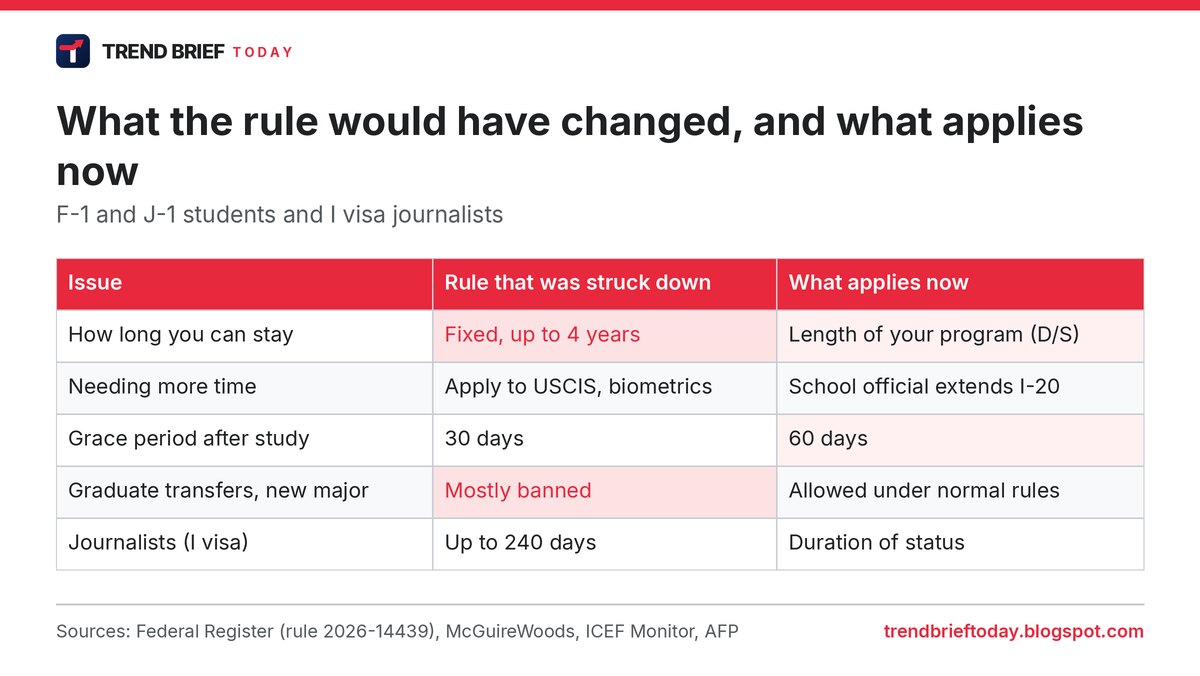
| Topic | Under the rule | What applies now |
|---|---|---|
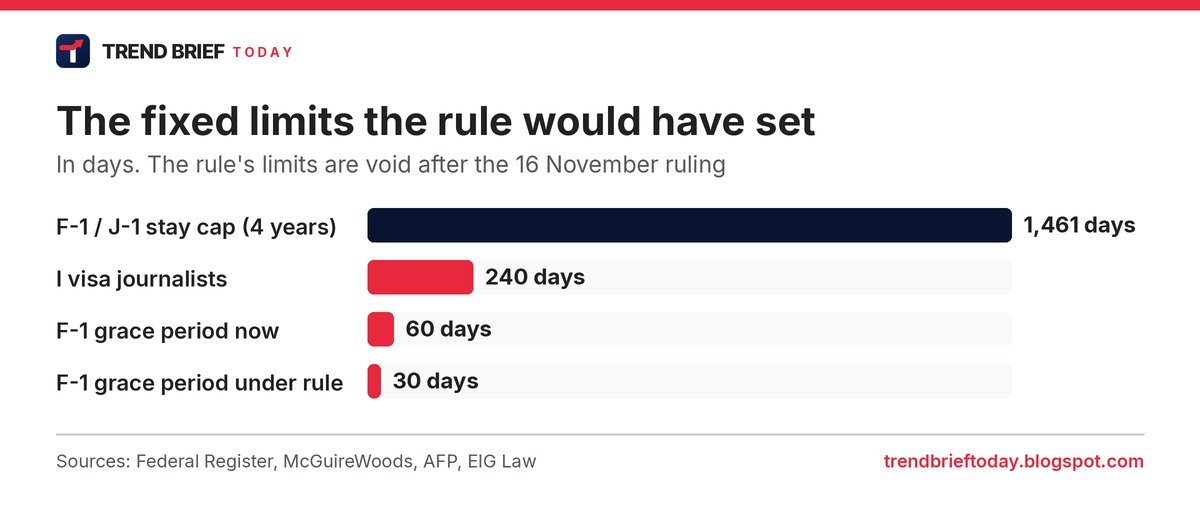
| Length of stay (F-1, J-1) | Program length, but no more than 4 years[4][5] | Duration of status[1][2] |
| Extra time | Extension of stay from USCIS on Form I-539, with possible biometrics[4][5] | Program extension through the school's DSO[2] |
| Grace period after study or OPT | 30 days[4][5] | 60 days[4][5] |
| Graduate transfers and changes of major | Barred in most cases[4][5] | Allowed under the normal rules[2] |
| Foreign journalists (I visa) | Up to 240 days[3][4][6] | Duration of status[2][3] |
The four-year cap was the part that worried universities most. AFP and Inside Higher Ed both note that it would have hit long courses such as PhD programs and joint degrees, and that it would have stopped students changing their academic concentration.[1][3]
Timeline
| Date | Event | Effect |
|---|---|---|
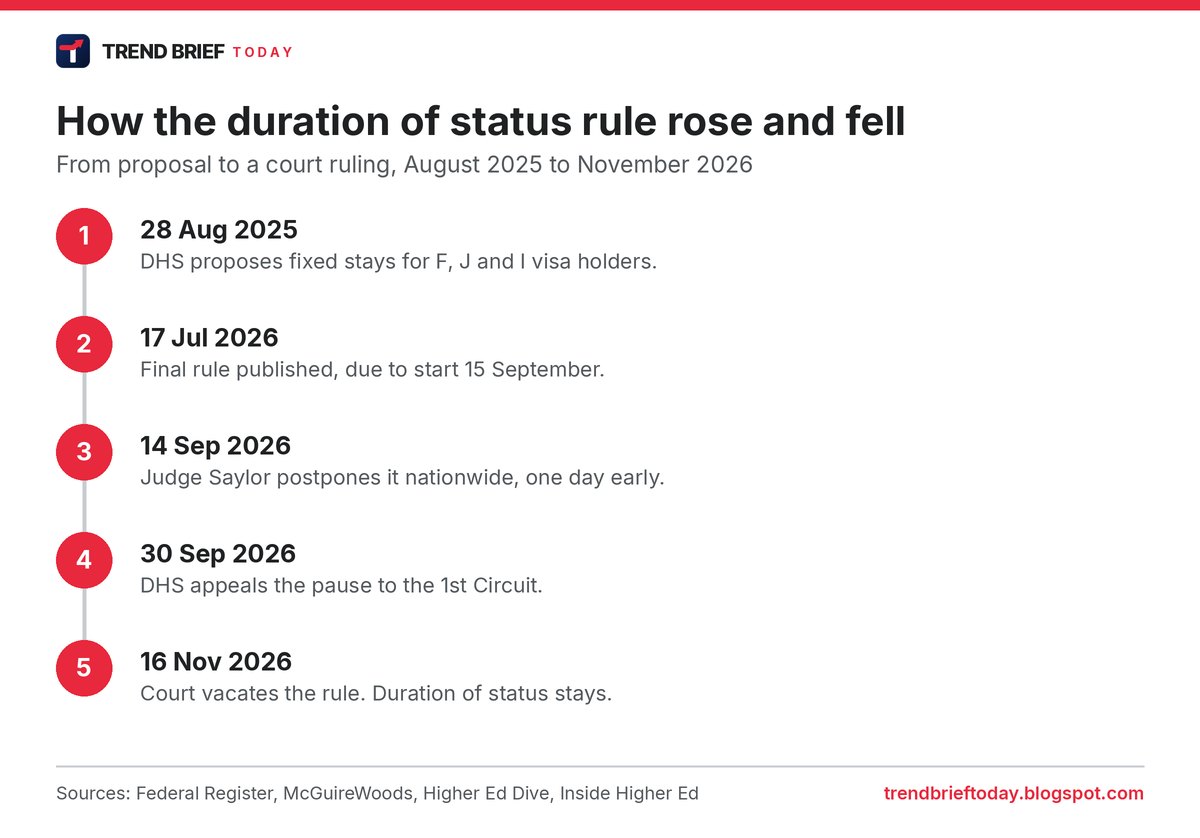
| 28 August 2025 | DHS publishes the proposed rule[4][9] | Public comment opens |
| 17 July 2026 | Final rule published in the Federal Register[4][5] | Start date set for 15 September[4][6] |
| August 2026 | Education groups and unions sue[1][2] | Case filed in Massachusetts[1][6] |
| 14 September 2026 | Saylor postpones the rule nationwide[5][8] | Rule never takes effect[6][8] |
| Late September 2026 | DHS appeals the postponement[7][1] | Case goes to the 1st Circuit[7][1] |
| 16 November 2026 | Saylor vacates the rule[1][2][3] | D/S stays in place[1][2] |
Why the court threw it out
The government argued that duration of status let students stay with little contact with immigration officials, which it linked to overstays and national security risks.[1][8] The court did not accept that this justified the rule. According to the plaintiffs' summary reported by ICEF Monitor, the judge found DHS had not weighed costs against benefits, had not tied the changes to its fraud and security concerns, had not looked at less burdensome options and had not properly answered the public comments.[2] Inside Higher Ed notes he had already found in September that DHS did not respond properly to comments or consider alternatives.[1][8]
One alternative came up again and again. ICEF Monitor says the court found DHS did not seriously consider improving its existing student tracking system, SEVIS, instead of building a costly new extension process.[2]
The rule also asked a lot of the immigration system. Under it, students needing more time would have filed with USCIS, which could approve or refuse at its discretion.[4][5] The Federal Register text shows commenters warned that a flood of new I-539 filings could leave students out of status while they waited.[4]
What it means for international students now
In short, nothing changes from the system students already know. ICEF Monitor says D/S remains in place, students can stay for the length of their program, and they can transfer or start another program without automatically needing a new extension from immigration.[2] Extensions, where needed, still go through the Designated School Official (DSO) on the Form I-20.[2][5]
Our own practical reading, based on the ruling and the rule text:
- No I-539 is needed just because of the four-year rule. That filing was part of the rule that is now gone.[4][2]
- The 60-day grace period still applies after you finish your course or post-completion OPT, not the 30 days the rule planned.[4][5]
- Talk to your DSO before transferring or changing your major, as you would have before the rule.[2]
- Keep an eye on the appeal. A higher court could still revive the rule, so keep your I-20 or DS-2019 dates and enrolment records tidy.[1][7]
This ruling is only about how long students may stay. It does not touch the separate DHS proposal to add a fee to OPT, which we covered in our DHS OPT fee explainer, or the plan on H-1B grace periods. The wider picture of falling new enrolments is in our international student enrollment 2026 report.

What happens next
The government has already appealed Saylor's September order to the U.S. Court of Appeals for the 1st Circuit, and Inside Higher Ed says the policy goes there next.[1][7] ICEF Monitor says an appeal of the final ruling is widely expected, but none had been confirmed when it published.[2] The reports we read carried no DHS statement on the 16 November ruling.[2][3]
The rule matters to a big group. AFP notes the United States hosted more than 1.1 million international students in 2023-24, more than any other country, and ICEF Monitor gives a similar figure of over 1.1 million in higher education and OPT.[3][2]
Frequently asked questions
Is the four-year limit on F-1 visas in effect?
No. It never took effect. The rule was postponed on 14 September 2026, a day before its start date, and vacated on 16 November 2026.[5][1][2]
What is duration of status (D/S)?
It is the way most F-1 and J-1 holders are admitted: you may stay while you are enrolled and making normal progress, rather than until a fixed date.[1][2]
Do I need to file Form I-539 for more time?
Not because of this rule. With D/S in place, program extensions go through your school's DSO, as before.[2][5]
Did the ruling also cover journalists?
Yes. The rule would have limited many I visa journalists to 240 days, and it is vacated as a whole.[3][4][2]
Can the rule come back?
It could if an appeals court reverses the ruling. The government's appeal of the September order is before the 1st Circuit.[1][7]
References
- "Judge Vacates New Visa Limits for International Students" (16 November 2026). Inside Higher Ed.
- "Breaking news: US court strikes down rule that would have ended Duration of Status (D/S) for international students" (17 November 2026). ICEF Monitor.
- "US judge tosses new visa rules for foreign students, journalists" (16 November 2026). Agence France-Presse, via Yahoo News.
- U.S. Department of Homeland Security (17 July 2026). "Establishing a Fixed Time Period of Admission and an Extension of Stay Procedure for Nonimmigrant Academic Students, Exchange Visitors, and Representatives of Foreign Information Media". Federal Register, 91 FR 44976, document 2026-14439.
- "Effective Date Postponed for DHS Final Rule Altering F, J and I Nonimmigrant Visa Duration" (September 2026). McGuireWoods client alert.
- "Federal Court Preliminary Injunction Blocks DHS Rule Limiting Duration of Status for International Students and Exchange Visitors" (15 September 2026). EIG Law.
- Schwartz, Natalie (1 October 2026). "DHS appeals decision blocking four-year cap". Higher Ed Dive.
- "Court temporarily blocks rule ending duration of status for international students" (September 2026). FYI: Science Policy News, American Institute of Physics.
- "DHS Proposes to Replace Duration of Status with Fixed Periods of Stay for F & J Nonimmigrants" (August 2025). Office of International Students and Scholars, Yale University.