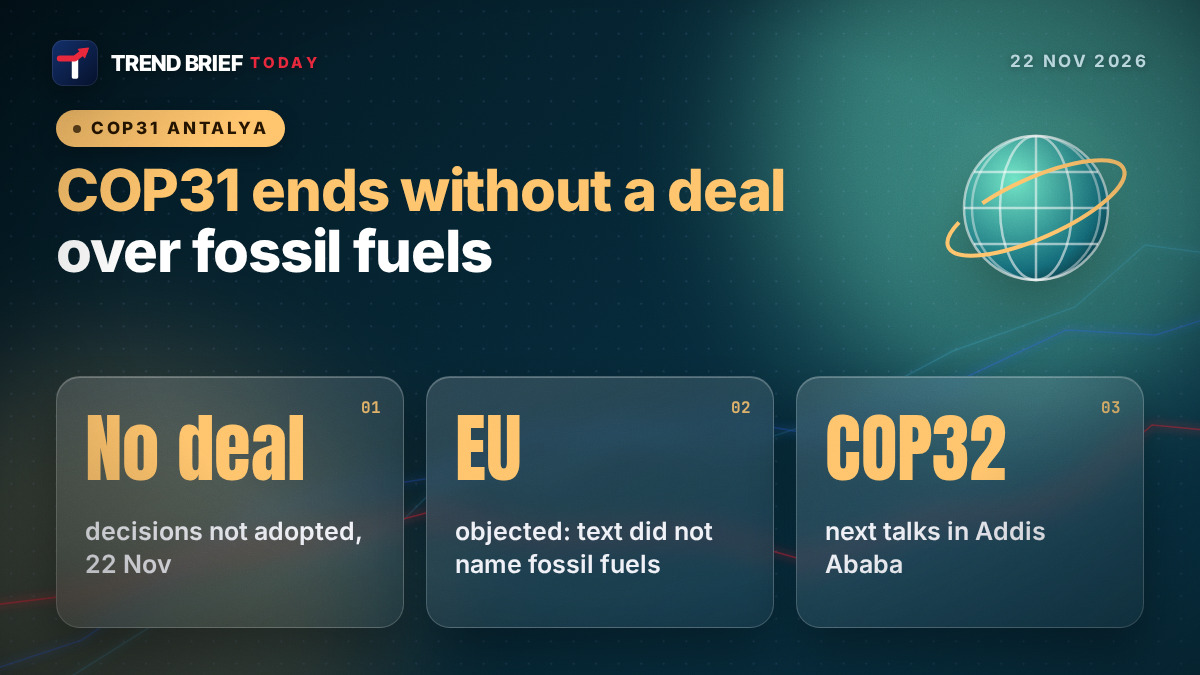
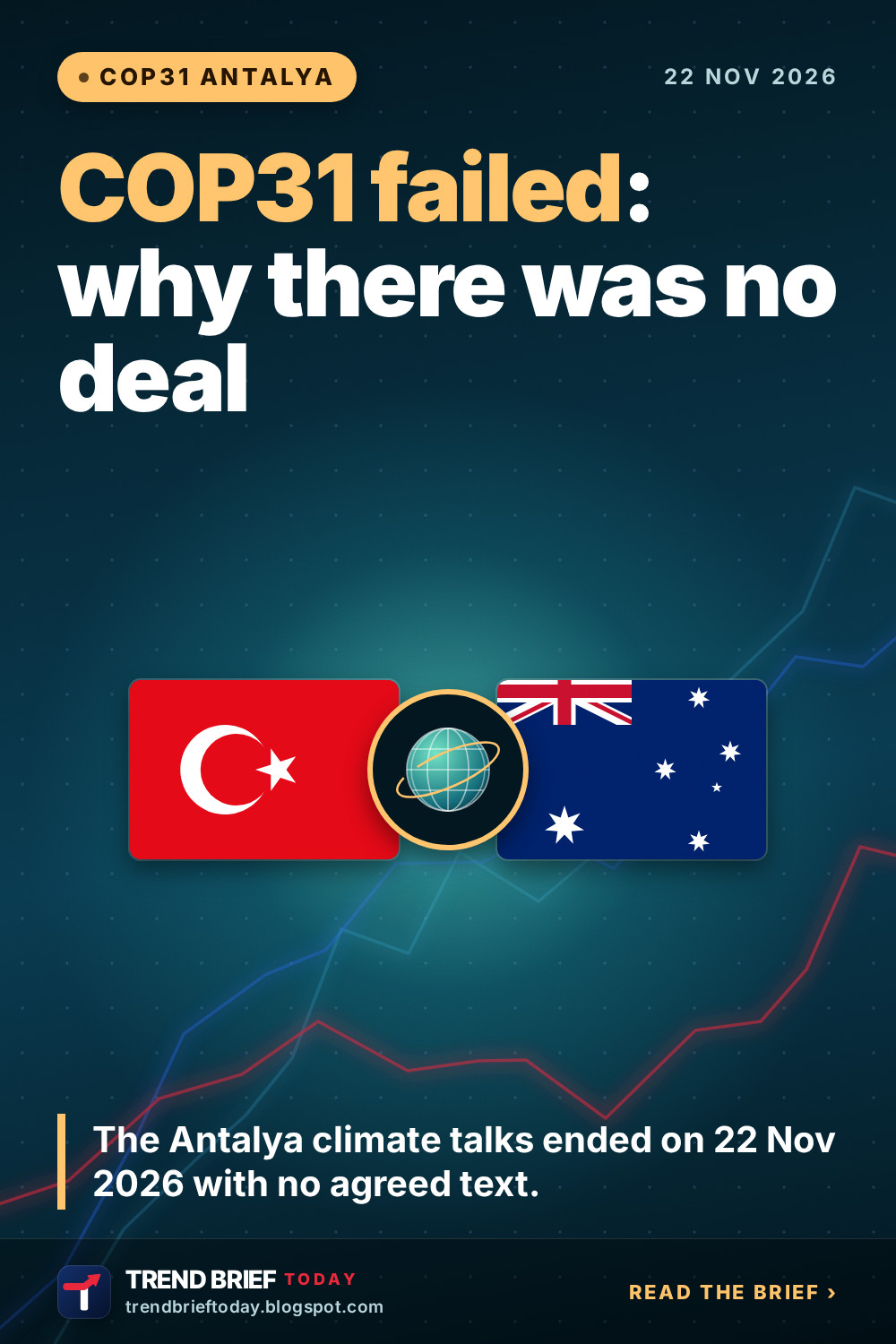
The COP31 climate summit in Antalya, Turkey, ended on Sunday 22 November 2026 without an agreed deal. At the closing plenary, COP31 President Murat Kurum said there was no agreement on the final text, so the decisions put to countries had not been adopted.[1][2] The European Union led the objections because the last draft did not mention fossil fuels, the main cause of climate change.[1][4] It is the first UN climate summit to break down this way since Copenhagen in 2009.[2][5]
 | |
| Event | UN Climate Change Conference (COP31)[1] |
|---|---|
| Venue | Antalya, Turkey[1][4] |
| Presidencies | Turkey (host, Murat Kurum) and Australia (lead negotiator, Chris Bowen)[2][5] |
| Scheduled end | Friday 20 November 2026[2][4] |
| Actual end | Sunday 22 November 2026, closing plenary[1][2] |
| Result | No consensus; decisions not adopted[1][2] |
| Main dispute | No mention of fossil fuels in the final text[1][4][5] |
| Next summit | COP32, Addis Ababa, Ethiopia[3] |
What happened at the end of COP31?
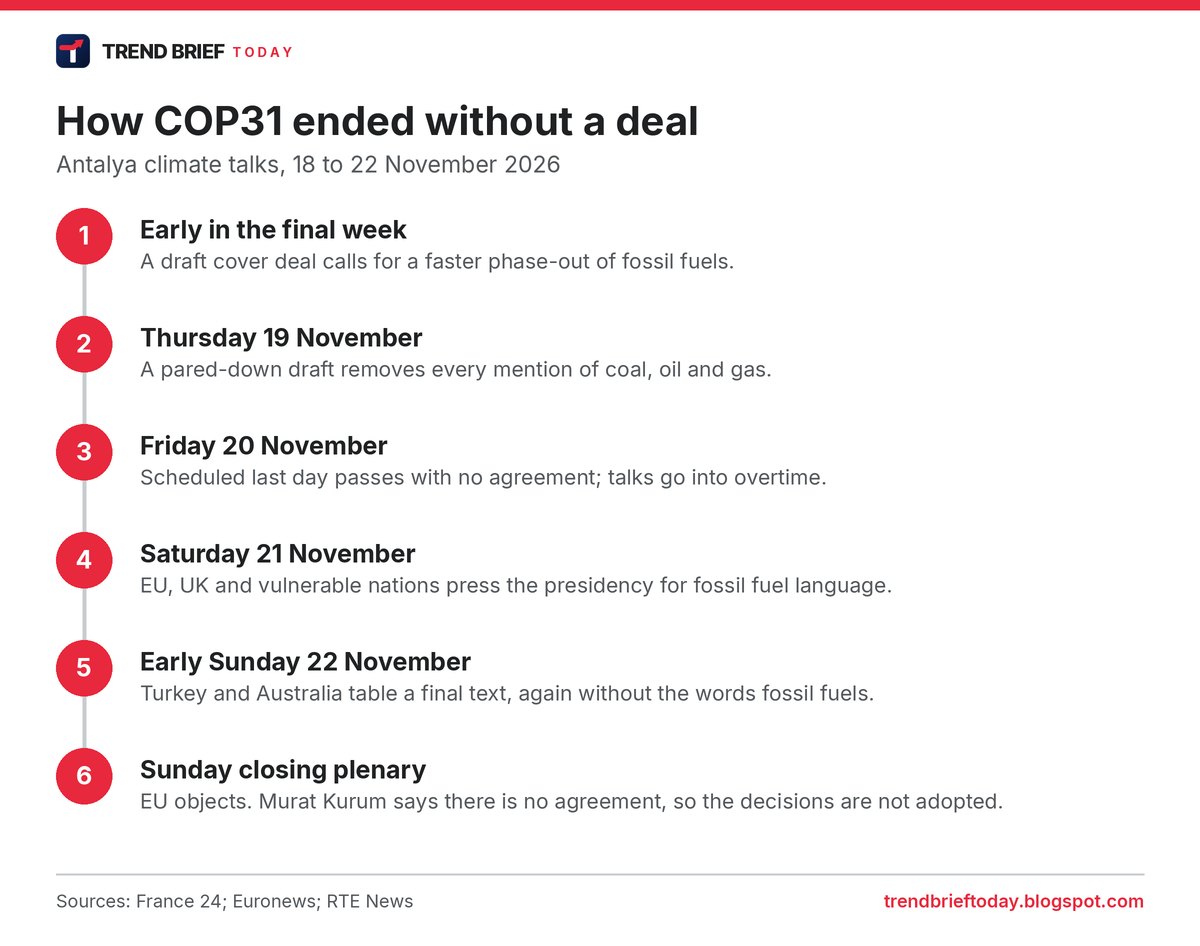
The talks had been due to finish on Friday 20 November but ran deep into the weekend as countries argued over fossil fuels, money for poorer nations and climate science.[2][4] Turkey and Australia, which shared the summit presidency, published a final compromise text early on Sunday and put it to the closing session, where it needed consensus from almost 200 countries.[4][5]
Before the session, Kurum had told delegates: "We believe that we have put forward a text which all the parties can agree upon."[5] That did not happen. Ireland's climate minister Darragh O'Brien, speaking for the EU because Ireland holds the rotating presidency of the bloc, told the plenary that the EU and its member states objected to the draft.[1][4]
Kurum then told the hall: "This text was not imposed on anyone," before adding: "I understand that there is no agreement on this text. For that reason, these decisions have not been adopted."[1] RTE News reported the same outcome: the COP31 President said at the closing plenary that a deal was not approved.[2]
Why did the EU and others reject the deal?
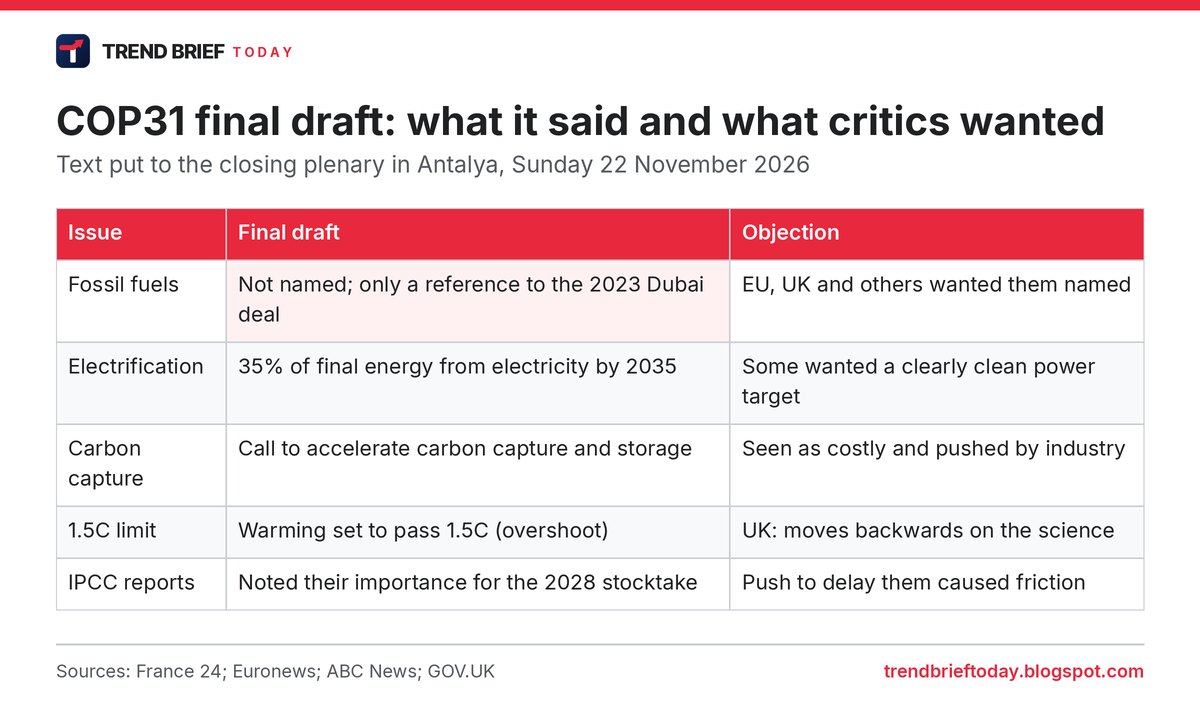
The single biggest problem was fossil fuels. An earlier draft released during the final week called for a faster phase-out of fossil fuels, but a pared-down version on Thursday stripped out every mention of coal, oil and gas.[1][4] The final Sunday text pointed back to the 2023 global agreement to move away from fossil fuels but did not name them.[1][5]
"We will not endorse a cover decision, or an Antalya Pact, that does not even mention fossil fuels, which is the key driver of climate change," O'Brien said.[2][4] Small island nations were also unhappy. Michael Joseph, the environment minister of Antigua and Barbuda, said: "We are very disappointed with how the text looks," adding that the draft was "quite silent" on fossil fuels.[1][4]
Oil-producing countries resisted spelling out a move away from fossil fuels, with Saudi Arabia named as a leading opponent of stronger language.[1][2] A German official told AFP during the final hours: "The oil-producing countries are putting up a fierce fight."[1][4]
What was in the final COP31 text?
Even though it was not adopted, the draft shows where the talks stood. It:
- Electrification: called for the share of electricity in total final energy use to reach 35% by 2035, alongside more "clean energy". Turkey and Australia had promoted electrification as a way to cut emissions and improve energy security.[1][5]
- Carbon capture: kept a contested call to accelerate carbon capture and storage, a technology backed by the fossil fuel industry and criticised by opponents as costly and ineffective.[1][4][5]
- 1.5C: accepted that global warming is on course to pass the 1.5C limit set in the Paris Agreement, while calling for faster work on ways to remove carbon later.[1][2]
- Science: "highlighted the importance" of the next reports from the Intergovernmental Panel on Climate Change (IPCC) for the 2028 global stocktake, after a push by Saudi Arabia, India and Kenya to delay those reports caused friction.[1][2]
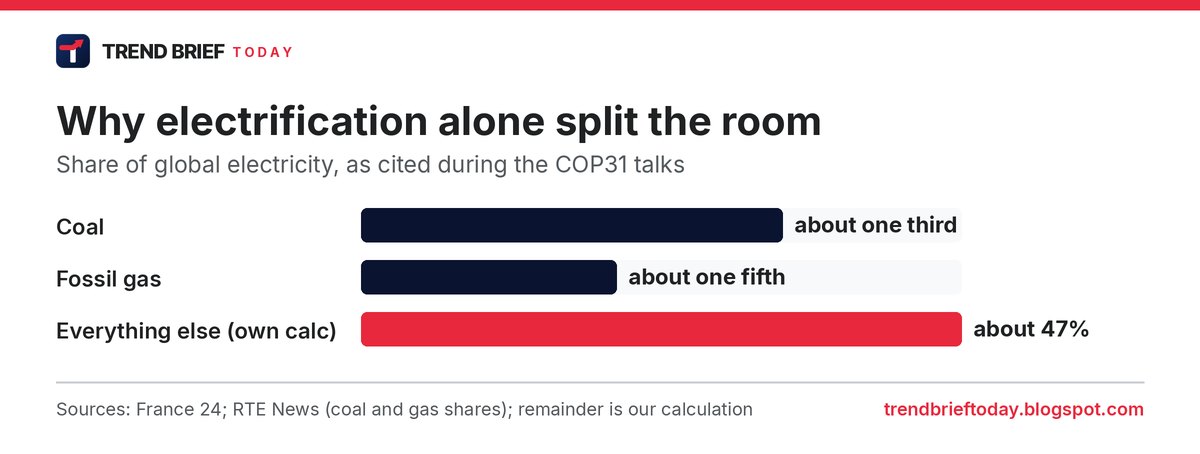
Some countries also wanted the electrification goal tied clearly to clean power. Around a third of the world's electricity still comes from coal and about a fifth from fossil gas, so more electric cars and heat pumps do not cut emissions as much if the grid stays dirty.[1][2]
What did the UK say?
The UK government published a statement shortly after the session. It said the UK "does not believe the cover decision proposed by the Presidencies meets the moment" and that "it moves us backwards on the science when we must accelerate implementation."[3]
The statement listed what the UK will now do with partners outside a formal deal: speed up the transition away from fossil fuels and protect forests, support clean electrification around the world, work on a "meaningful process" for adaptation finance, reform the COP process, protect oceans and support mountain and glacier-dependent communities. It said the UK would return to COP32 in Addis Ababa "with advances made, even stronger resolve and an improved COP process."[3]

Has a COP ended without a deal before?
Yes, but rarely. UN climate summits often overrun because decisions need consensus from nearly 200 delegations, yet they almost always end with some agreed text.[5] The last major breakdown came at Copenhagen in 2009, when countries failed to adopt the Copenhagen Accord by consensus.[2][5] NBC News dates the last outright failure of talks further back, to COP6 in The Hague in 2000.[6]
The failure lands in a difficult year: soaring energy prices and tensions linked to the war involving Iran hung over the talks, and the summit followed a run of climate disasters from extreme heat in Europe to glacial floods in Nepal.[1][2]
What happens next?
No new COP31 agreement means the existing framework, including the Paris Agreement, stays as it is, and the arguments move on to the next summit. The UK said it is "ready to return to COP32 in Addis Ababa", Ethiopia's capital, which hosts the next conference.[3]
In the meantime, the UK has said it will push ahead with willing partners in the six areas listed in its statement, without waiting for a new global text.[3]
The bigger question is whether countries can agree on fossil fuel language at all while major oil producers object. That fight, and the adaptation finance gap for poorer nations, will now carry over into COP32.[1][2][3]
Frequently asked questions
Did COP31 reach an agreement?
No. COP31 President Murat Kurum said on 22 November 2026 that there was no agreement on the text, so the decisions were not adopted.[1][2]
Which countries rejected the COP31 deal?
The EU, Panama and the Marshall Islands rejected it at the closing session, and Middle East Eye also names Norway and Vanuatu.[6][7] Saudi Arabia was among the oil producers that resisted any fossil fuel wording.[1][6]
What did Guterres say about COP31?
He said he was "deeply disappointed" and warned that "every delay makes our task harder and more costly".[9] He also said he shared a "profound frustration" with people who expected governments to act.[8]
Why did COP31 fail?
The EU and others refused to back a final text that did not mention fossil fuels, while oil-producing states resisted stronger language.[1][2][4]
Where was COP31 held?
In Antalya, Turkey, with Turkey hosting and Australia leading the negotiations.[2][5]
When did COP31 end?
On Sunday 22 November 2026, two days after its scheduled Friday finish.[1][2]
Where is COP32?
Addis Ababa, Ethiopia.[3]
References
- France 24, "COP31 ends without deal as EU rejects final text for omitting mention of fossil fuels", updated 22 November 2026.
- RTE News, "Oil states 'hijacked' COP31 climate talks - minister", 22 November 2026.
- GOV.UK, "UK Government position on COP31 Outcome", 22 November 2026.
- Euronews, "COP31 climate deal in doubt after European Union rejects draft", 22 November 2026.
- ABC News (Australia), "COP31 struggles to reach deal with parties at odds over fossil fuels", 22 November 2026.
- NBC News, "COP31 climate talks break down after angry dispute over fossil fuels", 22 November 2026.
- Middle East Eye, "Cop31 talks collapse as EU and other countries reject final climate deal", 22 November 2026.
- ABC News (Australia), "COP31 talks break down in longest ever UN climate debate", 22 November 2026.
- The National, "Climate talks collapse without deal at Cop31 in Turkey", 22 November 2026.
- The Sydney Morning Herald, "UN global climate talks led by Chris Bowen end in discord and recrimination", 22 November 2026.
- UN News, "COP31 ends without climate pact as UN chief warns there is 'no ambiguity in the science'", 22 November 2026.