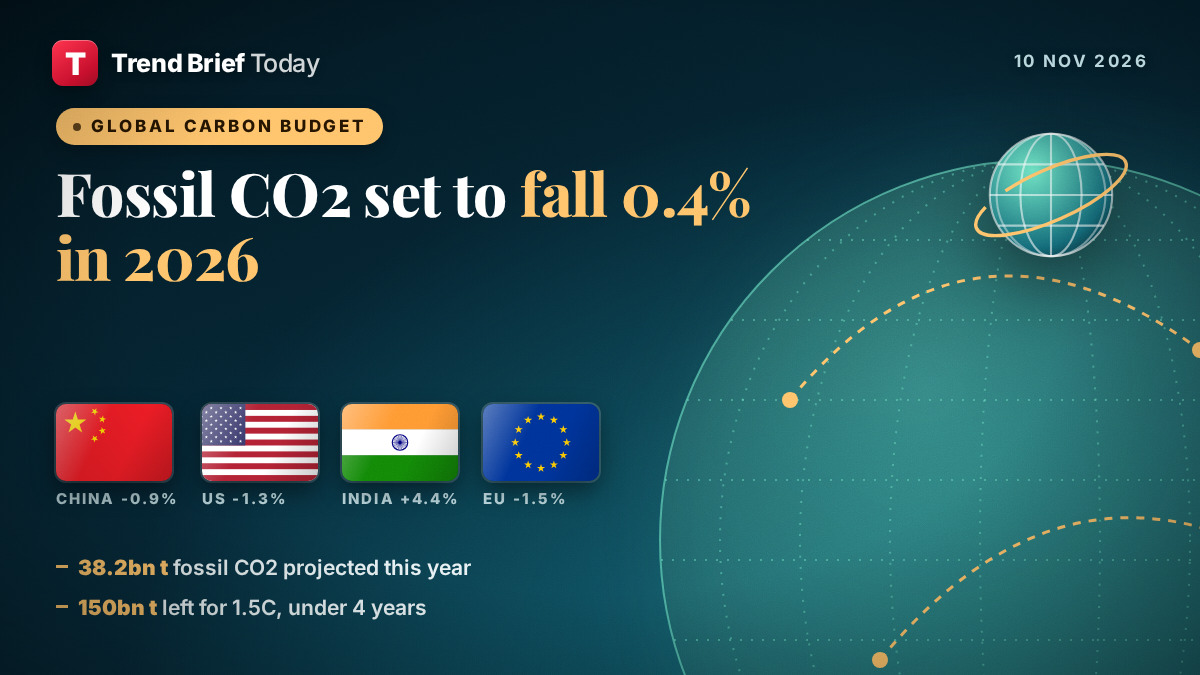
Carbon dioxide emissions from fossil fuels are projected to fall by about 0.4% in 2026, to 38.2 billion tonnes, according to the Global Carbon Budget 2026 published on November 10. It would be the first yearly fall since the Covid year of 2020. The scientists behind the report say most of the drop comes from oil, which fell after the Iran war pushed prices up, while solar, wind and electric cars covered about two thirds of the growth in energy demand. They also warn that it is not a peak: the likely range runs from a 1.5% fall to a 0.6% rise, and total CO2 including deforestation still reaches a record 43.3 billion tonnes.[1][2][3]
 | |
| Published | November 10, 2026 (21st edition) |
|---|---|
| By | Global Carbon Project, more than 140 scientists |
| Lead author | Pierre Friedlingstein, University of Exeter |
| Fossil CO2 in 2026 | 38.2 billion tonnes, down about 0.4% (range -1.5% to +0.6%) |
| Total CO2 in 2026 | 43.3 billion tonnes (42.8 billion in 2025) |
| Biggest change | Oil, down 1.9% |
| Rising | India, up 4.4%; coal, up 0.6% |
| CO2 in the air | 427.7 ppm, about 54% above pre-industrial |
| 1.5C budget left | 150 billion tonnes from the start of 2027 |
| Journal | Earth System Science Data (preprint) |
Are global emissions falling in 2026?
Slightly, if the projection holds. The Global Carbon Project puts fossil CO2 emissions, which in its counting means burning coal, oil and gas plus making cement, at 38.2 billion tonnes in 2026. That is about 0.4% below 2025, which was a record year.[1][2] Over the last ten years fossil emissions grew by about 0.9% a year, so a fall of any size breaks the pattern.[2][3]
The size of the fall is small and uncertain. Carbon Brief, which co-wrote its analysis with the report's lead author, says the 2026 number could end up anywhere between a 1.5% drop and a 0.6% rise, so "a small increase in emissions can not be ruled out".[2] For comparison, emissions dropped by about 6% in 2020 during the pandemic and by about 2% in 2009 during the financial crisis.[4]
Total CO2, which adds land-use change such as deforestation and peat fires, goes the other way. It is projected at 43.3 billion tonnes, up from 42.8 billion in 2025, because land-use emissions jump from 4.4 to 5.1 billion tonnes. The report links that rise to fires and forest damage in Southeast Asia during this year's strong El Niño.[1][2]
Why emissions fell: the Iran war and oil
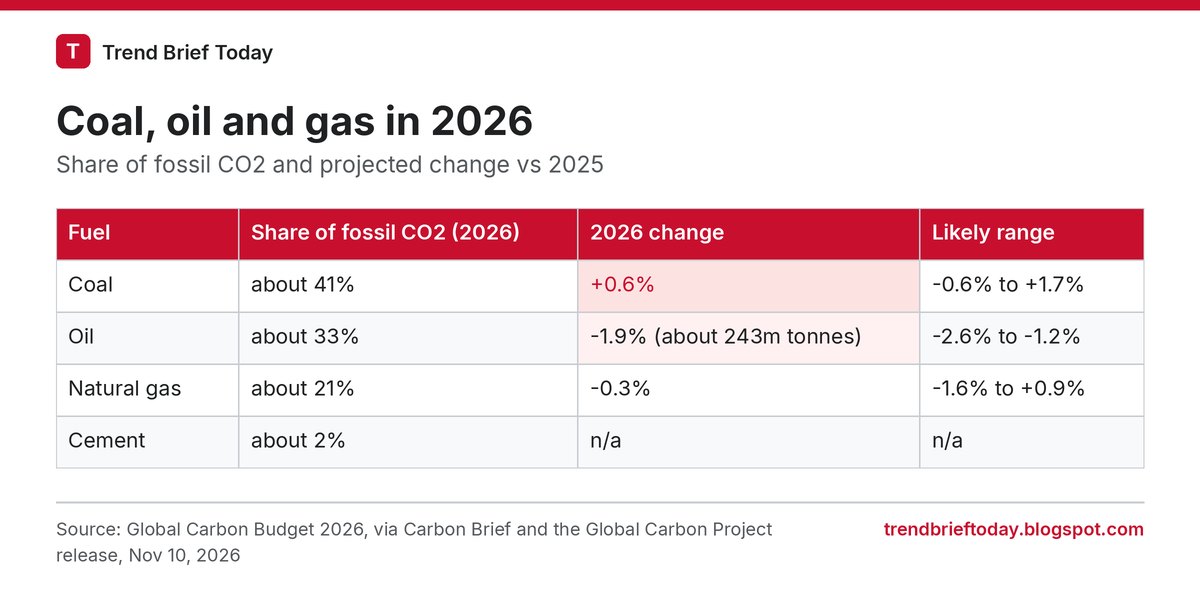
Oil is the whole story of the 2026 dip. Emissions from oil are projected to fall 1.9%, or about 243 million tonnes, with a likely range of -2.6% to -1.2%. Outside 2020, that is one of the biggest yearly falls on record.[2] The researchers tie it to higher prices and lower supply after the war on Iran and the closure of the Strait of Hormuz. Petrol and diesel prices in the US, China and the EU were 10% to 50% higher than in 2025, depending on the fuel and the month.[2][3] Our explainer on the Iran war and oil prices covers the Hormuz shock in more detail, and US drivers are only now seeing gas prices fall back below $4.
Coal and gas did not help much. Coal emissions are projected to rise 0.6% and gas emissions to dip 0.3%, which is effectively flat.[1][2]
Robbie Andrew of the CICERO climate institute in Oslo, one of the authors, told New Scientist the fall "may turn out to be a 'blip'" and that emissions would be expected to bounce back if there are no further crises.[4] Corinne Le Quéré of the University of East Anglia said much the same at the media briefing: a rebound is likely "when the oil tensions go away".[3]
Country by country: China, the US, India and the EU
Most big emitters are projected to cut emissions this year. India is the clear exception.[1][2]
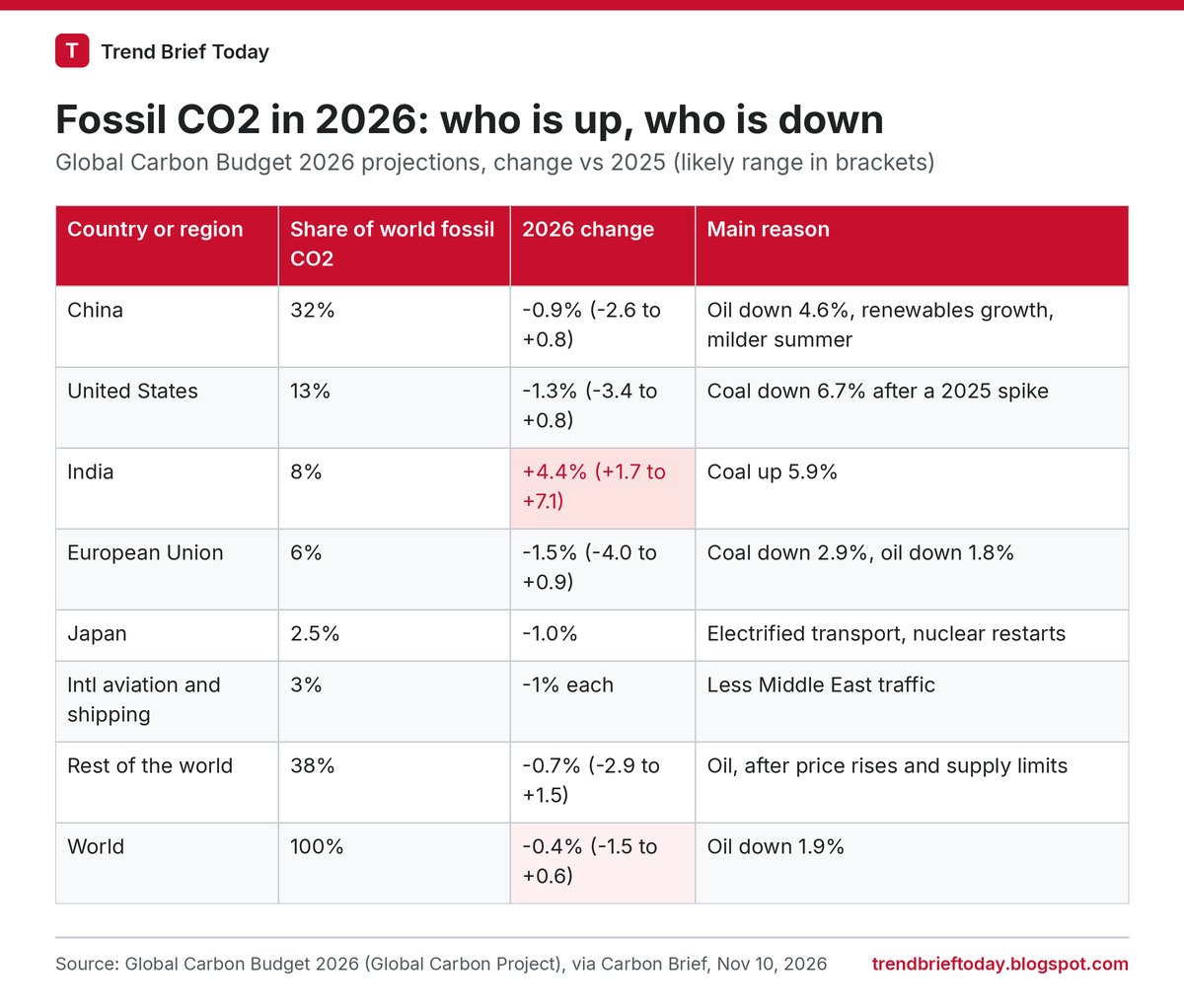
- China (32% of the world total): down 0.9%. Oil emissions fall 4.6% while coal rises only 0.3%. The report credits strong renewables growth and a milder summer than 2025's record heat. About half of the emissions avoided worldwide by renewables and electric cars are in China.[1][2]
- United States (13%): down 1.3%, mostly because coal emissions fall 6.7% after an unusual rise in 2025 caused by high gas prices and cold weather.[1][2]
- India (8%): up 4.4%, faster than its 3.5% yearly average over the last decade, with coal up 5.9%.[1][2]
- European Union (6%): down 1.5%, with coal down 2.9% and oil down 1.8%.[1][2]
- Rest of the world (38%): down 0.7%, mainly oil.[1][2]
One more detail matters for anyone comparing countries fairly. Per person, India emitted about 2.2 tonnes of fossil CO2 in 2025, against 14.5 tonnes in the US. The world average is about 4.6 tonnes in 2026.[2]
Have emissions peaked?
Not yet, the authors say. "A drop in emissions in one year is not a peak unless it is driven by structural change," said Glen Peters of CICERO.[1] A companion study in Nature Climate Change, led by Le Quéré, estimates that rising energy demand would have added about 0.78 billion tonnes of CO2 in 2026. Growth in solar, wind and electric vehicles offset about 0.54 billion tonnes of that, roughly 69%. The rest of this year's fall came from high energy prices, so on the central estimate emissions would have kept rising without the war.[2]
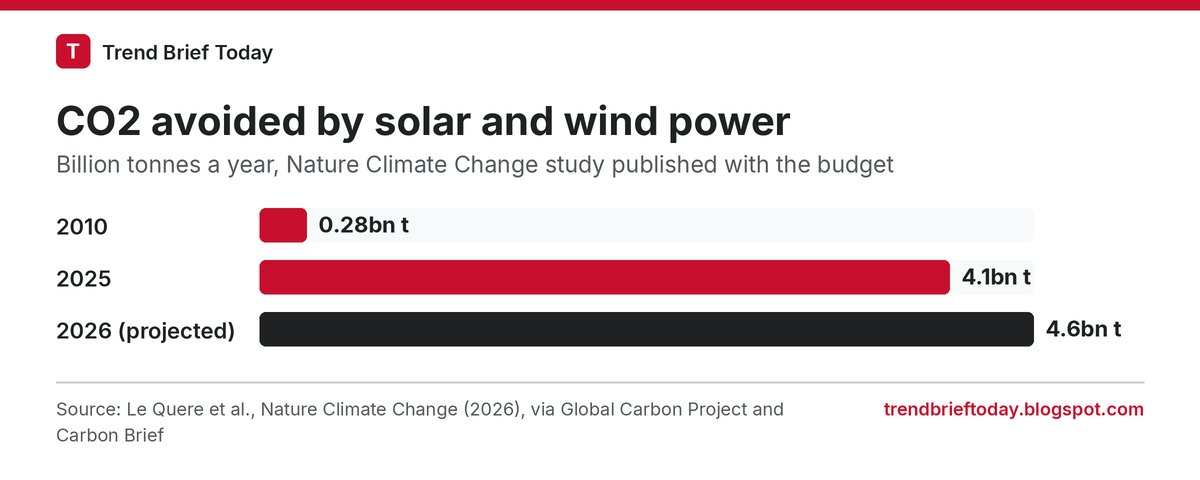
Looking ahead to 2028, the same study finds clean technology would offset 63% to 79% of new demand-driven emissions, depending on how fast it keeps growing. In both cases emissions in 2028 would still be higher than in 2025.[2][4] There is real progress in the detail: the number of countries that cut emissions while their economies grew over 2016 to 2025 is 40, up from 22 in the decade before.[2]
How much carbon budget is left for 1.5C?
The report puts the remaining budget for a 50% chance of keeping warming to 1.5C at 150 billion tonnes of CO2 from the start of 2027. Human-caused warming reached about 1.37C in 2025. The budgets for 1.7C and 2C are 510 and 1,035 billion tonnes.[1][2]
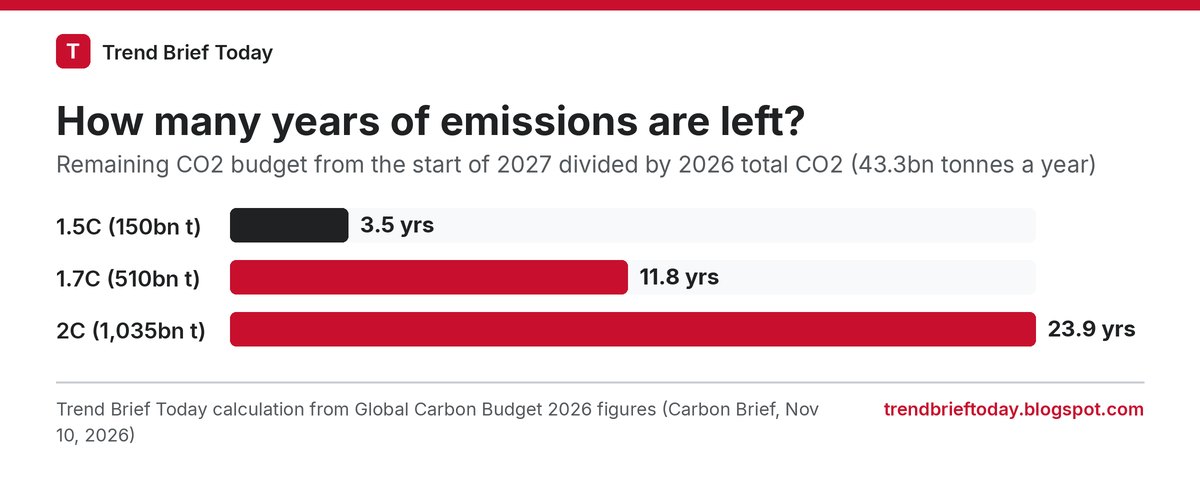
We divided those budgets by this year's emissions to turn them into years. At 43.3 billion tonnes of total CO2 a year, the 1.5C budget lasts about 3.5 years, 1.7C about 11.8 years and 2C about 23.9 years. Using fossil CO2 alone (38.2 billion tonnes) the 1.5C budget lasts about 3.9 years, which is where the report's "less than four years" line comes from.[1][3] This is simple arithmetic, not a forecast: emissions will not stay exactly flat, and the budgets themselves carry wide uncertainty.
Where the CO2 goes: land, ocean and air
Over 2016 to 2025, the ocean took up about 27% of human CO2 emissions and land about 22%; the rest stayed in the atmosphere. The land sink hit a record of about 13.3 billion tonnes in 2025 as tropical forests recovered from the 2023-24 El Niño.[2] The report warns that the strong El Niño that started in June 2026 is expected to weaken the land sink, mostly in 2027.[1][2] CO2 in the air is set to average 427.7 parts per million in 2026, about 54% above pre-industrial levels.[1][2]
Carbon removal is still tiny. New methods such as direct air capture offset less than 30 minutes' worth of yearly fossil CO2, the release says, while new forests offset only about half of the emissions from permanent deforestation.[1]
What it means for COP31 in Antalya
The report was timed for the second day of COP31 in Antalya, where countries are arguing over a voluntary electrification goal and a roadmap away from fossil fuels.[3] The findings give both sides something. Supporters of faster action can point out that clean energy is now covering most of the growth in demand and that the 1.5C budget is almost gone. Countries that want to go slower can point to India's rising emissions and to the fact that the 2026 dip came from a war, not from policy. The United Nations already said in September that the 1.5C goal would be missed within years; the debate now is how long the "overshoot" lasts.[3]
Timeline
| Date | Event |
|---|---|
| 2009 | Financial crisis: fossil emissions fall about 2%[4] |
| 2020 | Covid-19: fossil emissions fall about 6%, the last yearly drop before 2026[3][4] |
| 2025 | Fossil emissions hit a record; land sink highest on record[2][3] |
| February 2026 | War on Iran begins; the Strait of Hormuz is later closed[4] |
| June 2026 | Strong El Niño begins[2] |
| November 9, 2026 | COP31 opens in Antalya, Türkiye[3] |
| November 10, 2026 | Global Carbon Budget 2026 published: fossil CO2 projected down 0.4%[1] |
Frequently asked questions
What is the Global Carbon Budget?
It is a yearly, peer-reviewed estimate of where CO2 comes from (fossil fuels, cement, land use) and where it goes (land, ocean, atmosphere). The 2026 edition is the 21st and involves more than 140 scientists from over 90 institutions.[1][5]
Did global CO2 emissions go down in 2026?
Fossil CO2 is projected to fall about 0.4%, but total CO2 including land use is projected to rise to a record 43.3 billion tonnes. The final figures come next year.[1][2]
Why did emissions fall in 2026?
Mainly because oil use dropped after the Iran war pushed prices up, plus growth in solar, wind and electric cars.[1][3]
Which country emits the most CO2?
China, with about 32% of global fossil CO2, followed by the US with 13%, India with 8% and the EU with 6%.[2]
How long until the 1.5C carbon budget runs out?
At current emissions, between about 3.5 and 3.9 years from the start of 2027, depending on whether you count total or fossil CO2.[1][2]
References
- "Fossil CO2 emissions decrease in 2026". Global Carbon Project / University of Exeter. November 10, 2026.
- "Analysis: Fossil-fuel CO2 emissions set to dip in 2026 as Iran conflict hits oil use". Zeke Hausfather and Pierre Friedlingstein, Carbon Brief. November 10, 2026.
- "Fossil fuel emissions fall due to Iran war, renewables: Research". AFP via The Straits Times. November 10, 2026.
- "Global carbon emissions set to fall in 2026 due to Iran energy shock". New Scientist. November 10, 2026.
- "Global Carbon Budget 2026". Friedlingstein, P. et al., Earth System Science Data Discussions (preprint essd-2026-895). November 10, 2026.