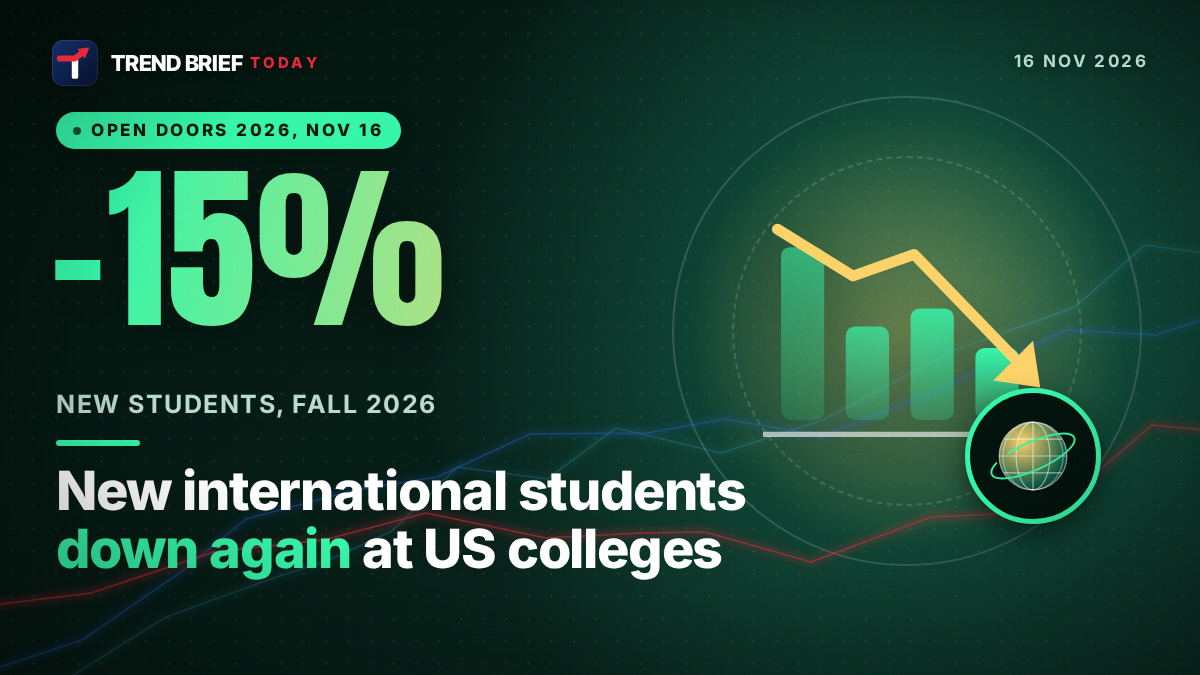
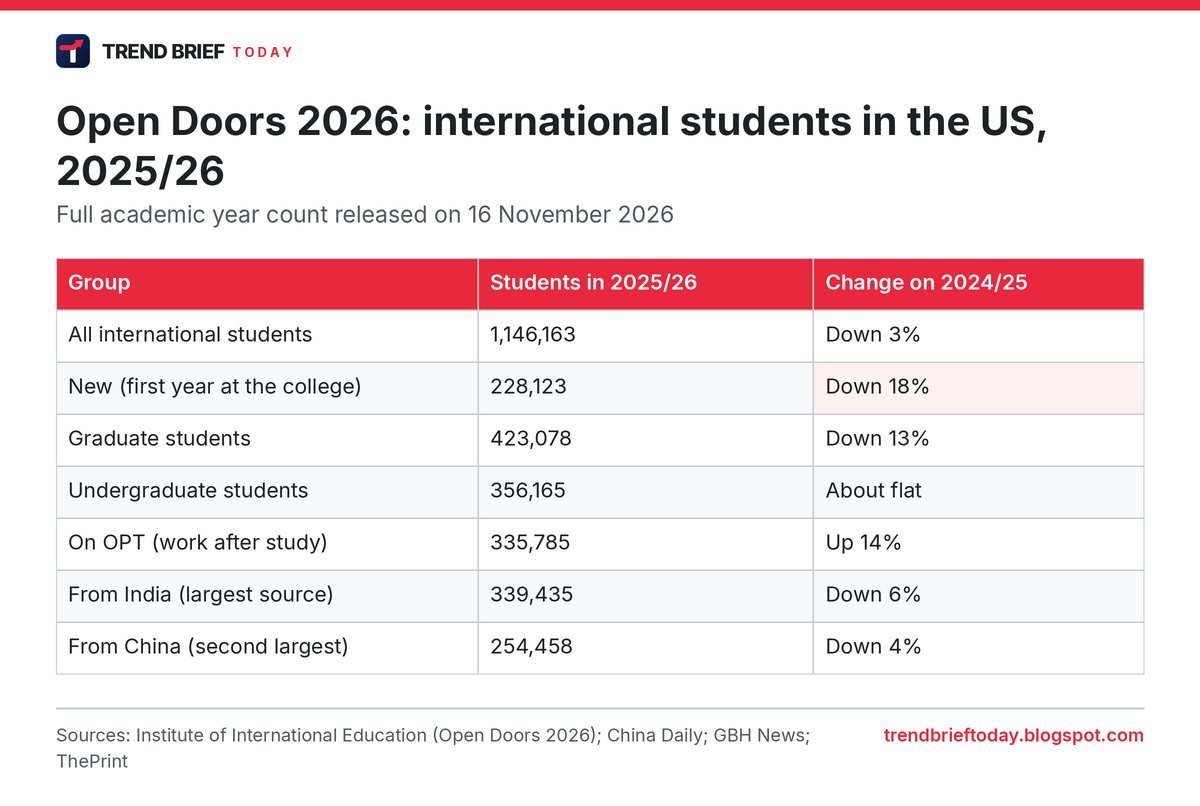
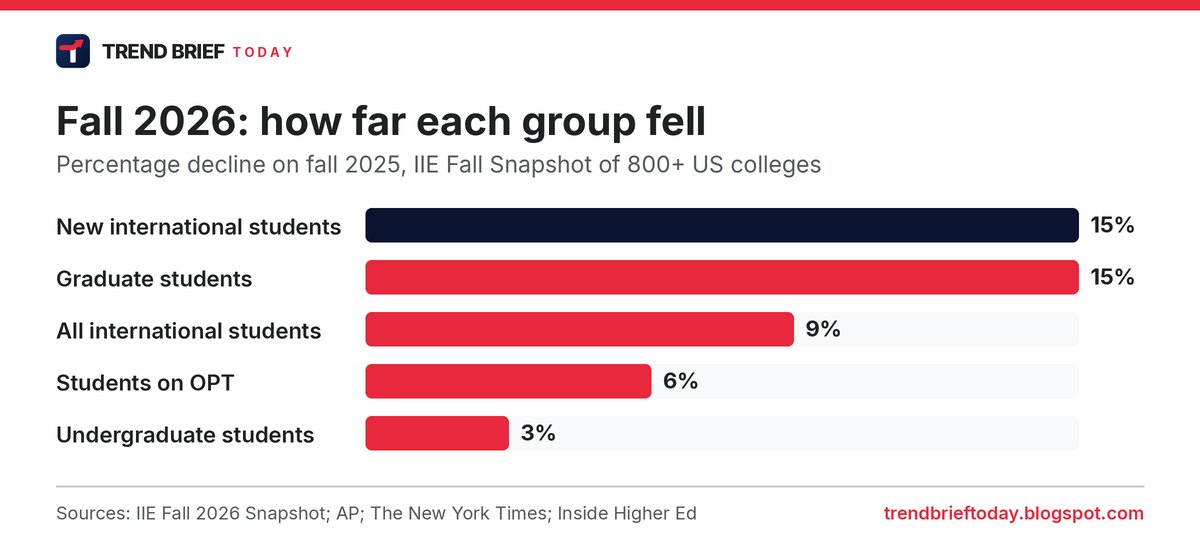
International student enrollment at US colleges fell again in fall 2026. A survey of more than 800 colleges released on 16 November found that new international students were down 15% and all international students were down 9% compared with fall 2025.[1][2][3][4] The full count for the last school year, Open Doors 2026, shows 1,146,163 international students in 2025/26, down 3%, with new students down 18%.[1][5][7]
 | |
| Fall 2026, all students | Down 9%[1][3][4] |
|---|---|
| Fall 2026, new students | Down 15%[1][2][4] |
| 2025/26 total | 1,146,163 (down 3%)[1][5] |
| 2025/26 new students | 228,123 (down 18%)[1][5] |
| Largest source | India, 339,435 (down 6%)[1][5][9] |
| Second source | China, 254,458 (down 4%)[1][5][9] |
| Share of US students | About 6%[1][5] |
| Published by | Institute of International Education[1][2] |
What the new numbers say
There are two sets of figures, and they measure different things. Open Doors 2026 is the full count for the 2025/26 academic year, based on data from about 3,000 colleges.[4][7] The Fall 2026 Snapshot is a quicker survey of more than 800 colleges, taken this autumn, that gives an early look at the current school year.[1][2][5]
The snapshot is the worrying one for colleges. Total international enrollment fell 9% this fall, which is a much steeper drop than the 3% fall a year earlier.[3][4] New students, those at their college for the first time, fell 15%, after an 18% fall the year before.[3][4][6]
Put those two years together and the number of new international students is roughly 30% lower than it was in fall 2024. That is our own rough calculation (0.82 x 0.85 = 0.70), and it mixes a full count with a survey, so treat it as a guide rather than an official figure.
Graduate students took the biggest hit
The fall is concentrated at the graduate level. In the 2025/26 count, international graduate students fell 13% to 423,078, driven by a 22% drop in master's students.[1][4][5][6] Doctoral numbers rose 3%.[1][8] Undergraduate numbers barely moved, at 356,165.[1][5][7]
This fall the pattern continued. The snapshot shows graduate enrollment down 15%, undergraduates down 3% and students on Optional Practical Training (OPT), the work program for recent graduates, down 6%.[1][4][5] OPT had been the one area holding the total up: it grew 14% to 335,785 in 2025/26.[1][5]
Community colleges are the exception. Their international enrollment rose 3% in 2025/26, the third year of growth in a row.[4][6][7]
India and China
India was the top source of international students for the third year running, but its numbers fell about 6% to 339,435.[1][5][9] The fall came almost entirely from graduate students: Indian graduate enrollment dropped 34%.[1][7] That is a fall from 177,892 to 116,609, or about 61,000 fewer Indian graduate students in one year.[7][9]
China, the second largest source, fell 4% to 254,458.[1][5][9] Even so, nine of the top 25 sending countries hit record highs in 2025/26: Bangladesh, Canada, Colombia, Ghana, Italy, Nepal, Pakistan, Peru and Vietnam.[1][8]
| Country | Students | Change on 2024/25 |
|---|---|---|
| India | 339,435 | Down about 6%[1][9] |
| China | 254,458 | Down about 4%[1][5] |
| Indian graduate students | 116,609 | Down 34%[1][8][9] |
Why students are turning away
Colleges in the survey blamed the visa application process (88%) and travel restrictions (70%) more than anything else.[2][4][8] Mirka Martel, IIE's head of research, said institutions pointed to three pressures: other countries recruiting harder, US visa policies, and the rising cost of a US degree.[2][5][6]
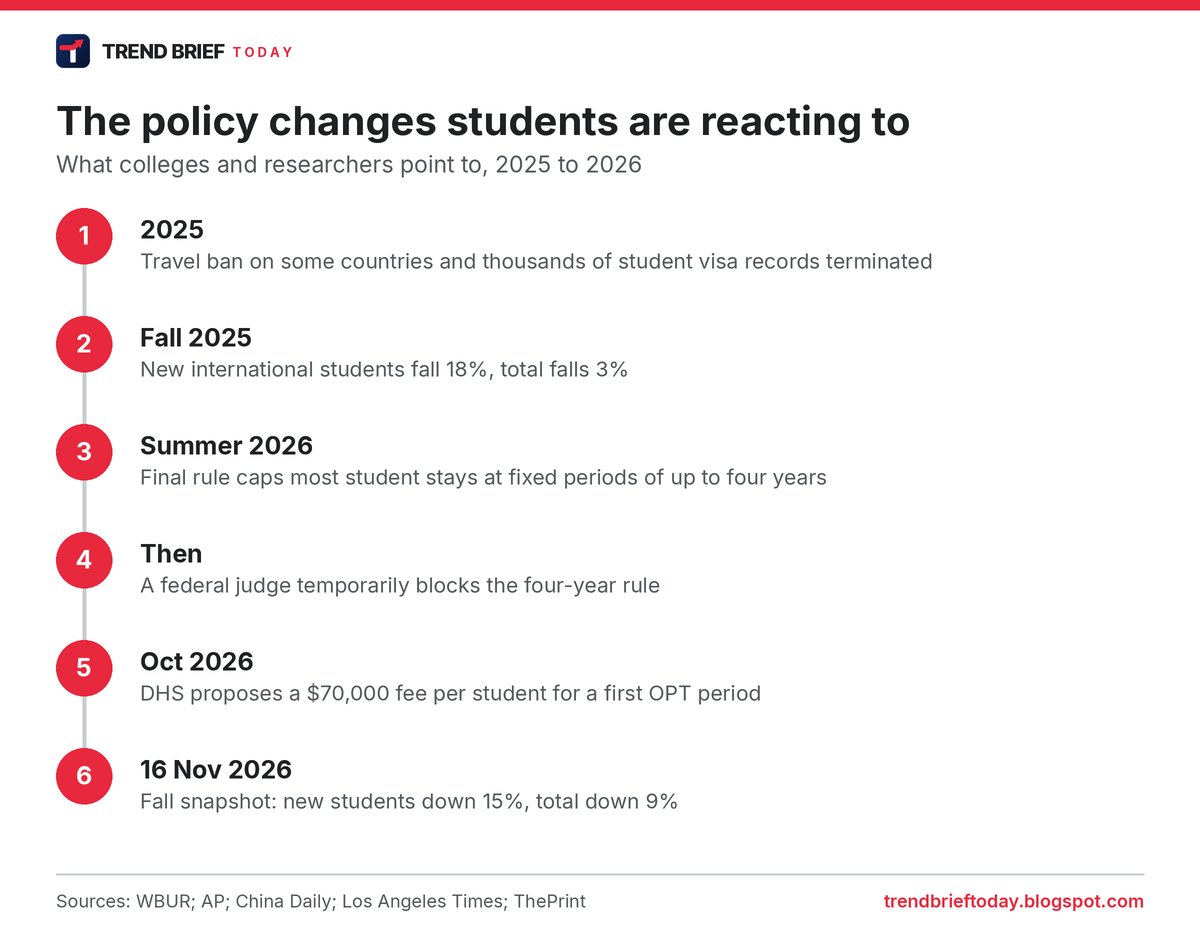
The policy pressure has built up over two years. Since 2025 there has been a travel ban on some countries and thousands of students have had their legal status terminated.[2][4][6] This summer the administration finalised a rule that would limit most international students to fixed stays of up to four years, but a federal judge has temporarily blocked it.[2][5][6]
The OPT fee and why it matters
In October the Department of Homeland Security proposed that colleges pay $70,000 for each student they recommend for OPT.[2][6][9][10] With a later extension, such as the STEM extension, the total could reach $100,000 per student.[5][9] The rule is not final, and education groups expect a court challenge if it goes ahead.[2][6]
Martel said: "We had 95 percent of institutions tell us that international students would likely look to another country if OPT was not available."[5][6] We explained who pays, when it could start and what students can do now in our guide to the DHS OPT fee.
What it costs the US economy
International students contributed nearly $56 billion to the US economy in 2025, according to the Department of Commerce figure quoted by IIE.[1][5] NAFSA, the association of international educators, estimates their contribution fell by $2.4 billion this fall as numbers dropped.[2][8]
The money matters to colleges because many international students pay full tuition.[3][6] For graduates hoping to stay and work, the job route after study is also getting harder; see our report on IBM ending H-1B and green card sponsorship for most consulting roles.
If you are thinking of studying in the US
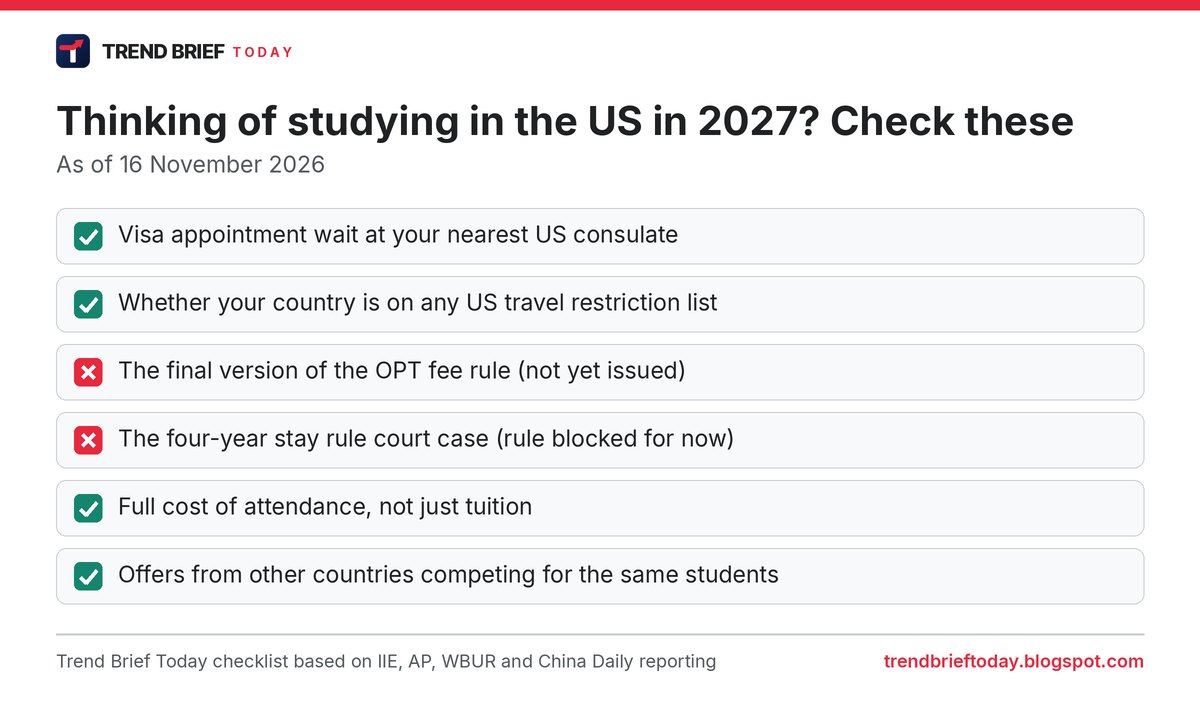
The US is still the world's top destination for international students, with more than 1.1 million last school year.[1][5][7] But two of the rules behind this year's drop are still open: the OPT fee is only a proposal, and the four-year stay rule is on hold in court.[2][6] Anyone applying for 2027 should check the latest on both before paying a deposit.
Frequently asked questions
How many international students are in the US in 2026?
Open Doors 2026 counted 1,146,163 in the 2025/26 school year, down 3%. This fall's survey suggests the number has fallen a further 9%.[1][4][5]
Why is international student enrollment declining?
Colleges mostly blame the visa process and travel restrictions, along with competition from other countries and the cost of a US degree.[2][4][6]
Which country sends the most students to the US?
India, with 339,435 students in 2025/26, ahead of China with 254,458.[1][5][9]
Is the $70,000 OPT fee in force?
No. It is a proposed rule and has not been finalised.[2][6]
What is Open Doors?
It is the annual count of international students in the US and of Americans studying abroad, published by the Institute of International Education.[1][4]
References
- Institute of International Education via PR Newswire, U.S. Colleges and Universities Host 1.1M International Students in 2025-2026 School Year, 16 November 2026.
- Associated Press via ABC News, Fewer students are traveling from abroad to study at US universities, report shows, 16 November 2026.
- Stephanie Saul and Steven Rich, The New York Times, International Students Are Turning Away From U.S. Universities, 16 November 2026.
- Inside Higher Ed, International Student Enrollment Down 9% in Fall 2026, 16 November 2026.
- Lia Zhu, China Daily, US international student enrollment falls amid visa restrictions, rising costs, 16 November 2026.
- Suevon Lee, WBUR, Visa hurdles, high tuition costs creating a 'perfect storm' for lower international student enrollment, 16 November 2026.
- Kirk Carapezza, GBH News, International student enrollment at US colleges falls 3%, 16 November 2026.
- CNBC TV18, US universities lose ground with India and China students amid Trump immigration policies, 16 November 2026.
- ThePrint, US sees 15% drop in fresh international student enrolments; India top source despite 6.5% decline, 16 November 2026.
- Los Angeles Times, California loses international students at twice the U.S. rate, 16 November 2026.