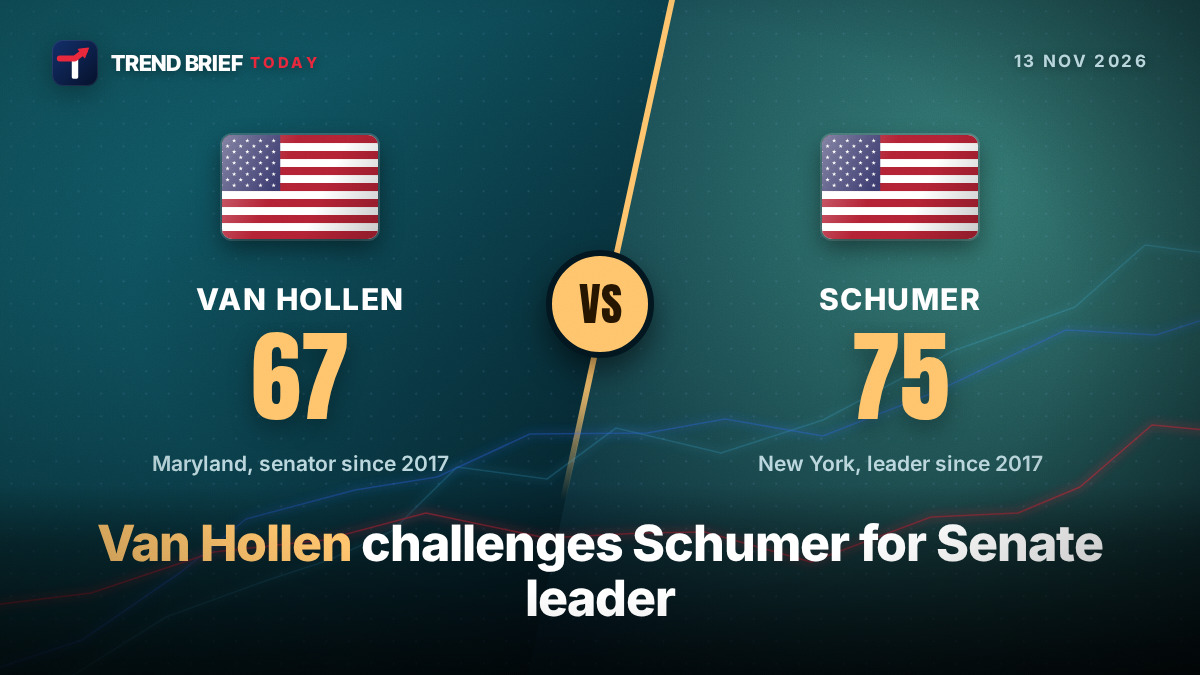
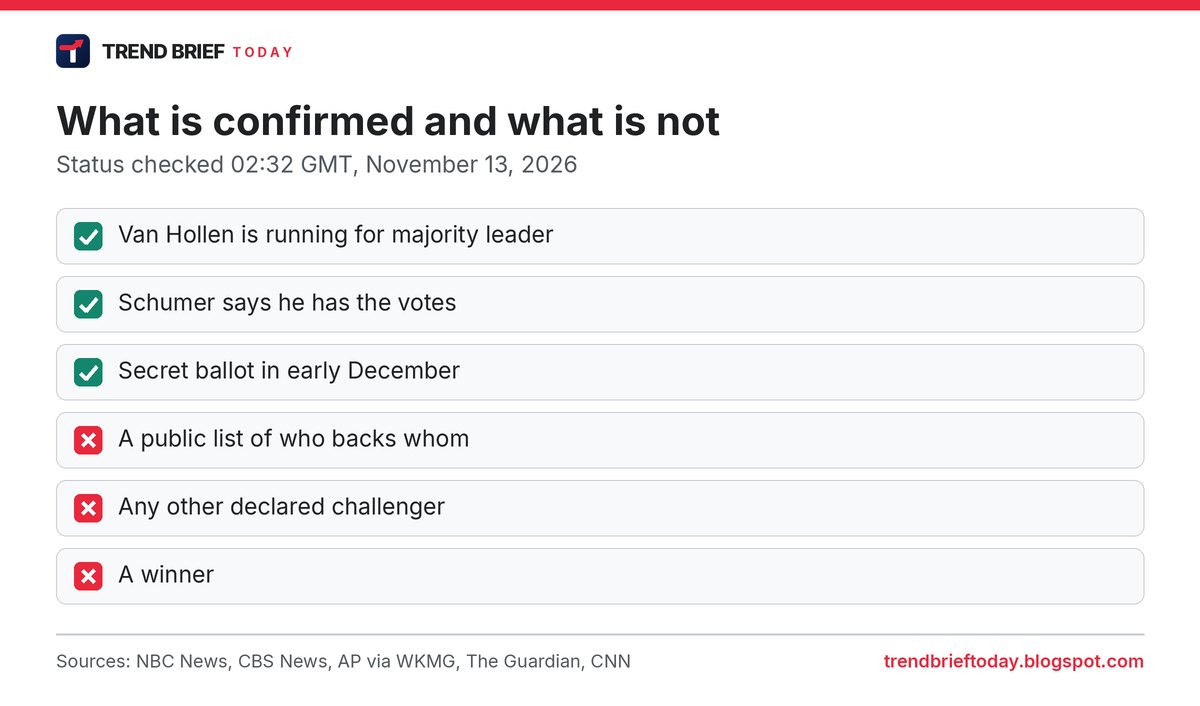
Senator Chris Van Hollen of Maryland said on Thursday, November 12, 2026, that he will run for Senate majority leader, setting up the first contested race for Senate Democratic leader in decades against Chuck Schumer, who has led the caucus since 2017.[1][2][3] Democrats will pick their leader for the new Congress in a closed-door, secret-ballot vote in early December, which CNN reports is set for December 1, and the winner needs a simple majority of the caucus.[2][3][4] Schumer says he already has the votes.[1][3][5]
 | |
| Challenger | Chris Van Hollen (D-Maryland), 67[1][3] |
|---|---|
| Incumbent | Chuck Schumer (D-New York), 75, leader since 2017[3][4] |
| Announced | Thursday, November 12, 2026 (evening, US Eastern)[1][2][5] |
| Vote | Early December; CNN reports December 1[2][4] |
| Format | Closed-door, secret ballot of Senate Democrats[2][3][4] |
| To win | Simple majority of the caucus[3][4] |
| Caucus size | At least 55 senators in January[1][4] |
| Job | Senate majority leader in the new Congress[1][3] |
What happened
Van Hollen announced his bid on Thursday evening, US time, in a statement and a post on X. "In this election, the American people called for change," he said, adding: "It's now on us to meet this moment, and to do that we need new leadership. This is not about any one person, it's about answering the call of the American people. That is why I'm running for Senate Majority Leader."[2][3]
Earlier in the week he had said he was in "listening mode" and calling colleagues, and on the weekend he had told CNN that seeking the job was "not my focus".[1][4] By Thursday he had decided. NBC News called it the most serious challenge Schumer has faced for the job, while noting that Schumer is still favoured to keep it.[3]
Schumer replied on X shortly afterwards: "I welcome any discussion about the future of our caucus and the important work ahead. I'm proud of what we've accomplished together, 55 seats and counting is an amazing result, and I have the votes to continue serving as Democratic Leader."[1][2][3] A week earlier he had told the Associated Press, "I'm going to win it."[2][5]
Why now: the midterm result
The timing comes straight out of the midterms. Democrats flipped eight Senate seats so far and will start January with at least 55 senators, which makes the next Democratic leader the Senate majority leader.[4] You can read the full count in our midterm results explainer.
A big win would usually protect a leader. Here it has done the opposite. Several of the new senators won primaries in which Schumer's camp was not on their side, and Van Hollen has built his case around that. "We have two newly elected senators who would not be there if Schumer and the DSCC had their way," he said at a post-election progressive conference this week, accusing Schumer and the Democratic Senatorial Campaign Committee of siding "with the crypto industry" and AIPAC against those candidates.[4][6][7]
Schumer's side points to the same result as proof that his strategy worked. Kirsten Gillibrand, the New York senator who chairs the DSCC, credited his "strategic leadership" and said: "You will see, despite all the grumblings, enormous gratitude for the hard work he has done to get us to this position."[1][6]
Who has said what
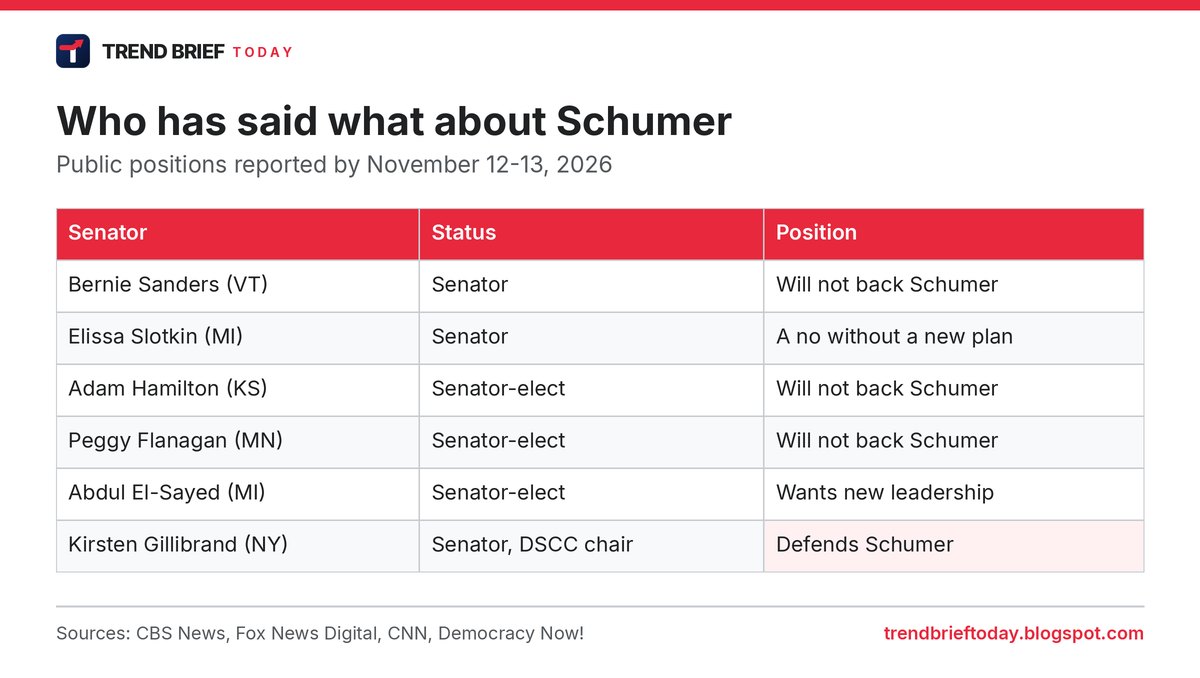
Most Democratic senators have not said publicly how they will vote.[2][4] These are the clearest public positions so far:
| Senator | Status | Position |
|---|---|---|
| Bernie Sanders (Vermont) | Senator, independent who caucuses with Democrats | "I will not be supporting Chuck to be reelected as the Democratic leader"[1][4][6] |
| Elissa Slotkin (Michigan) | Senator | "I'm a no until and unless I see" a plan that is "definitively different"[1][4][6] |
| Adam Hamilton (Kansas) | Senator-elect | Will not back Schumer[1][6][8] |
| Peggy Flanagan (Minnesota) | Senator-elect | Will not back Schumer[6][8] |
| Abdul El-Sayed (Michigan) | Senator-elect | Wants new leadership; praised Van Hollen as "willing to take risks"[1][4][8] |
| Kirsten Gillibrand (New York) | Senator, DSCC chair | Defends Schumer's record[1][6] |
Sanders, a longtime ally, put it this way at a news conference with Slotkin: "I personally have known Chuck Schumer for over 30 years, and I like Chuck. Nobody who works harder than Chuck Schumer. But in my view, the time is now for change."[1] Slotkin said she was "not actively seeking this job" but was "seeking change".[1]
How the vote works
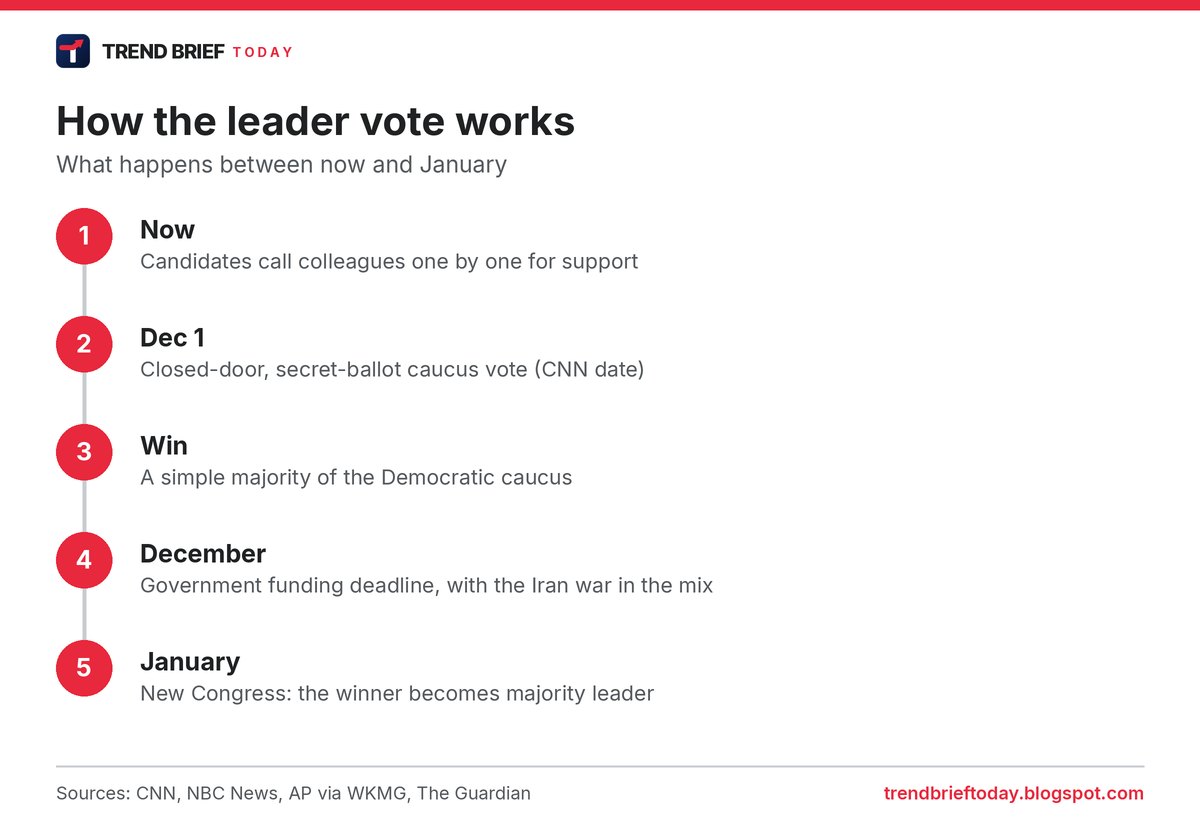
This is not a Senate floor vote, and Republicans have no part in it. Senate Democrats choose their own leader for the next Congress in a private meeting. The ballot is secret, which is one reason public counts of supporters are unreliable.[2][3][5]
- When: early December, according to AP and the Guardian. CNN gives the date as December 1.[2][4][5]
- Who votes: the Democratic caucus, which will have at least 55 members in January.[4]
- What it takes: a simple majority of the caucus.[3][4] With 55 members that would be 28 votes, if everyone votes; that figure is our own arithmetic, not a party rule we have seen published.
- What the winner gets: the job of Senate majority leader when the new Congress begins in January, because Democrats will hold the majority.[1][3]
The vote also lands in a busy month. Van Hollen's team says he wants the new majority to use every tool available to end the Iran war, starting with the government funding bill needed to avoid a shutdown in December.[3] Senate Democrats are already debating whether to use that deadline that way.[9][10]
Who is Chris Van Hollen
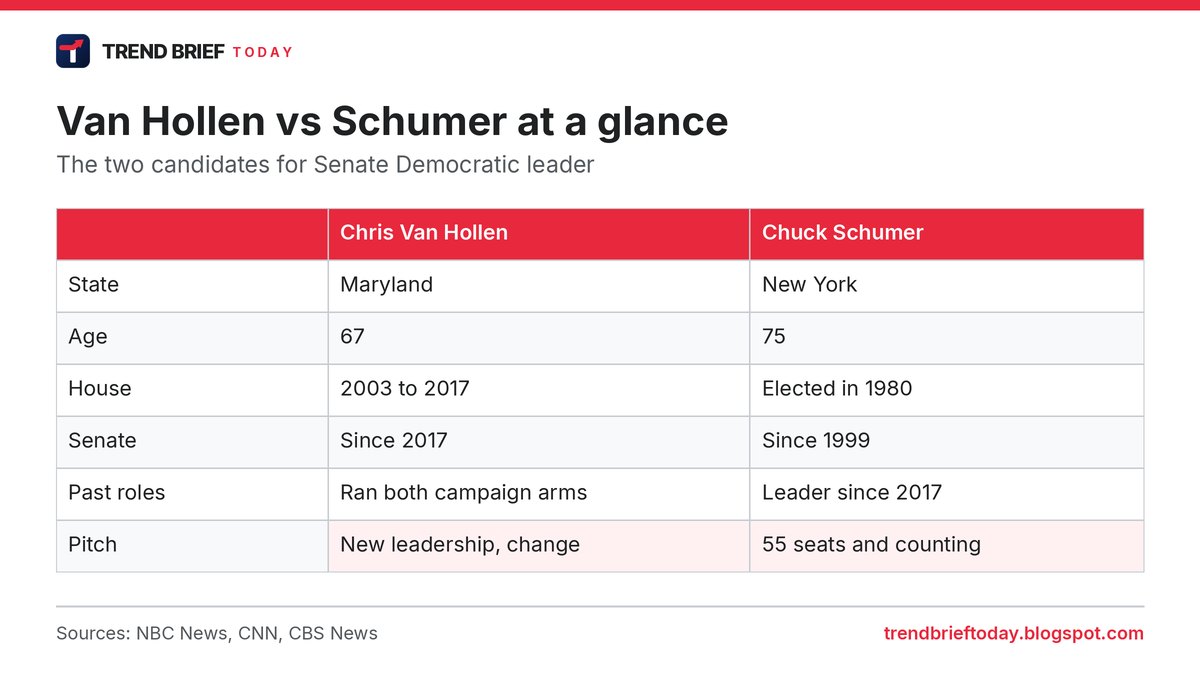
Van Hollen, 67, has been a senator for Maryland since 2017. Before that he spent 14 years in the House, from 2003.[3][4] He has held leadership roles before, including chairing both the House and Senate Democratic campaign arms, which makes him an unusual candidate to carry an anti-establishment message.[4]
His national profile grew over the past two years. He travelled to El Salvador to meet Kilmar Abrego Garcia, a Maryland resident who had been mistakenly deported there, and he has been one of the sharpest Democratic critics of the Israeli government's conduct of the war in Gaza.[1][4] He has also said he is thinking about running for president in 2028.[4][6]
Who is Chuck Schumer
Schumer, 75, has led Senate Democrats since 2017. He was first elected to the House in 1980 and moved to the Senate in 1999.[3][4] Since the election he has been meeting Democratic senators about an agenda for 2027 and, according to AP, laid out a plan for the first 100 days in private caucus meetings this week.[2][5] He told reporters on Tuesday he was "confident I will be elected majority leader".[4]
His critics on the left say he has not fought President Trump hard enough, and many are uneasy with his long support for Israel.[4] He may also face a 2028 primary in New York, and CNN names Representative Alexandria Ocasio-Cortez as a possible challenger.[4]
What to watch next
Three things will tell you how this is going before the ballot. First, whether more returning senators say publicly where they stand; most have not.[2][4] Second, whether anyone else enters the race. No one else had declared as of this update. Third, the December funding fight, which Van Hollen wants to use to press for an end to the Iran war.[3][9]
For the House side of the new Congress, see our page on who leads Congress in 2027.
Frequently asked questions
Is Chris Van Hollen running against Schumer?
Yes. He announced on November 12, 2026 that he will run for Senate majority leader, which means challenging Schumer for the top Democratic job.[1][2][3]
When is the Senate Democratic leader vote?
Early December, in a closed-door secret ballot. CNN reports the date as December 1.[2][4][5]
How many votes does Van Hollen need?
A simple majority of the Democratic caucus.[3][4] In a 55-member caucus that would be 28, by our count.
Does Schumer have the votes?
He says he does.[1][3] The ballot is secret and most senators have not said how they will vote, so nobody outside the caucus can check that claim.[2][4]
Who becomes majority leader if Schumer wins?
Schumer would stay as Democratic leader and become majority leader in January, when Democrats take control of the Senate.[1][3]
References
- CBS News. "Chris Van Hollen will challenge Chuck Schumer for Senate majority leader". 12 November 2026.
- The Associated Press, via WKMG. "Van Hollen to challenge Schumer for Senate Democratic leader, saying voters 'called for change'". Mary Clare Jalonick. 12 November 2026.
- NBC News. "Sen. Chris Van Hollen says he will challenge Sen. Chuck Schumer for majority leader". Frank Thorp V and Sahil Kapur. 12 November 2026.
- CNN. "Chris Van Hollen launches challenge against Chuck Schumer to lead Senate Democrats". 12 November 2026.
- The Guardian. "Chris Van Hollen to challenge Chuck Schumer for Senate majority leader". 13 November 2026.
- Fox News. "Democrats turn on Schumer after historic election wins as potential challenger emerges". 12 November 2026.
- The New Republic. "Van Hollen Calls Out Schumer for Siding With AIPAC and Crypto". 10 November 2026.
- Democracy Now!. "Incoming Freshman Senators Call for New Leadership to Replace Top Democrat Chuck Schumer". 6 November 2026.
- The Hill. "Senate Democrats weigh December funding deadline to force an end to Iran war". 12 November 2026.
- WCVB. "Iran war raises government shutdown risk, some lawmakers say the risk is worth taking". 12 November 2026.