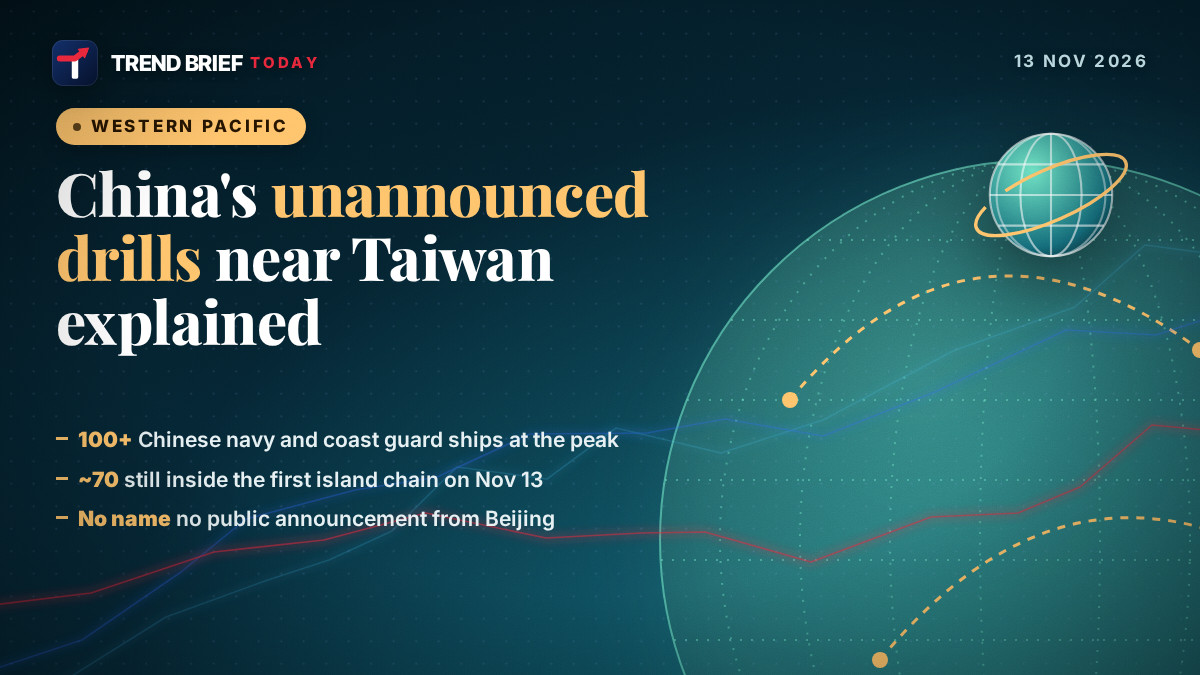
China held a large military exercise across the western Pacific and around Taiwan in early November 2026 without announcing it or giving it a name. A senior Taiwan security official told Reuters it massed more than 100 navy and coast guard ships at its peak and called it "silent intimidation".[1][2][3]
 | |
| Where | Western Pacific, around Taiwan and east of the Philippines[1][3] |
|---|---|
| When | Early November 2026, still going on 13 November[1][2][3] |
| Peak size | More than 100 Chinese navy and coast guard ships[1][3] |
| Now | About 70 ships inside the first island chain (13 November)[1][2] |
| Forces | Eastern, Northern and Southern theatre commands, Liaoning carrier group[1][3] |
| Announced? | No. No name and no public notice from Beijing[1][3] |
| China's line | Carrier training is "routine" and not aimed at any country[1][3] |
| G7 response | Paris statement, 11 November: a threat to stability and freedom of navigation[4][5] |
What happened
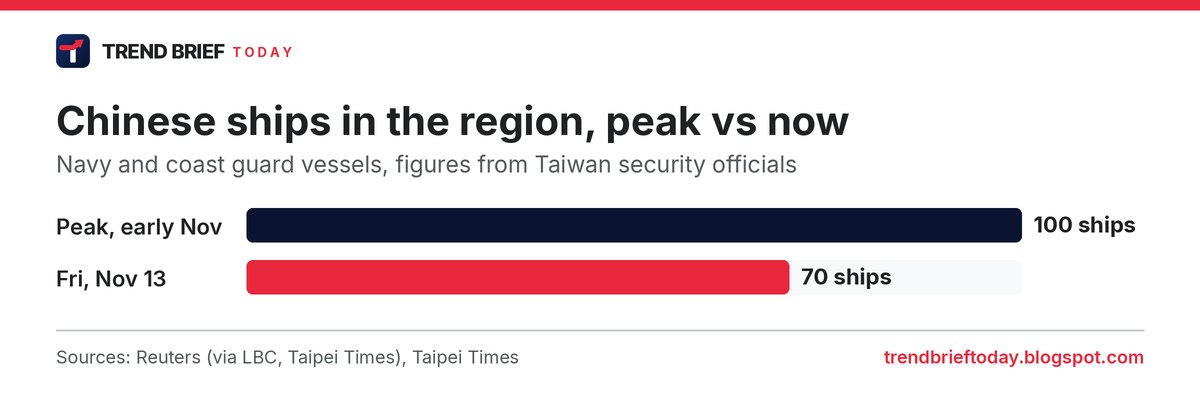
Reuters reported on Friday, 13 November, that China carried out a large exercise across the western Pacific and around Taiwan in early November without the usual public announcement.[1][2] A senior Taiwan security official, who spoke on condition of anonymity, said the Chinese military and coast guard at one point massed more than 100 vessels in the region and ran drills that included simulated attacks on other militaries and on cities, Taiwan's among them.[1][2]
The same number had already been made public in Taipei. The Taipei Times reported that Joseph Wu, secretary-general of Taiwan's National Security Council, posted details of more than 100 Chinese naval and coast guard ships operating off Taiwan, in the South China Sea and out into the Pacific, and that Taiwan's defence ministry had reported a large rise in Chinese military aircraft around the island, even though China had not declared any drills.[3]
According to the Taiwan official quoted by Reuters, a Chinese submarine also launched an intercontinental ballistic missile from the Yellow Sea into mainland China during the exercise.[1][2] That claim comes from a single unnamed official, and China has not commented on it.
Why Taiwan calls it "silent intimidation"
The key word is silent. When China held its last formally named drill aimed at Taiwan, "Justice Mission 2025", nearly a year ago, it announced it. This time there was no name and no notice, yet the official said the naval deployment was larger than Justice Mission 2025 and one of the largest Chinese naval deployments to date.[1][2]
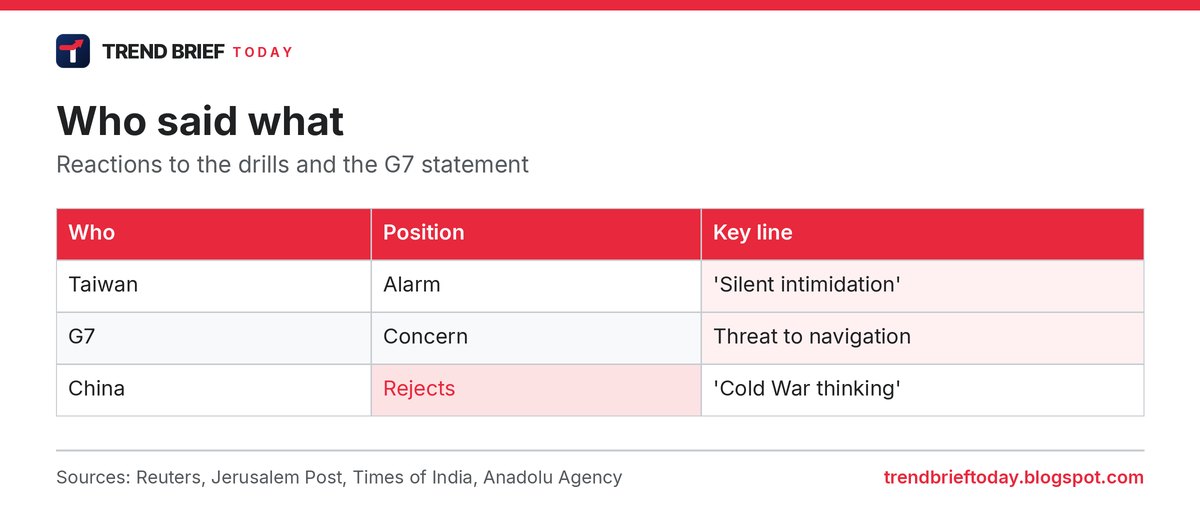
"It is a silent exercise, and in effect, silent intimidation," the official said, comparing it to "a robber hiding a gun in the pocket of a coat" with the muzzle pointed at a bank teller: enough to scare, without setting off the alarm.[1][2] A foreign intelligence source told Reuters the "silent drills without a name" looked deliberate, letting Beijing apply military pressure while avoiding a diplomatic backlash.[1][2]

What "area denial" means
Taiwan's defence minister, Wellington Koo, confirmed on Tuesday, 10 November, that China was running "area denial" drills in the western Pacific with the Liaoning carrier group and other naval formations.[3][4] Area denial, often written A2/AD, means keeping an outside force away from a fight. Around Taiwan, that means stopping US or allied ships from coming to help if China attacked.[3]
Koo said the drills were "intended to undermine peace and stability in the Indo-Pacific region" and that Taiwan would share intelligence with allies to keep watching them.[3] China's defence ministry has said the Liaoning group's training in the western Pacific is an annual routine and not directed at any country.[1][3]
The Taiwan official also said forces from three Chinese theatre commands, Eastern, Northern and Southern, worked together. That suggests Beijing was rehearsing more than a blockade of Taiwan: broader operations across the western Pacific, and an effort to merge regional fleets into a single far-seas force.[1][2]
Where things stand now
The deployment has shrunk this week. Two Taiwan security officials told Reuters about 70 Chinese vessels were operating inside the first island chain on Friday.[1][2] Wu posted on X late on Thursday that although the number had fallen, "the groups of Northern, Eastern & Southern Theater Commands plus Liaoning carrier strike group remain operating in waters east of the Philippines", and that Chinese air force activity near Taiwan stayed high.[1][2]
China's defence ministry did not respond to Reuters' request for comment.[1][2] On Friday, the state-backed Global Times warned that if Taiwan's ruling party kept "seeking 'independence by relying on external forces or military means'" it would "face a harsh reckoning", Reuters reported.[1][2]
The G7 warning and China's reply
The drills overlap with a diplomatic row. G7 foreign ministers said in a joint statement published late on Wednesday, 11 November, after talks in Paris, that China's increasingly assertive activities in the waters east of Taiwan "threaten regional stability, freedom of navigation and the safety of international shipping".[4][5] They added: "We reaffirmed our opposition to any unilateral attempts to change the status quo, particularly by force or coercion, or the threat thereof."[4][5]
Taiwan has said for months that China's coast guard has patrolled off its east coast regularly since June, and officials believe Beijing is practising for a possible blockade using military, paramilitary and civilian ships. Taipei sees those waters as a vital supply route from allies in a crisis.[4][5]
Beijing rejected the statement. Foreign ministry spokesperson Mao Ning said it "disregards objective facts" and that the G7 had "grossly" interfered in China's internal affairs, describing the group as an ideological clique engaged in bloc politics.[6] Taiwanese spokesperson Karen Kuo thanked the G7 and the EU and said Taiwan would strengthen its defence and work with partners.[6]
Why the timing matters
Officials in Taipei say the drills were meant to pressure Taiwan and other governments before major international meetings.[1][2] China hosts the APEC leaders' summit in Shenzhen next week, where US President Donald Trump and Chinese President Xi Jinping are expected to meet for the third time this year. Taiwan also attends APEC.[1][2] Taiwan also holds local elections at the end of November.[3]
On Thursday, 12 November, Xi gave a speech in Beijing marking the 160th birthday of Sun Yat-sen, saying the complete "reunification" of China with Taiwan must be realised and that resolving the Taiwan question is an "unwavering historical mission" of the Communist Party.[4] Reuters noted he urged peaceful "reunification" and made no mention of using force.[1][2] China has never renounced the use of force to bring Taiwan under its control.[1][4]
Timeline
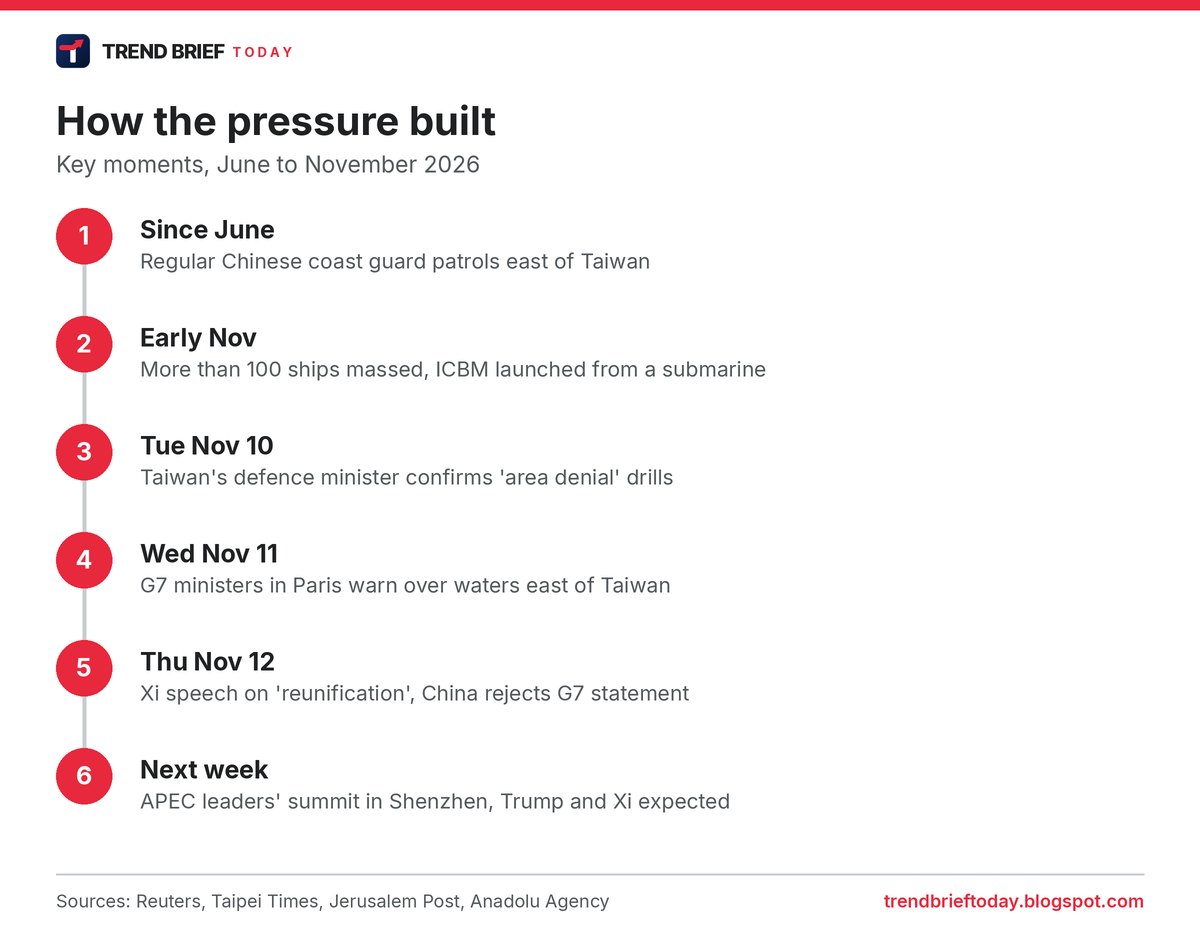
| Date | Event |
|---|---|
| Nearly a year ago | China holds "Justice Mission 2025", its last formally named drill aimed at Taiwan[1][2] |
| Since June 2026 | Regular Chinese coast guard patrols off Taiwan's east coast[4][5] |
| Early November 2026 | More than 100 Chinese navy and coast guard ships massed; submarine ICBM launch reported[1][3] |
| 10 November | Defence minister Wellington Koo confirms "area denial" drills[3][4] |
| 11 November | G7 foreign ministers' statement in Paris[4][5] |
| 12 November | Xi's "reunification" speech; China rejects the G7 statement[4][6] |
| 13 November | Reuters reports the "silent intimidation" drills; about 70 ships still deployed[1][2] |
| Next week | APEC leaders' summit in Shenzhen[1][3] |
Frequently asked questions
Is China doing military drills around Taiwan right now?
Yes, according to Taiwan. About 70 Chinese vessels were inside the first island chain on 13 November, down from a peak of more than 100, and the Liaoning carrier group is still east of the Philippines.[1][2]
Why didn't China announce the drills?
China has not said. A foreign intelligence source told Reuters the lack of a name looked deliberate, to apply pressure while avoiding a diplomatic backlash.[1][2]
Were these drills bigger than Justice Mission 2025?
At sea, yes, according to a senior Taiwan security official, who called it one of the largest Chinese naval deployments to date.[1][2] China has published no figures.
What did the G7 say about Taiwan?
That China's assertive activities east of Taiwan threaten regional stability, freedom of navigation and the safety of shipping, and that it opposes changing the status quo by force or coercion.[4][5]
What does China say?
That the carrier training is routine and not aimed at any country, and that the G7 interfered in its internal affairs.[1][3][6]
References
- Reuters via LBC. "China stages unannounced Pacific drills in 'silent intimidation' of Taiwan, officials say". 13 November 2026.
- Taipei Times (Reuters). "China stages Pacific drills in 'silent intimidation' of Taiwan". 13 November 2026.
- Taipei Times. "China conducting 'area denial' drills". 11 November 2026.
- The Jerusalem Post (Reuters). "G7 foreign ministers say China's actions east of Taiwan threaten stability". 12 November 2026.
- The Times of India. "G7 members raise alarm over China's activities near Taiwan". 12 November 2026.
- Anadolu Agency. "China accuses G7 of 'Cold War thinking' over Taiwan statement". 12 November 2026.