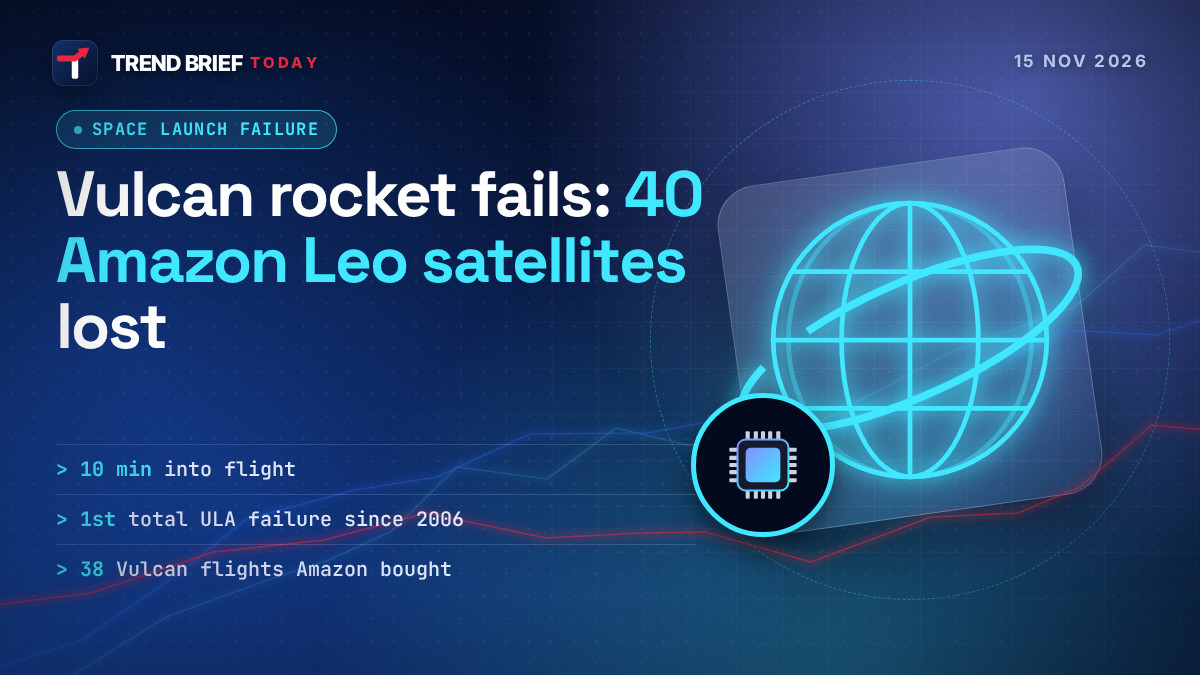
A United Launch Alliance (ULA) Vulcan rocket failed on Sunday, 15 November 2026, about 10 minutes after lifting off from Cape Canaveral in Florida, and the 40 Amazon Leo internet satellites on board never reached orbit. It is the first total mission failure in ULA's 20-year history and the first of 38 Vulcan launches Amazon has bought for its rival to SpaceX's Starlink. ULA says it does not yet know what went wrong.[1][2][3]
 | |
| Date | Sunday, 15 November 2026[1][4] |
|---|---|
| Liftoff | 12:40 p.m. ET (17:40 GMT)[1][4] |
| Launch site | Space Launch Complex 41, Cape Canaveral Space Force Station, Florida[1][4] |
| Rocket | ULA Vulcan Centaur with six solid rocket boosters (fifth Vulcan flight)[1][3] |
| Payload | 40 Amazon Leo broadband satellites[1][3][4] |
| Outcome | Anomaly about 10 minutes into flight; payload did not reach orbit[1][4] |
| Record | First total mission failure since ULA formed in 2006[1][2] |
| Cause | Not yet known; investigation under way[2][3] |
What happened on Sunday
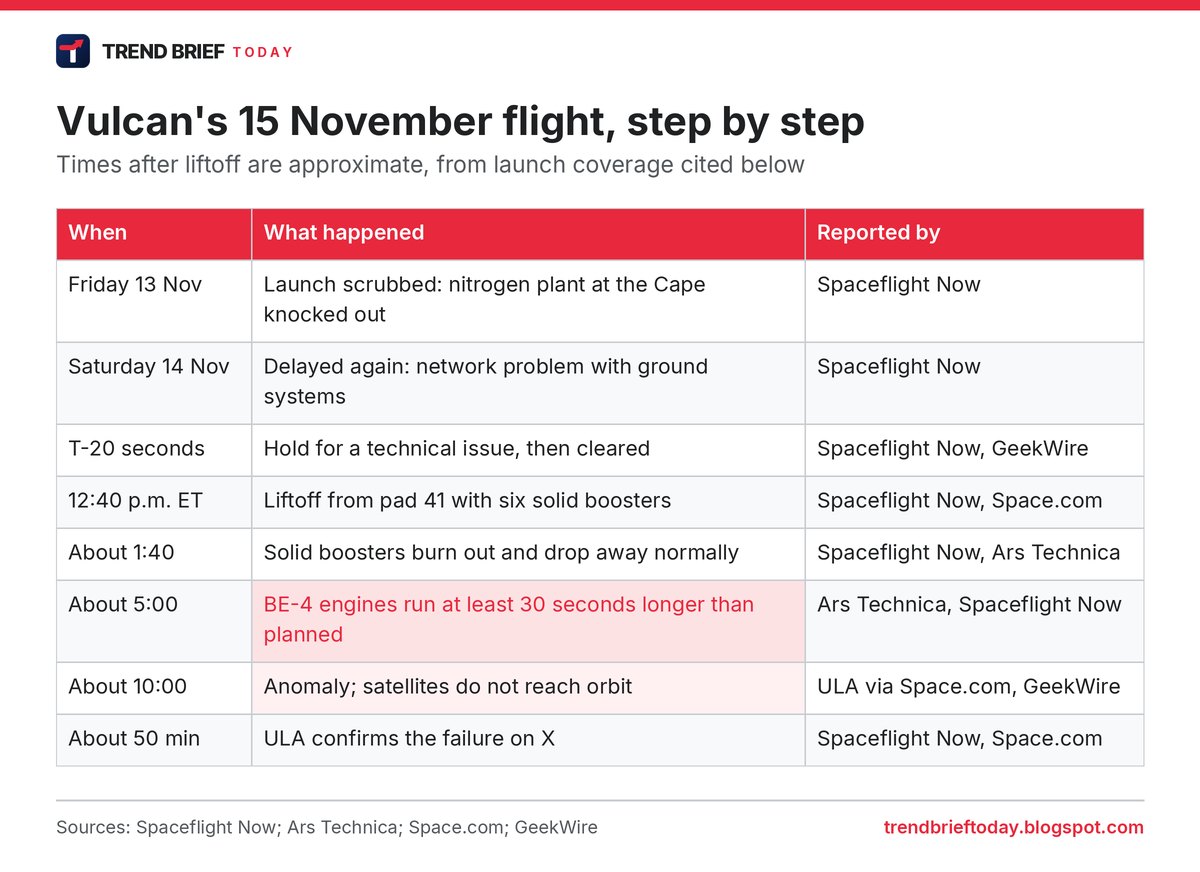
The Vulcan finally got off the ground at the third attempt. A try on Friday was called off when a nitrogen plant that serves several launch companies at the Cape broke down, and Saturday's attempt was stopped by a network problem between the rocket and ground systems.[1] On Sunday the countdown was held at 20 seconds for a technical issue, which ULA fixed before lifting off at 12:40 p.m. Eastern time near the end of the launch window. Nobody has said whether that issue had anything to do with what came next.[1][3]
The first two minutes looked normal. The six Northrop Grumman solid rocket boosters, which had caused trouble on two earlier Vulcan flights, burned out and fell away on time.[1][2][3] After that, things started to look wrong. The two Blue Origin BE-4 engines on the first stage were meant to shut down just before the five-minute mark but kept firing for at least 30 seconds longer, and the live animation on ULA's webcast, which is driven by real telemetry, showed the rocket starting to spin.[2][1]
The Centaur V upper stage separated, lit its two RL10 engines and appeared to steer to get back on course. ULA ended its broadcast without mentioning a problem.[2][1] About 50 minutes after liftoff, it posted a statement on X: the Vulcan "suffered an anomaly 10 minutes into the flight and failed to deliver the Amazon mission to orbit."[1][4] Ars Technica reports that the rocket and its 40 satellites fell back to Earth minutes after launch.[2]
What caused the Vulcan failure?
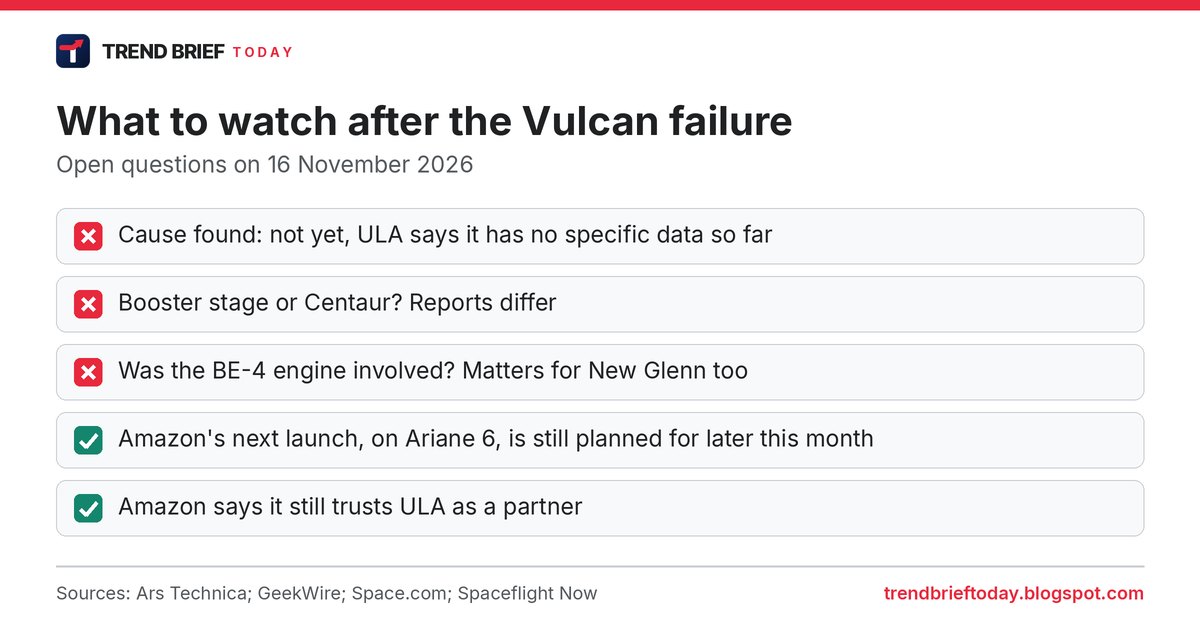
Nobody knows yet. ULA said: "Since the anomaly just occurred, we don't have any specific data yet to understand what occurred today."[4] It promised to "find the cause, determine the appropriate corrective action and return to flight as quickly as possible", and said Amazon and its other customers will see the investigation as it goes.[1][2]
Early reports point in two directions. ULA's own update put the trouble during the Centaur upper stage burn, and Spaceflight Now and GeekWire reported it that way.[1][3] Ars Technica, however, says several sources told it the anomaly happened in the first stage, not in the Centaur or the solid boosters. An engine overburn like the one seen on Sunday can be a sign that a stage is underperforming and is firing longer to make up for it.[2] We will only know which account is right when ULA publishes findings.
The engines matter for more than one company. The BE-4 also powers Blue Origin's New Glenn, which exploded during a ground test in May because of a faulty valve in one of its BE-4s. ULA chief executive Mark Peller said before the flight that the engines on this Vulcan had been retrofitted with Blue Origin's fix.[1][3] If a BE-4 turns out to be at fault, Ars Technica notes, it could also hold up New Glenn's return to flight.[2]
Why it matters for Amazon Leo
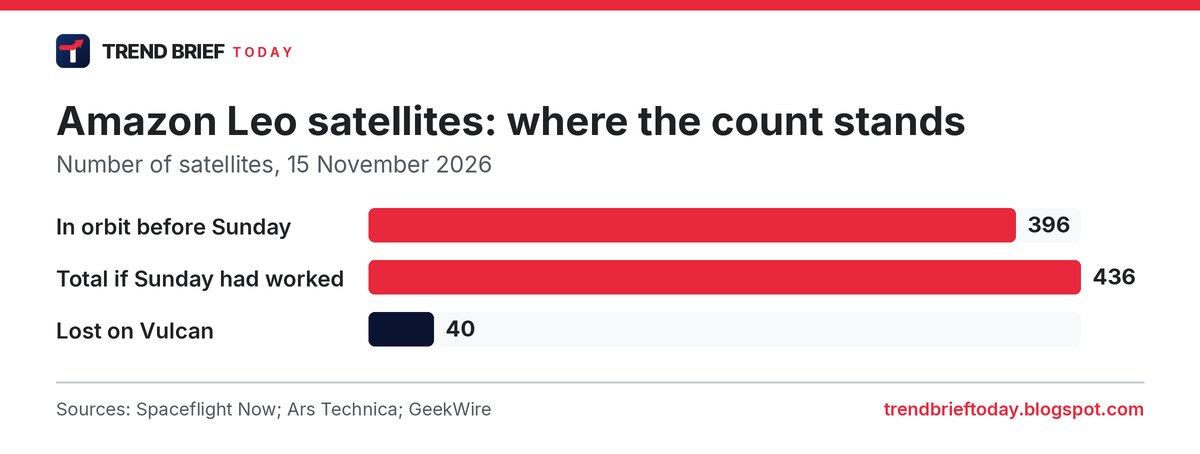
Amazon Leo, the network once called Project Kuiper, is Amazon's plan to sell satellite broadband straight to homes and businesses, the first head-to-head rival to Starlink in that market.[2][3] Before Sunday it had 396 satellites in orbit, and this flight would have taken the total to 436.[1][2][3] That is a small part of the more than 3,200 first-generation satellites it needs.[2][3]
Losing 40 satellites hurts, but the bigger problem is the rocket. Vulcan was meant to be the programme's "primary workhorse" for years, carrying more than 1,500 satellites, and Amazon had said a second Vulcan flight could follow within weeks.[3] Now that has to wait for the investigation. Its other big rocket, New Glenn, has been grounded since May, so two of Amazon's three largest launch contracts are on hold at once.[1][2][3]
Amazon was calm in public. "There is risk with any launch, and that's especially true for inaugural missions like LV-01," it said. "ULA has been a trusted partner for Amazon, and we believe they'll learn from this mission and deliver on their long-term plans for Vulcan."[2][3] Its next launch is on Europe's Ariane 6, planned for later in November.[2][3]
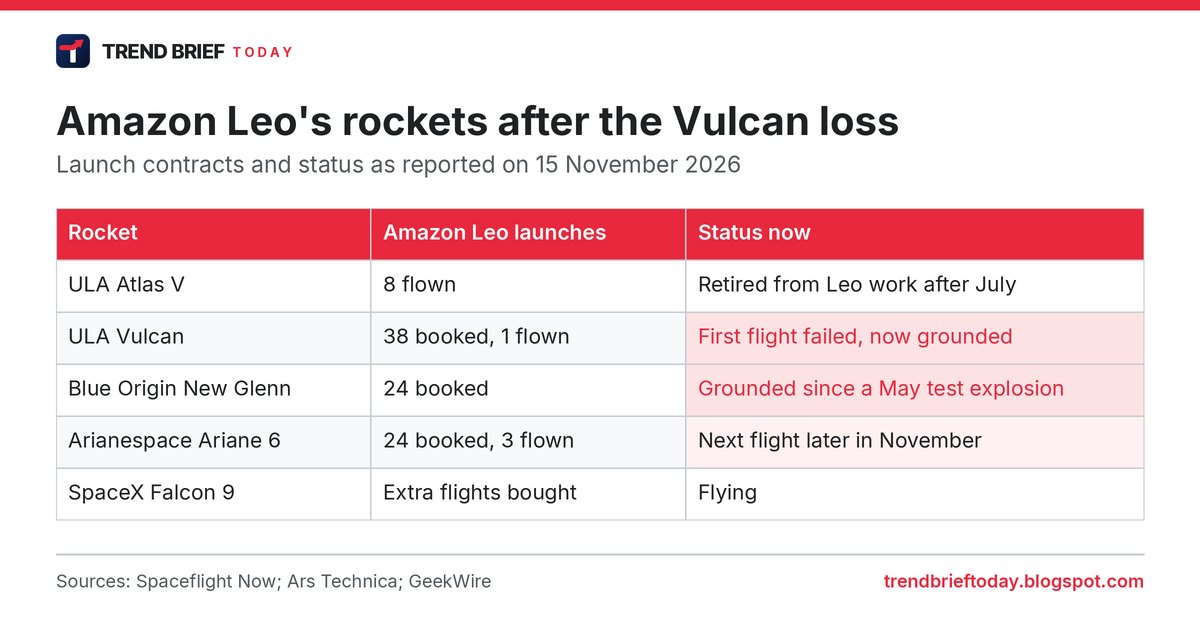
| Rocket | Amazon Leo bookings | Status on 16 November |
|---|---|---|
| ULA Vulcan | 38 launches, 1 flown[1][2] | First Leo flight failed, expected to be grounded[2] |
| Blue Origin New Glenn | 24 launches[1][3] | Grounded since a May test explosion[1][2] |
| Arianespace Ariane 6 | 24 launches, 3 flown[2] | Next flight later in November[2][3] |
Vulcan's track record so far
Vulcan replaced ULA's Atlas V and first flew in January 2024. Sunday's launch was its fifth flight, its first in nine months and the first with six solid boosters.[1][3][4] On the second flight, in October 2024, and the fourth, in February 2026, a solid booster nozzle failed. Both times the rocket still reached orbit, but the US Space Force paused Vulcan national security launches after February while ULA and Northrop Grumman fixed the nozzles.[1][3][4] This time the boosters worked and something else went wrong.
ULA, a joint venture of Boeing and Lockheed Martin, had never lost a mission outright since it was formed in 2006.[1][3] It also has new leadership: long-time chief executive Tory Bruno left for Blue Origin last December, and Peller, who led Vulcan's development, became CEO in August.[3]
| Vulcan flight | When | What happened |
|---|---|---|
| Flight 1 | January 2024[4] | Debut[4] |
| Flight 2 | October 2024[3][4] | Solid booster nozzle problem, still reached orbit[3][4] |
| Flight 4 | February 2026[3][4] | Second nozzle problem, still reached orbit[3] |
| Flight 5 (LV-01) | 15 November 2026[1] | Failed about 10 minutes in, 40 satellites lost[1][3] |
What happens next
Vulcan is expected to stay grounded for an open-ended period while engineers go through the data.[1][2] That reaches beyond Amazon. Ars Technica reports that Vulcan is meant to carry about half of the US military's national security launches in the next few years, so the Pentagon is likely to lean even harder on SpaceX, and that the rocket's problems could also touch NASA's Artemis Moon plans.[2] For SpaceX, which runs Starlink and launches most US missions, the failure leaves its two main American rivals in launch and broadband slowed at the same time. For a look at where SpaceX's own next rocket stands, see our report on Starship Flight 15 and the first ship catch.
Starlink's power in space has been a political story too this month, with Ukraine asking for limits on its military version to be lifted; see Starshield restrictions in Ukraine.
Frequently asked questions
What happened to the ULA rocket launch today?
ULA's Vulcan rocket lifted off at 12:40 p.m. ET on 15 November 2026 but suffered an anomaly about 10 minutes into the flight. Its 40 Amazon Leo satellites did not reach orbit.[1][4]
How many Amazon satellites were lost?
Forty Amazon Leo satellites were lost. Amazon had 396 in orbit before the launch.[2][3]
Has a ULA rocket failed before?
Not completely. This is ULA's first total mission failure since the company was formed in 2006. Two earlier Vulcan flights had booster nozzle problems but still reached orbit.[1][3]
Was Blue Origin's BE-4 engine to blame?
That is not known. The first stage engines fired longer than planned, and Ars Technica's sources point to the first stage, but ULA has not named a cause.[1][2]
When will Amazon launch more Leo satellites?
Amazon's next planned launch is on an Ariane 6 rocket later in November. Vulcan flights will wait for the investigation.[2][3]
References
- William Harwood, Spaceflight Now, ULA suffers first outright failure with loss of Vulcan rocket carrying 40 Amazon Leo satellites, 15 November 2026.
- Stephen Clark, Ars Technica, Vulcan rocket fails during launch, dealing major blow to SpaceX competitors, 15 November 2026.
- GeekWire, Amazon loses 40 Leo satellites in ULA Vulcan launch failure, a new setback for its Starlink rival, 15 November 2026.
- Mike Wall, Space.com, Vulcan Centaur rocket fails during return-to-flight launch, 40 Amazon satellites lost, 15 November 2026.