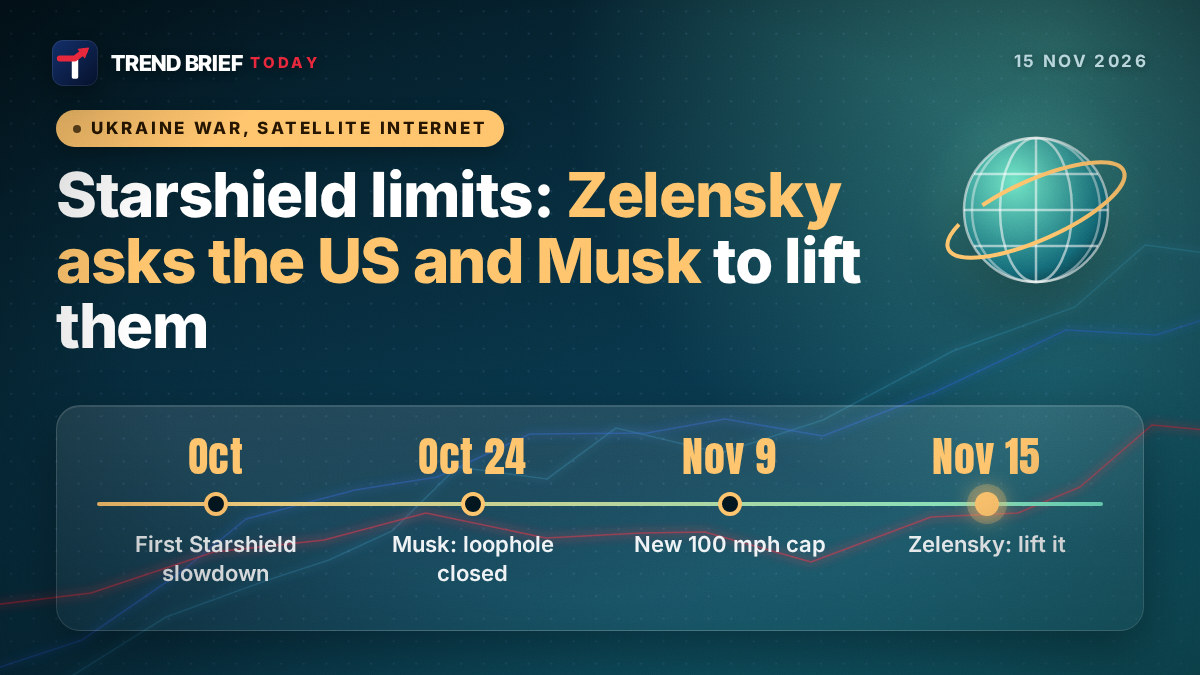
Ukrainian President Volodymyr Zelensky on Sunday, 15 November 2026, asked the United States and Elon Musk's SpaceX to lift new speed limits on Starshield, the military version of Starlink that Ukraine uses to guide interceptor drones. He says the drones lose their link at about 100 mph (161 km/h) near the front line, so they cannot catch Russia's jet-powered Shahed drones. SpaceX has called Ukraine's claim false, and the White House had not commented by Sunday evening.[1][2][4]
 | |
| System | Starshield, the military-grade version of SpaceX's Starlink[1][6] |
|---|---|
| Provided to Ukraine by | The US government[1] |
| Reported limit | About 100 mph (161 km/h) for connected devices[1][4] |
| Where | Along the front line and over Russian-occupied areas[1][4] |
| Started | Monday, 9 November 2026, according to Zelensky[1][4] |
| Earlier slowdown | October 2026, later restored[6][7] |
| SpaceX position | Told Axios the Ukrainian claim was false[4] |
| Latest | Zelensky asks the US and SpaceX to lift the limits, 15 November[1][2] |
What Zelensky said on Sunday
Zelensky's post on Sunday was short and blunt. "We are counting on these restrictions being lifted," he wrote. "The protection of lives and Ukraine's energy infrastructure ahead of winter directly depends on this."[1][2] He said he had told the foreign ministry, the defence ministry and his own office to work closely with the American side and with SpaceX, and added: "It is important to be on the right side of history."[1][2]
His complaint is practical. Russia keeps sending Shahed drones at electricity substations, and Ukraine now uses its own interceptor drones to hunt them. Zelensky says those interceptors "lose connection with their operators at a speed of 161km/h (100mph) and simply cannot catch up with Russian jet-powered 'shaheds'", because the limits on Starshield terminals along the front line and in the occupied territories are "still there".[1][3] On Saturday he questioned whether this was a technical fault at all. Al Jazeera reports he said Starlink had pointed to technical problems, but Ukraine does "not believe that is the case".[3]
The timing matters for ordinary Ukrainians. Overnight into Sunday, a strike on an energy site in the Odesa region left about 41,000 households without power, according to the energy company DTEK.[2][3] Ukraine's army said it shot down 106 of 132 Russian drones launched that night.[3]
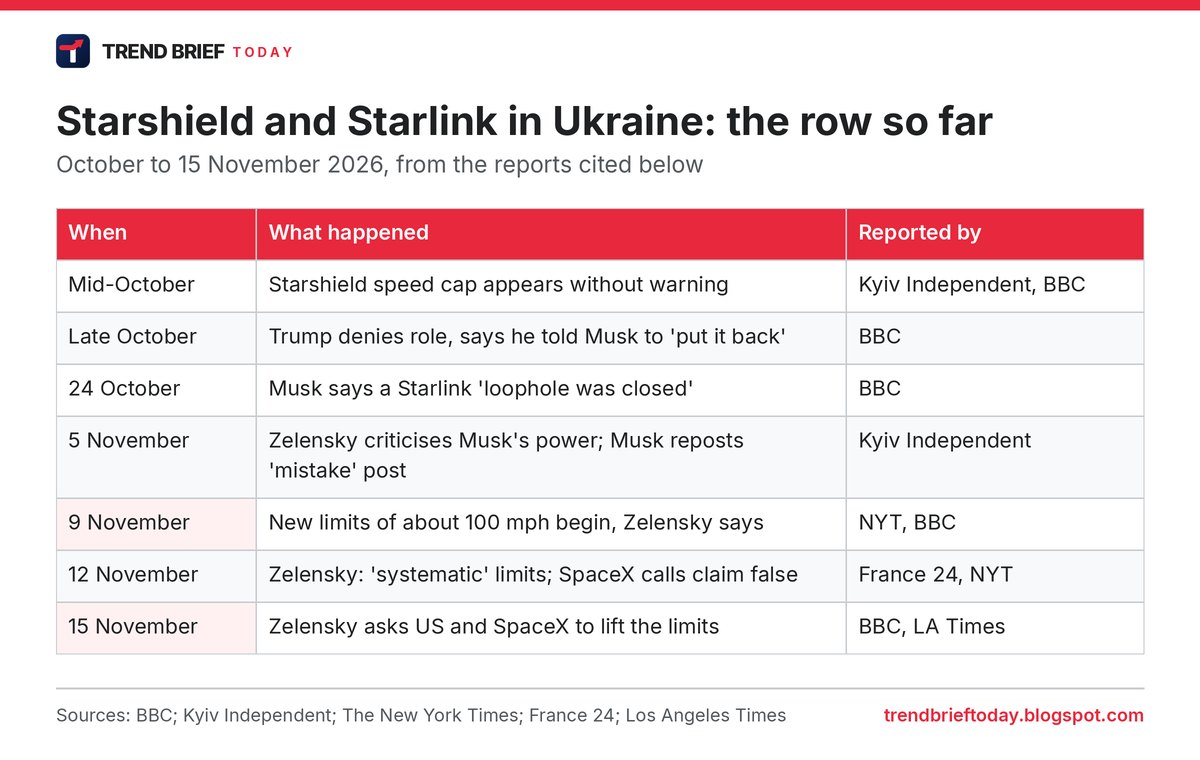
Starlink and Starshield are not the same thing
Most headlines say "Starlink", but the November problem is with Starshield. Both run on SpaceX satellites in low Earth orbit. Starlink is the civilian service, and Ukrainian units use it to talk to each other on the battlefield. Starshield is the more secure, military-grade service. It lets drone operators see targets in real time and fly interceptor drones, and it is provided to Ukraine by the US government.[1][6]
That split is why the blame keeps moving around. Musk has said Starshield is controlled by the US government and that "what they decide to do is up to them".[6] Zelensky, by contrast, said on Saturday that the limits seemed to have been imposed by SpaceX, even though Secretary of State Marco Rubio had earlier assured Ukraine that Starshield was more under US government control, according to the AP's report in the Los Angeles Times.[2]
| Point | Starlink | Starshield |
|---|---|---|
| Type | Civilian commercial service[6] | Military-grade version[1] |
| Main job in Ukraine | Battlefield communications[1] | Intercepting missiles and drones[1] |
| Speed limit reported | 70-90 km/h for drones, does not work over Russia[6] | About 161 km/h near the front since 9 November[1][4] |
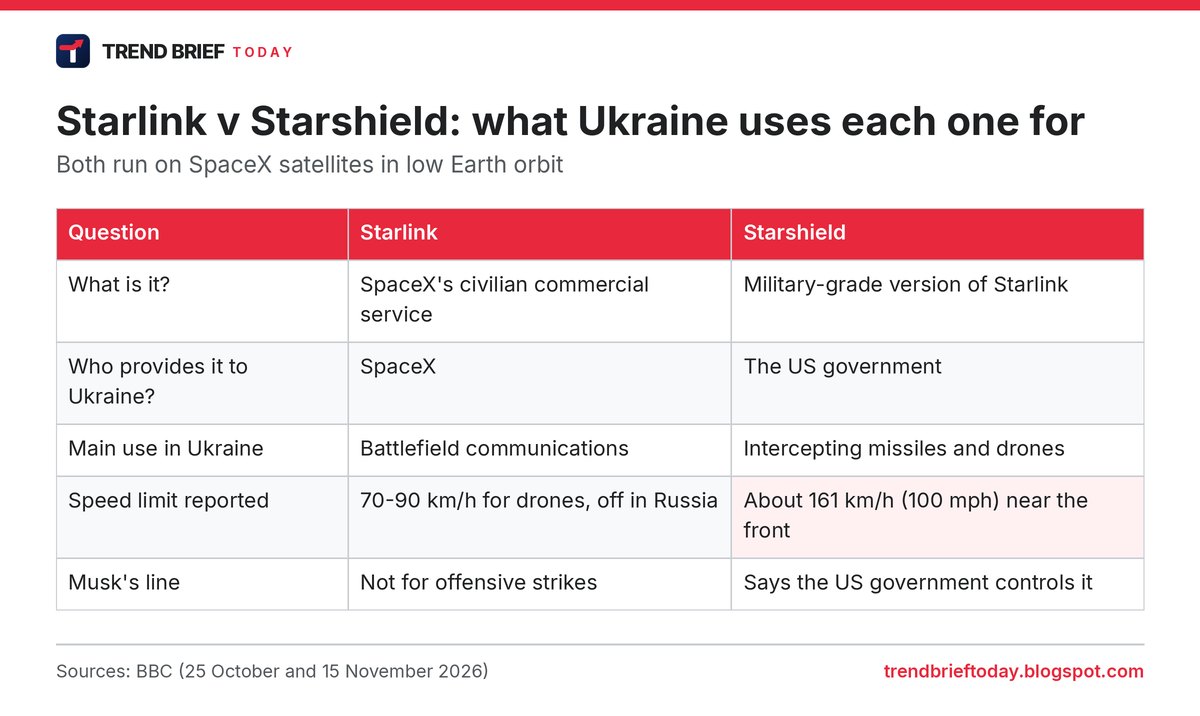
How the row started in October
Ukraine first noticed Starshield slowing down in mid-October, with a speed cap that arrived without warning and made it harder to intercept jet-powered drones.[1][7] It came during a tense spell between Kyiv and Washington. France 24 links the first problems to a row between Zelensky and Donald Trump over a US-Russia diesel deal, and the BBC to a dispute over Ukrainian strikes on Russian oil refineries, which Trump said had pushed oil prices higher.[1][5]
Trump denied ordering any slowdown and said he had told Musk to "put it back".[6] On Saturday 24 October, Musk wrote on X that Ukraine's military had "violated Starlink terms of service and used it for offensive drone strikes to kill people", and that "that loophole was closed last week".[6] Ukrainian adviser Serhii Beskrestnov answered that drones on commercial Starlink were already capped at 70 to 90 km/h and did not work over Russia, so they "physically cannot" be used for deep strikes.[6] Service then came back, and Zelensky later said the weeks of throttling had cost civilian lives.[7]
Relations did not improve. On 5 November Zelensky told German TV there was "too much power in the hands of one very wealthy person". The same day Musk reposted a post on X that called it a "mistake" for SpaceX to have sent Ukraine thousands of free Starlink dishes at the start of the war.[7] The Kyiv Independent also reported that the Pentagon's watchdog turned down a request from US senators of both parties to investigate the October disruption.[7]
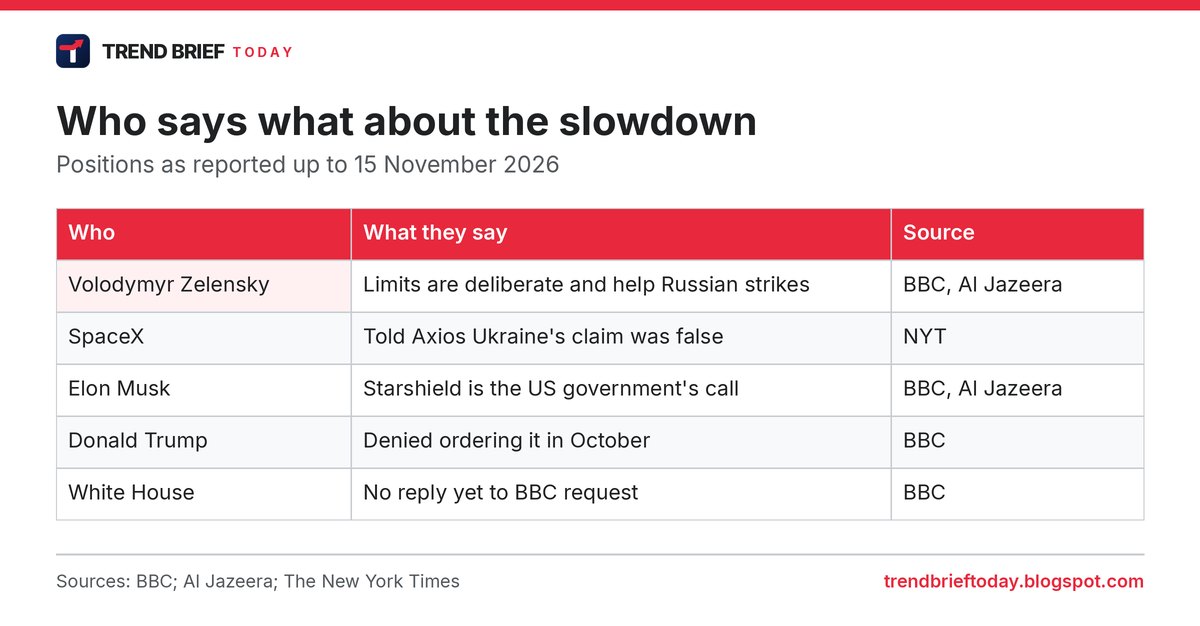
The second slowdown in November
On Thursday 12 November Zelensky said his units had recorded "significant disruptions" for several days, calling them "systematic speed restrictions" and "not random errors". "This is helping the Russians kill more Ukrainians and carry out more accurate strikes," he said.[5] The New York Times reported that he dated the new limits to Monday 9 November and said they applied over Russian-occupied areas, not the whole country.[4]
That detail worries Kyiv for a political reason as well as a military one. "If you impose restrictions there, you are already partially recognising the temporarily occupied territories as not ours," Zelensky said.[1][4] It lands while US envoys push a peace plan in which, Zelensky says, Washington floated Ukraine giving up Donbas in return for NATO membership. We covered that in Ukraine NATO membership for Donbas and in our Ukraine peace talks explainer.
SpaceX has not given a full public account. The New York Times said Musk and SpaceX did not answer its questions on Friday evening, and that SpaceX had earlier told Axios the Ukrainian claim was false.[4] The BBC said it had asked the White House for comment.[1]
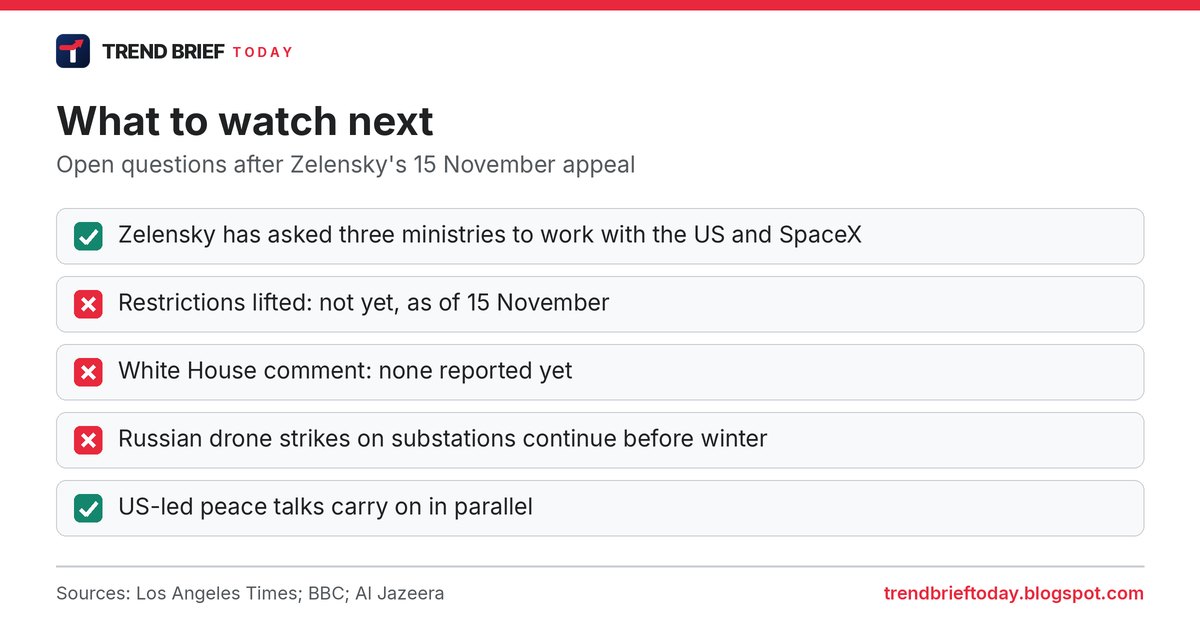
What happens next
There are three things to watch. First, whether the speed limits are lifted. Zelensky has made that request in public and given three parts of his government the job of pushing it with the US and SpaceX.[2] Second, whether anyone in Washington takes ownership of the decision, since both Trump and Musk pointed elsewhere in October.[6] Third, the weather. Russia has repeatedly hit Ukraine's power grid in winter, and Zelensky's argument is that every week of slow Starshield links means more drones reach substations.[2][3]
For SpaceX itself, this is a separate story from its consumer plans in the US. If you came here looking for those, see our explainer on Starlink Mobile and SpaceX's plan to take on the big carriers.
Frequently asked questions
What is Starshield?
Starshield is the military-grade version of SpaceX's Starlink satellite internet. Ukraine uses it to fly interceptor drones and to intercept missiles and drones, and it is provided to Ukraine by the US government.[1]
Has Elon Musk turned off Starlink in Ukraine?
No. Ukraine says Starshield, not the whole Starlink network, is being slowed to about 100 mph along the front line and over occupied areas. SpaceX has said the claim is false.[1][4]
Why does a speed limit matter for drones?
Zelensky says Ukrainian interceptor drones lose their link to operators above about 161 km/h, which is too slow to catch Russia's jet-powered Shahed drones.[1][3]
When did the restrictions start?
The first slowdown was in mid-October 2026 and was later restored. Zelensky says the new limits began on Monday 9 November.[4][7]
Who controls Starshield?
Musk has said the US government controls it. Zelensky said on Saturday that the limits appeared to come from SpaceX, despite earlier US assurances.[2][6]
References
- Dan Sales, BBC News, Zelensky urges US and Musk to lift Starlink restrictions and be on 'right side of history', 15 November 2026.
- Samya Kullab, Associated Press via Los Angeles Times, Zelensky says Starshield restrictions threaten Ukraine's energy defenses ahead of winter, 15 November 2026.
- Al Jazeera, Starshield restrictions help Russia's energy attacks on Ukraine: Zelenskyy, 15 November 2026.
- Kim Barker, The New York Times, Ukraine's Starshield Access Is Being Restricted Again, Zelensky Says, 14 November 2026.
- France 24, New restrictions to Starshield network 'kill more Ukrainians', Zelensky says, 12 November 2026.
- Aleks Phillips, BBC News, Musk says SpaceX restricted Ukraine's Starlink connection as service restored, 25 October 2026.
- Abbey Fenbert, The Kyiv Independent, Musk reposts tweet calling Starlink service for Ukraine 'mistake', 7 November 2026.