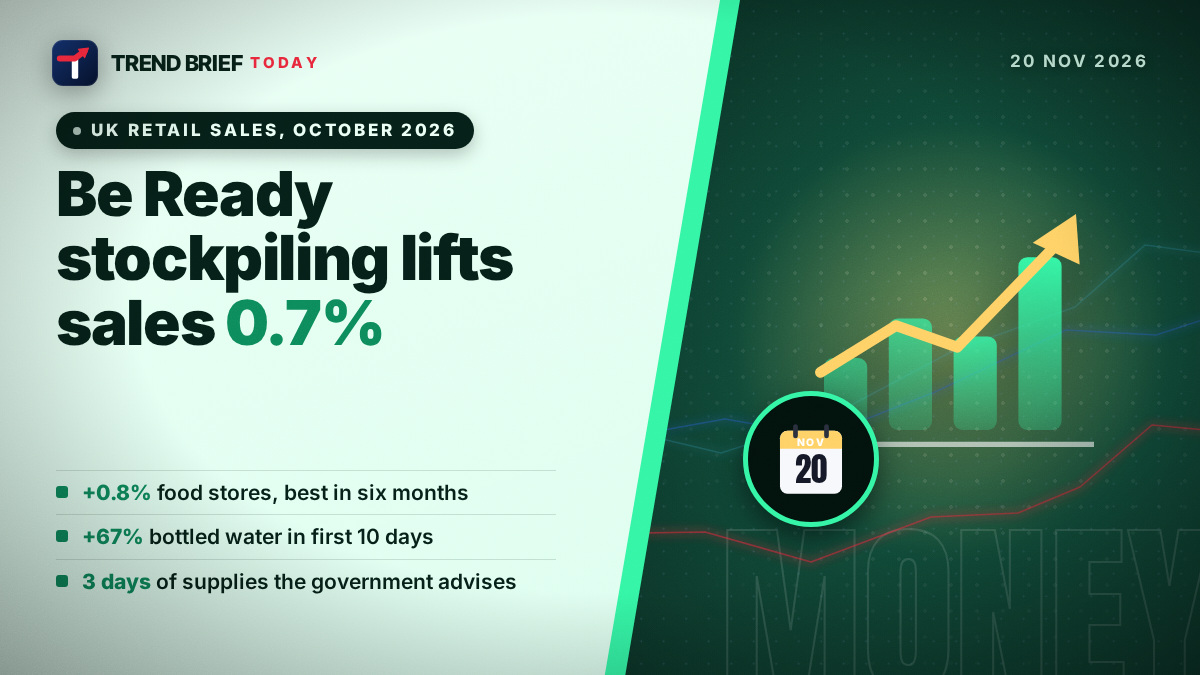
UK retail sales volumes rose 0.7% in October 2026, against forecasts of a small fall or no change, and the Office for National Statistics says a large part of the lift came from supermarkets selling more tinned food and UHT milk after the government's Be Ready emergency campaign launched on 22 October.[1][5] Food store volumes rose 0.8%, the strongest month in half a year, while hand sanitiser and bottled water sales jumped 83% and 67% in the campaign's first ten days.[4][5] Look closer, though, and October only won back what September lost: the volume index is exactly where it was in August.[1]
 | |
| Published | 20 November 2026, ONS[1] |
|---|---|
| Volumes, month | +0.7% (September revised to -0.6%)[1] |
| Volumes, 3 months | +0.4% vs three months to July[1] |
| Volumes, year | +2.3% vs October 2025[1] |
| Forecast | -0.1% (economists polled, per PA)[5] |
| Food stores | +0.8%, strongest in six months[1][5] |
| Fuel | -2.2%, steepest fall since April[1][4] |
| Online share | 29.2% of spending (29.1% in September)[1] |
| Campaign | Be Ready, launched 22 October 2026[2] |
| Next release | 18 December 2026 (November data)[1] |
What the October retail sales figures show
The quantity of goods bought in British shops rose by 0.7% between September and October, the ONS said on Friday morning.[1] Economists had pencilled in a dip of about 0.1%, according to PA, and the Guardian reports a consensus of flat sales, so either way this was a beat.[4][5] Compared with October 2025, volumes were up 2.3%. Over the three months to October, the measure the ONS itself prefers because single months jump around, sales rose 0.4%.[1]
Grant Fitzner, the ONS chief economist, put the cause plainly: "Supermarkets have told us that sales of long-life food items such as tinned food and UHT milk were boosted by the government's 'Be Ready' campaign."[4][7] That is an unusual thing for a statistics office to say. Retail sales reports usually blame the weather, discounting or the timing of Easter. This time it was a government leaflet.
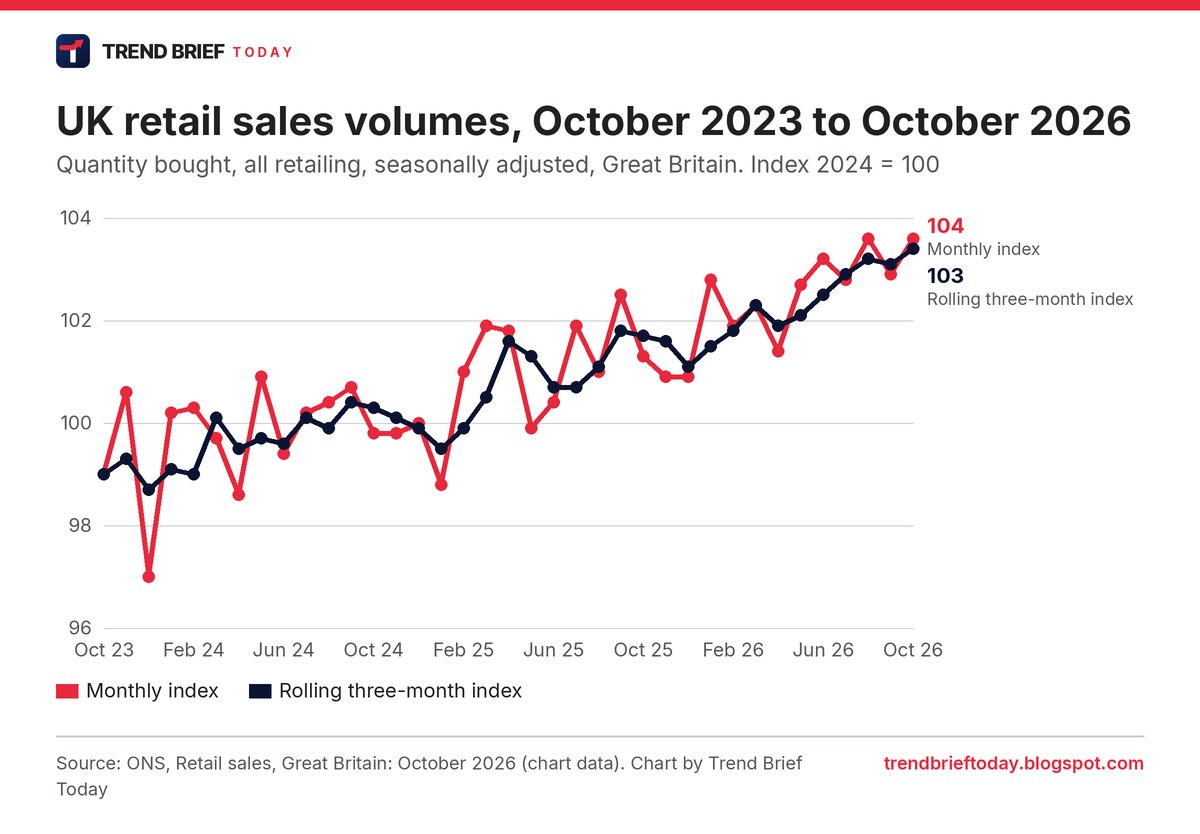
The chart is the honest way to read October. Volumes have climbed slowly since early 2025, with a saw-tooth month to month. October's index reading of 103.6 (2024 = 100) is the joint highest in the three years shown, but it is identical to August's.[1] Put another way, a good October cancelled a bad September and nothing more. Over the two months from August to October, retail volumes were flat by our reading of the ONS index.
| Month | Volume index (2024 = 100) | Change on month (ONS) | What the ONS said drove it |
|---|---|---|---|
| August 2026 | 103.6 | +0.8% (revised up from +0.7%) | Not explained in the October bulletin |
| September 2026 | 102.9 | -0.6% (revised from -0.4%) | Warm weather hit autumn clothing; stock problems at some big retailers |
| October 2026 | 103.6 | +0.7% | Long-life food after Be Ready; clothing, galleries, toys and sports goods |
Source for the table: ONS chart data and bulletin text.[1] The "what drove it" column is our summary of the ONS commentary, with September's clothing explanation also reported by the Guardian and City AM.[4][6]
Which shops did best
Food stores, which are mostly supermarkets, grew 0.8% on the month, the fastest rate since a 1.4% rise in April.[4][5] That is the stockpiling effect. But the biggest single jump came from somewhere less obvious: "other non-food stores", which jumped 3.1%, its largest rise since January. The ONS put that down to art galleries recovering from a quiet September and stronger sales of sports equipment, games and toys.[1][4]
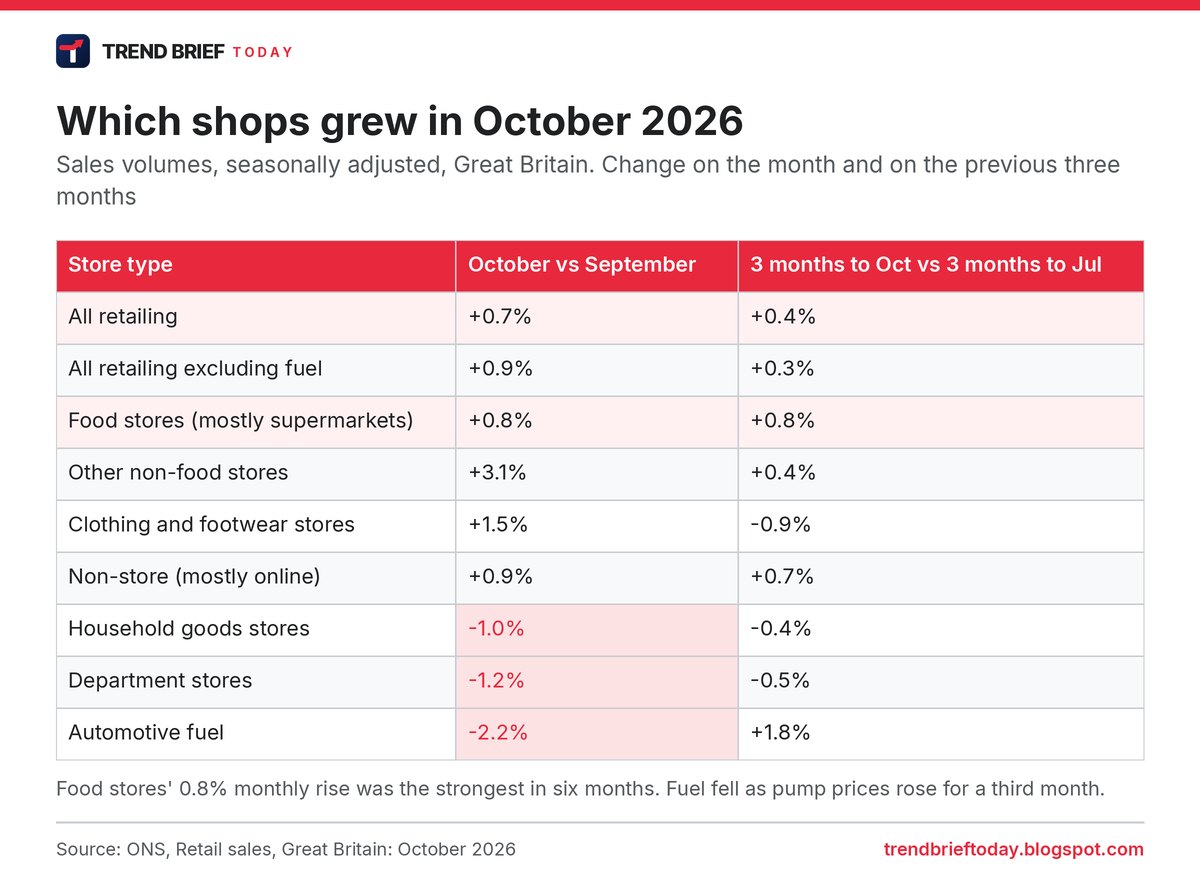
Clothing and footwear shops rose 1.5% as people bought more per visit, new ranges landed and stock problems from September cleared.[1][6] Online and other non-store retailers rose 0.9% as colder weather finally sold autumn coats.[1][4] The losers were department stores (-1.2%), household goods (-1.0%) and fuel, where volumes fell 2.2% as pump prices rose for a third month in a row.[1][4] Strip out fuel and sales rose 0.9%, a slightly better number than the headline.[1]
Spending in cash terms, rather than volumes, rose 1.2% across shops and websites. Online spending rose 1.5% in the month and was 9.7% higher than a year earlier, nudging the online share of all retail spending to 29.2%.[1]
What is the Be Ready campaign?
Be Ready is the government's household emergency advice, launched by the Cabinet Office and Security Minister Dan Jarvis on 22 October 2026. It asks households that can do so to keep three days of supplies, so that if power, water, phones or the internet go down, emergency services can concentrate on people who need help most.[2] It replaced the earlier "Prepare" website, which had been publishing similar advice since May 2024, and it is the first stage of a three-year campaign. More than 500 organisations signed up to share it, and radio and social media advertising aimed at families with young children and older people is to follow.[2][7]
The three-day benchmark is borrowed. France, Ireland and the Netherlands use the same figure, and the government says the point is to bring the UK in line with European neighbours where this kind of advice is normal.[2] The scenarios listed include storms, flooding, major power cuts and cyber attacks.[7] The official line is calm: "Those who can follow this advice should follow this advice," Jarvis said. There is no instruction to panic-buy, and the checklist itself tells people to build up a kit gradually during normal shopping trips.[2][3]
| Category | What the checklist suggests | Detail from the guidance |
|---|---|---|
| Water | Bottled water for 3 days | 3 litres per person per day for drinking; more for cooking and washing |
| Food | Non-perishable food for 3 days | No fridge or cooking needed, e.g. tinned meat, fish or vegetables, dried fruit, nuts |
| Hygiene | Hand sanitiser, wet wipes, bathroom products | None given |
| Light and warmth | Torch and spare batteries; blankets, sleeping bags, warm clothes | Torches are safer than candles |
| Information | Battery or wind-up FM radio; charged power bank | Write down the frequencies of the stations you use |
| Money and documents | Cash in coins and notes; copies of ID and documents; phone numbers | For when card payments or cash machines are down |
| Medical | First aid kit; medication and supplies | Request repeat prescriptions up to 5 working days ahead |
| Babies and pets | Ready-to-feed formula, nappies, wipes; pet food and water | Ready-made formula, as you may not be able to boil water |
Source: Be Ready checklist.[3] The free steps matter as much as the shopping. The guidance points people to the Priority Services Register, which tells energy and water companies that a household needs extra help during an outage; households with children under five are among those eligible.[2][3]
What people actually bought
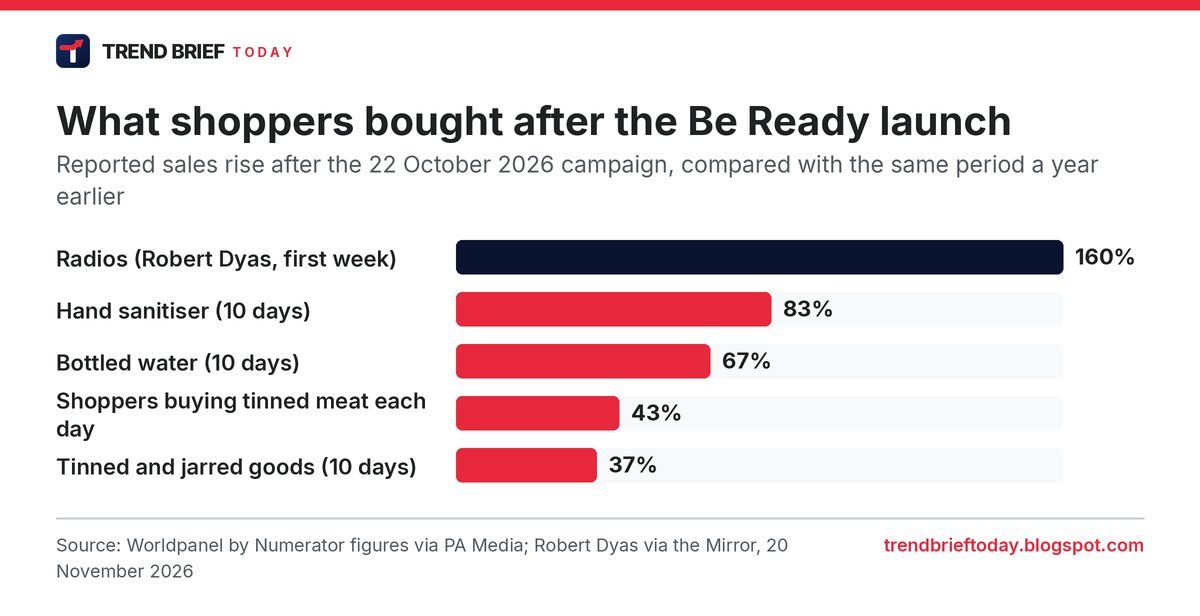
Industry data reported by PA shows how quickly the advice turned into sales. In the ten days after the launch, hand sanitiser sales were up 83% on the same period last year, bottled water was up 67% and tinned and jarred goods were up 37%.[5] The number of people buying tinned meat each day rose 43%, about 400,000 extra shoppers a day, but the typical amount bought stayed at around 500g, which suggests people were adding a tin or two rather than clearing shelves.[5] The Mirror, using the same industry numbers for sanitiser and water, adds that Robert Dyas sold 160% more radios in the week after the list came out, and that at least seven wind-up radio models sold out across several retailers.[7]
Princes, the tinned tuna maker, said earlier in November that it had seen "an increase in demand" for tinned fish, meat and vegetables since the campaign began.[5][6] The Guardian's headline used the word "rush", but a related Guardian report said Britons were stockpiling water and tins "but not panic buying", and the 500g figure supports that reading: steady top-ups, not trolley-loads.[4][5]
Prices are a quieter part of the story. Worldpanel by Numerator says supermarket prices are 2.6% higher than a year ago, up from 2.5% in September, so people buying more tins are also paying a little more for each one.[5]
How much water does a 3-day kit need?
Water is the item people underestimate, because it is heavy. The government's figure is 3 litres per person per day for drinking alone.[3] We worked out what that means for different households, rounding up to whole 2-litre bottles:
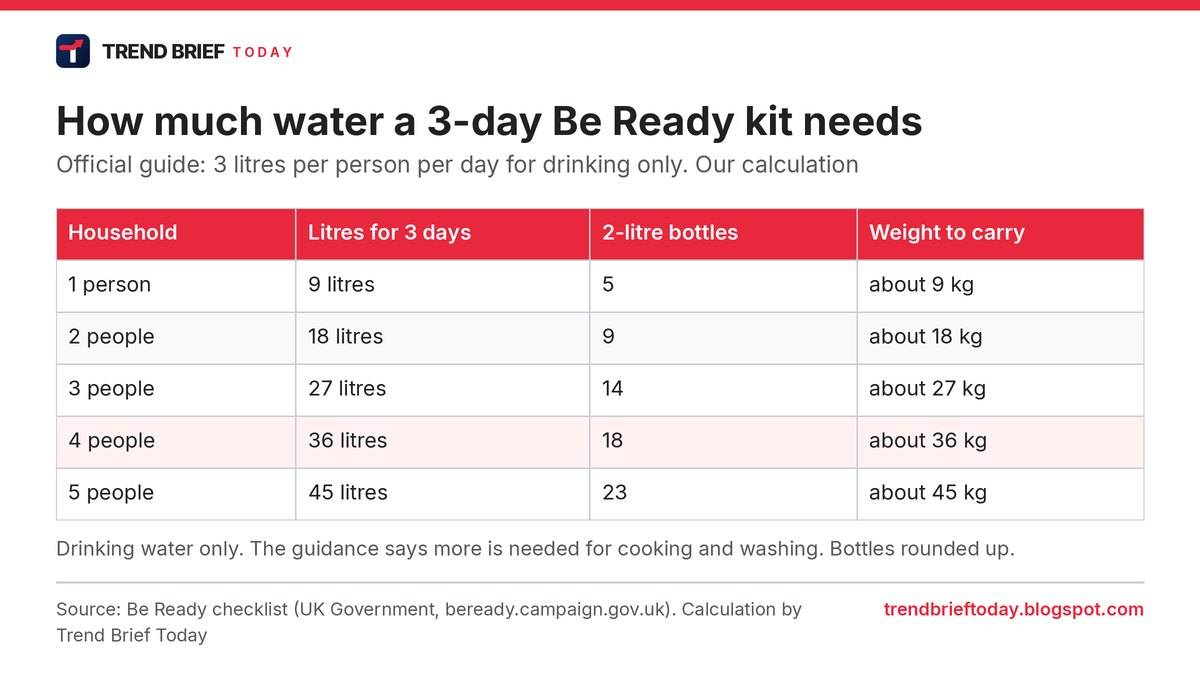
For a family of four that is 36 litres, or eighteen 2-litre bottles, weighing about as much as a large suitcase. That one line on the checklist probably explains a good share of the 67% jump in bottled water sales.[5] If you are building a kit on a budget, the guidance is clear that you do not need to do it in one trip: check what is already in the cupboard, add an item or two each shop, and set a six-monthly reminder to swap anything near its date.[3]
Is the boost a one-off?
Most of the people quoted think so. Rajeev Shaunak, head of consumer at the consultancy MHA, told City AM the stockpiling lift was "probably a one-off which hides the challenges facing retailers as they head into the crucial festive trading season", and added that "a rush for discounts is not the same as a recovery in demand."[6] Sandra Prince of Lloyds called it a "short-term spike" that showed how fast shoppers react.[6] Erin Brookes of Alvarez & Marsal was more upbeat, saying October suggests consumers are "still willing to spend this festive season" despite higher interest rates and inflation.[4]
Our reading leans towards the cautious side, for three reasons. First, the two-month picture is flat: October's index matches August's.[1] Second, a stockpile is a one-time purchase. Once a cupboard holds three days of tins, the household does not buy them again until they expire, so November and December could see food volumes give some of this back. Third, confidence is still weak. GfK's consumer confidence index rose two points to -22 in November, but only after falling to its lowest level since Brexit in October.[6]
What would change that view is November's figure, due on 18 December, which will include Black Friday on 27 November.[1] If volumes hold up without a fresh stockpiling push, October will look less like a blip.
What it means for you
- If you are building a Be Ready kit: buying gradually is what the government asks for, and it avoids paying peak prices for items in demand. Bottled water and wind-up radios were the items that sold out after the launch, so get those early.[3][7]
- If you are worried about prices: supermarket inflation of 2.6% is modest by recent standards, but it is edging up.[5]
- If you are waiting for Black Friday: retailers came into November with a better October than expected, which gives them room for discounts but does not mean they are flush.[4][6]
Frequently asked questions
How much did UK retail sales rise in October 2026?
Volumes rose 0.7% on the month, 0.4% over three months and 2.3% on a year earlier, according to the ONS first estimate published on 20 November 2026.[1]
Why did retail sales rise?
Supermarkets reported more sales of long-life food such as tinned goods and UHT milk after the government's Be Ready campaign. Clothing, toys, sports goods and art galleries also rose.[1]
What does the Be Ready campaign ask people to do?
Keep three days of supplies, including 3 litres of water per person per day, non-perishable food, a torch, a battery or wind-up radio, cash, copies of documents and medicines, and sign up to the Priority Services Register if eligible.[3]
Is the government telling people to stockpile?
It is asking households that can do so to keep a small three-day supply, built up gradually. It has not told people to panic-buy.[2][3]
When are the next retail sales figures?
The ONS publishes November 2026 retail sales on 18 December 2026.[1]
References
- "Retail sales, Great Britain: October 2026". Office for National Statistics. 20 November 2026.
- "Households encouraged to take small, simple steps to stay prepared in an emergency". Cabinet Office, GOV.UK. 22 October 2026.
- "Be ready for emergencies" (Be Ready checklist). UK Government, Be Ready campaign. Retrieved 20 November 2026.
- "Household rush to stockpile emergency supplies sends British retail sales soaring". Mark Sweney, The Guardian (via AOL). 20 November 2026.
- "Government's Be Ready warning boosts sales as shoppers stockpile food". Michael Taylor, PA Media (via AOL). 20 November 2026.
- "Retail sales beat expectations as Brits follow stockpiling advice". City AM. 20 November 2026.
- "Tinned food sales surge after Brits told to 'be prepared' for sudden emergencies". The Mirror. 20 November 2026.