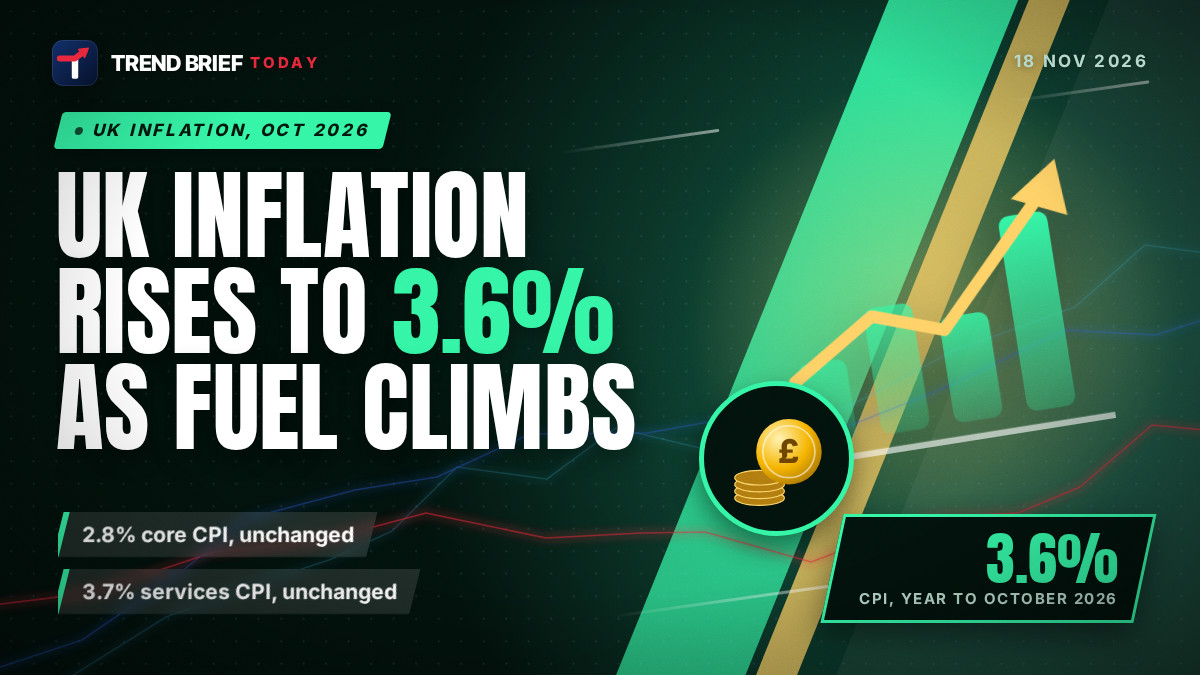
The UK inflation rate rose to 3.6% in October 2026, up from 3.5% in September, the Office for National Statistics said on Wednesday 18 November. It is the fourth rise in a row and the highest rate since September 2025. Petrol and diesel did most of the damage, with diesel at a record 199.5p a litre, while core inflation (2.8%) and services inflation (3.7%) did not move. The figure was exactly what economists expected, and it keeps another Bank of England rate rise on the table for 17 December.[1][2][7][8]
 | |
| CPI (12 months) | 3.6%, up from 3.5%[1][2] |
|---|---|
| CPI (one month) | 0.5%[1] |
| Core CPI | 2.8%, unchanged[1][3] |
| Services CPI | 3.7%, unchanged[1][4] |
| Goods CPI | 3.5%, up from 3.2%[1] |
| CPIH | 3.7%, up from 3.6%[1] |
| Forecast | 3.6% (Pantheon consensus)[7] |
| Bank Rate | 4%, next decision 17 December 2026[5][6] |
| Target | 2% CPI[5] |
| Next CPI release | 16 December 2026 (November data)[1] |
What is the UK inflation rate now?
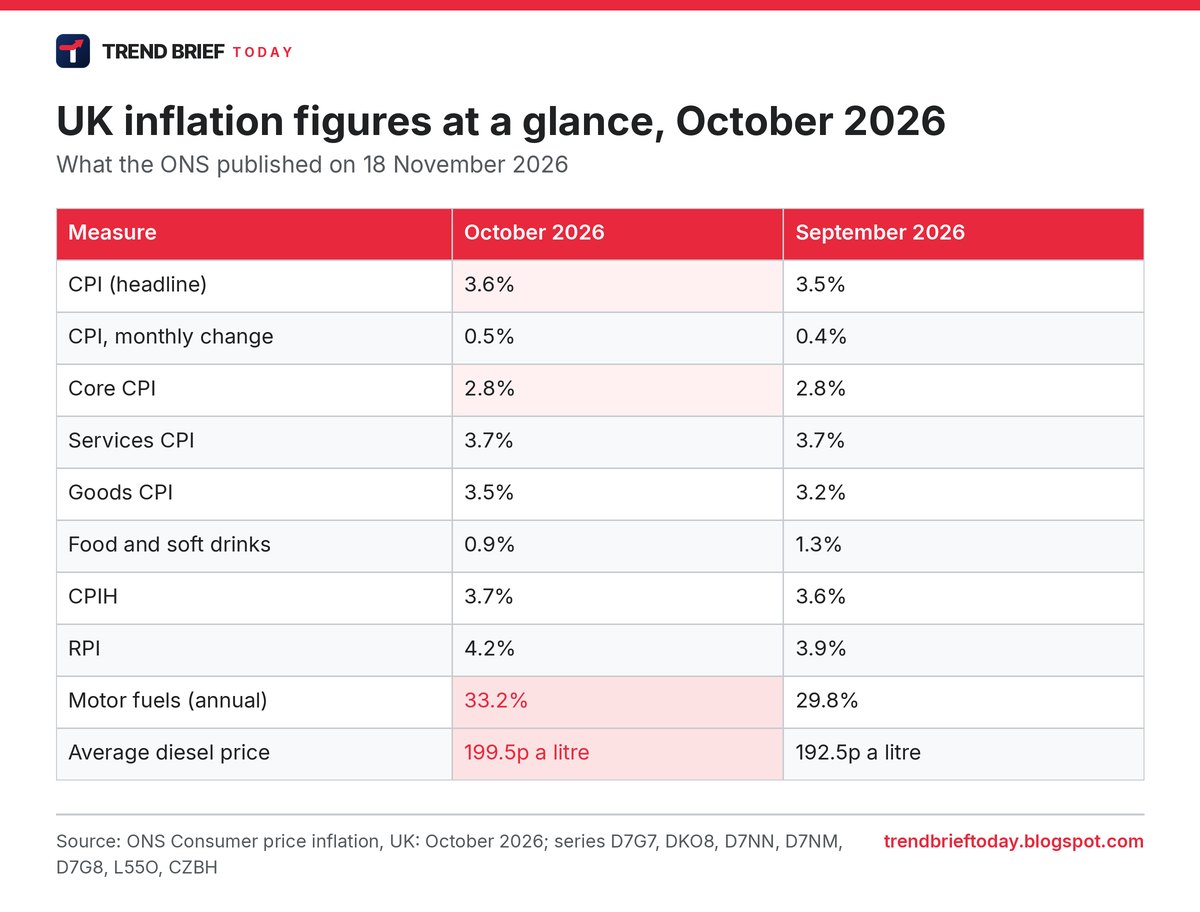
Prices measured by the Consumer Prices Index (CPI) were 3.6% higher in October 2026 than a year earlier. In September the gap was 3.5%. Over the single month from September to October, prices rose 0.5%, compared with 0.4% in the same month of 2025, and that bigger monthly jump is what pushed the annual rate up.[1]
The rate has now risen every month since June, when it was 2.6%. October's 3.6% matches October 2025 and is the highest since September 2025, when CPI was 3.8%.[2][7] Headline and core inflation both came in exactly as forecast, investingLive reported, while services inflation was a touch softer than the 3.8% economists had pencilled in.[8]
The ONS's broader measure, CPIH, which adds owner occupiers' housing costs and Council Tax, rose to 3.7%. The older Retail Prices Index (RPI) rose to 4.2% from 3.9%.[1][9]
Why prices rose: fuel, tobacco and the energy cap
Almost all of the extra inflation came from a few items whose prices are set by world energy markets or by government, not by the everyday shop floor.
- Petrol and diesel. The average price of petrol rose 5.2p a litre in October to 174.7p, the highest since August 2022. Diesel rose 7.0p to 199.5p, the highest since the ONS records began in January 1996. Motor fuel prices were 33.2% higher than a year earlier.[1]
- Tobacco. Tobacco prices jumped 5.2% in the month, after a duty rise took effect on 1 October. In 2025 the duty rise came later, on 26 November, so the timing alone lifted this year's annual comparison.[1][7]
- Gas. Ofgem's price cap went up in October. Gas prices rose 6.3% in the month.[1][7]
Some things pulled the other way. Electricity prices fell 0.8% in the month, partly because VAT on electricity was cut from 5% to zero from 1 October. Restaurant and hotel prices fell 0.4% in the month, and hotel prices alone dropped 3.8%.[1]
The Bank of England said in November that direct energy effects already explained about 1 percentage point of September's 3.5% rate, mostly from fuel, and that it expected that contribution to build over the next few quarters.[5]
Core and services inflation: the good news
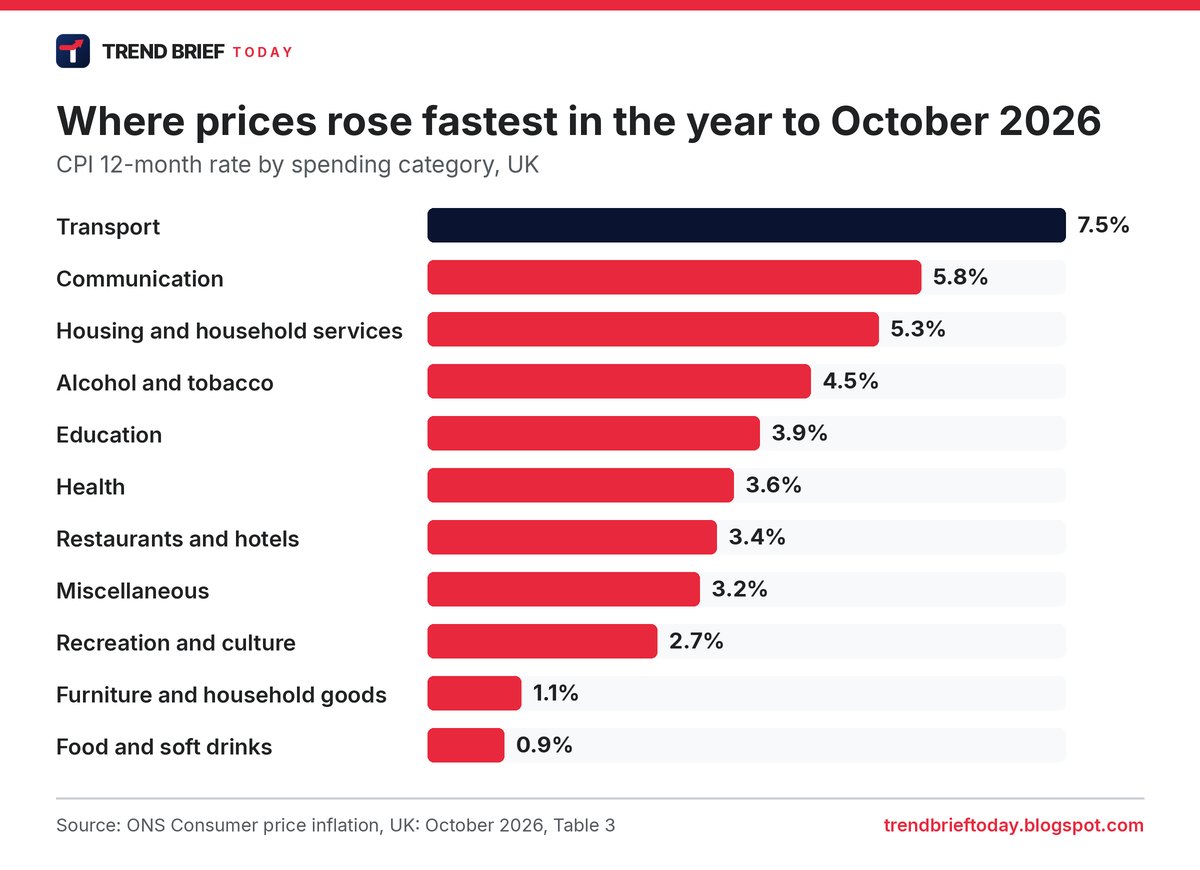
The numbers the Bank of England watches most closely did not get worse. Core CPI, which strips out energy, food, alcohol and tobacco, stayed at 2.8%. Services inflation, which mostly reflects wages and domestic costs, stayed at 3.7%.[1][4][8]
That matters because the Bank's worry is not the fuel spike itself. It is whether high energy costs feed into wages and other prices and stay there, which it calls "second-round effects". In its November minutes the Bank said there was still "limited evidence of knock-on effects on other prices and wages".[5] October's flat core and services figures fit that picture. Goods inflation, on the other hand, rose to 3.5%, the highest since September 2023, because goods include fuel.[1]

Food inflation is the lowest since 2021
Shoppers got some relief at the till. Food and non-alcoholic drink prices were 0.9% higher than a year ago, down from 1.3% in September and the lowest rate since September 2021. Chocolate prices fell 2.9% in the month as cocoa costs eased and discounts nearly doubled, according to the ONS.[1] Clothing and footwear prices were 0.5% lower than a year earlier.[1]
What it means for interest rates and the December decision
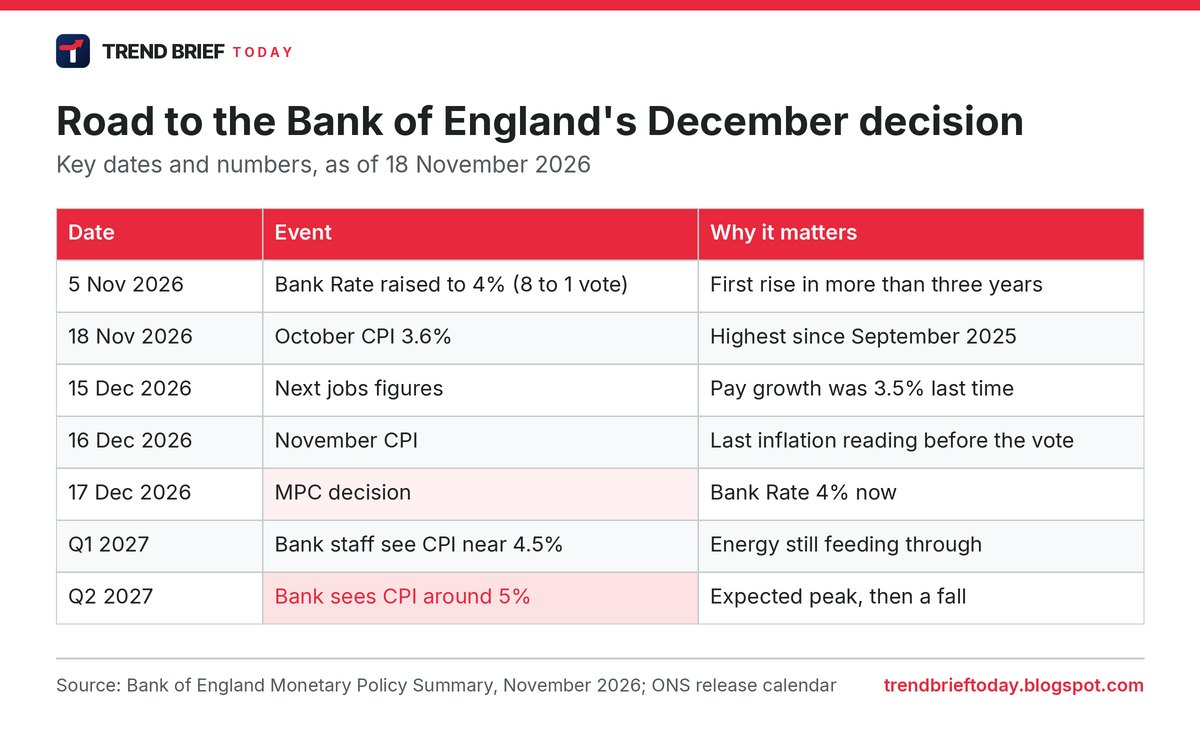
The Bank of England raised Bank Rate to 4% on 5 November by an 8 to 1 vote, with Catherine Mann voting for a bigger rise to 4.25%. It said CPI inflation was "expected to rise to around 5% by the middle of next year". Bank staff expected about 4.5% in the first quarter of 2027 and about 5% in the second quarter.[5][7] Governor Andrew Bailey wrote that, without news that softens the risks, he could "see the argument for a further increase in rates".[5]
October's 3.6% was in line with forecasts, so on its own it does not change much.[7] The one small surprise was services inflation, which held at 3.7% when forecasters had expected 3.8%, a slightly reassuring sign for rate-setters.[8] The Bank has two more data points before it decides on Thursday 17 December: jobs and pay figures on 15 December and November inflation on 16 December.[10][1][6] For the latest labour market numbers, see our UK unemployment rate page. For longer forecasts, see NIESR's UK inflation forecast to 2030.
What it means for you
- Mortgages. Fixed-rate deals tend to follow what markets expect from the Bank, and a figure in line with forecasts gives them little new to react to. Tracker mortgages follow Bank Rate directly, so 17 December is the date to watch. Our UK house prices November 2026 page has current two-year fixed and tracker rates.
- Savings. With inflation at 3.6%, a savings account needs to pay more than that just to keep its spending power.
- Pay. Regular pay was growing 3.5% a year in July to September, slightly below October's CPI rate, so for many workers real pay is flat or falling slightly.[1][10]
Timeline
| Month | CPI (12 months) | Note |
|---|---|---|
| October 2025 | 3.6% | Last time the rate was this high, until now[2] |
| April 2026 | 2.8% | Services inflation drops to 3.2%[2][4] |
| June 2026 | 2.6% | Low point of 2026[2] |
| July 2026 | 2.9% | First of four rises in a row[2] |
| August 2026 | 3.1% | Fuel prices climbing[2] |
| September 2026 | 3.5% | Energy adds about 1 point, Bank says[2][5] |
| 5 November 2026 | n/a | Bank Rate raised to 4%[5] |
| October 2026 | 3.6% | Record diesel price, tobacco duty, Ofgem cap[1] |
| 16 December 2026 | n/a | November CPI due[1] |
| 17 December 2026 | n/a | Bank of England decision[6] |
Frequently asked questions
What is the UK inflation rate for October 2026?
CPI inflation was 3.6% in the 12 months to October 2026, up from 3.5% in September. CPIH was 3.7% and RPI was 4.2%.[1]
Was it higher than expected?
No. A consensus of forecasters compiled by Pantheon Macroeconomics expected exactly 3.6%.[7]
What is core inflation in the UK?
Core CPI, which leaves out energy, food, alcohol and tobacco, was 2.8% in October, the same as in September.[1][3]
Why is UK inflation rising?
Mainly fuel. Diesel hit a record 199.5p a litre and motor fuels were 33.2% dearer than a year ago. A tobacco duty rise on 1 October and a higher Ofgem gas cap added to it.[1][7]
Will interest rates go up in December?
Nobody knows yet. The Bank raised rates to 4% in November and its governor said he could see the argument for another rise unless the risks ease. The decision is on 17 December, after one more set of jobs and inflation figures.[5][6]
When is the next UK inflation release?
The ONS will publish November's figures at 7am on Wednesday 16 December 2026.[1]
References
- "Consumer price inflation, UK: October 2026" (18 November 2026). Office for National Statistics.
- "CPI annual rate 00: all items, series D7G7". Office for National Statistics. Retrieved 18 November 2026.
- "CPI 12-month rate excluding energy, food, alcoholic beverages and tobacco, series DKO8". Office for National Statistics. Retrieved 18 November 2026.
- "CPI annual rate: services, series D7NN". Office for National Statistics. Retrieved 18 November 2026.
- "Bank Rate increased to 4%: November 2026 Monetary Policy Summary and Minutes" (5 November 2026). Bank of England.
- "Upcoming Monetary Policy Committee dates". Bank of England. Retrieved 18 November 2026.
- "Inflation set to have risen amid energy bill increases and tobacco duty hike" (18 November 2026). Henry Saker-Clark, PA, via The Independent.
- "UK October CPI +3.6% vs +3.6% y/y expected" (18 November 2026). Giuseppe Dellamotta, investingLive.
- "RPI all items: percentage change over 12 months, series CZBH". Office for National Statistics. Retrieved 18 November 2026.
- "Labour market overview, UK: November 2026" (17 November 2026). Office for National Statistics.