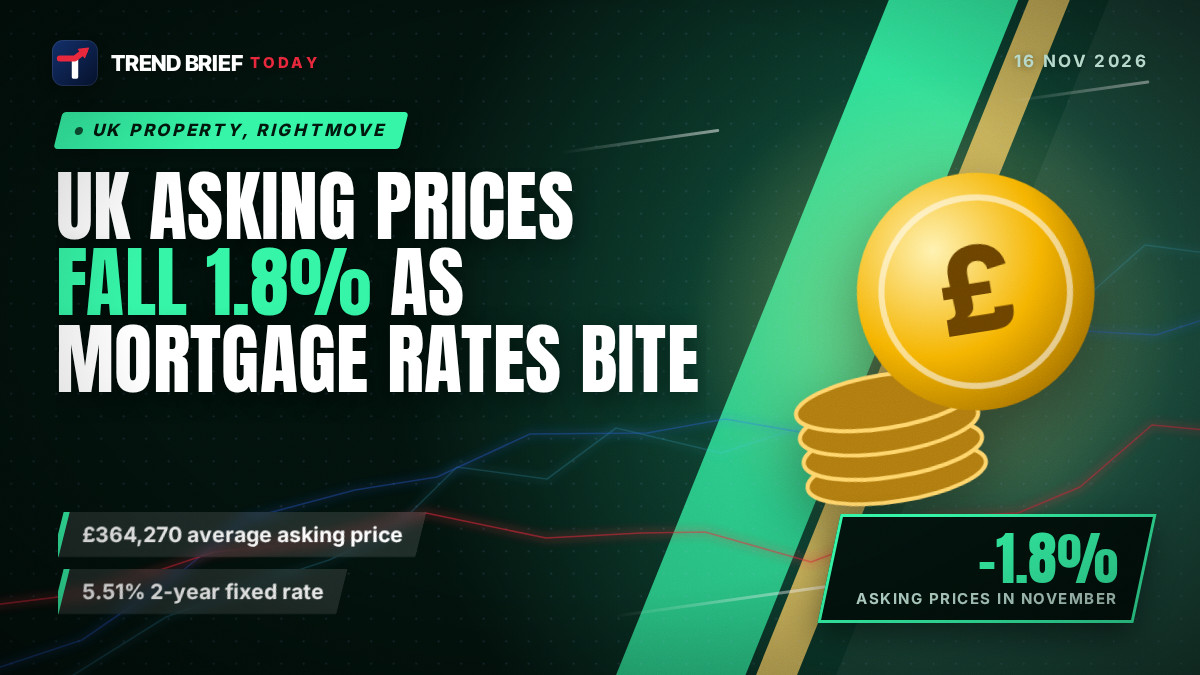
UK house prices fell more than usual in November 2026. Rightmove says the average asking price of a home newly put up for sale dropped 1.8%, or £6,745, to £364,270, against a typical November fall of 1.1%.[1][2][3] Asking prices are now 0.2% lower than a year ago, and Rightmove blames mortgage rates: the average two-year fixed deal is 5.51%, up from 4.25% in February.[2][4]
 | |
| Average asking price | £364,270[1][2] |
|---|---|
| Monthly change | Down 1.8% (£6,745)[1][3][4] |
| Usual November change | Down 1.1% (10-year average)[1][2] |
| Annual change | Down 0.2%[1][2] |
| 2-year fixed rate | 5.51%[2][4] |
| 2-year tracker rate | 4.72%[4][6] |
| Bank Rate | 4.0%[4][6][10] |
| Homes for sale | Highest in 12 years[1][5][7] |
| Published by | Rightmove[1][2] |
What Rightmove's November figures show
Asking prices always slip in November, because sellers who list late in the year tend to price for a quieter winter market. Over the past decade the average November fall has been 1.1%.[1][2] This year's 1.8% drop is bigger than that.[1][4]
The annual picture has turned too. The average asking price is 0.2% below November 2025, which puts 2026 on course to finish with prices lower than at the end of last year.[1][2][5] Buyer demand is down 8% on a year ago and the number of sales agreed is down 7%, while new listings are up 3%.[2][5][7] That leaves the number of homes for sale at its highest level in 12 years, so buyers have the most choice since 2014.[1][5][7]
Colleen Babcock, Rightmove's property expert, said the larger-than-usual fall suggests "many sellers are aware that they need to price temptingly in the high mortgage rate market".[1][3][5]
Why mortgage rates are the main cause
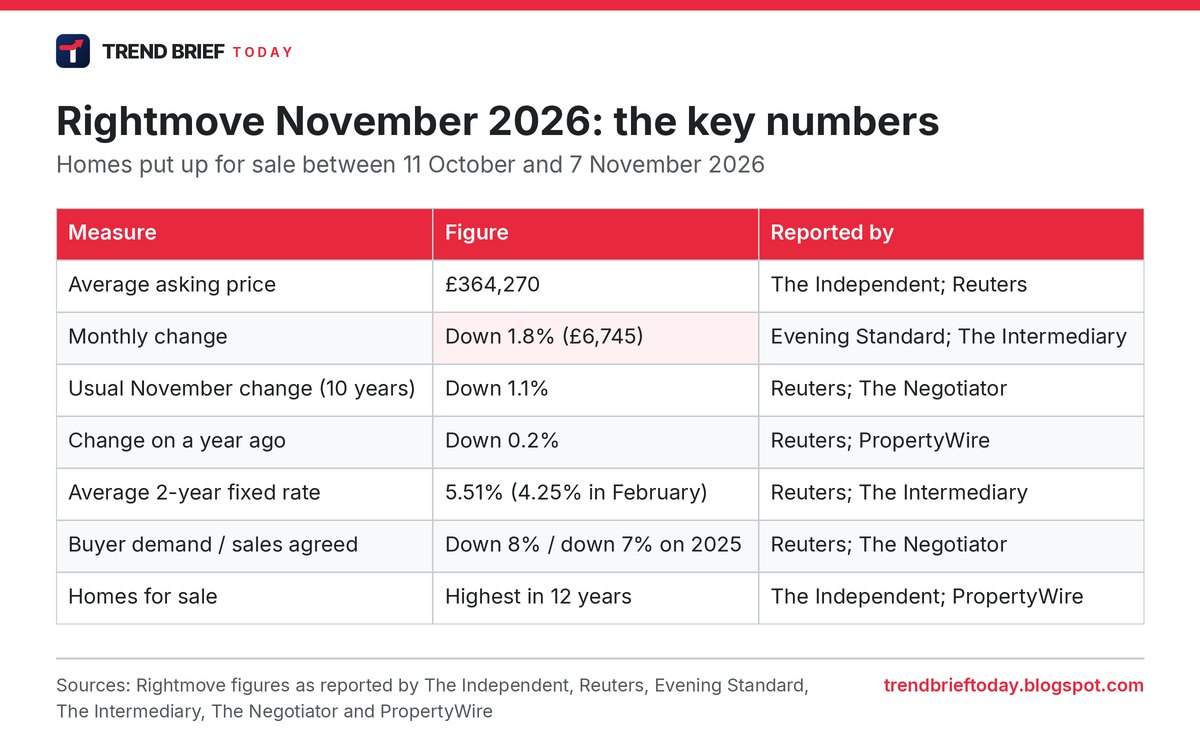
Rightmove's daily tracker puts the average two-year fixed mortgage rate at 5.51%. That is a touch lower than last month's 5.55%, but well above the 4.25% seen in February, before the Iran war pushed borrowing costs up.[2][4][8][11] Rightmove's mortgage expert Matt Smith said the rise since February adds "more than £200 a month to the cost of a typical new mortgage".[6][10]
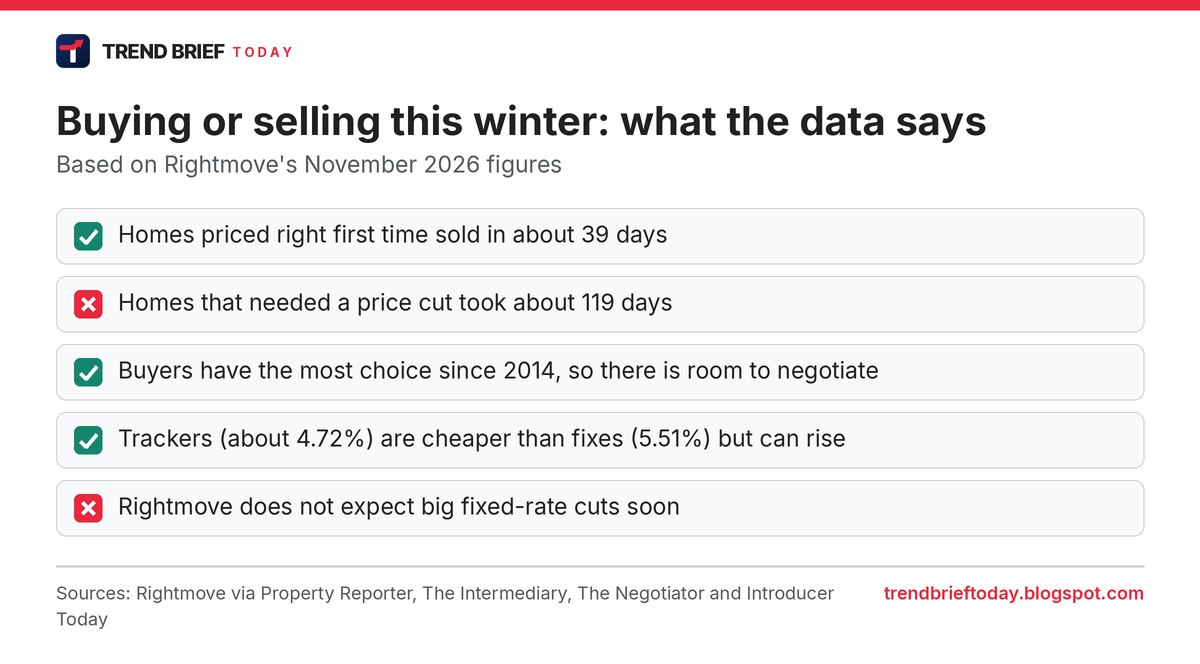
Bank Rate now stands at 4.0% after the Bank of England's latest rise.[2][4][10] Tracker mortgages, which follow Bank Rate, are cheaper on average at 4.72% for two years, but the monthly payment can change.[4][6][10]
To show what that means in pounds, we worked out the monthly cost of a £300,000 repayment mortgage over 25 years. At February's 4.25% it is about £1,625 a month. At today's 5.51% it is about £1,844, around £219 more. A 4.72% tracker comes to about £1,705. These are our own figures using the standard repayment formula and ignore fees, so your lender's quote will differ.
House prices by region: a north-south split
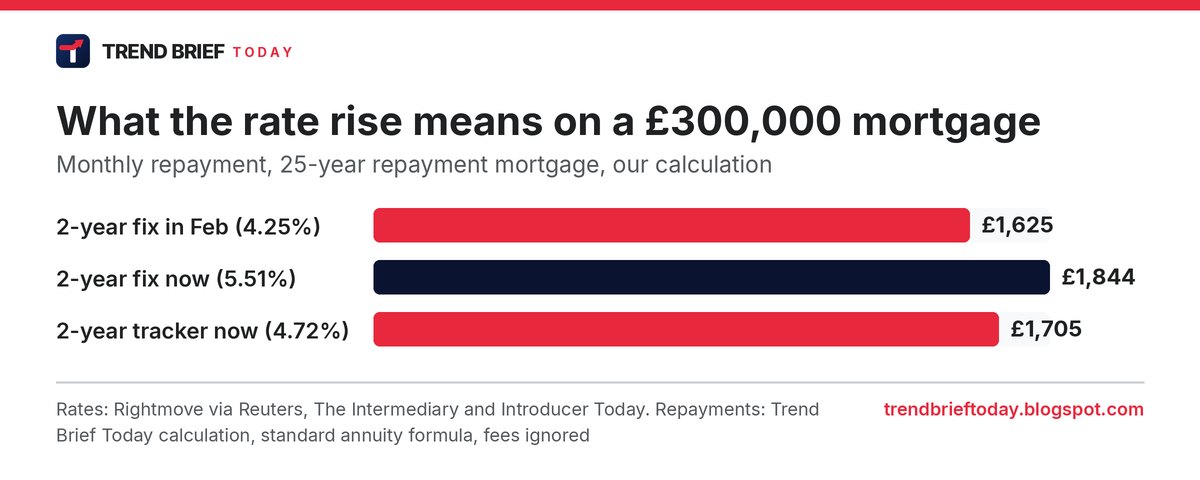
Where you live matters more than usual this year. Every region in southern England has lower asking prices than a year ago, and the South West has fallen the most, by 1.1%.[4][5][6] The Midlands, the North of England, Scotland and Wales have all risen, with Scotland up the most at 3.8%.[4][5][7]
Tom Bill of Knight Frank said buyers are "working on tighter budgets due to the higher cost of borrowing", which has stalled price growth this year.[8][9] Higher-priced areas feel a rate rise most, because the same percentage adds more pounds to a bigger loan.
| Area | Annual change | Note |
|---|---|---|
| Scotland | Up 3.8%[4][5] | Best performing area |
| Midlands, North of England, Wales | Up[5][7] | All recorded annual rises |
| Great Britain average | Down 0.2%[1][2] | £364,270 |
| Southern England regions | All down[4][6] | South West the weakest |
| South West | Down 1.1%[4][5] | Weakest region |
Flats are struggling more than houses
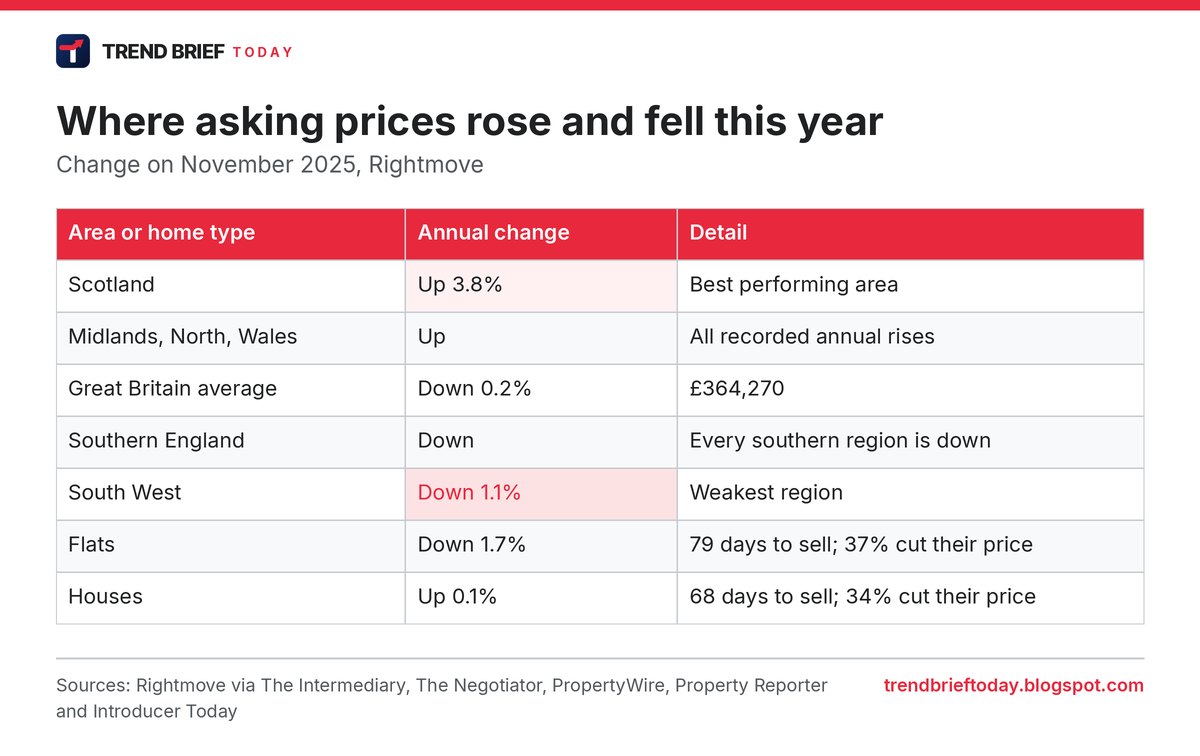
Asking prices for flats are down 1.7% on a year ago, while house prices are up 0.1%.[4][5][7] Over ten years the gap is wide: flats have risen only 5%, houses 30%.[4][5][7]
Flats also take longer to sell, at an average of 79 days against 68 days for houses, and more of them need a price cut: 37% of flat listings were reduced, against 34% of houses.[4][6]
Pricing right at the start makes a big difference. Rightmove found that homes which never needed a reduction found a buyer in about 39 days, while those that did took about 119 days.[4][6]
What it means if you are buying or selling
For buyers, the numbers point to a market with plenty of choice and room to haggle. Babcock said buyers can afford to be selective when several similar homes are competing for attention.[1][3] Rightmove does not expect any big drop in fixed mortgage rates soon, and says trackers may suit movers who can cope with payments that change month to month.[5][7]
For sellers, the message is to price realistically from day one. Ian Harris of NAEA Propertymark said sellers "need to price realistically to reflect what purchasers can afford in a market where choice remains high".[4][12]
Asking prices are not the same as sale prices. They show what sellers hope to get, and the final price agreed can be lower, especially in a market where buyers have this much choice.[2][4]
Frequently asked questions
Are UK house prices falling in 2026?
Asking prices are. Rightmove's average is 0.2% lower than a year ago, and 2026 is on track to end below 2025.[1][2] Prices are still rising in Scotland, Wales, the Midlands and the North.[5][7]
What is the average house price in the UK right now?
The average asking price for a newly listed home in Great Britain is £364,270, according to Rightmove's November 2026 index.[1][4]
What is the average mortgage rate in November 2026?
About 5.51% for a two-year fixed deal and 4.72% for a two-year tracker, according to Rightmove's daily tracker.[4][6]
Will house prices drop further in 2027?
Nobody can say for sure. Rightmove expects fixed rates to stay high for now, and Knight Frank said that with the Middle East conflict unresolved, the 2027 outlook "appears to hinge on how events in Washington rather than Westminster unfold".[5][8][9]
Is Rightmove's index the same as the ONS house price figure?
No. Rightmove tracks the asking prices of newly listed homes, not the prices homes actually sell for.[2][4]
References
- The Independent (PA), Rightmove records £6,745 fall in the average home asking price in November, 16 November 2026.
- Suban Abdulla, Reuters via TradingView, UK property asking prices fall more than usual in November, Rightmove says, 16 November 2026.
- Evening Standard, London house prices fall by more than usual with homes for sale at 12 year high, 16 November 2026.
- The Intermediary, Asking prices down 1.8% in November: Rightmove, 16 November 2026.
- Marc Shoffman, The Negotiator, Sellers cut asking prices as high mortgage rates restrict buying power, 16 November 2026.
- Property Reporter, Asking prices slashed by 1.8% in November as sellers chase stretched buyers: Rightmove, 16 November 2026.
- PropertyWire, UK asking prices fall 1.8% as mortgage costs squeeze buyers, 16 November 2026.
- Business Live, UK house prices fall in November 2026 as Iran war drives mortgage rates higher, 16 November 2026.
- Property Industry Eye, Sellers slash asking prices as property industry reacts to latest figures, 16 November 2026.
- Introducer Today, Seller expectations fall as mortgage rates force bigger price cuts: Rightmove, 16 November 2026.
- Sharecast, UK house asking prices fall as mortgage costs squeeze buyers, 16 November 2026.
- Property118, Rising mortgage rates put pressure on housing market as sellers lower asking prices, 16 November 2026.