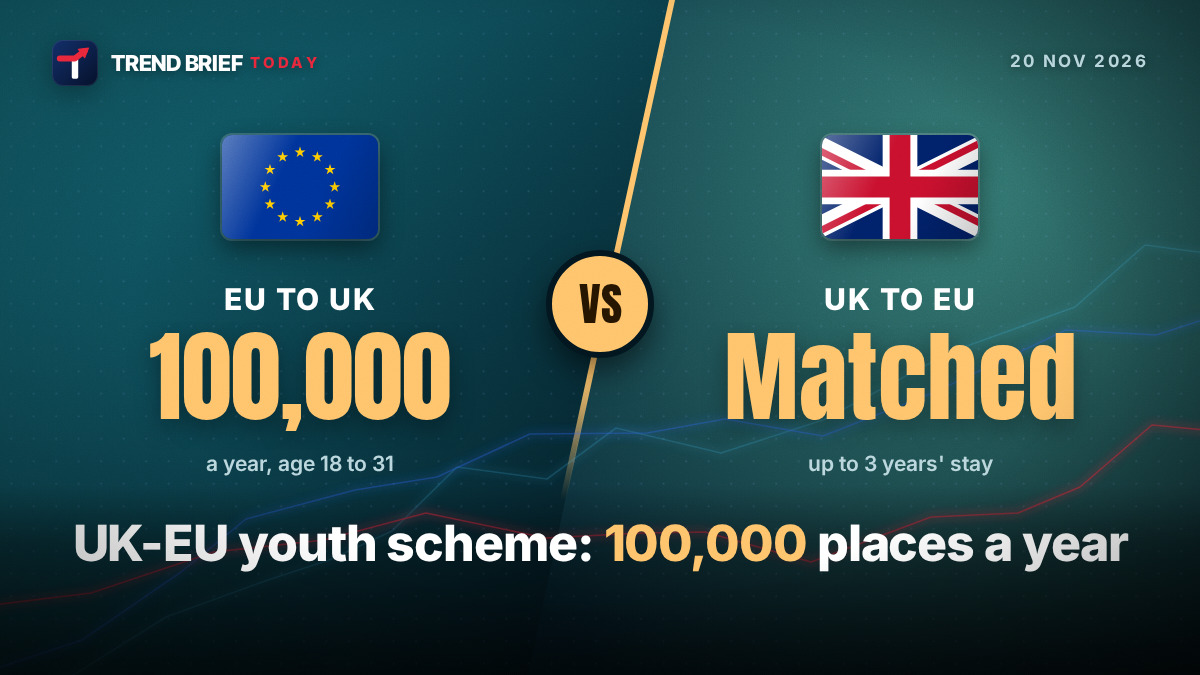
Britain and the EU agreed on 20 November 2026 to create a youth mobility scheme, sometimes called the youth experience scheme, that will let up to 100,000 young Europeans a year live, work, study or travel in the UK for up to three years, with the same number of young Britons able to go the other way.[2][4][8] The age limit has been reported as 18 to 31.[2][5] The catch is timing: the draft text aims to apply the agreement by 2028 and to have places open "no later than January 2030", and visa fees have not been published yet.[2][6]
 | |
| Agreed | 20 November 2026, UK-EU summit in Brussels[4][8] |
|---|---|
| Places | Up to 100,000 a year, matched both ways[2][4] |
| Age | 18 to 31 (reported; raised from 30)[2][5] |
| Length of stay | Up to 3 years[3][6] |
| What you can do | Work, study, au pair, volunteer or travel[6] |
| Agreement applied | No later than 2028 (draft text)[2] |
| First places | No later than January 2030 (draft text)[2] |
| Fees | Not yet published |
| Open issue | EU student tuition fees, six-month deadline[3][7] |
What was agreed on 20 November
The youth scheme is one of three agreements at the heart of Andy Burnham's first EU summit as prime minister. The other two cover food and farming checks (the SPS deal) and a link between the UK and EU carbon markets.[4][7] Downing Street said on Friday that both sides had agreed timelines for all three, and a government spokesman put it bluntly: "The deal is done, negotiations have concluded."[2][4] Its summit-day press release had listed "restoring opportunities for young people" as one of four priorities, promising to give them "back the chance to live, work, study and travel in Europe".[1]
In Brussels, European Commission President Ursula von der Leyen called it a "turning point" in relations, and Burnham said the deal would benefit every person in the UK.[7] Earlier in the day he had told reporters it was "a good day for young people in Britain", adding that Gen Z and millennials "arguably were the biggest losers" from Brexit.[2]
The core of the youth agreement, as reported by Reuters, is simple. It is a reciprocal programme allowing up to 100,000 young people a year from the EU and the UK to live, work and study in each other's territory for up to three years.[4] The draft text seen by the Guardian lists the activities: "work, studies, au pairing, volunteering, or simply travelling".[6]
How big is 100,000?
Britain already runs a youth visa called the Youth Mobility Scheme, but no EU country is in it. It covers 13 countries and territories, from Australia to Uruguay, and each has its own yearly quota set in the Immigration Rules.[10] We added those quotas up for 2026.
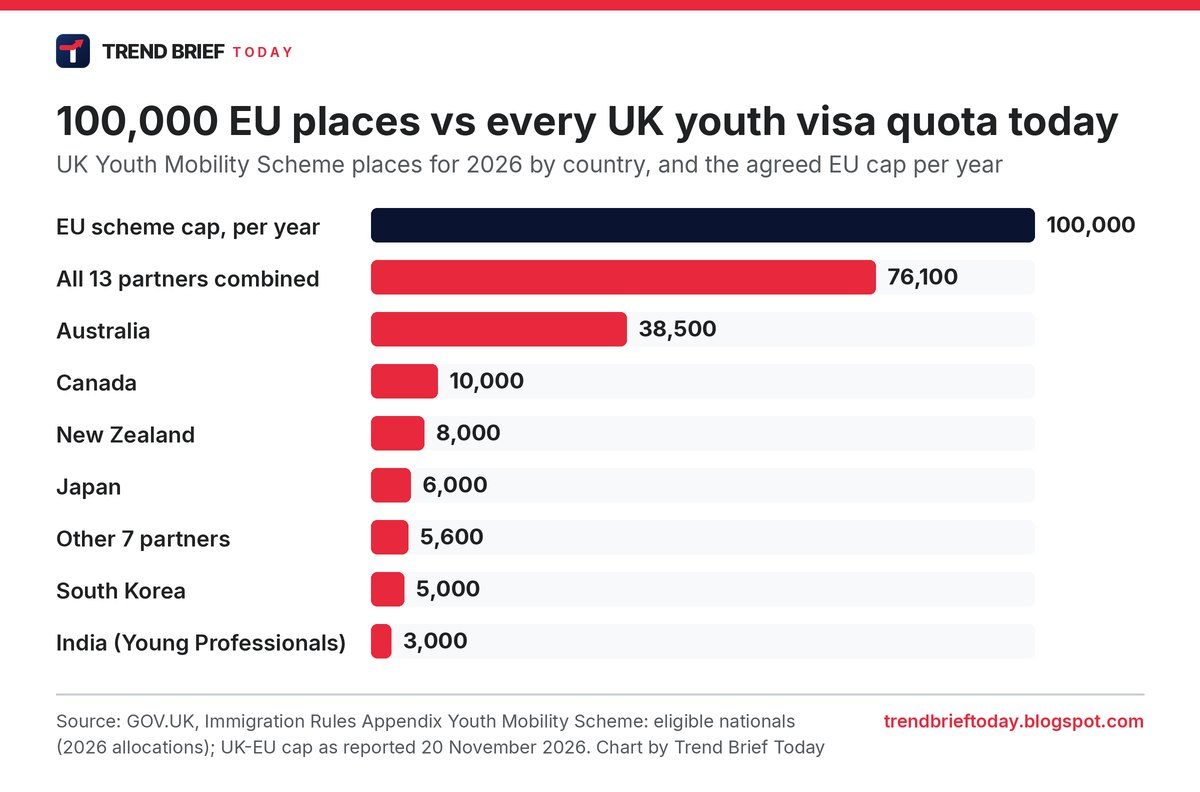
The total across all 13 partners is 76,100 places. The EU cap alone is 100,000, which is about 31% more than every current youth deal combined and 2.6 times the Australian quota of 38,500, the largest today.[10] That is why the number mattered so much in the talks. Reuters reports that Britain, mindful that immigration was a factor in the Brexit vote, had proposed only 50,000 places, and the Guardian says the UK had pushed for 50,000 to 80,000 before agreeing to 100,000 late on Thursday.[3][5]
The flow does not have to be even, though. The Guardian reports that the number of young Britons allowed into the EU will be matched but could be higher, with some countries, including Germany, prepared to take unlimited numbers.[5] For a British 22-year-old, the more useful question may be which EU country, not whether there is a place.
Who can apply
Here is what has been reported so far about eligibility. None of it is final until the legal text is published.
- Nationality: citizens of the 27 EU member states coming to the UK, and British citizens going to the EU.[4][8]
- Age: 18 to 31, according to the Evening Standard. The Guardian and PA both report that the upper limit was raised from 30 to 31 during the final talks.[2][5]
- Purpose: work, study, au pairing, volunteering or travel, if the draft wording survives.[6]
- Length: up to three years.[3][4]
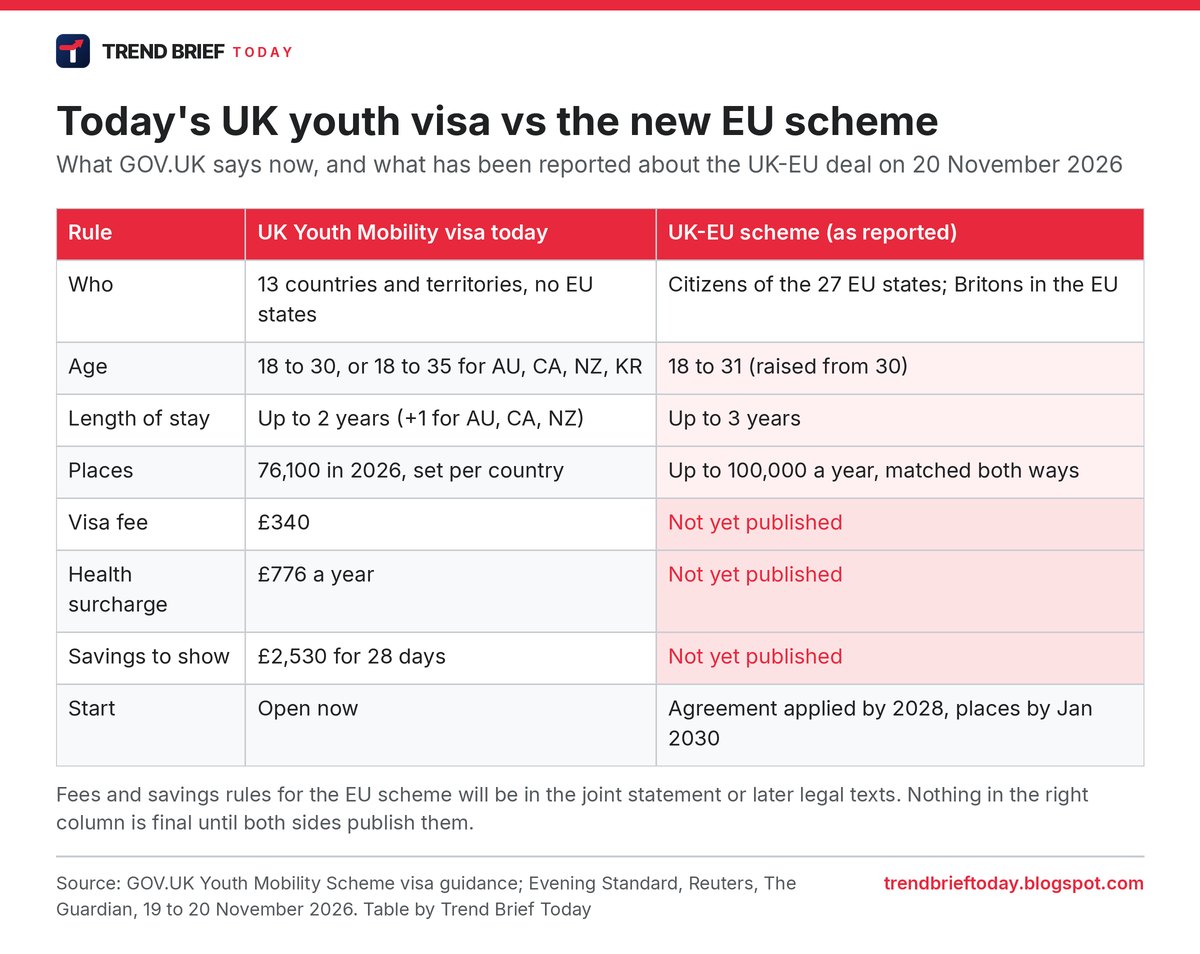
Things we do not know yet: whether applicants will need savings in the bank, whether there will be a ballot when a country's places run out, whether people with children can apply, and whether the UK's Immigration Health Surcharge will apply. The current UK youth visa requires all of the first three and charges the surcharge, so they are the obvious questions for the joint statement.[9]
What could it cost?
No fee has been announced. To give a sense of the stakes, here is what a young Australian or Canadian pays today for the existing UK youth visa, using the GOV.UK rates: a £340 application fee, a health surcharge of £776 per year of the visa, and proof of £2,530 in savings held for 28 days in a row.[9] If an EU applicant were charged the same rates for a three-year stay, the bill would look like this. This is our illustration, not an announced price.
| Stay | Application fee | Health surcharge | Total paid to the Home Office | Savings to show (not a fee) |
|---|---|---|---|---|
| 2 years (current standard visa) | £340 | £1,552 (2 x £776) | £1,892 | £2,530 |
| 2 years + 1-year extension (Australia, Canada, New Zealand) | £680 (2 x £340) | £2,328 (3 x £776) | £3,008 | £2,530 |
| 3 years in one visa (if the EU scheme used today's rates) | £340 | £2,328 (3 x £776) | £2,668 | £2,530 |
Our calculation from GOV.UK rates.[9] The health surcharge is by far the largest part of the bill, which is why it will matter more than the headline visa fee. A £2,668 cost would be a real barrier for some 19-year-olds, and that is a point the UK and the EU will have to settle before the scheme opens.
When does it start?
Not soon. The Evening Standard quotes the draft text agreed by negotiators: "We aim to apply this agreement no later than 2028 and endeavour to ensure that opportunities under the scheme will be available to our young people no later than January 2030."[2] The Guardian explains the delay: work permits in the EU are controlled by the 27 national governments, not by Brussels, so each country has to put its own rules in place.[6]
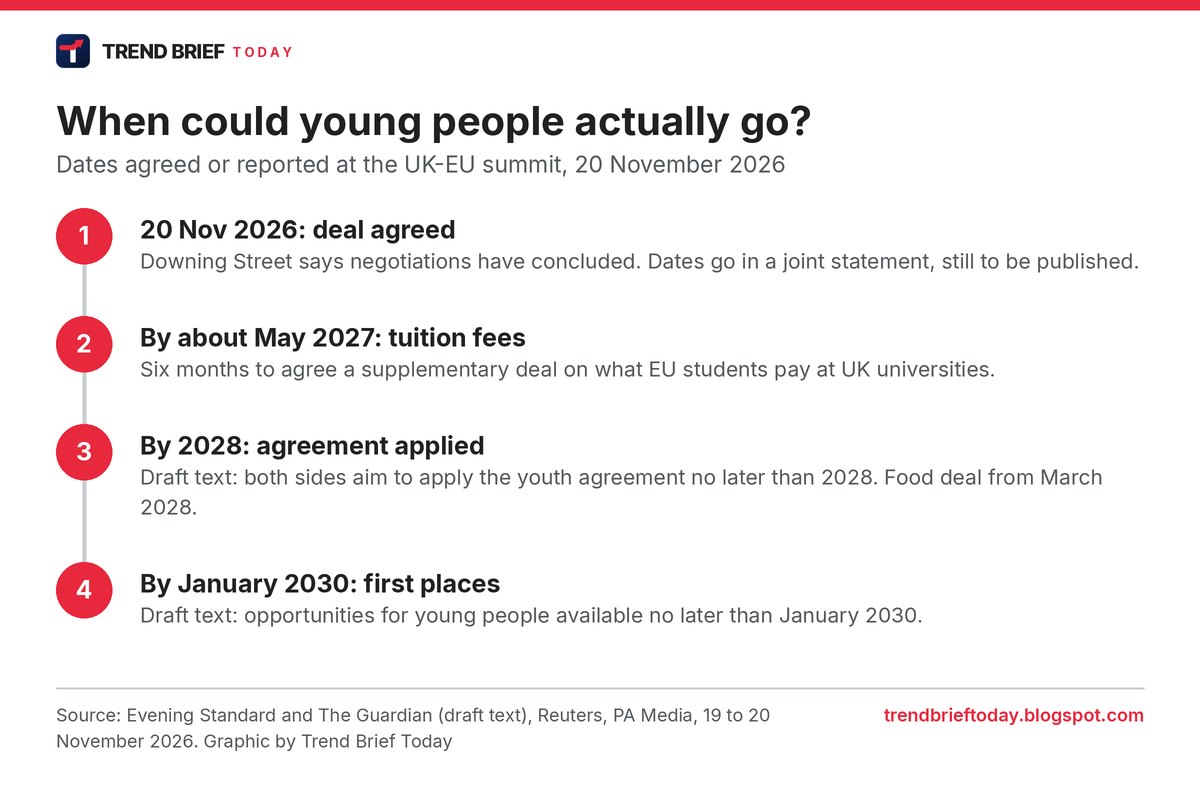
There is also a political risk in the timetable. The EU wants its students to pay "home" tuition fees at British universities instead of international rates, which Reuters says are typically about four times higher.[3] The Evening Standard says that would mean a cut from up to £38,000 a year to £9,970.[2] Britain would only offer "significantly reduced" fees, so the two sides gave themselves six months to agree a separate deal.[3][5]
The two sides do not describe that link the same way. DW, citing the German news agency DPA, says the EU made the other agreements conditional on a fees deal.[11] Downing Street says the start dates are set out in the joint statement and are not conditional on the fees issue.[7] The published joint statement lists the youth scheme alongside the food and carbon deals and says the sides look forward to their "joint and timely entry into force"; the tuition fees deal is a separate agreement to be finished within six months.[13]
| Date | Step | Status |
|---|---|---|
| May 2025 | First UK-EU summit commits to work on a youth experience scheme | Done |
| July 2026 | Planned second summit postponed after Keir Starmer resigned | Done[3] |
| 19 November 2026 | UK accepts a 100,000 cap and an age limit of 31 | Done[5] |
| 20 November 2026 | Summit in Brussels; Downing Street says the deal is done | Done[4][7] |
| About May 2027 | Six-month deadline for a tuition fees deal | Pending[3] |
| By 2028 | Agreement applied (draft text) | Pending[2] |
| By January 2030 | First places open to young people (draft text) | Pending[2] |
Will you still be eligible?
The long lead time has an awkward side effect. Someone who is 29 today and excited about the deal may be too old by the time places open. We checked each birth year against the reported 18 to 31 limit on 1 January 2030, assuming the rule works like today's UK visa, where you must be 31 or under on the day you apply.[9]
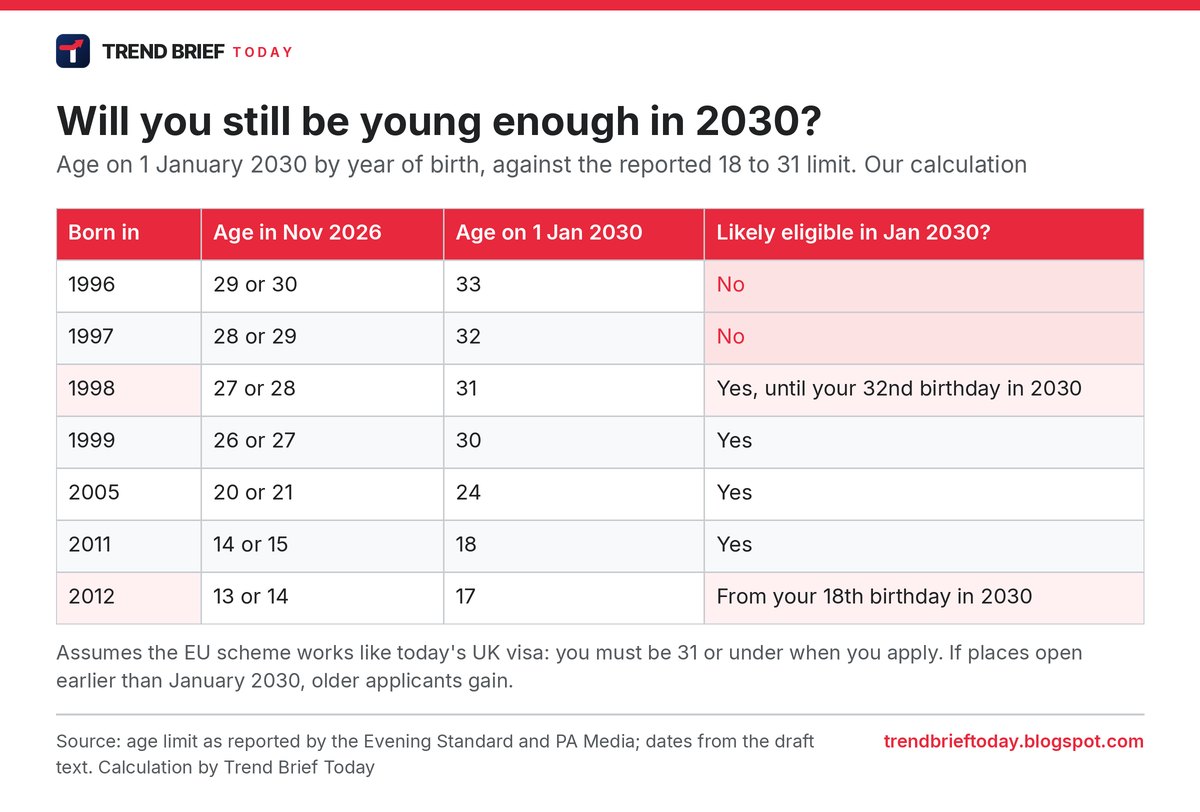
On that reading, anyone born in 1997 or earlier is likely to miss out if places only open in January 2030, while those born in 1998 would need to apply before their 32nd birthday that year. People born in 2012, who are 13 or 14 now, become eligible on their 18th birthday in 2030. If the scheme opens earlier than the January 2030 backstop, older applicants gain, which is one reason the joint statement's dates matter so much.[2]
Is this free movement?
No. Free movement before Brexit had no cap, no age limit and no time limit. This scheme has all three: 100,000 places, an upper age of 31 and a maximum of three years.[2][4] It is closer to the working holiday visas Britain already swaps with Australia or Japan, just much bigger.[10]
The politics still matter. Nigel Farage called the reset a "betrayal" and said Burnham had been "naive", while business groups welcomed it.[4][8] ABTA, the travel trade body, said before the summit that the number of UK workers in tourism roles across the EU had fallen 69% since Brexit, and that nearly half of travel industry leaders started in overseas jobs such as tour reps.[4] Business Secretary Jonathan Reynolds has dismissed claims that young Europeans would take jobs that could go to young Britons who are not in work or education.[12]
What to do now
- If you are British and under 30: there is nothing to apply for yet. Watch for the joint statement, then for the rules of the specific EU country you want, because each sets its own permits.[6]
- If you are an EU citizen hoping to work in the UK: the existing UK youth visa is not open to EU nationals, so the usual skilled worker or student routes still apply until the new scheme opens.[9]
- If you are close to 30: the date the scheme opens matters more to you than anyone. Our age table shows that a January 2030 start would rule out everyone born before 1998.
- If you are a student: the tuition fee talks are separate and run for six months. Nothing changes for current EU or UK students this academic year.[3]
Frequently asked questions
What is the UK-EU youth mobility scheme?
A reciprocal deal agreed on 20 November 2026 that lets up to 100,000 young people a year from the EU live, work, study or travel in the UK for up to three years, with matching places for young Britons in the EU.[4][6]
What is the age limit?
18 to 31, as reported by the Evening Standard. The upper limit was raised from 30 to 31 in the last days of talks.[2][5]
When can I apply?
Not yet. The draft text aims to apply the agreement by 2028 and to have places available no later than January 2030. The joint statement published on 20 November keeps both dates.[13]
How much will the visa cost?
The application fee has not been set. The official explainer says EU participants will pay the Immigration Health Surcharge at 75% of the full rate, which on today's £776 is about £582 a year by our calculation.[14] The current UK Youth Mobility visa costs £340 plus the full £776 per year.[9]
Is it the same as the Youth Mobility Scheme visa?
No. The existing visa covers 13 countries and territories, not EU states, allows up to two years and has 76,100 places in 2026. The EU scheme is a separate, larger deal.[9][10]
Does it depend on the tuition fees deal?
The two sides disagree. DW, citing DPA, says the EU made the agreements conditional on a fees deal; Downing Street says the start dates are not conditional on the fees issue.[7][11]
References
- Prime Minister's Office, 10 Downing Street, GOV.UK, Prime Minister in Brussels to deliver deal that cuts costs for Britain, 20 November 2026.
- Rachael Burford, London Evening Standard, What is the Youth Mobility Scheme and how will it affect Londoners?, 20 November 2026.
- Reuters via Euronext, Britain and EU to launch reset with food and youth mobility deals, 20 November 2026.
- Reuters via Majorca Daily Bulletin, UK-EU reset deal agreed, Downing Street says, youth mobility green lit, 20 November 2026.
- Jennifer Rankin, Lisa O'Carroll and Jessica Elgot, The Guardian via AOL, UK and EU close to post-Brexit deal as they agree 100,000 youth mobility cap, 19 to 20 November 2026.
- The Guardian via AOL, What's in the UK-EU relationship reset draft, and what else is at stake for Burnham?, 20 November 2026.
- Helen Corbett and David Hughes, PA Media via The Irish News, UK-EU relationship at 'turning point' as Burnham agrees new deal with Brussels, 20 November 2026, 12:28 GMT.
- Al Jazeera, 'The deal is done': EU, UK agree to reset relations 10 years after Brexit, 20 November 2026.
- UK Visas and Immigration, GOV.UK, Youth Mobility Scheme visa (overview, eligibility and extension pages), checked 20 November 2026.
- Home Office, GOV.UK, Immigration Rules Appendix Youth Mobility Scheme: eligible nationals (2026 allocations), updated 8 April 2026.
- Sertac Comak, DW, EU and UK hold a rare summit in bid to 'rebuild ties', 20 November 2026.
- The Independent via MSN, EU-UK summit live: Burnham secures Brexit reset deal with Brussels, 20 November 2026.
- "UK-EU Summit 2026 Joint Statement". GOV.UK. 20 November 2026.
- "UK-EU Summit 2026 Explainer: Youth Experience Scheme". GOV.UK. 20 November 2026.
- "'Costs cut': Prime Minister secures deal with EU ... worth up to £17 billion per year". Prime Minister's Office, GOV.UK. 20 November 2026.