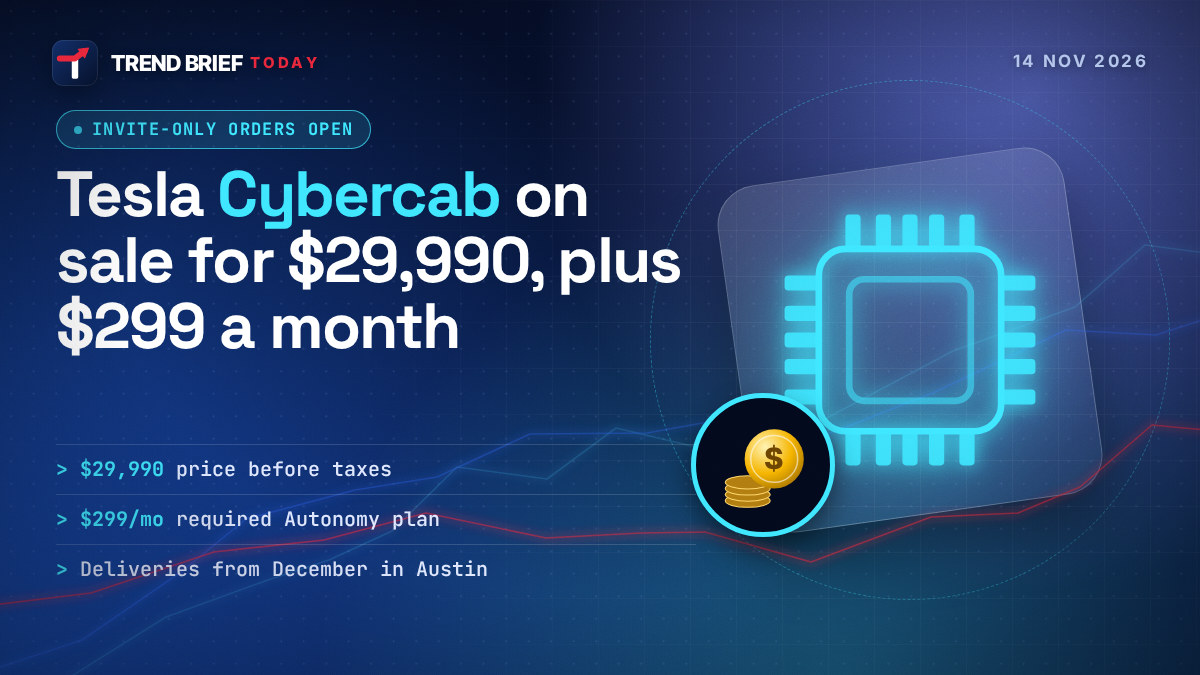
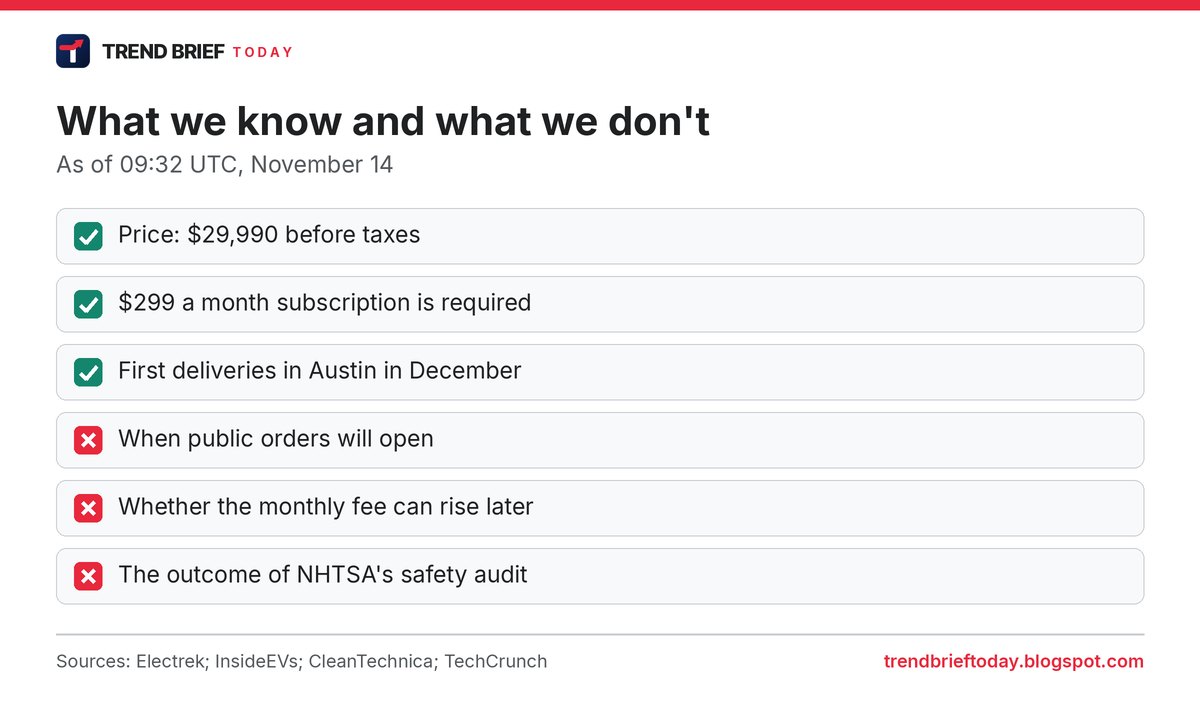
Tesla has started selling the Cybercab, its two-seat robotaxi with no steering wheel or pedals, for $29,990 before taxes. The catch is a required $299-a-month "Autonomy" subscription, and for now only invited buyers can order. First deliveries are due in December in Austin, Texas, and the car only works inside Tesla's Robotaxi service areas.[1][2][3][4]
 | |
| Price | $29,990 before taxes[1][2][3] |
|---|---|
| Subscription | $299 a month, required, first month included[1][2][3] |
| Deposit | $1,000, non-refundable[1][2][4] |
| Who can order | Invited "select customers" only[1][3][4] |
| First deliveries | December 2026, Austin, Texas[1][2][3] |
| Seats | Two[1][2] |
| Controls | No steering wheel or pedals[1][2][6] |
| Works in | Tesla Robotaxi service areas only[1][3] |
| Regulator | NHTSA audit of its safety certification still open[5][6][7] |
What Tesla announced
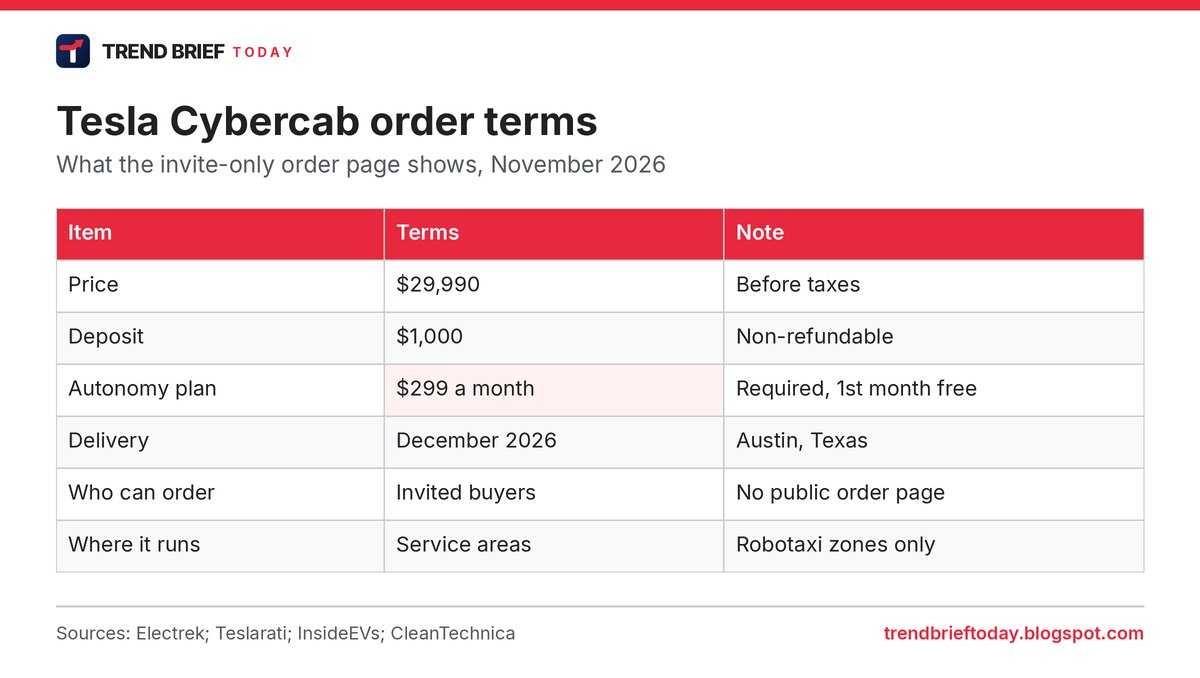
On Friday, November 13, Tesla's Robotaxi account on X said that "select customers are now being invited to purchase Cybercab for personal use".[1][3] Screenshots of the order page show a price of $29,990 before taxes and an estimated delivery of December 2026 in Austin.[1][2][3] Buyers have to put down a $1,000 deposit, which Tesla says is non-refundable.[1][2][4]
The Cybercab is the gold two-seater that Tesla already uses in its own Robotaxi ride service. It has no steering wheel and no pedals, and it was designed from the start to drive itself.[1][2][3] Elon Musk had long promised a Cybercab priced under $30,000, and the list price just meets that promise.[1][2]
There is no public order page. Tesla says initial availability is limited, and it has not said when people without an invite will be able to buy one.[3][4]
The $299 a month catch
The price is only half the story. The order page has a $299-a-month "Autonomy Subscription" already ticked, with the first month included, and the fine print says the subscription and regular maintenance are "required to operate".[1][2] Because the car has no steering wheel or pedals, the owner cannot simply drive it themselves if they stop paying.[2][4]
That fee works out at $3,588 a year. InsideEVs puts it at "some $3,600 per year just to use the vehicle, before insurance or maintenance costs".[3] CleanTechnica points out that Tesla could change the monthly price later, and owners would have no other way to run the car.[4]
What a Cybercab really costs
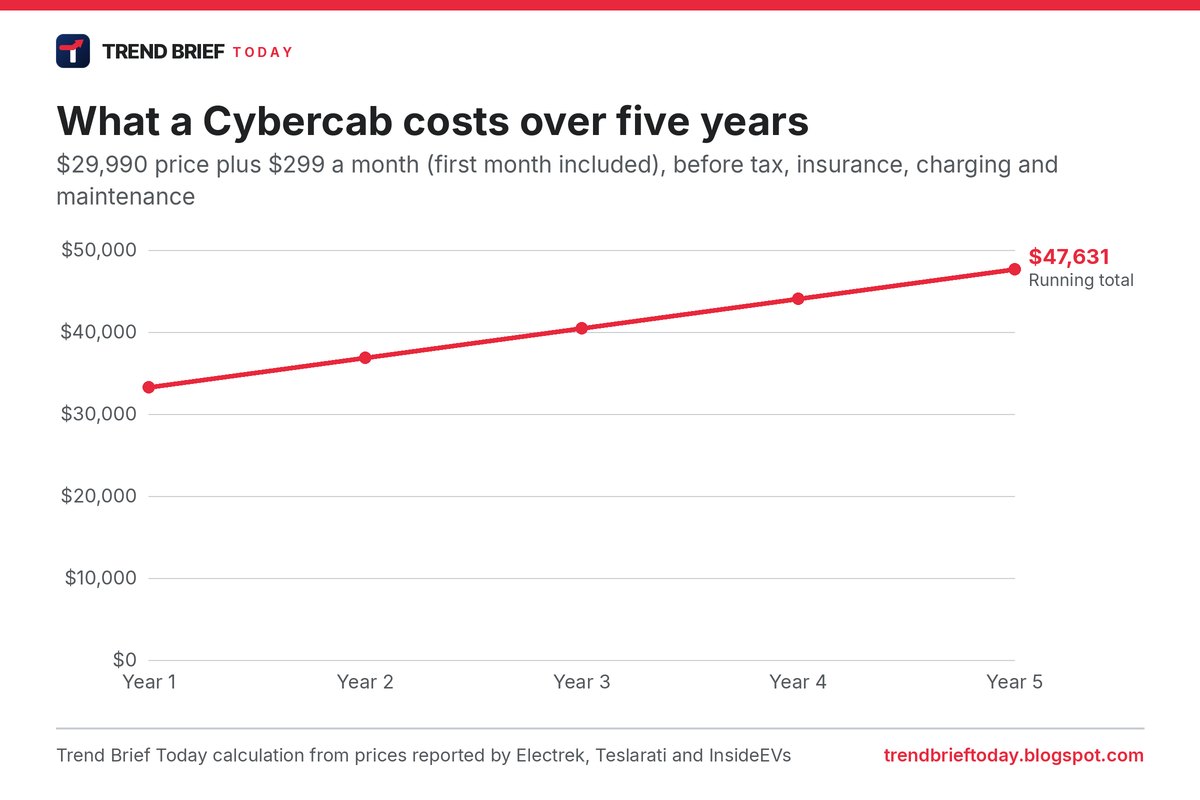
We added the listed price and the monthly fee together, assuming the fee stays at $299 and counting the free first month. These figures leave out sales tax, registration, insurance, charging and maintenance, so the real bill will be higher.
| Owned for | Months paid | Running total |
|---|---|---|
| 1 year | 11 | $33,279 |
| 3 years | 35 | $40,455 |
| 5 years | 59 | $47,631 |
Our calculation: $29,990 plus $299 for every month after the first. Electrek puts the five-year total at about $47,600 and CleanTechnica at about $47,840 (CleanTechnica counts all 60 months).[1][4]
Over five years the subscription adds about $17,600, which is more than half the price of the car itself. For someone who already spends well over $300 a month on ride-hailing and lives inside a Robotaxi zone, that maths might work. For most other buyers it is a lot to pay for a two-seater that can only go where Tesla's software is allowed to take it.[1][4]
Where a Cybercab can actually go
Tesla says the car will only work in "supported service areas".[1][3] In practice that means the zones where Tesla runs its Robotaxi service, which today are in cities in Texas and Florida.[1][6] Austin and Miami are among them.[1][3]
Outside those zones the car cannot be driven, because there are no manual controls to fall back on.[1][2] Teslarati, a site that follows Tesla closely, says buyers "will need to accept the geographic and operational constraints of current autonomous deployment".[2] Electrek's Fred Lambert is blunter: anywhere outside the zones, he writes, the car is "a $30,000 sculpture in your driveway".[1]
The safety investigation
Federal rules in the US still require manual controls such as a foot brake. The National Highway Traffic Safety Administration (NHTSA) is in the middle of rewriting some of those rules for vehicles built to drive themselves, but the old standards still apply for now.[5][6]
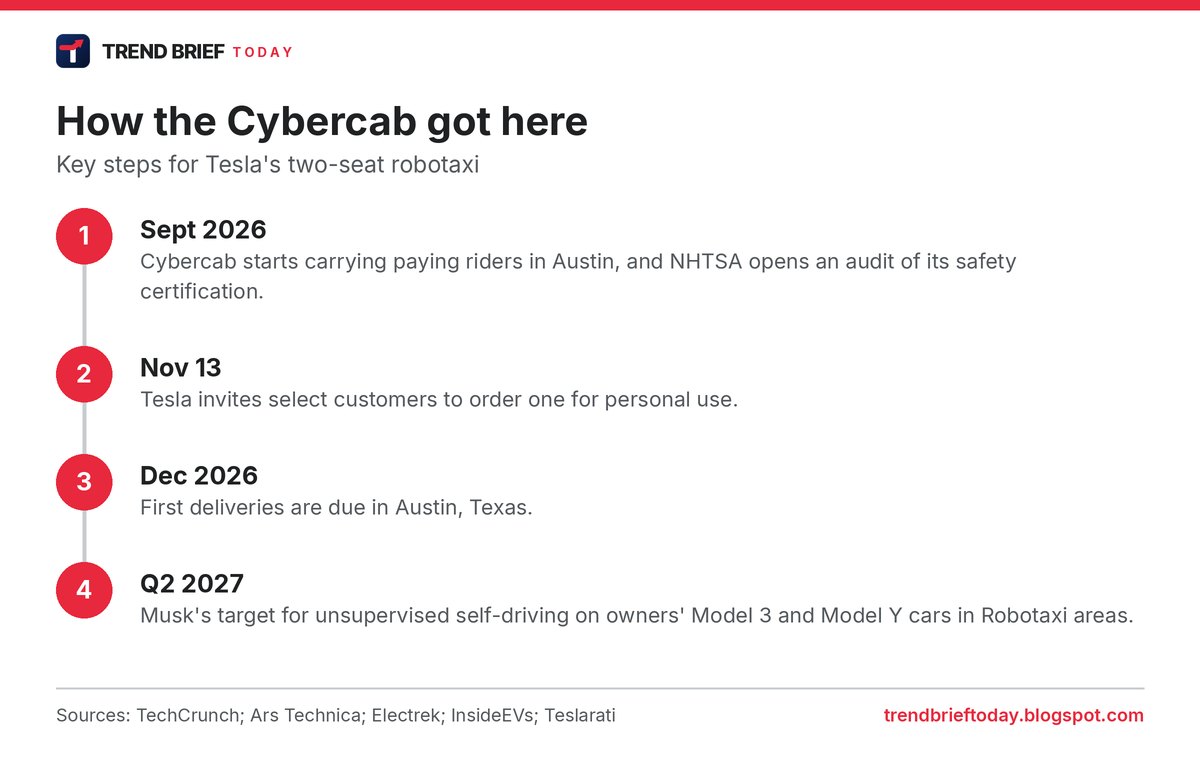
Tesla started using Cybercabs for public rides in Austin in early September. Within hours, NHTSA opened an "audit query" into how Tesla had certified the car.[5][6][7] Tesla says the Cybercab meets every federal safety standard, so it did not ask for an exemption.[5][6] Amazon's Zoox, which also builds a robotaxi with no steering wheel, took the other route: it applied for an exemption and got final approval in July 2026, with a cap of 2,500 vehicles a year.[5][7]
NHTSA has not announced the outcome of its audit, and the investigation is still open while Tesla starts selling the car to the public.[1][7]
What it means for current Tesla owners
Many Tesla drivers have paid for Full Self-Driving on their Model 3 or Model Y over the years and are still waiting for it to run without a human watching. Musk's latest target for that is the second quarter of 2027, in areas where the Robotaxi service operates.[1][3] Both InsideEVs and Electrek say some of those owners will not be happy to see a new car get unsupervised driving first.[1][3]
The Cybercab could still be a milestone. Today's driverless cars are owned and run by companies such as Waymo, Zoox and Tesla itself. InsideEVs says the Cybercab could become the first Level 4 self-driving car that ordinary people can actually own, if deliveries go ahead.[3]
Frequently asked questions
How much is the Tesla Cybercab?
$29,990 before taxes, plus a required $299-a-month Autonomy subscription. The first month of the subscription is included.[1][2][3]
Can anyone buy a Cybercab?
Not yet. Tesla is only inviting "select customers" to order, and there is no public order page.[1][3][4]
When will the Cybercab be delivered?
Tesla's order page shows an estimated delivery of December 2026 in Austin, Texas.[1][2][3]
Does the Cybercab have a steering wheel?
No. It has no steering wheel and no pedals, so it can only drive itself, and only inside Tesla's supported service areas.[1][2][6]
Is the Cybercab subscription optional?
No. Tesla's fine print says the subscription is required for the car to operate.[1][2]
How much does a Cybercab cost over five years?
About $47,600 if the fee stays at $299 a month, before taxes, insurance, charging and maintenance.[1][4]
References
- Electrek (Fred Lambert), Tesla Cybercab orders open at $29,990 + $299/mo, only in Robotaxi zones, 13 November 2026.
- Teslarati (Joey Klender), Tesla Cybercab goes on sale for $29,990, slated for December deliveries, 13 November 2026.
- InsideEVs (Tim Levin) via Yahoo Autos, Tesla Opens Self-Driving Cybercab Orders To 'Select Customers' At $29,990, 14 November 2026.
- CleanTechnica (Zachary Shahan), Tesla Starts Selling Cybercab, $30,000*, 13 November 2026.
- TechCrunch (Sean O'Kane, Kirsten Korosec), Feds launch investigation into Tesla's Cybercab deployment, 4 September 2026.
- Ars Technica (WIRED), Tesla's Cybercab has been deployed, and it's already under investigation, 5 September 2026.
- Electrek (Fred Lambert), Tesla wants its sworn Cybercab answers to NHTSA kept entirely secret, 5 November 2026.
- The Wall Street Journal, Tesla Opens Sales Of Autonomous Cybercab For 'Select' Customers, 14 November 2026 (headline only, paywalled).