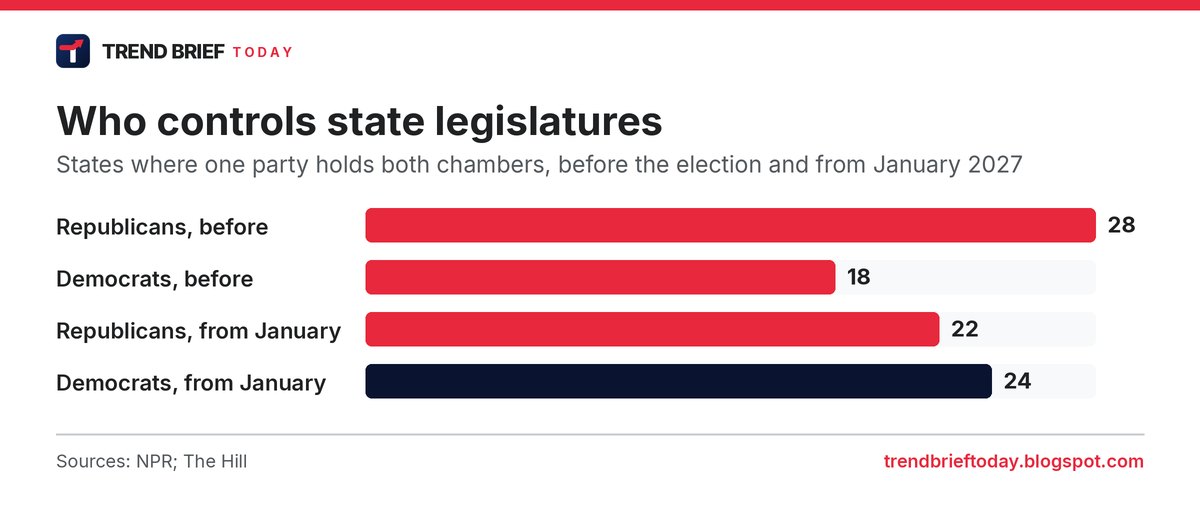
Democrats flipped 12 state legislative chambers in the 2026 US midterm elections and are set to control both chambers in 24 state legislatures from January, against 22 for Republicans, the first time in 16 years that Democrats will run a majority of statehouses.[1][2] Before the 3 November vote, Republicans controlled 28 legislatures and Democrats 18.[1] Democrats also won six new "trifectas", control of the governor's office and both chambers, in Arizona, Michigan, Minnesota, Nevada, Pennsylvania and Wisconsin.[1][3]
 | |
| Election day | 3 November 2026[3] |
|---|---|
| Chambers flipped | 12, all to the Democrats (The Hill count)[2] |
| Full legislative control | Democrats 24, Republicans 22 (was 18 and 28)[1][2] |
| Split legislatures | North Carolina, Texas, Georgia[1][2] |
| Trifectas from January | Democrats 22, Republicans 17, divided 10 (NCSL)[1] |
| New Democratic trifectas | Arizona, Michigan, Minnesota, Nevada, Pennsylvania, Wisconsin[1][3] |
| Republican trifectas broken | Georgia, Iowa, New Hampshire, Ohio, Texas[1] |
| Still counting | Alaska; one North Carolina Senate seat (recount)[1][2] |
| New sessions begin | January 2027[2] |
The result in numbers
The Hill counts 12 individual chambers that switched to Democratic control. Republicans will hold both chambers in 22 states, down from 28 before the election, while Democrats will hold both in 24.[2] NPR, using its own data, says Democrats picked up seats in nearly every state that held legislative elections, including reliably Republican states such as Texas, Utah and Florida.[1]
The National Conference of State Legislatures (NCSL) told the Associated Press that 2026 is likely to end up as the election with the most legislative seats and chambers changing parties since 2010, when Republicans took over state governments across the country during the Great Recession.[3] This year's result reverses much of that 2010 shift.[1]
Which chambers flipped?
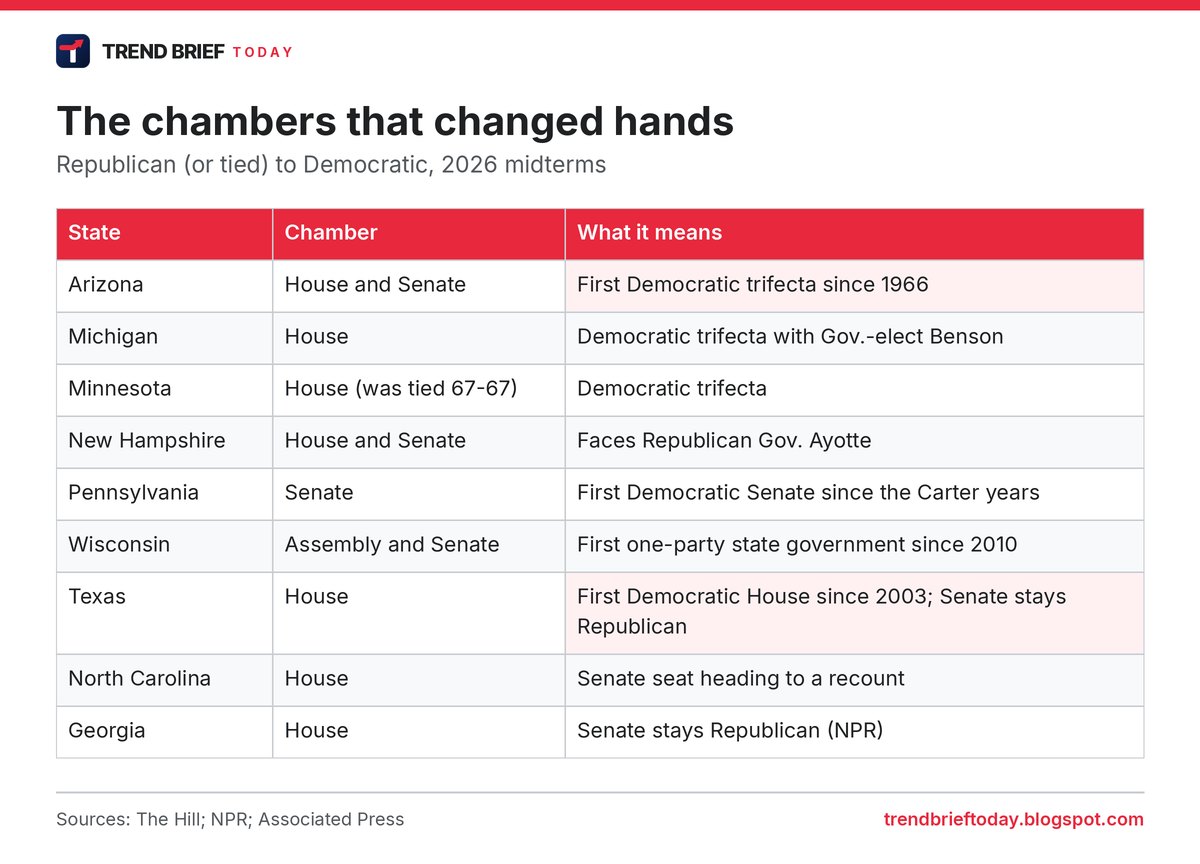
Going by The Hill, the Associated Press and NPR, these are the chambers that changed hands:[1][2][3]
- Arizona: both the House and the Senate. Democrats will have a 37-23 majority in the House and 20-10 in the Senate, according to the Arizona Democratic Legislative Campaign Committee.[2] Republicans had held the Arizona House for 60 years and the Senate since the early 1990s.[3]
- Michigan: the House, which Republicans won in 2024. Democrats kept the Senate.[2]
- Minnesota: the House, which had been tied 67-67 since 2024. Democrat Zack Stephenson will lead it.[2]
- New Hampshire: both chambers, for the first time since 2018, although Republican Gov. Kelly Ayotte was re-elected.[2][3]
- Pennsylvania: the Senate, the first Democratic majority there since Jimmy Carter was president.[1][2]
- Wisconsin: the Assembly and the Senate.[2]
- Texas: the House, Republican since 2003. Republicans held the Texas Senate.[1][3]
- North Carolina: the House.[1][2][3]
- Georgia: the House, a Democratic majority for the first time in more than 20 years, NPR reports; Democrats came close in the Senate.[1] The Hill had still listed Georgia as not final.[2]
The six new Democratic trifectas
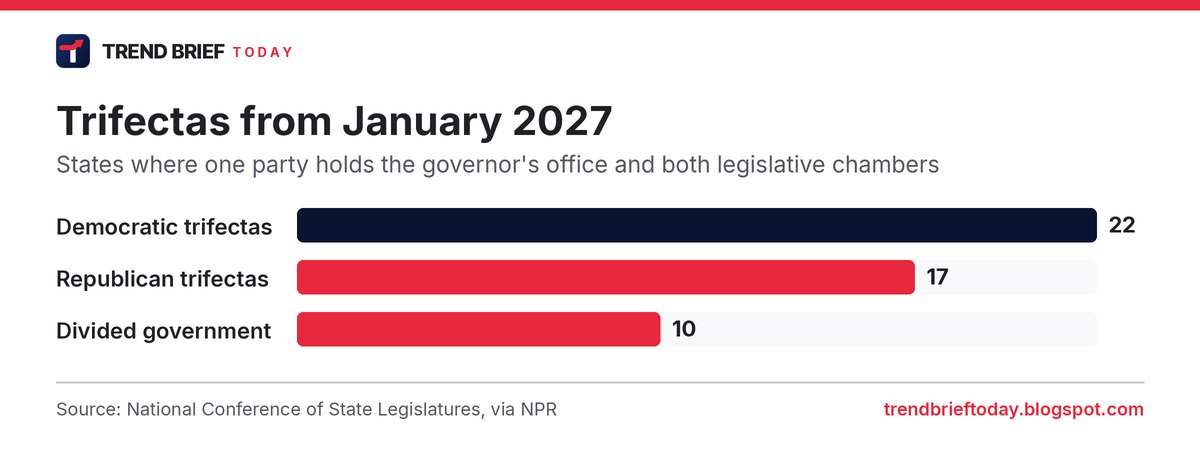
A trifecta is when one party holds the governor's office and both chambers of the legislature, so it can pass laws without needing the other party. NPR, citing the NCSL, expects Democrats to have 22 trifectas and Republicans 17 from January, with 10 states divided; before the election Republicans had a few more than Democrats.[1] The Hill, citing Axios, says that could mean about 53% of Americans living in a state with full Democratic control.[2]
Arizona is the headline. It will have a Democratic trifecta for the first time since 1966.[1][3] In her first term Gov. Katie Hobbs vetoed more than 540 bills passed by the Republican legislature.[3] "When I co-founded the ADLCC in 2014, there were so few Democrats in the state Senate that we joked we could all share one pizza," Hobbs wrote. "Now, Arizona will have a Democratic trifecta for the first time in 60 years. We're going to need a lot more pizza."[2]
The other five are Michigan (with Gov.-elect Jocelyn Benson), Minnesota (Gov.-elect Amy Klobuchar), Pennsylvania (Gov. Josh Shapiro), Wisconsin (Gov.-elect David Crowley, the first single-party control there since 2010) and Nevada, where Democrats already ran the legislature and won the governor's office.[1][2][3]
Texas, North Carolina and Georgia: split legislatures
In three Republican-run states, Democrats won one chamber, leaving the legislature divided.[1][2] In Texas, Democrats will run the House for the first time in 24 years, and voters also elected Gina Hinojosa as the state's first Democratic governor since Ann Richards lost to George W. Bush in 1994.[1][3] Republicans kept the Texas Senate.[3]
North Carolina is the closest. Democrats won the House; in the Senate, a Republican leads the race for one seat by just over a couple of hundred votes and it is likely heading to a recount. That seat decides whether Republicans keep a one-seat majority or the chamber is tied, in which case the Democratic lieutenant governor would break ties.[1]
What could change: vouchers, wages, Medicaid and maps
State legislatures write laws on taxes, abortion, health care and school funding, and they have been important in either advancing or blocking President Trump's agenda.[1] Some of the early plans reported so far:
- Arizona: Hobbs has tried to limit the state's billion-dollar school voucher programme, which pays private school tuition regardless of family income; Democrats also talk about help with rent, utilities and childcare.[1]
- Pennsylvania: Shapiro has promised to work with the new legislature to raise the minimum wage to $15 an hour, strengthen abortion rights and build more affordable housing.[1]
- Georgia: Democrats could try to win over a few Republicans to expand Medicaid, and House Democrats may try to repeal the six-week abortion ban, a harder sell in the Republican Senate.[1]
- North Carolina: Democrats are expected to try to roll back some abortion restrictions, and Gov. Josh Stein wants both parties to work on affordability.[1]
The longer-term stake is maps. The Democratic Legislative Campaign Committee points out that state legislatures draw congressional district maps in most states, which shapes who wins the US House.[4] The next full redistricting comes after the 2030 census.
Supermajorities and vetoes
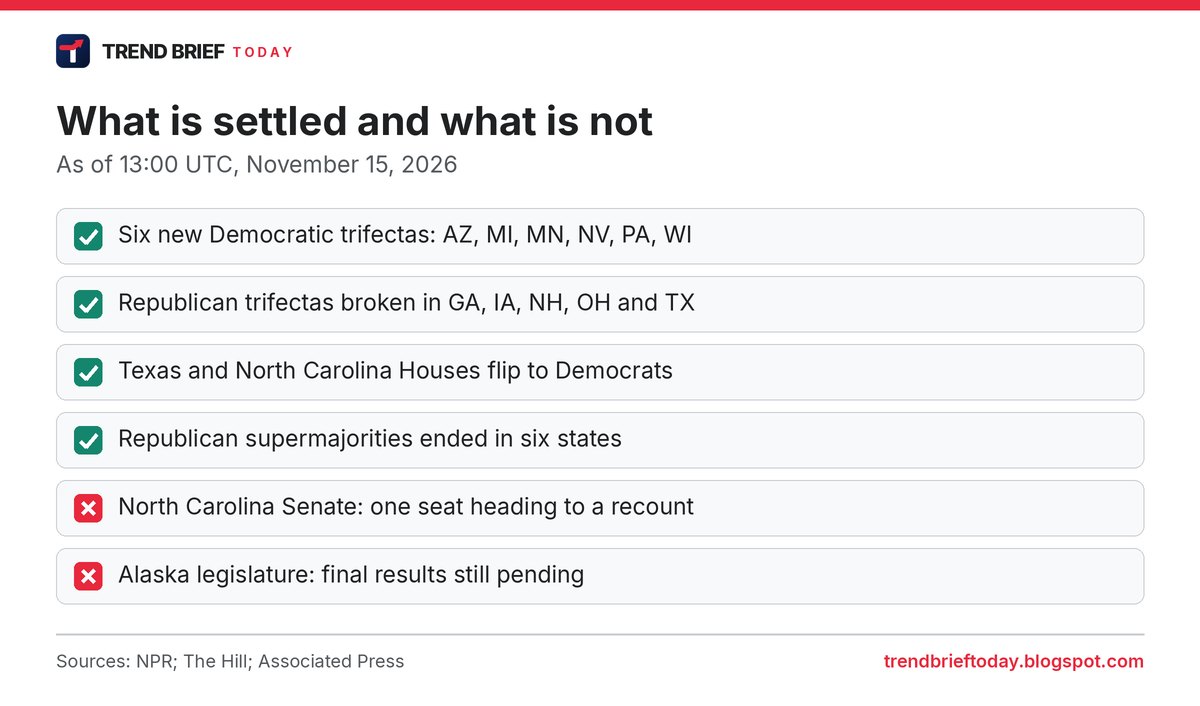
Even where Democrats fell short of a majority, they won enough seats to end Republican veto-proof supermajorities in six states, according to the government relations firm MultiState, as reported by NPR.[1] That matters most where the governor is a Democrat, such as North Carolina, Ohio and Kansas, because the governor's veto now sticks.[1] In Kansas, the House will be 68-57 Republican, below the two-thirds needed to override a veto.[5]
What the parties said
Heather Williams, president of the Democratic Legislative Campaign Committee, said the wins "proved what is possible when you put statehouses at the center of a national strategy."[1] The Republican State Legislative Committee blamed the national anti-incumbent mood and heavy Democratic spending. "Ultimately, the results of this cycle underscore both the challenges Republicans face and the importance of maintaining a strong, sustained presence in the states," its president, Edith Jorge-Tuñón, wrote.[1]
For the federal picture, see our US midterm results explainer, and for the one Senate race still being counted, our Alaska election results page.
Frequently asked questions
How many state legislatures do Democrats control after 2026?
Democrats are set to control both chambers in 24 state legislatures from January 2027, against 22 for Republicans, with the rest split or still being counted.[1][2]
Which state legislative chambers flipped in 2026?
The Arizona House and Senate, Michigan House, Minnesota House, New Hampshire House and Senate, Pennsylvania Senate, Wisconsin Assembly and Senate, Texas House and North Carolina House, with NPR also reporting a Democratic majority in the Georgia House.[1][2][3]
What is a trifecta in US politics?
When one party holds the governor's office and both chambers of the state legislature. Democrats are expected to have 22 from January and Republicans 17.[1]
Did Democrats flip the Texas House?
Yes, for the first time since 2003. Republicans kept the Texas Senate, and Democrat Gina Hinojosa won the governor's race.[1][3]
When does Arizona's Democratic trifecta start?
When the new legislature meets in January 2027. It is the state's first Democratic trifecta since 1966.[1][2][3]
Is North Carolina's Senate still undecided?
One seat is likely heading to a recount. If Democrats win it, the Senate is tied and the Democratic lieutenant governor breaks ties.[1]
References
- Saige Miller, NPR, Midterm voters ended the long-running GOP dominance in state legislatures, 15 November 2026.
- Sarah Davis, The Hill (via Nexstar), Democrats now control majority of state legislatures. Here's the 6 they flipped, 14 November 2026.
- Associated Press via Colorado Politics, Democrats win Arizona governor, House and Senate (Out West Roundup), 15 November 2026.
- Democratic Legislative Campaign Committee, 2026 Election Results, accessed 15 November 2026 (party source).
- Trend Brief Today, US midterm results 2026 explained (Kansas House figures from WIBW and KCUR), 13 November 2026.