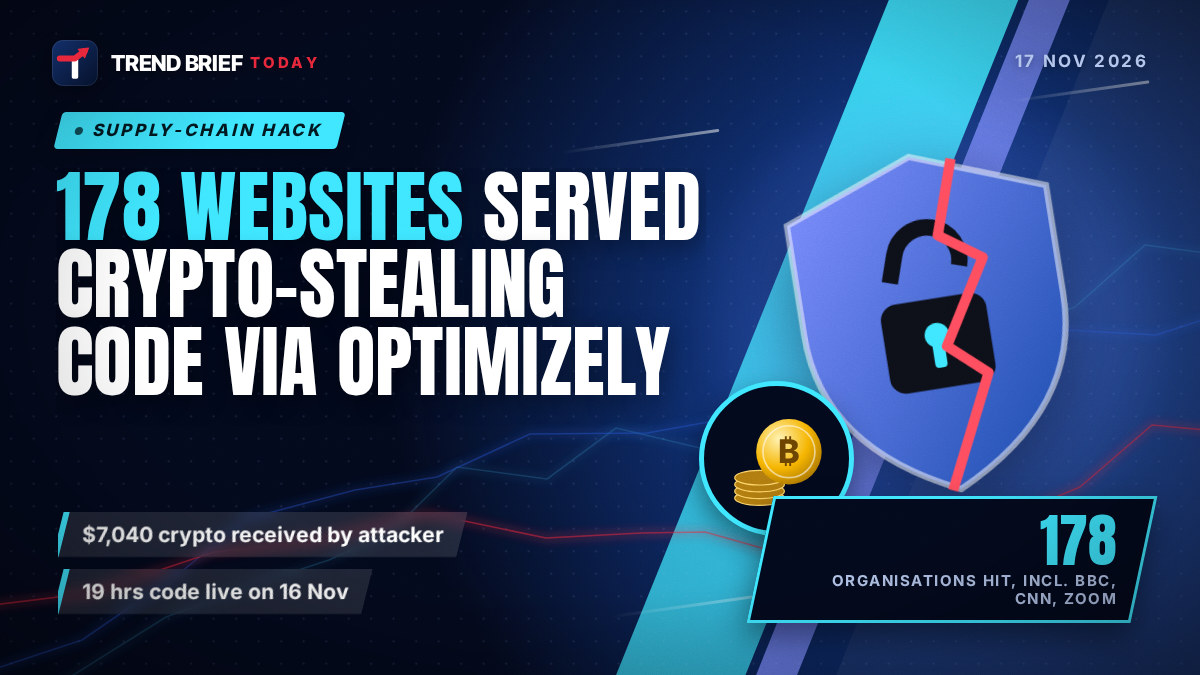
On Monday 16 November 2026 an attacker abused a flaw in Optimizely, a website testing service, to slip malicious JavaScript into the pages of at least 178 organisations, including the BBC, CNN, Fox News, Zoom, Salesforce, IKEA and several HSBC sites. For about 19 hours visitors were served code that swapped cryptocurrency wallet addresses, skimmed card numbers typed into forms and tried to hack older iPhones. Optimizely says the flaw is fixed and the code has been removed.[1][2][3]
 | |
| Date | 16 November 2026, about 04:21 to 23:11 UTC[2] |
|---|---|
| Platform abused | Optimizely Web Experimentation[1] |
| Organisations hit | 178 (188 infected snippets out of 1,611 checked)[2][5] |
| Well-known sites | BBC, CNN, Fox News, NPR, Zoom, Salesforce, GitLab, IKEA, HSBC, Equifax, Air France-KLM, Ledger[2][3] |
| What the code did | Crypto address swapping, card skimming, cookie and screenshot theft, iOS exploit kits[2][3] |
| Crypto received | About $7,040 by 19:25 UTC on 16 November[2][5] |
| Found by | Report URI (Scott Helme)[3][8] |
| Attacker | Not named[5] |
| Status | Flaw fixed, code removed, per Optimizely[1] |
What happened
Optimizely sells a tool that lets companies test different versions of their web pages. To use it, a site loads a small JavaScript file, called a snippet, from Optimizely's servers on every page. Whatever code is in that file runs in the visitor's browser with the same power as the site's own code.[4][9]
On 16 November someone changed those files. Report URI, a web security company founded by researcher Scott Helme, says the attacker added code to the "Project JavaScript" field of customer projects, a custom-code box that runs on every page, and left the rest of each snippet alone. The tampered files were still delivered from Optimizely's own trusted servers, so to a browser they looked normal.[2][5]
Optimizely confirmed it in a status notice at 01:02 UTC on 17 November: "an unauthorized party exploited a vulnerability in Experimentation and used it to add malicious JavaScript to some customer projects." It said it had fixed the vulnerability, removed the injected code, secured affected user accounts and added protections "to prevent unauthorized code from being delivered".[1][7]
In a fuller statement to BleepingComputer, Optimizely said the weak spot was in its Experimentation account signup flow. It said it had blocked the vulnerable path, ended active sessions, revoked tokens, reset access for affected users and notified all affected customers.[3] Report URI says it still does not know how the attacker got write access to so many unrelated customer projects, and that "that's for Optimizely to explain".[2]
Which websites were hit?
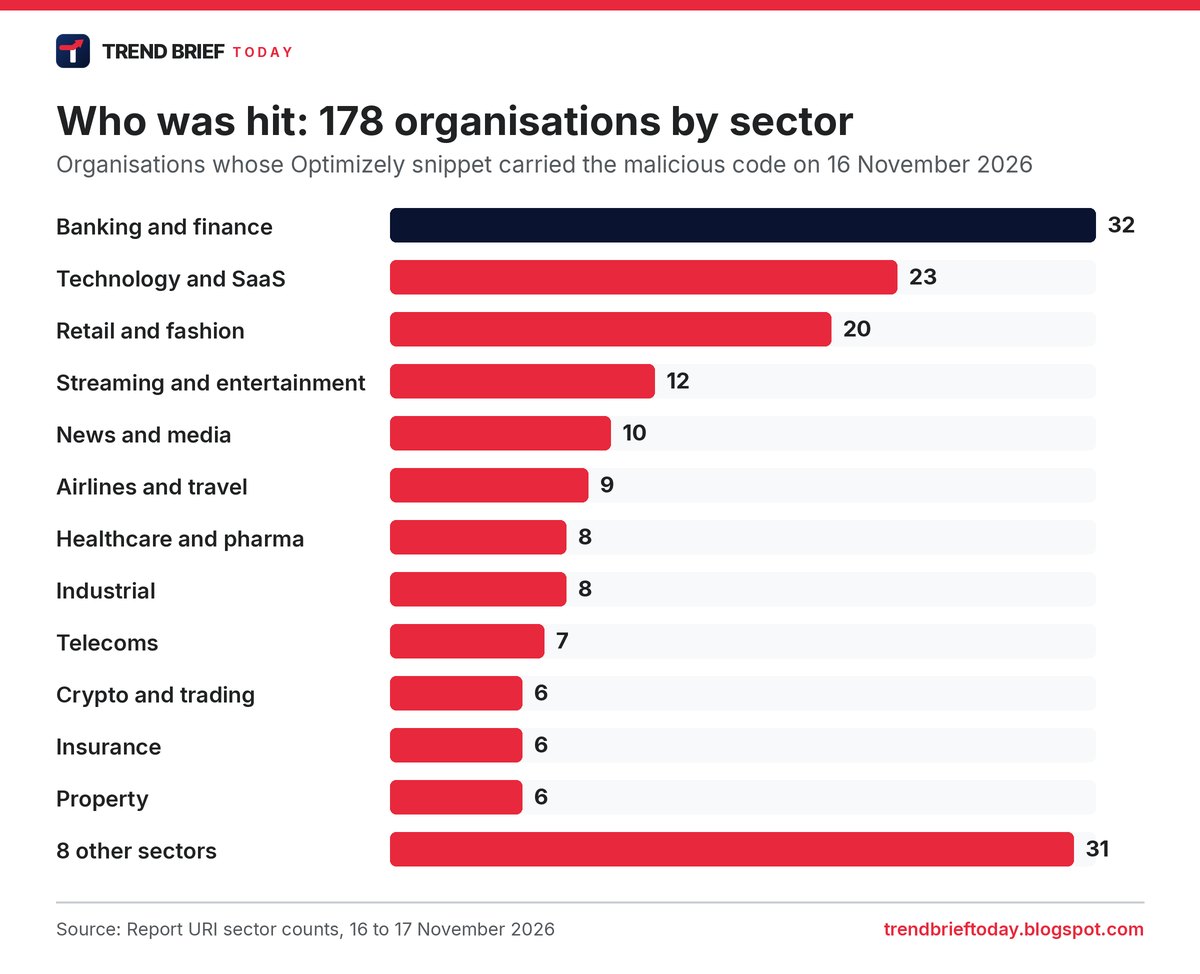
Report URI fetched 1,611 different Optimizely snippets and found the malicious code in 188 of them, belonging to 178 organisations. It says the real number is probably higher, because it could only check snippets it found in time.[2][5] BleepingComputer separately confirmed that the script loaded, or tried to load, on Zoom, KLM, GitLab, the BBC, CNN, Salesforce, Smartsheet and Stamps.com, among others.[3]
| Sector | Organisations | Examples named by researchers |
|---|---|---|
| Banking and finance | 32 | HSBC (US, Hong Kong, UAE, Australia and others), Equifax (US, UK, Canada), Paychex, TaxAct, Funding Circle |
| Technology and SaaS | 23 | Zoom, Bitly, Salesforce, GitLab, Mixpanel, Typeform, Hootsuite, Tableau, Optimizely itself |
| Retail and fashion | 20 | IKEA (home design tool), ASOS, Mattel, American Eagle, American Girl, Levi's sites in Asia-Pacific |
| Streaming and entertainment | 12 | Peacock, NOW TV, SkyShowtime, Starz, D&D Beyond, SeaWorld |
| News and media | 10 | BBC, CNN, Fox News, NPR, CTV News, Fox Sports, Top Gear |
| Airlines and travel | 9 | Alaska Airlines, Hawaiian Airlines, Air France-KLM, Transavia, Trafalgar, Contiki |
| Telecoms | 7 | Virgin Media, O2, Virgin Media O2, TalkTalk, Vodafone Australia, Mint Mobile |
| Crypto and trading | 6 | Ledger, IG, OANDA, interactive investor |
| Insurance | 6 | Admiral, Mutual of Omaha, Asurion, Securian Financial |
| Gambling | 4 | PokerStars, Betfred, tombola, Betsson |
| Other sectors | 49 | Invisalign, Takeda, Heineken, Starbucks Canada, Change.org, UNICEF USA, Lucid Motors, Freshfields |
The sector counts and names above come from Report URI's published list, which it says reflects the status at 21:52 UTC on 16 November.[2] Several UK household names are on it, including the BBC, Virgin Media, O2, TalkTalk, Admiral, ASOS and interactive investor. HSBC appears through its sites in the US, Hong Kong and other markets; HSBC's main UK site is not on the published list.[2] Salesforce told BleepingComputer it had switched off Optimizely scripts across its sites as a precaution and would tell customers "without undue delay" if it found any access to their data.[3]
What the malicious code did
Every visitor got the same script, called track.js, and all of its parts were active at once. What happened to a visitor depended on their device and what they did on the page.[2]
- Swapped crypto wallet addresses. It looked for valid Bitcoin, Ethereum, TRON, Solana, TON, Litecoin, Bitcoin Cash and Dogecoin addresses on the page and in the clipboard, and replaced them with the attacker's. Copy an address from an infected page and you could paste the attacker's instead.[2][3]
- Skimmed payment cards. From 13:43 UTC it watched forms for a card number, expiry date and security code and sent them to the attacker's server. Cards typed into payment boxes hosted by Stripe, Adyen and similar firms were out of its reach; cards typed into a site's own fields were not.[2][5]
- Stole cookies and screenshots. Next to wallet or payment wording it sent the page address, readable cookies and a screenshot of the page to the attacker.[2][3]
- Attacked older iPhones and iPads. On Apple mobile devices it loaded two exploit kits, Coruna and DarkSword. Report URI says iOS 18.7.3 and later, and iOS 26.3 and later, are patched against them.[2][5]
Report URI says the attacker rebuilt the script 26 times during the day, adding features and wallets as it went.[2][8] The code also had a backup: if the attacker's server was blocked, a full copy of the payload was hidden inside the snippet and run directly.[2][3]
How much was stolen?
The only figure anyone can see is the money that reached the attacker's crypto wallets, because those payments are public on the blockchain. Report URI counted about $7,040 received by 19:25 UTC on 16 November, all within roughly nine hours.[2][5] Most of it was Bitcoin, worth about $5,489 by the researchers' later count.[2] The wallets were emptied early on 17 November. One address used to cash out had also been used in earlier attacks in March and on 3 November 2026, which is how Report URI linked this attacker to previous campaigns.[2]
Nobody outside the attacker knows how many card numbers, cookies or screenshots were taken, or how many iPhones were infected. Report URI says it has "no way to see" those numbers.[2] BleepingComputer adds that some of the wallets were active before the attack, so it is hard to say exactly how much crypto was stolen in this campaign.[3]
Timeline
| Time (UTC) | US Eastern | Event |
|---|---|---|
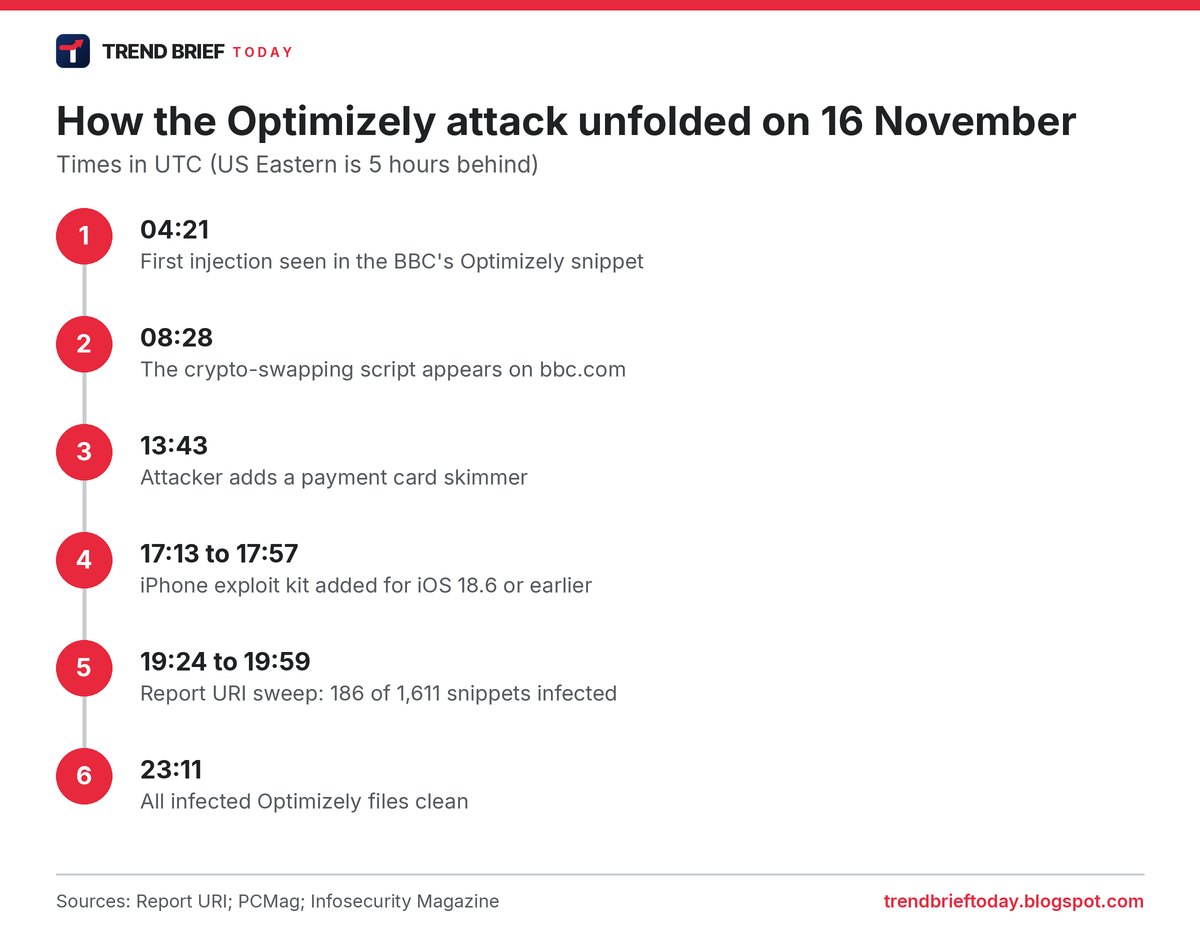
| 16 Nov 04:21 | 11:21pm Sun | First injection seen, in the BBC's Optimizely snippet[2][8] |
| 16 Nov 08:28 | 3:28am Mon | The crypto-swapping script first appears on bbc.com[2] |
| 16 Nov 13:03 | 8:03am | Attacker moves stolen crypto to exchanges[2] |
| 16 Nov 13:43 | 8:43am | Card skimmer added to the script[2] |
| 16 Nov 15:06 | 10:06am | Report URI's monitoring flags the code on a customer website[9] |
| 16 Nov 17:13 to 17:57 | 12:13pm to 12:57pm | Second iPhone exploit host added[2] |
| 16 Nov 19:24 to 19:59 | 2:24pm to 2:59pm | Report URI sweep finds 186 of 1,611 snippets infected[2] |
| 16 Nov 20:40 to 21:10 | 3:40pm to 4:10pm | Mass clean-up of the files[2][8] |
| 16 Nov 23:11 | 6:11pm | All infected Optimizely files clean[2][5] |
| 17 Nov 00:37 | 7:37pm Mon | Attacker's main server domain suspended[2] |
| 17 Nov 01:02 | 8:02pm Mon | Optimizely posts its security incident notice[1] |
Was I affected, and what should I do?
Only people who opened one of the affected sites on 16 November were exposed, and most of them will have lost nothing. The risk is real in three cases: you sent crypto, you typed a card number into the site's own form, or you used an iPhone or iPad on an old version of iOS.[2][6]
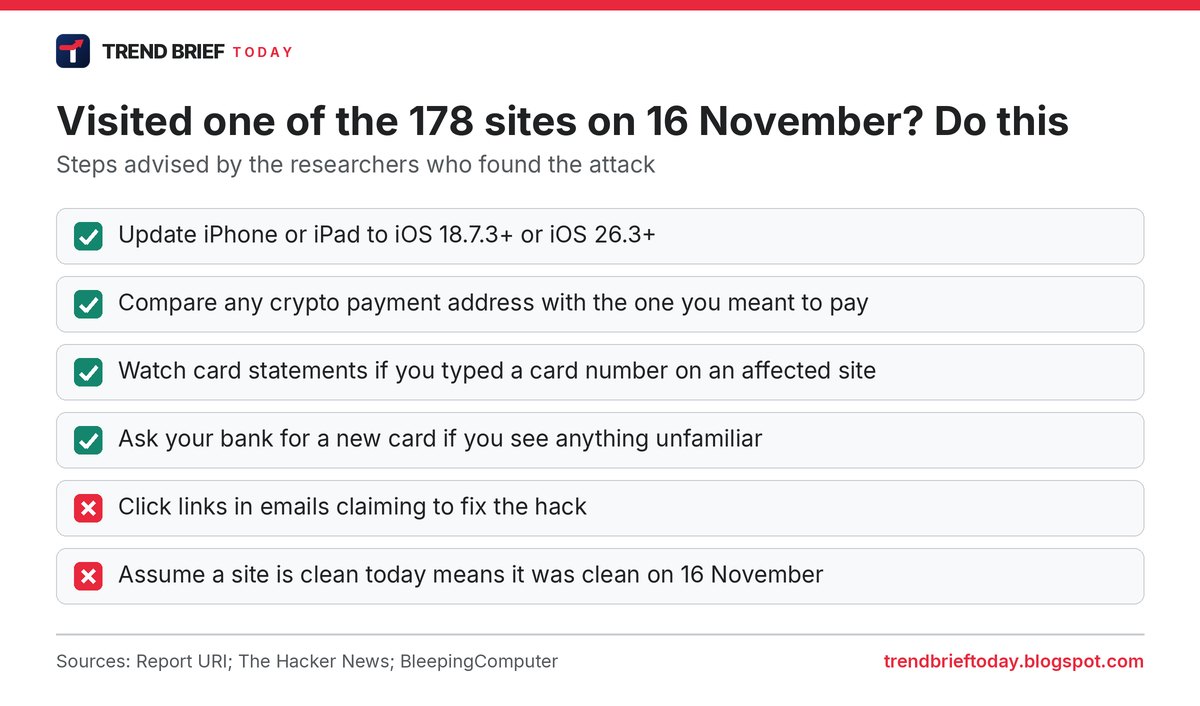
- Update your iPhone or iPad to iOS 18.7.3 or later, or iOS 26.3 or later. Report URI says pages on iOS 18.6 or earlier reloaded every 60 seconds to retry the exploit, which was a visible symptom.[2]
- Check any crypto payment you made that day. If the address you sent to does not match the one you meant to pay, it may have been swapped.[2][6]
- Watch your card statements if you paid on one of the sites, and call your card issuer if you see anything you do not recognise.[3][6]
- Watch your accounts if you were logged in to something sensitive while browsing an affected site.[3]
Our own advice on top of that: be careful with emails or texts that mention this attack and ask you to "verify" a card or wallet. Big news stories like this are often followed by phishing that borrows the headlines.
What website owners should do
If your site uses Optimizely Web, the researchers say to open every project's Project JavaScript and every experiment's custom code and look for the attacker's domain (1688360.cc), the text atob( and any script you did not write. Review which users, API tokens and integrations can change your account, and rotate their credentials.[2][6] Report URI also says to treat cards typed into your own forms on 16 November, and secrets stored in cookies not marked HttpOnly, as possibly exposed.[2]
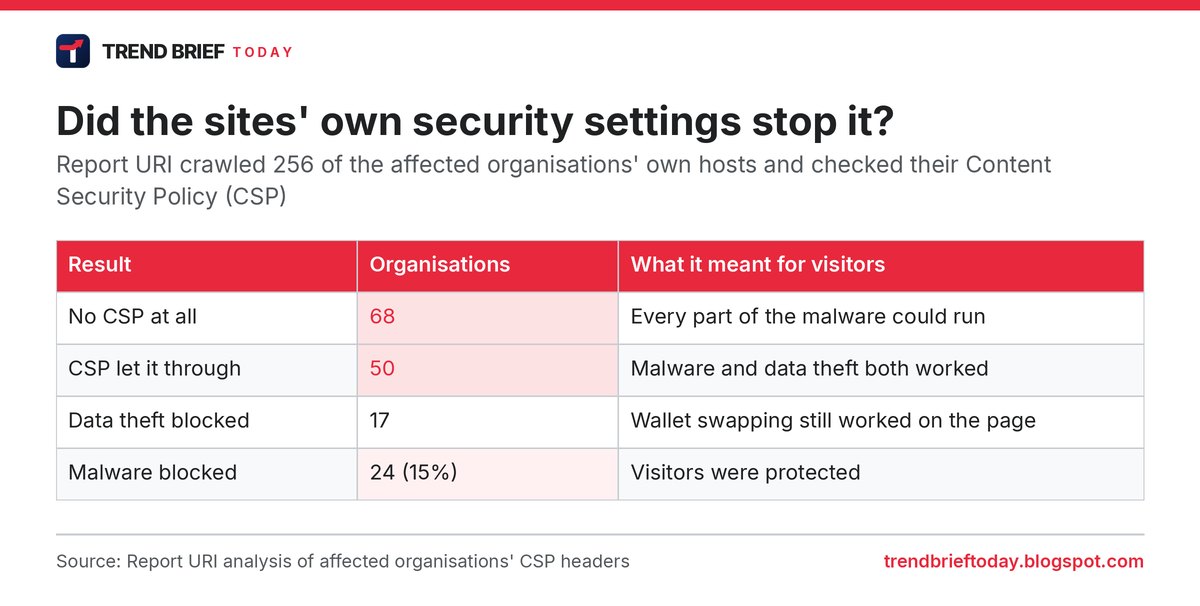
The longer-term fix is a Content Security Policy (CSP), a browser rule that says where a page may load code from and send data to. Report URI checked the affected organisations' own sites. Only 24 of them, about 15%, had a CSP that blocked the malware. 68 had no CSP at all.[2] Allowing Optimizely's own server in a CSP did not help, because the bad code came from that server. Helme argues that even a "report-only" CSP, which blocks nothing but sends alerts, would have warned site owners the moment their third-party code changed.[2][9]
Is this linked to the other outages this week?
There is no sign of that. The attack came in a week of big US tech failures, including Microsoft's Outlook outage, the FAA ground stop and Apple's iCloud outage on 17 November, and none of those has been blamed on a cyberattack.[10] Apple said its outage was caused by an internal update and was not a cyberattack (see Apple outage today).[10][11] The Optimizely incident is a different kind of problem: a trusted outside supplier whose code was changed, which security people call a supply-chain attack.[4][9]
Frequently asked questions
What is the Optimizely hack?
An attacker exploited a vulnerability in Optimizely's Web Experimentation product on 16 November 2026 and added malicious JavaScript to customer projects, so the code ran on those customers' websites.[1][3]
How many websites were hit?
Report URI found the code in 188 snippets belonging to 178 organisations, and says the true number is probably higher.[2][5]
Was the BBC hacked?
Not in the usual sense. Report URI says the affected websites were not necessarily running vulnerable code of their own; they were loading JavaScript from a supplier they trusted. The BBC's Optimizely snippet carried the malicious code, so visitors to bbc.com and bbc.co.uk on 16 November were served it.[2]
Is it safe to use these websites now?
The researchers say all infected Optimizely files were clean by 23:11 UTC on 16 November and stayed clean, and Optimizely says the flaw is fixed.[1][2]
Who was behind it?
The attacker has not been named. Report URI linked one of the wallets to activity going back to March 2026.[2][5]
Does it affect Android phones?
The phone exploit kits targeted iPhones and iPads. The crypto swapping and card skimming ran in any browser, including on Android and desktop computers.[2]
References
- Optimizely. "Web Experimentation Security Incident". Optimizely Service Status. 17 November 2026, 01:02 UTC. Retrieved 17 November 2026.
- Scott Helme. "World's Largest Brands Infected With Malware Via Optimizely". Report URI. 16 November 2026, updated 17 November 2026. Retrieved 17 November 2026.
- Lawrence Abrams. "Optimizely hack infected CNN, Fox News, BBC, Salesforce sites with malware". BleepingComputer. 16 November 2026. Retrieved 17 November 2026.
- Sinisa Markovic. "Malware spread through Optimizely hits 178 organizations, including BBC, CNN and Zoom". Help Net Security. 17 November 2026. Retrieved 17 November 2026.
- Alessandro Mascellino. "Optimizely Flaw Exploited to Serve Malicious Code to Visitors of 178 Organizations". Infosecurity Magazine. 17 November 2026. Retrieved 17 November 2026.
- Swati Khandelwal. "Hijacked Optimizely Scripts Served Card Skimmer and iOS Exploit Kits to CNN, BBC and Zoom Visitors". The Hacker News. 17 November 2026. Retrieved 17 November 2026.
- Eduard Kovacs. "Optimizely Vulnerability Exploited to Serve Malware on Major Websites". SecurityWeek. 17 November 2026. Retrieved 17 November 2026.
- Michael Kan. "Hacker Tampers With 178 Websites to Steal Crypto, Credit Card Info". PCMag. 17 November 2026. Retrieved 17 November 2026.
- Scott Helme. "Reflecting on the Optimizely Incident and Why We Keep Failing". scotthelme.co.uk. 17 November 2026. Retrieved 17 November 2026.
- Sarah Perez. "Apple services, including iCloud, App Store, and Apple Music, hit by outage". TechCrunch. 17 November 2026. Retrieved 17 November 2026.
- Juli Clover. "Apple Blames Internal Update for Outage, Says It Wasn't a Cyberattack". MacRumors. 17 November 2026. Retrieved 17 November 2026.