The Leonid meteor shower peaks tonight, the night of Tuesday 17 into Wednesday 18 November 2026.[1][5][7] The best time to watch is from about midnight until the sky starts to get light, when the shower's radiant in Leo is up and the first quarter Moon has set.[1][2][6] Expect around 10 to 15 meteors an hour from a dark site, with no storm forecast this year.[1][2]
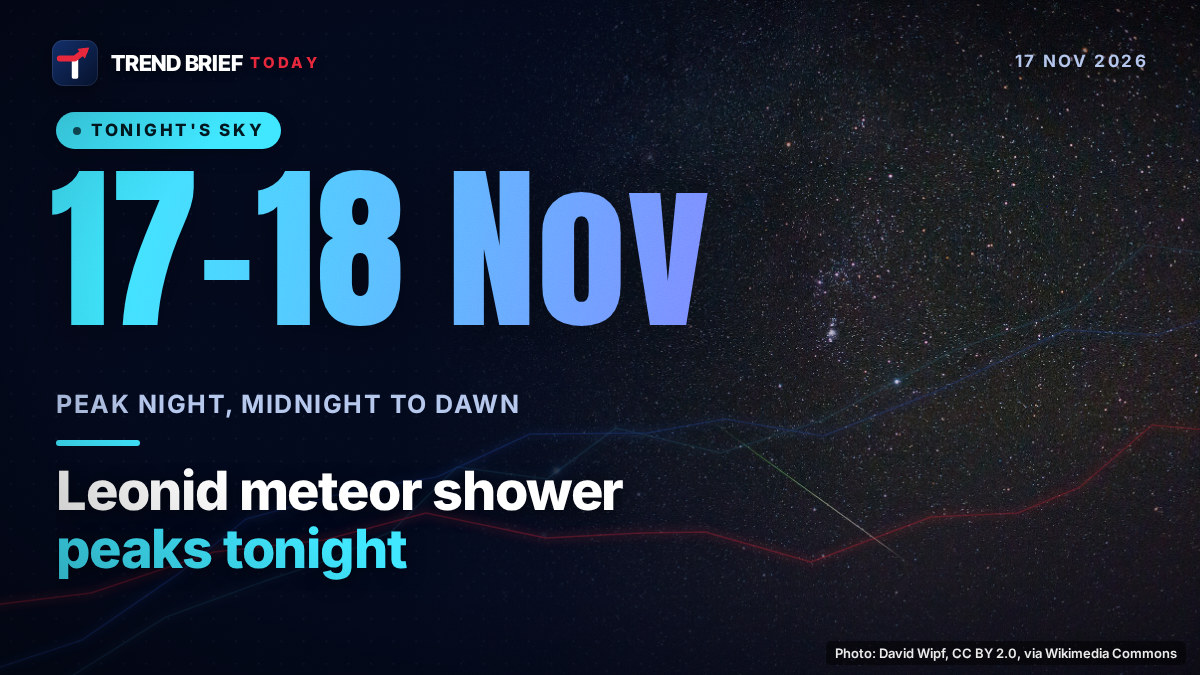 | |
| Cover photo: David Wipf, CC BY 2.0, via Wikimedia Commons. | |
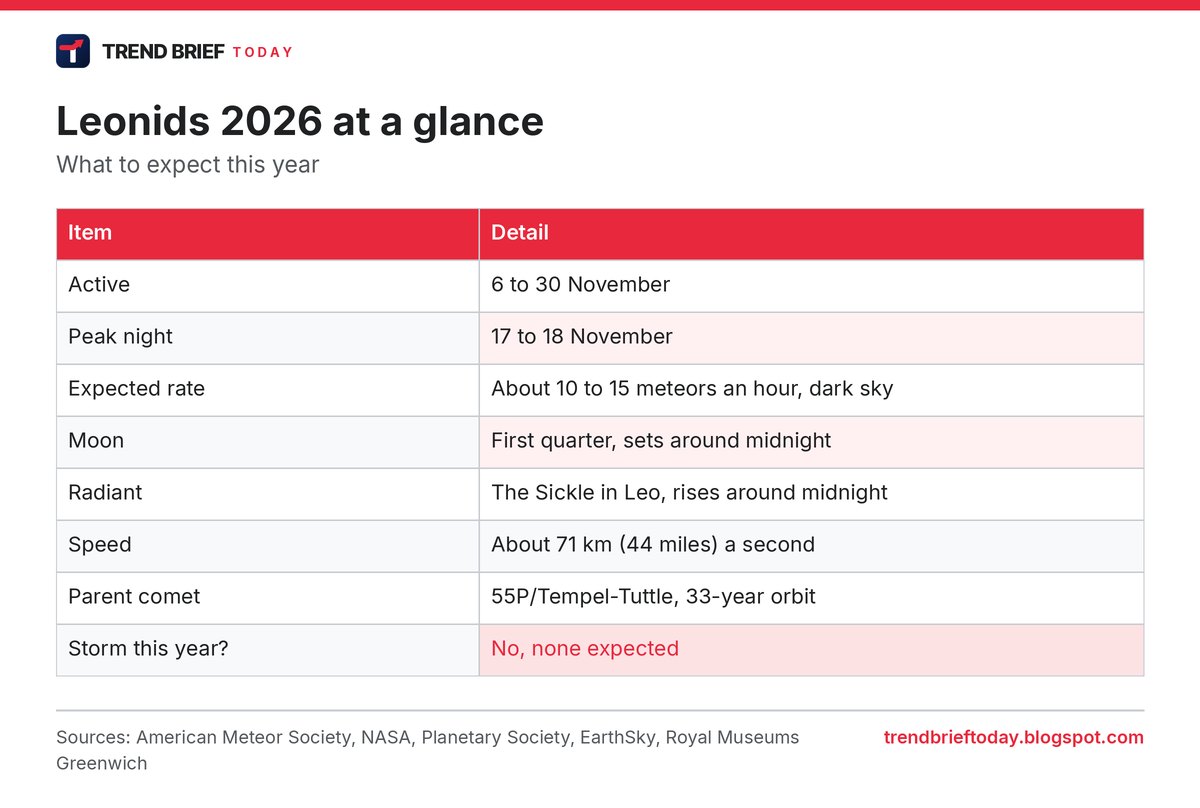
| Peak night | 17 to 18 November 2026[1][5][7] |
|---|---|
| Active | 6 to 30 November[4][5] |
| Best time | Midnight to dawn, local time[1][6] |
| Rate | About 10 to 15 an hour, dark sky[1][2] |
| Moon | First quarter, sets around midnight[1][2][5] |
| Radiant | The Sickle of Leo[5][6] |
| Speed | About 71 km (44 miles) a second[3][5] |
| Parent comet | 55P/Tempel-Tuttle[2][3][4] |
| Storm in 2026? | Not expected[2][4] |
When is the Leonid meteor shower 2026?
The Leonids run through most of November. The American Meteor Society lists them as active from 6 to 30 November, and Royal Museums Greenwich gives the same window.[4][5] The peak is on the night of 17 into 18 November, which is tonight for most readers, according to The Planetary Society, Royal Museums Greenwich and timeanddate.[1][5][7]
Sources do not all line up on the exact moment. EarthSky, using American Meteor Society figures, puts the peak at about 00:00 UTC on 18 November, which is midnight in London and 7 pm on Tuesday on the US East Coast.[2] The AMS calendar itself marks 16 to 17 November as peak night, while BBC Sky at Night Magazine says activity centres on the nights of 17 to 18 and 18 to 19 November.[4][6] The practical answer is simple. The Leonids do not switch off after the peak, and EarthSky and Sky at Night both suggest watching on the mornings around it.[2][6] If tonight is cloudy, try Wednesday night.
What time to watch: best time by city
The key thing is to go out late. The radiant, the point in Leo where the meteors seem to come from, rises around midnight and climbs higher towards dawn, so the hours after midnight are the most productive.[1][2] NASA also advises starting at about midnight local time.[3]
This year the Moon helps. It is at first quarter, and The Planetary Society and EarthSky both say it sets around midnight, leaving the pre-dawn hours dark.[1][2] For the UK, Royal Museums Greenwich says the Moon sets just before midnight on peak night.[5]
The table below turns that into local times. We worked out when the sky starts to brighten (astronomical twilight) and sunrise for each city on the morning of 18 November. After the "sky gets light" time, fainter meteors start to vanish, so aim to be out well before it.
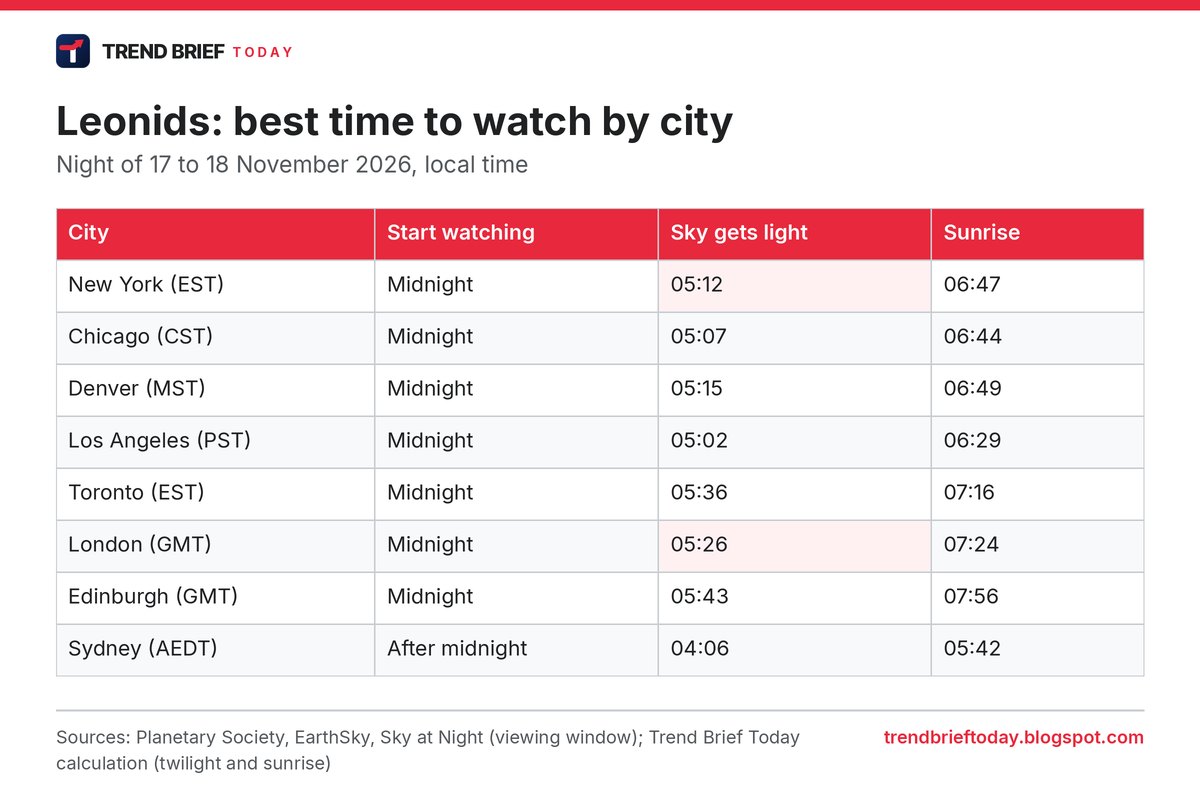
| Where you are | Best window | Why |
|---|---|---|
| US East Coast and Toronto | Midnight to about 5 am | Moon down, Leo rising in the east[1][2] |
| US Central, Mountain and Pacific | Midnight to about 5 am | Same pattern in local time[1][3] |
| London and southern England | Midnight to about 5:20 am | Moon sets just before midnight[5][6] |
| Scotland | Midnight to about 5:40 am | Longer dark mornings further north[5][6] |
| Australia | After midnight to about 4 am | Visible, but the view is better from the north[1] |
Where to look
You do not have to find Leo first. Meteors can appear anywhere in the sky.[1][3] If you do want to find the radiant, it sits in the head of Leo, a backwards question mark of stars known as the Sickle, which rises in the east after midnight in November.[1][5][6]
NASA and The Planetary Society both make a point that surprises many first timers: looking away from the radiant is often better.[1][3] Meteors close to it look short because they are coming almost straight at you, while those further away, around 45 degrees from it, leave longer streaks.[1][3] So lie back, face roughly east, and take in as much sky as you can.[3]
How many meteors will I see?
Set your expectations low and you will enjoy it more. The Planetary Society expects about 15 an hour at a dark site, and EarthSky says 10 to 15 in an average year.[1][2] NASA notes that rates are often as low as about three an hour.[3] Those figures assume a really dark sky, so a suburban garden will show fewer.
What the Leonids lack in numbers they make up for in speed. They hit the atmosphere at about 71 km (44 miles) a second, among the fastest of any shower.[3][5] NASA adds that they are often bright and colourful, and known for fireballs.[3]
How to watch the Leonids
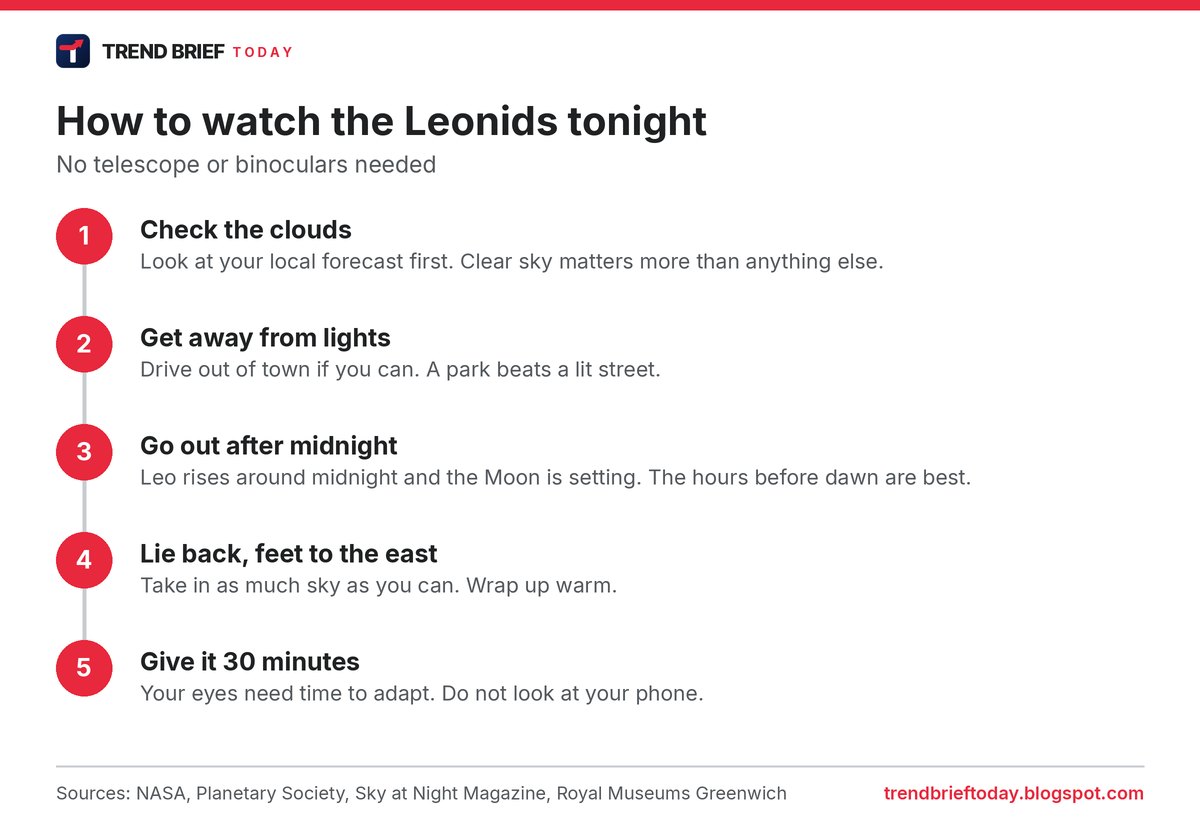
You do not need any equipment. The Leonids are a naked-eye sight, and all you really need is your eyes, patience and a mostly clear sky.[1][5]
- Get away from street lights. The darker the site, the more you will see.[1][3]
- Wrap up warm and bring a lawn chair, blanket or sleeping bag so you can lie back.[3]
- Give your eyes time. NASA says it takes less than 30 minutes in the dark for them to adapt, and The Planetary Society also stresses letting your eyes adjust.[3][1]
- Watch with friends. Sky at Night suggests one person can take breaks while the others keep looking.[6]
In the UK, parts of the country had snow and ice this week, so check the overnight forecast first; our UK snow forecast brief has the background on the cold spell.
Why the Leonids are famous: the 33-year storm cycle
The Leonids come from comet 55P/Tempel-Tuttle, which orbits the Sun about once every 33 years.[2][3] It was found twice, by Wilhelm Tempel in December 1865 and by Horace Tuttle in January 1866.[2][3] Each November, Earth passes through the dust it has left behind.[3][7]
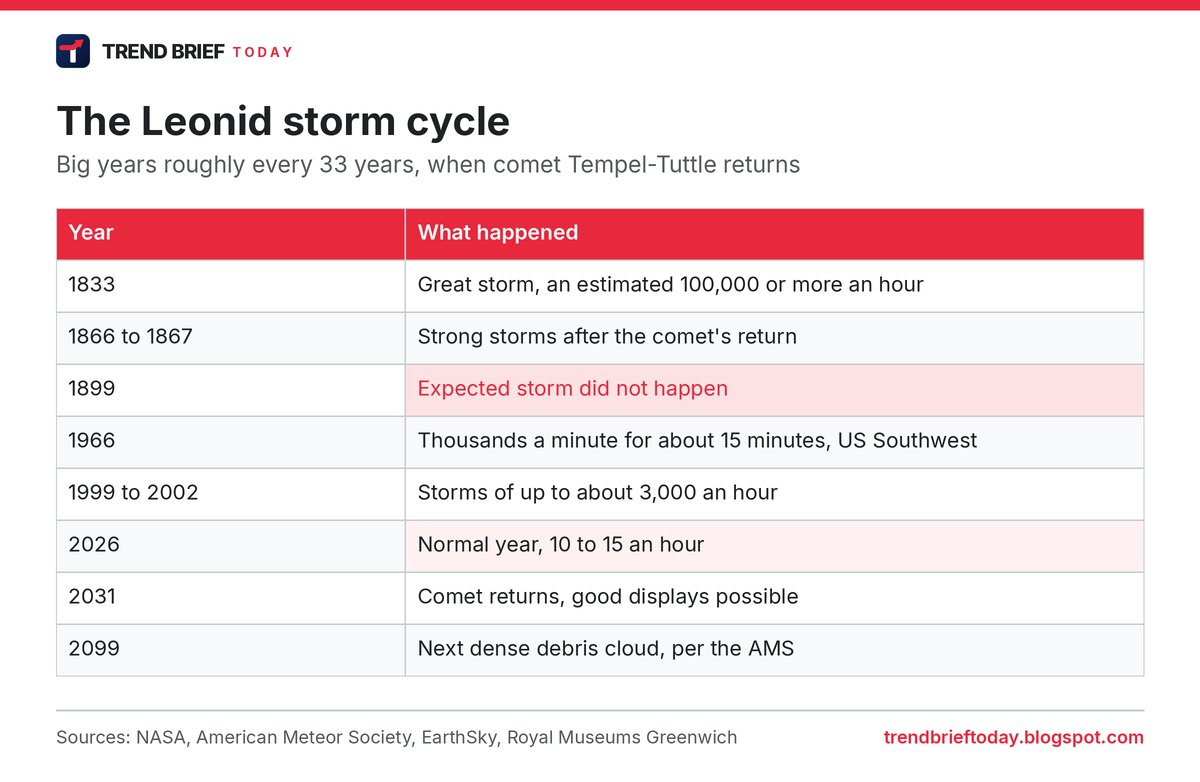
When the comet is near the Sun and Earth crosses a dense trail of older debris, the shower can turn into a storm, which astronomers define as at least 1,000 meteors an hour.[1][3] The 1833 storm is estimated at 100,000 or more an hour.[2][5] In 1966, observers saw thousands a minute for about 15 minutes.[1][3] The last storms came between 1999 and 2002.[3][4][5]
The cycle is not reliable, though. The storm everyone expected in 1899 never came.[2][5] The comet is due back in 2031, but the American Meteor Society does not expect Earth to meet another dense debris cloud until 2099, so the next returns may bring good displays of 100 or more an hour rather than true storms.[2][4]
More meteor showers in 2026
If you miss the Leonids, the Geminids are the next big one, usually the strongest shower of the year, peaking on the night of 13 to 14 December with only a thin crescent Moon, according to the AMS.[4] After that come the Ursids around 21 to 22 December.[4] For more space news, see our briefs on Starship Flight 15 and NASA astronaut applications.
Frequently asked questions
What time is the Leonid meteor shower tonight?
Watch from about midnight local time until the sky starts to brighten, roughly 5 am in the US and 5:30 am in the UK.[1][2][6]
Can I see the Leonids from the UK?
Yes. Royal Museums Greenwich says the Moon sets just before midnight on peak night, leaving the rest of the night dark.[5][6]
Where can the Leonid meteor shower be seen?
From both hemispheres, though The Planetary Society says the view is somewhat better from the Northern Hemisphere.[1]
Do I need a telescope?
No. Use your eyes only, from the darkest place you can reach.[3][5]
Will there be a Leonid meteor storm in 2026?
No storm is expected this year.[2][4]
Can I still see them after tonight?
Yes, at a lower rate. The shower stays active until 30 November.[4][5]
References
- "The Leonid meteor shower 2026: How to watch". The Planetary Society. Retrieved 17 November 2026.
- "Leonid meteor shower: All you need to know in 2026". EarthSky. Retrieved 17 November 2026.
- "Leonids". NASA Science. Retrieved 17 November 2026.
- "Meteor Shower Calendar". American Meteor Society. Retrieved 17 November 2026.
- "Leonid meteor shower: when and where to see it in the UK". Royal Museums Greenwich. Retrieved 17 November 2026.
- "See the Leonid meteor shower tonight. Top tips for complete beginners". BBC Sky at Night Magazine. Retrieved 17 November 2026.
- "Leonid Meteor Shower 2026". timeanddate.com. Retrieved 17 November 2026.
Image credits: Cover photo: David Wipf, CC BY 2.0, via Wikimedia Commons.