The government wants to cap ground rent on existing leasehold homes in England and Wales at £250 a year, starting in 2028, and then cut it to a peppercorn, which in practice means nothing, 40 years later.[1][2] The Commonhold and Leasehold Reform Bill that carries the cap is being introduced to Parliament on November 19, 2026, so nothing changes on your lease yet.[1][6] If you pay £250 or less today, the cap does not lower your bill. If you pay more, you would save the difference every year, and a doubling ground rent would stop doubling for good.[2]
 | |
| Law | Commonhold and Leasehold Reform Bill[1] |
|---|---|
| Introduced | November 19, 2026, House of Commons[1][6] |
| Cap | £250 a year, fixed in cash terms[2] |
| Start | 2028 (government target)[1][2] |
| Ends | Peppercorn after 40 years[2] |
| Covers | Most existing long residential leases in England and Wales[2] |
| Paying over £250 now | About 770,000 to 900,000 leaseholders[2] |
| Refunds of past rent | No[2] |
| Minister | Matthew Pennycook, Minister for Housing[1] |
What is the ground rent cap?
Ground rent is the yearly sum a leaseholder pays the freeholder simply because the lease says so. Unlike a service charge, you get nothing back for it: no repairs, no cleaning, no insurance.[2] Older leases often charge £50 or £100. Leases sold in the 2000s and 2010s, especially on new-build flats and some houses, can charge several hundred pounds and include clauses that double the rent every 10, 15 or 25 years.[2][5]
New leases have been limited to a peppercorn since the Leasehold Reform (Ground Rent) Act 2022, so the problem sits with the roughly 3.8 million existing leasehold homes that still carry a ground rent.[2] The new Bill reaches back into those contracts. The government's policy statement puts it in one line: a legislative cap on ground rents of £250 a year, "changing to a peppercorn after 40 years", applying to "most long residential leases not already covered by existing legislation".[2]
Housing minister Matthew Pennycook said the leasehold system "routinely subjects them to excessive extraction" and called the Bill "the beginning of the end for the feudal leasehold system".[1]
When does the £250 cap start?
Not yet, and not next year either. The government says it aims to put the cap in place in 2028, "subject to" the Bill passing through Parliament and getting Royal Assent.[1][2] Property Week reports the Bill was introduced on November 19, 2026, after a draft version was published for scrutiny in January.[6][4]
That gap matters for anyone with a rent review due in 2027. If your lease says the rent rises next year, it still rises next year. The cap then pulls it back down to £250 once it is in force. The government has also said landlords will not have to refund ground rent already paid above £250.[2]
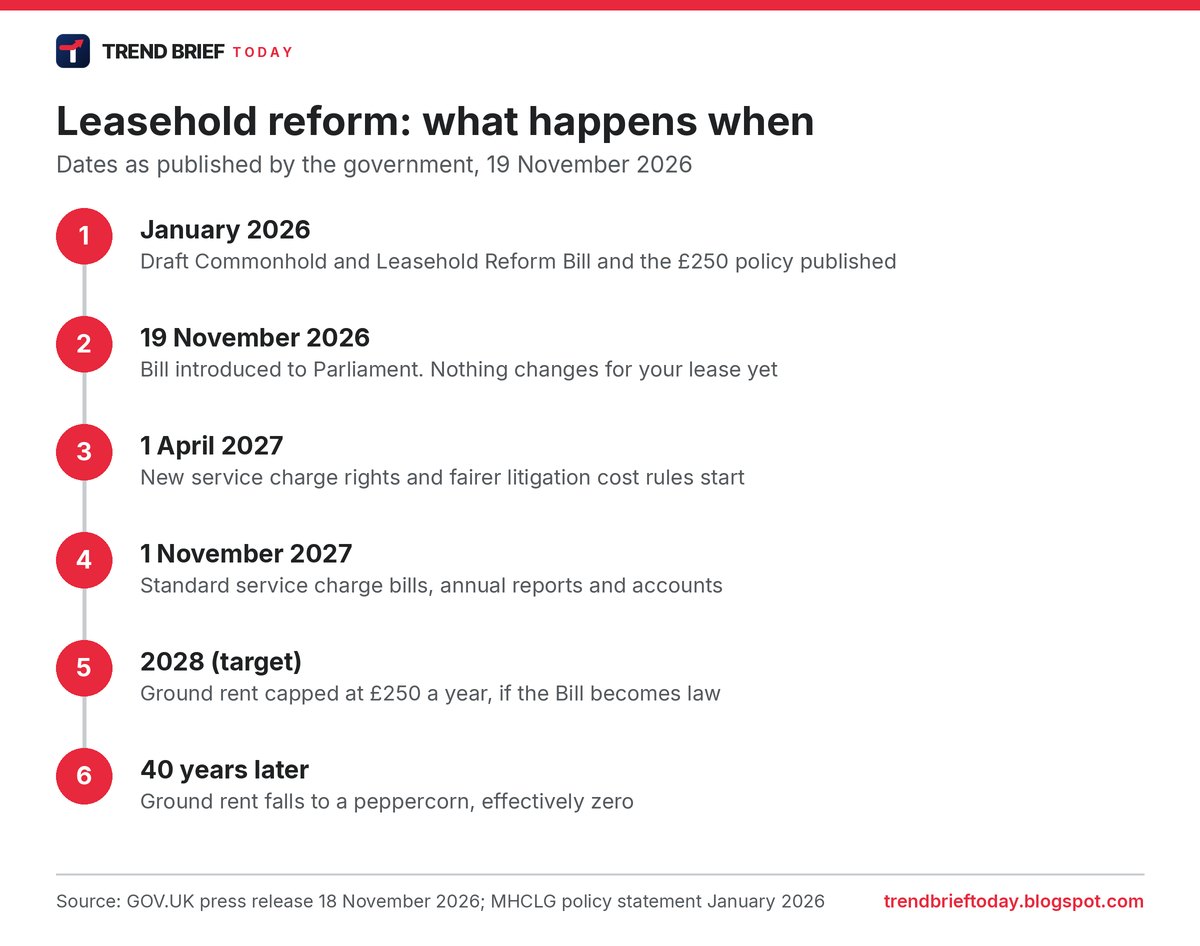
| Date | What happens | Status |
|---|---|---|
| January 2026 | Draft Bill and £250 cap policy published | Done[4] |
| November 19, 2026 | Bill introduced to Parliament | Now[1] |
| April 1, 2027 | Service charge information rights, new rules on landlord legal costs | Planned, under the 2024 Act[1] |
| November 1, 2027 | Standard service charge bills and annual reports | Planned, under the 2024 Act[1] |
| 2028 | £250 ground rent cap | Target, needs Royal Assent[1][2] |
| 40 years after the cap | Ground rent falls to a peppercorn | Proposed[2] |
How much will I save?
The sum is simple: whatever your lease charges above £250 is the yearly saving. A £400 rent saves £150 a year, a £1,000 rent saves £750. If you pay £250 or less, the cap changes nothing for you for the next 40 years, and then your rent falls to zero along with everyone else's.[2]
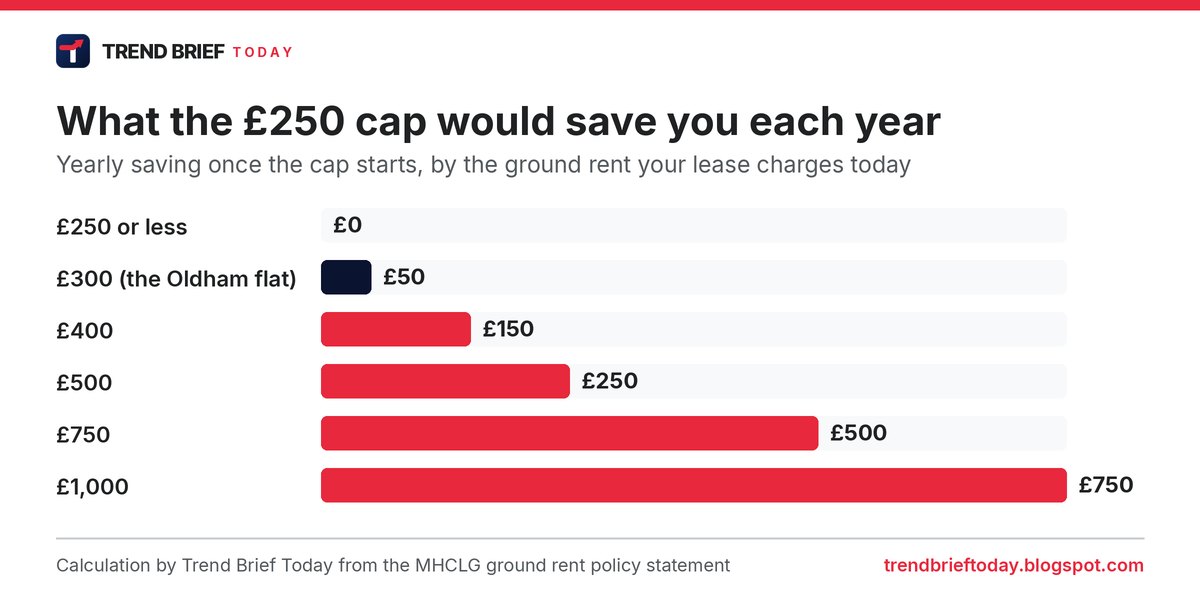
BBC News spoke to Fozia Malik, who owns a one-bedroom flat in Oldham. Her ground rent goes up from £150 to £300 in January, on top of more than £4,000 a year in service charges.[5] On the government's plan she pays £300 until the cap starts, then £250. That is £50 a year, or £2,000 across the 40-year transition, before her ground rent ends altogether. It is a real saving but a small one next to her service charge, and that is the point campaigners keep making.
The bigger wins are on escalating leases. Our worked example below takes a £350 ground rent from 2028 and runs it for 40 years under two common doubling clauses, then compares both with a fixed £400 rent and with the cap.
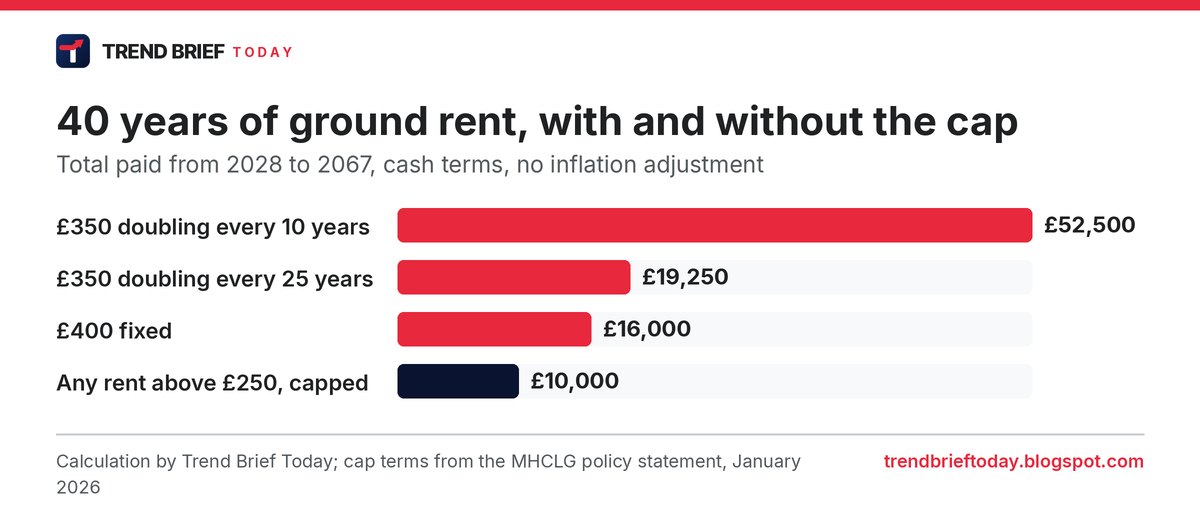
| Lease from 2028 (no cap) | Total over 40 years | Saving with the £250 cap |
|---|---|---|
| £350, doubling every 10 years | £52,500 (last decade at £2,800 a year) | £42,500 |
| £350, doubling every 25 years | £19,250 | £9,250 |
| £400, fixed | £16,000 | £6,000 |
| £300, fixed | £12,000 | £2,000 |
| £250 or less | £10,000 or less | £0 |
The CMA already took action against some developers over leases that doubled more often than every 20 years, and the government says those undertakings still stand.[2] The cap goes further because it hits every rent above £250, however it got there.
Why £250 in 40 years is worth much less
The cap is fixed in cash. It never goes up with inflation.[2] That is good news for leaseholders and the main complaint from investors. At 2% inflation a year, £250 in the 40th year buys what about £113 buys today. At 3% it is about £77. In real terms the cap shrinks every year until the peppercorn switch makes it zero.
| Inflation each year | £250 in 20 years, in today's money | £250 in 40 years, in today's money |
|---|---|---|
| 2% | About £168 | About £113 |
| 3% | About £138 | About £77 |
The government looked at linking the cap to inflation and said no, because it "would expose leaseholders to large increases in ground rent during periods of high inflation".[2]
Why £250 and not zero?
The government's 2023 consultation set out five options, from an immediate peppercorn to a cap at a share of the property's value.[8] It picked a cash cap for two reasons it spells out in the policy statement.[2]
The first is mortgages. Lenders get nervous once ground rent goes above 0.1% of a home's value or above £250 a year, and the government found only one of the 12 major lenders whose rules did not mention either figure.[2] The median flat in England and Wales sold for £245,000 in the year to March 2025, and 0.1% of that is £245, which is almost exactly the cap.[2] So £250 is roughly the line where a flat stops being easy to sell or remortgage.
The second is money for freeholders. A peppercorn on day one would hit ground rent investors and pension funds hardest. The government's own table shows a 20-year transition would transfer 68% to 73% of the value of ground rents from freeholders to leaseholders, against 55% to 61% for the 40 years it chose.[2]
| Transition before peppercorn | Value moved from freeholders to leaseholders | Government choice |
|---|---|---|
| 20 years | 68% to 73% | No |
| 40 years | 55% to 61% | Yes[2] |
| 60 years | 50% to 57% | No |
Put another way, freeholders keep 39% to 45% of what their ground rents would have been worth, according to the government's own estimate of total leaseholder savings of £10.0 billion to £12.7 billion over the life of the leases.[2]
Who benefits, and where?
About 770,000 to 900,000 leaseholders pay more than £250 now and would see a lower bill on the first day, and the government says up to one million could benefit.[1][2] Over the full 40 years all 3.8 million leasehold homes with a ground rent are affected, because they all end at a peppercorn.[2]
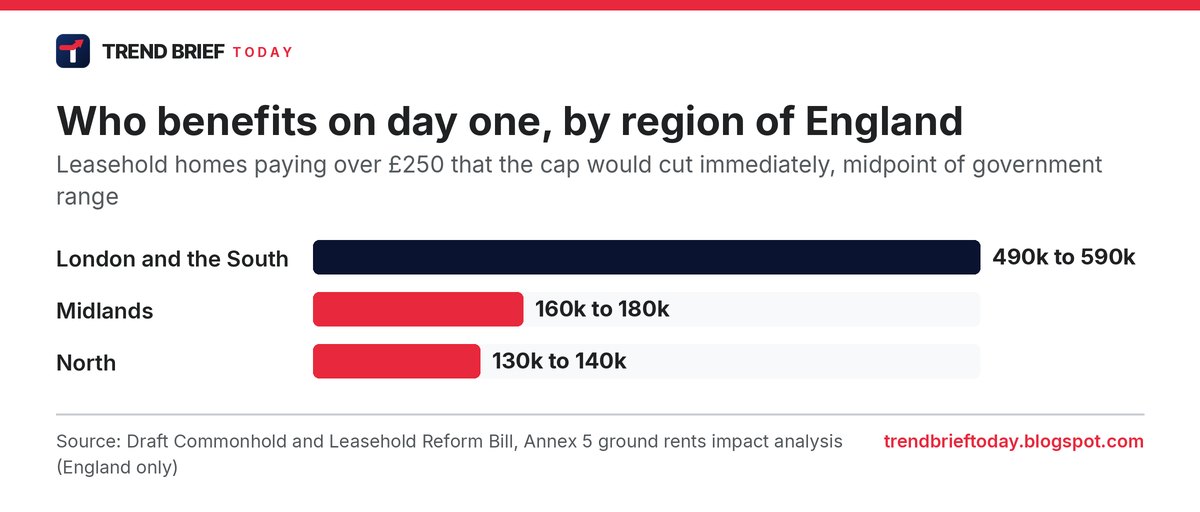
The split is lopsided. On the government's England-only modelling, 490,000 to 590,000 of the day-one winners are in London and the South, out of about 1.8 million leasehold homes there. In the North it is 130,000 to 140,000 out of about 1.2 million.[3] That works out at roughly three in ten leasehold homes in the South paying above the cap, against about one in nine in the North. Our ratio uses the midpoint of each range.
Typical rents are lower than headlines suggest. After checking a sample of English Housing Survey answers against registered lease documents, the government puts the median ground rent at £80 to £95 a year. The top fifth of leases has a median of £300 to £350, which is the group the cap is aimed at.[2]
| Group of leases (England, 2020 to 2024) | Mean ground rent | Median ground rent |
|---|---|---|
| All leases with a ground rent | £124 to £153 | £80 to £95 |
| Top 20% | £343 to £437 | £300 to £350 |
| Bottom 80% | £67 to £69 | £35 to £40 |
What else is in the Bill?
The ground rent cap is the part that changes bills, but the Bill is much wider. The government lists these measures:[1]
- Forfeiture ends. A landlord could no longer threaten to take your home over a small unpaid bill such as a disputed service charge. A court-led system replaces it.[1]
- Admin fee caps. Ministers get powers to cap permission fees, such as asking to keep a pet or change a front door.[1]
- Commonhold by default. Most new flats would be sold as commonhold, where owners hold their flat forever and run the building together. Shared ownership is among the exceptions.[1]
- Easier conversion. An existing block could switch to commonhold with 50% support instead of 100%. Owners who say no stay on modified leases until they sell.[1]
- Cheaper lease extensions. Marriage value goes for leases with 80 years or less left, and leaseholders mostly stop paying the landlord's costs. 990-year extensions become available.[1]
- Fleecehold estates. Up to 1.75 million freehold homes on private estates get protection from enforcement over unpaid estate charges.[1]
The cap also feeds into what it costs to buy your freehold or extend your lease. Lower future ground rent means a lower price, and the government says the change "will feed through into enfranchisement calculations".[2]
Who is against it?
The Residential Freehold Association, which speaks for the largest freeholders, said "the only thing this Bill brings to an end is Britain's reputation as a safe place to invest" and accused ministers of "retrospectively capping the contractual income on which UK investors and pensioners rely".[6] It claims £18.7 billion could be wiped from investments.[5][7]
Campaigners are pleased but not finished. Katie Kendrick of the National Leasehold Campaign said success "will be measured by whether existing leaseholders can actually afford to benefit", warning that expensive freehold purchases could leave millions "trapped".[7] Giles Grover of End Our Cladding Scandal told the BBC there is a risk of a two-tier system between buyers of new homes and people who already own leasehold flats.[5]
Our read: the cap is the most concrete thing in the Bill for people who own today. Commonhold helps future buyers, and conversion depends on neighbours agreeing and on the price of the freehold. The cap is automatic. If the Bill passes as written, you do not have to apply for it or go to a tribunal.[2]
What should leaseholders do now?
- Find your ground rent clause. Your lease, or the title register from HM Land Registry, shows the rent and any review dates. Note whether it is fixed, doubling or linked to RPI.
- Keep paying. The cap is not law. Unpaid ground rent is still a breach of your lease until the new rules start.
- Think before a lease extension. If you were about to extend mainly to get rid of a high ground rent, compare the cost with the cap and the planned removal of marriage value. Get advice from a specialist solicitor or valuer.[1][2]
- Selling? Buyers' lenders often apply the £250 or 0.1% test. Telling a buyer the rent will be capped from 2028 is fair, but say it is planned, not passed.[2]
- Shared owners: the rent you pay on the share you do not own is not ground rent and is not capped.[2]
Frequently asked questions
When will ground rent be capped at £250?
The government aims for 2028, if the Commonhold and Leasehold Reform Bill passes Parliament and gets Royal Assent.[1][2]
Will my ground rent go down if I pay £150?
No. The cap only cuts rents above £250. A rent of £150 stays at £150 until the switch to a peppercorn 40 years later.[2]
Will I get back ground rent I have already paid?
No. The government says landlords will not have to refund past ground rent above the cap, though consumer protection law still applies.[2]
Does the cap apply in Scotland or Northern Ireland?
No. The Bill covers England and Wales. Property law is devolved in Scotland and Northern Ireland.[1]
What does peppercorn ground rent mean?
A token rent with no money value. In practice you pay nothing. New leases have worked this way since the 2022 Act.[2]
Does the cap rise with inflation?
No. It stays at £250 in cash for 40 years.[2]
More UK money guides: January energy price cap forecast, UK inflation, October 2026 and UK unemployment figures.
References
- Ministry of Housing, Communities and Local Government and Matthew Pennycook MP, "Beginning of the end for thousand year old leasehold system", GOV.UK, November 18, 2026.
- Ministry of Housing, Communities and Local Government, "Addressing unregulated and unaffordable ground rent: policy statement" (PDF), GOV.UK, January 2026.
- Ministry of Housing, Communities and Local Government, "Draft Commonhold and Leasehold Reform Bill, Annex 5: Ground rents reform" (PDF), GOV.UK, 2026.
- Ministry of Housing, Communities and Local Government, "Draft Commonhold and Leasehold Reform Bill", GOV.UK, first published January 27, 2026.
- Tarah Welsh and Jade Thompson, "'Feudal' leasehold system set to be scrapped in England and Wales", BBC News via Yahoo News, November 19, 2026.
- Ciaran Nerval, "Ground rents capped from 2028 as leasehold bill enters parliament", Property Week, November 19, 2026.
- Marc da Silva, "Government unveils sweeping leasehold reforms as campaigners celebrate and industry backlash erupts", Property Industry Eye, November 18, 2026.
- Department for Levelling Up, Housing and Communities, "Modern leasehold: restricting ground rent for existing leases" (consultation and summary of responses), GOV.UK, November 9, 2023, updated March 19, 2026.
- Ministry of Housing, Communities and Local Government. "Historic move to dismantle leasehold and transform homeownership". GOV.UK. 19 November 2026.
- Tarah Welsh, Jade Thompson and Becky Morton. "Timetable set out for dismantling leasehold system in England and Wales". BBC News. 19 November 2026.